
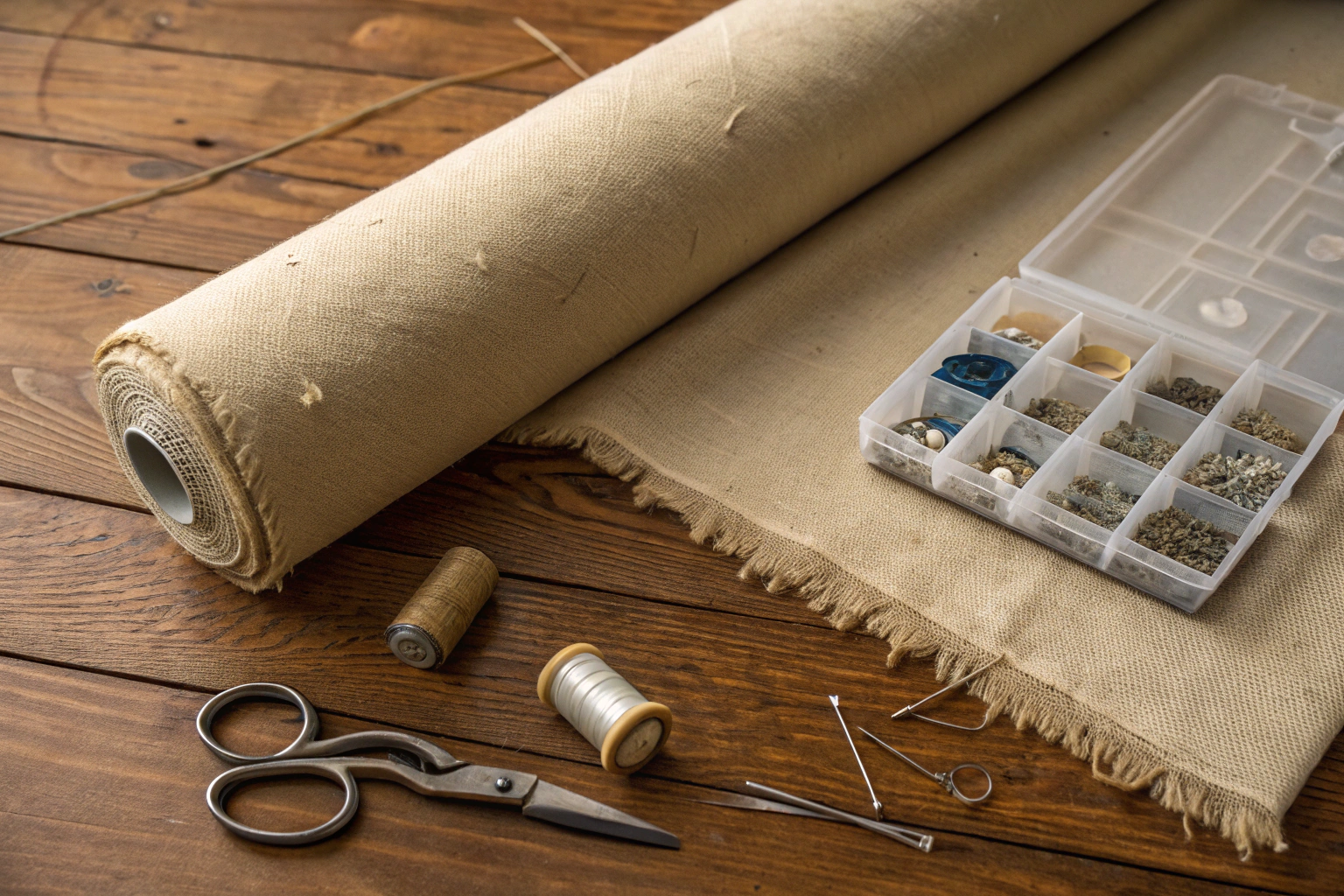
You’ve sourced the perfect heavy linen. It has that beautiful, rustic stiffness. The weight is substantial. You can already picture the structured blazer or the architectural tote bag. Then you sit down at your sewing machine. The needle hits the fabric and… thunk. A sickening snap. A broken needle, a skipped stitch, a hole right through your expensive material. Or worse, the machine strains, pulls the weave apart, and leaves a puckered seam that screams "homemade" instead of "artisanal." I have watched so many small designers struggle with this exact moment. They blame the fabric when the real villain is a tiny, cheap piece of metal they never think to check. Using the wrong needle on our heavy linen isn’t just a nuisance; it literally destroys the structure of the fabric.
The fix is simple, and I will tell you exactly what we recommend right now. For our heavy linen (anything 280 GSM and above), you need a Microtex/Sharp needle, size 100/16, or a Heavy-Duty Jeans needle in size 110/18. The sharp point is critical. Linen doesn’t have the elasticity of cotton; it doesn’t like being pushed aside by a ballpoint needle. A sharp needle cuts cleanly through the flax fibers, preventing the giant "nail holes" that wreck your seam integrity. The eye of a jeans needle is also deeper, which feeds our thicker bonded linen threads smoothly. The right needle changes everything. It reduces the friction heat that causes thread breakage, and it respects the natural character of the linen without breaking it down.
But choosing the needle is just step one. You also need to match that needle to your thread, adjust your machine’s presser foot pressure, and understand how the needle plate interacts with a loosely woven slub. I’ve spent years troubleshooting these exact production headaches for our garment factory partners. They can’t afford a row of Juki machines to go down because of a needle malfunction. I’m going to walk you through the specific needle brands we test, the exact sizes for different weights of our linen collection, and a few old-school tailoring tricks that solve the most common linen-sewing nightmares.
What Is the Best Needle Size for Heavyweight Linen Fabrics?
Size matters more than you think. A lot of home sewists and startup studios try to use a universal needle, maybe a size 80/12, on a heavy 300 GSM linen. The result is violent. The needle is too thin to push through the dense weave. It flexes, hits the hook timing of the machine wrong, and snaps. Or, the slim needle point tries to pierce a thick flax fiber, fails, and pushes the entire fiber down instead of cutting it. This creates a "flagging" effect where the fabric pops up and down with the needle, and the stitch loop never forms correctly. You look at the back of your fabric and see a tangled "bird’s nest." That’s the needle failing to do its job. The pain is real, and the time lost is money.
For our specific range of heavy linens, I break it down by weight. For a mid-heavy 200-280 GSM linen (our rustic tablecloth weight), you run a size 100/16 Microtex. For our 280-350 GSM (structured jacket weight), you step it up to a size 110/18. For our absolute thickest 400+ GSM canvas-weight linen that we sometimes coat and laminate for accessories, we actually switch to a size 120/20 industrial needle. The rule is simple: the thicker the fabric, the thicker the shank of the needle needs to be to avoid deflection. But just as importantly, the eye needs to be wide enough. A size 100 needle has an eye that measures about 1.0mm. If you try to thread a chunky 40-weight topstitching thread through a size 80 needle (0.8mm eye), it shreds. That frayed thread dust fills your machine and causes tension disasters.

Why Does a Jeans Needle Work Better Than a Universal for Linen?
A universal needle has a slightly rounded point. It’s a compromise needle. It "separates" the fibers rather than truly piercing them. For a knit or an elastic cotton, that’s fantastic because you want to preserve the loop integrity of the knit. But linen is a bast fiber. Flax fibers are like tiny bamboo rods glued together by natural pectin. If you push them aside with a ballpoint, they don’t rebound smoothly like cotton. They get crushed, leaving a permanent, ugly hole that looks like a tiny puncture wound.
A jeans needle is sharp—a modified medium ballpoint, but often a sharp tip in the higher qualities—and has a reinforced, stiff blade. The "sharp" part cuts the flax cleanly. The "stiff" part stops the needle from flexing when it hits a tough slub. I always tell our clients: hold a heavy linen up to the light. See those thick and thin slubs? Every time a flimsy needle hits a thick slub, it deflects. A jeans needle powers straight through. This is why our garment factory partners who cut and sew our linen for ZARA-level brands use Organ or Groz-Beckert jeans needles by the thousand. They can’t risk micro-deflection. It would throw the pattern matching off by a millimeter, which ruins a tight-fitting blazer. If you are learning how to choose the correct needle for sewing thick linen fabric, start by throwing away your universal pack and getting dedicated jeans needles.
When Should I Use a Topstitching Needle on Heavy Linen?
Topstitching is the crown jewel of a linen garment. It’s the contrasting thread, the bold detail. But it requires a massive thread, often a 30- or even 20-weight, to look right. A standard needle eye cannot feed this thread. It abrades it. That’s why you need a topstitching needle. These needles have an extra-long, extra-wide eye (often 2.0mm or more), a deep groove on the front to protect the thread as it passes through the fabric, and a very sharp, acute point.
I have a specific setup I use in our sample room for linen trench coats. We use an 80-weight bonded nylon in the bobbin and a chunky 30-weight cotton in the top. The needle is an Organ 110/18 Topstitch. The large eye means the cotton thread doesn’t strip. The deep groove means the fabric doesn’t create so much friction that it snaps the cotton fibers. If you try to topstitch heavy linen with a regular 100/16 denim needle, you’ll get a frayed, inconsistent stitch line that looks fuzzy. Here’s a test: sew a one-meter seam. If you see a pile of white dust (fiber lint) building up on your needle plate, your needle eye is too small for that thread. Go up to a topstitching needle immediately. It will save your seam and your sanity. (I must add here, investing in a genuine Organ or Schmetz needle really is much better than the cheap unbranded sets).
Which Sewing Thread Prevents Breakage in Linen Seams?
You can have the perfect needle, but if you pair it with a weak thread, you’ve built a suit of armor held together by paperclips. The thread is the constant stress point. Linen doesn’t stretch much. So when you sit down in a pair of linen pants, the seam at the seat doesn’t just gently stretch; it absorbs a massive shock load. If your thread is old, brittle cotton, or a cheap staple-spun polyester, it will snap. The tiny frays turn into broken stitches, the seam pops, and you have a catastrophic garment failure right where you least want it. I’ve seen a whole shipment of linen dresses get returned not for the fabric quality, but because the side seams gave out. The brand used the wrong thread.
We exclusively spec high-tenacity bonded nylon or core-spun polyester (Perma Core) for constructing heavy linen garments. Bonded nylon has a tensile strength that’s roughly 50% higher than regular nylon. It’s coated with a special resin that reduces internal friction, so when the needle punctures the dense linen, the thread glides through the eye without heating up and melting. Core-spun poly is genius. It’s a filament polyester core wrapped in cotton. The polyester core gives it the tensile strength of steel (it won’t break), while the cotton wrapping swells slightly in the wash. This swelling fills the tiny needle holes in the linen, creating a waterproof, locked-in seam. If you are doing a structured home decor piece or a tote bag, I even go up to a bonded nylon size 69 (Tex 70). This stuff is practically unbreakable by hand. Use a matching heavy needle, and your seams will outlast the apocalypse.

Why Is Waxed Thread Ideal for Hand-Sewing Linen Details?
Machine sewing is fast, but nothing matches the detail of a hand-stitched linen hem or a pick-stitched lapel. However, hand-sewing flax is torture on your hands and your thread. Linen is abrasive. As you pull a standard cotton sewing thread through the fabric eye repeatedly, the constant friction saws the thread in half. You find yourself re-threading the needle every five minutes and cursing the day you started.
You must use waxed linen thread or a beeswax-coated poly-cotton. The wax acts as a lubricant and a protector. I prefer a tradition-heavy Irish linen thread for buttonholes on our tailored jackets. Before I sew, I pull the thread through a block of pure beeswax three times, then run it under a warm dry iron (protected by a cloth) to melt the wax into the fibers. This "glazing" process creates a stiff, strong thread that flies through the fabric without tangling. If you are constructing a bag, a pre-waxed bonded nylon thread, like Maine Thread or a similar heavy-duty brand, will save your fingers. It gives you that clean, angled saddle stitch look and ensures that even if one stitch breaks, the wax friction locks the adjacent stitches in place so the seam doesn’t run. Exploring how to select thread for sewing linen clothes by hand will point you toward these heritage methods that actually work faster than modern shortcuts.
Can I Use Regular Polyester Thread for High-Stress Linen Areas?
No, and I will tell you why with a specific failure I saw in a sample room. Regular spun polyester looks smooth, but under a microscope, it’s made of short fibers twisted together. When you repeatedly pull it against a hard, slubby linen, those short fibers lift and fray. The thread loses 20% of its strength just from the abrasion of sewing. It also creates a ton of lint that clogs up your machine’s tension disks. This is why industrial machines running linen need constant cleaning.
A client in Canada bought our heavy linen for a line of motorcycle messenger bags in 2022. They ignored my advice and used a cheap, high-luster spun polyester from a local craft store. During a load test, where they hung a 20kg weight from the strap, the seams didn’t just pop; the thread literally shredded into lint. We recreated the test with a bonded nylon Tex 70. The nylon stretched slightly but held the 20kg weight for 24 hours without a single fiber breaking. The difference is in the molecular chain. Filament threads are like a solid steel cable. Spun threads are like a rope made of short twigs. For anything structural on heavy linen, always choose the cable. This is a critical part of mastering the best sewing thread for high tension linen garments techniques we teach our designer partners.
| Thread Type | Composition | Tensile Strength | Best Application for Heavy Linen |
|---|---|---|---|
| Bonded Nylon | Continuous filament, resin-coated | Very High | Construction seams, bags, outdoor upholstery |
| Core-Spun Poly | Poly core, cotton wrap | High | Garment seams, shirts, pants needing wash-fill |
| Spun Polyester | Short staple fibers | Medium-Low | Temporary basting, low-stress decorative seams |
| Waxed Linen | Natural linen fiber, wax-coated | Medium | Hand-sewn hems, buttonholes, saddle stitching |
How to Adjust Machine Tension for Thick Linen Weaves?
You swapped the needle, and you loaded a heavy thread. Now your machine sounds like a cement mixer. The stitches on top look perfect, but underneath, the bobbin thread is just a straight line with big, loopy knots. That’s a tension fail, and it’s the number one frustration I hear from new linen sewists. Heavy linen compresses under the presser foot; thinner cottons don’t. When the foot compresses the thick weave, it changes the thickness of the fabric going through the hook area. The machine timing is literally expecting a thinner sandwich, and you’ve given it a hamburger. The result is an unbalanced stitch that weakens the entire seam.
The golden rule for heavy linen: lower the presser foot pressure before you touch the top tension. Most domestic machines have a dial on the top left for this. For our 300 GSM linen, I usually drop the pressure by about 25-30%. You want the fabric to feed smoothly without the foot mashing it down like a vice. If the pressure is too high, the feed dogs can’t move the heavy linen properly, and you get a "puddling" effect where the stitch length shrinks to zero. Once the pressure is right, increase your top tension slightly to pull the knot up into the thick fabric center. I aim for a balanced lock where the knot is buried right in the middle of the linen’s thickness, not sitting on top or peeking out from the bottom.

Why Does My Machine Skip Stitches Only on Thick Linen?
Skipped stitches are almost always a hook timing issue triggered by needle deflection. You have a heavy flax slub, the needle hits it, and instead of going straight down, the needle bends back by a micro-fraction of a millimeter. The hook of the bobbin case then rotates past, but it misses the thread loop on the bent needle. The result: a gap in your seam.
The fix is a needle with a stiffer blade, first of all. But there is another cause: the thickness of the seam. When you cross a seam allowance, like sewing a flat-felled side seam, you suddenly jump from 2 layers to 4 layers (or 6 if you’ve interlined it!). The foot tilts, the fabric flags, and the stitch skips. My personal trick, which our seamstresses use every day, is a "hump jumper." This is a cheap plastic block that you wedge behind the presser foot to level it when approaching a thick crossover. It stops the foot from rocking. I also always keep a rubber mallet on the cutting table. Before sewing a thick intersection, I hammer the seam allowance flat. This compresses the linen fibers temporarily, giving me a flatter profile to feed through the machine. This is a traditional tailor’s hammer technique for a reason. If you’re searching for solutions for fixing skipped stitches when sewing thick linen fabric, start by leveling your presser foot.
How Do I Stop Heavy Linen from Puckering Along the Seam?
Puckering is when the seam looks like a gathered little lettuce edge. It’s usually caused by the machine feeding the bottom layer of fabric faster than the top layer. Linen has a high friction coefficient; it’s grippy. When the feed dogs move the bottom layer forward, the top layer, which is pressed against the metal presser foot, drags behind. This stretches the bottom layer until the needle locks the stitch, and then the stretched fabric relaxes into a pucker.
I have two specific fixes for this. First, use a roller foot or a Teflon foot. The Teflon coating has a near-zero friction surface, so the top layer slides through at the same speed as the bottom layer. It’s a magic trick for pure linen. Second, adjust your thread tension symmetry. If the needle tension is too high, it pulls the bobbin thread up too tightly, cinching the fabric transversely. For thick linen, I often drop the top tension by one click and tighten the bobbin case by a tiny quarter-turn, finding a looser equilibrium that doesn’t crush the weave.
Also, try a "stretch and sew" technique. Hold the fabric firmly in front and behind the presser foot, pulling it taut (but not stretching it) as it feeds. This eliminates the slack that causes the micro-puckers. Here’s a pro tip: a slight pucker often disappears after a proper steam press. Linen fibers relax with heat and moisture. If you’re facing persistent puckering issues, researching how to prevent seam puckering on natural linen fabrics will steer you toward these precise mechanical adjustments. (A little note here: a tailor’s clapper used after steaming also does absolute wonders for flattening bulky seams.)
What Sewing Machine Foot Is Required for Fumao’s Coated Linen?
Coated linen is a beast of a different nature. Whether we’ve given it a wax finish, a polyurethane (PU) layer, or an acrylic lacquer for water resistance, that surface is a non-porous, sticky nightmare for a standard metal presser foot. The metal literally scrapes the coating off, leaving a shiny, scratched track next to your seam line. It’s a permanent scar on the fabric. You might think the coating is tough, but a few millimeters of dragging metal will ruin the aesthetic completely. And the sticky surface? It grips the bottom of a standard foot, causing the machine to stick-slip-stick-slip, creating wildly uneven stitch lengths that look like a heart monitor readout. It ruins your fabric and your timing.
You absolutely must switch to a Teflon (PTFE) foot or a roller foot for our coated linens. The Teflon foot is white and has a glass-smooth bottom. The coating on the fabric can’t stick to it. It glides. The roller foot replaces the flat ski with a small metal wheel. This is an even better solution for heavily waxed linens, as the wheel physically rolls over the sticky wax without any drag force. In our sample room, when we process our dry-waxed canvas, the Juki machines are permanently set up with these feet. We never use a metal foot. We also switch to a straight-stitch foot with a flat underside (no side grooves) to maximize the contact area and distribute the pressure evenly, preventing the compressed spots that look like dimples on the coated surface.

Can a Walking Foot Prevent Fabric Slipping on Laminated Linen?
When you laminate a heavy linen with a thick PVC or a foam backing, you are sewing a sandwich of totally different material densities. The bottom foam layer is spongy, and the top linen is rigid. A standard feed system only pushes from the bottom. The spongy bottom just absorbs the motion, while the rigid top fabric stands still. The seam grows longer and longer, misaligning your cut edges. The solution is a walking foot or a true compound feed machine.
A walking foot has a second set of feed dogs on top of the fabric. The foot literally takes a step forward with the bottom feed dogs. It grabs the top layer of your coated linen and pulls it in perfect synchronization with the bottom layer. For our structured, laminated linen bags (a favorite for a San Francisco bag maker we work with), a walking foot is non-negotiable. I recommend an even-feed foot for domestic machines or, if you are doing production volume, a needle-feed industrial machine like a Juki DNU-1541. The walking foot eliminates the “shifting” and ensures your pocket flaps and zipper panels actually match up. If you are building technical accessories, look into a walking foot machine for sewing thick coated textiles to understand why this mechanism is worth the investment.
What Stitch Length Optimizes Durability in Coated Linen?
With coated fabrics, every needle hole is a permanent puncture. If you perforate the fabric with too many tiny, tight stitches, you create a dotted tear-off line, like a check in a notebook. The fabric will literally rip right along your seam. You are creating a perforation. The standard 2.5mm stitch length used on a fine poplin shirt is a death sentence for a waxed linen bag.
I extend the stitch length to a minimum of 3.5mm, sometimes 4.0mm for structural seams. This spaces the needle holes apart, preserving the tensile strength of the coated fabric. It also looks much more rugged and professional on heavy goods. I test this constantly. We take a seam, clamp it in our tensile tester, and pull. A seam with 2.5mm stitches usually rips at the perforation line at around 30 kg of force. The same fabric with a 3.5mm stitch often holds until 45 kg, because the material between the holes stretches without tearing. I also reduce the needle size slightly for coated linen (using a 90/14 Microtex sharp for a 2-layer seam instead of a 100/16) if the coating is thick. A smaller needle makes a smaller hole, which the coating can partially seal back around. This is critical advice when you start exploring how to set stitch length for laminated linen projects to ensure they survive real-world use.
Conclusion
Sewing heavy linen is not about fighting the fabric; it’s about respecting its nature. You’ve seen how breaking a needle isn’t bad luck, but a mismatch—using a skinny universal point on a dense, tough bast fiber. We’ve walked through the precise needles, from the 110/18 Jeans sharp for the main seam to the 120/20 for the topstitch, and why they deserve to be paired with a thread that won’t turn to lint under stress, like our bonded nylon or waxed linen. The details are in the adjustments: dropping the presser foot pressure to stop the mash, leveling the foot to stop the skip, and switching to Teflon to stop the drag on a waxed finish. Every skipped stitch and broken thread has a mechanical, fixable cause.
I want your heavy linen projects to reflect the quality of the fabric we weave. A puckered seam or a split seam can make the best textile look amateur. But a clean, flat-felled seam with a perfect topstitch? That’s a selling point. If you are scaling up your production and need hands-on advice for sewing our specific heavy linens or coated canvases, please connect with our team. For technical specifications and to request our sewing guide samples, reach out to our Business Director, Elaine. Her email is elaine@fumaoclothing.com. Let’s turn that beautiful bolt of heavy linen into a perfectly constructed garment.








