
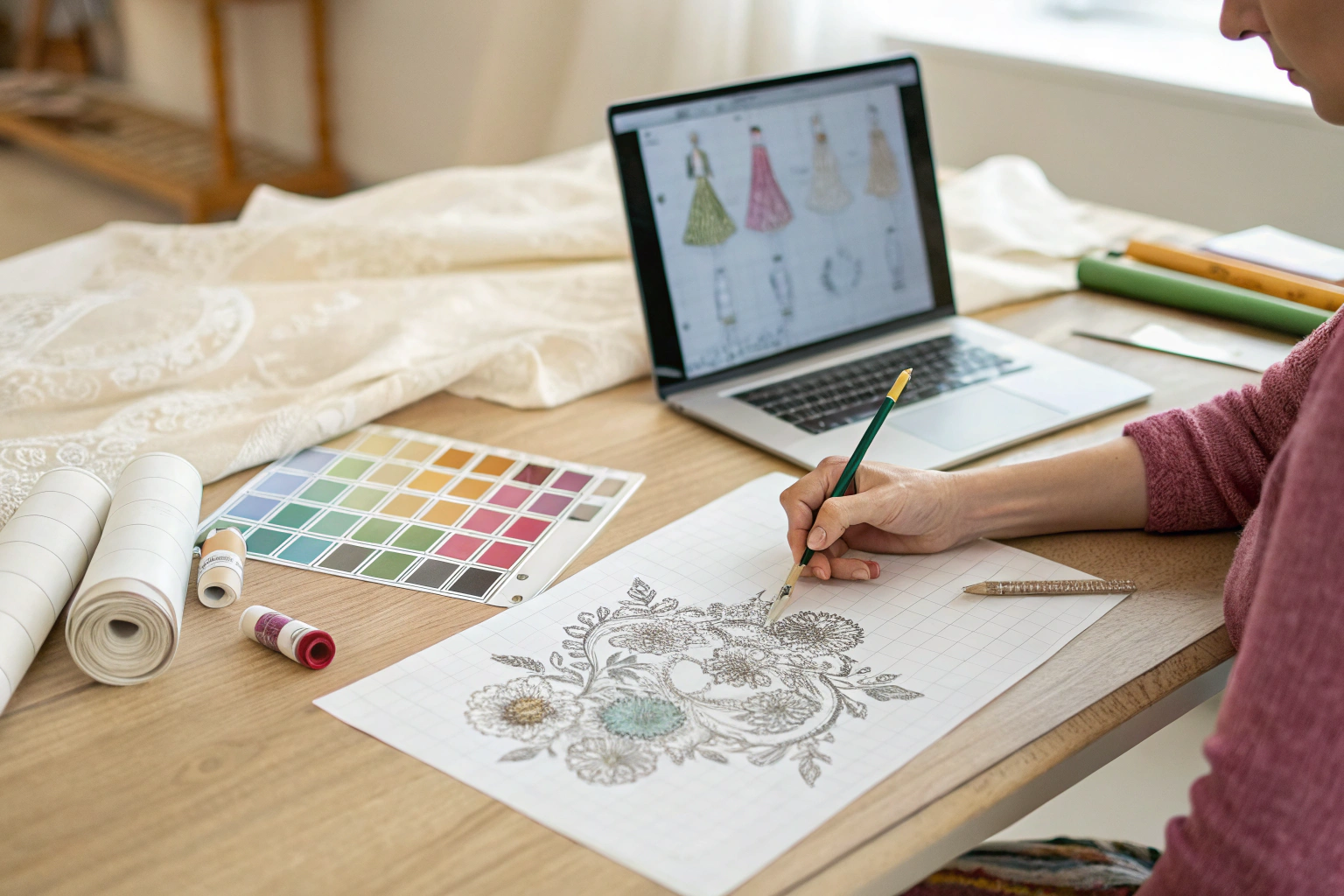
You spent months developing a custom print with our design team. It’s exclusive. It’s the core of your brand’s identity for the next season. You launch it, and three weeks later, a fast-fashion giant has a pixel-for-pixel copy on their website, at half the price, printed on cheap polyester. Your heart shatters. You feel robbed, and legally, you probably were. But here’s the hard truth: without a registered design patent, you have almost no legal stick to beat them with. You can send angry emails, but a copyright takedown on Alibaba is a game of whack-a-mole. You need a government-issued, enforceable property right that says, "This visual surface ornamentation is mine." The pain isn’t just the copy; it’s the powerlessness.
We actively help our clients secure that power. Registering a design patent for a cotton print created with us is not only possible; we have streamlined the documentation to make the process faster. A design patent protects the ornamental features of a functional item—in your case, the unique two-dimensional pattern applied to our cotton-linen base cloth. It gives you a 15-year monopoly (from the date of grant) to stop anyone else from making, using, or selling fabric bearing that specific visual design. The key is that the design must be novel, non-functional, and clearly documented. You must file the application before you sell it publicly, or within the 12-month grace period in the US. We time our pre-production seals to match your filing date.
But a patent application is a precise legal instrument. The drawings need specific shading techniques, the broken lines need to separate the pattern from the fabric, and the claim must use the right language. I’m going to break down what you need from us—the digital vector files, the physical swatches, the inventor assignments—and how the USPTO examination process works for a textile print. This is how we turn your creative work into a defendable business asset.
What Design Files Do I Need from the Printer for a Patent?
The single most common reason a design patent application gets rejected by the USPTO is terrible drawings. A mood board or a styled photo is not a patent drawing. The patent office has strict formal requirements for the figures. You can’t just send a screenshot of the Photoshop file. The drawings must show every line, dot, and shape of the pattern in clear, reproducible black ink, usually on a white background. The shading must specifically indicate the contour and surface character of the design, not just the color. If your flower has a gradient, you need to render that gradient with dot stippling or line shading in black and white.
From our print factory, we provide you with the "Patent-Ready Vector Art Package." After we finalize the color separation and approve the strike-off, we don’t just send you a JPEG. We export the final pattern in an uncompressed Adobe Illustrator (AI) or CorelDRAW (CDR) vector format. This file contains the exact, scalable line art of your design. You hand this to a patent illustrator, and they can convert the vector lines into formal USPTO figure drawings without any guesswork. We also provide a "Color Reference Swatch" card with Pantone codes and a signed "Declaration of Originality" from our design team lead, stating that the pattern was created in collaboration with you and is not a derivative of an existing stock image. This chain of title is critical for the inventor’s oath.

Why Can’t I Just Use a Photo of the Fabric for the Application?
A photograph shows a crumpled, draped piece of fabric with shadows and highlights. The USPTO examiner needs to see a flat, undistorted view of a single repeat unit of the design. A photo introduces the texture of the fabric and the lighting effects, which are not part of the ornamental design you are trying to protect. You are claiming the 2D graphic pattern, not the 3D slub texture of the linen.
The examiner will issue an "Objection to the Drawings" if they see any surface shading that implies a texture not part of the claimed design. We’ve helped a client fix this exact issue. A Los Angeles-based textile designer submitted her initial patent application with high-resolution scans of the actual printed cotton. The examiner rejected the drawings because the weave of the cotton showed through in the scan. We had to supply our clean, flat digital separations. The patent illustrator then used those vectors to create formal ink drawings with a solid black outline, completely divorced from the fabric substrate. The rule is simple: the figures must only show the ornamentation you are claiming. The raw vector file is your golden ticket to a clean filing.
Do You Provide the "Broken Line" Drawings for the Fabric Product?
Yes, and this is the strategic part of the claim. You are patenting the print pattern, but you want it to apply to a product—specifically, a textile or a garment. In a design patent drawing, solid lines show what you claim. Broken (dashed) lines show the environment the design sits in, which you are not claiming.
If you want to claim the pattern for a specific fabric, we provide a drawing template where the pattern is shown on a rectangular swatch. The rectangle’s boundary is drawn in broken lines, meaning "this is just a piece of cloth, not the specific size of the cloth." The pattern itself is in solid lines. This gives you the broadest protection. It stops someone from copying your print onto a dress, a bedsheet, or a scarf. If you only claim the pattern on a specific T-shirt silhouette, a copier could legally put it on a tote bag and argue it’s a different article. We always advise using the standard broken-line textile panel as the environmental structure. This strategy is key when you are learning how to prepare formal patent drawings for textile print patterns.
How Do I Confirm the Print Design Is "Novel" Before Filing?
You’ve created a beautiful print. But is it truly new? A design patent examiner will search the USPTO database, Google Patents, and even commercial catalogs for "prior art." If anyone, anywhere in the world, has published a pattern that is "substantially similar" to yours, your application will be rejected with a printed citation of the prior design. "Substantially similar" means an ordinary observer, familiar with textile designs, would confuse your design for the prior one. This is a subjective standard, and it’s the biggest legal hurdle.
We help you run a pre-filing "knockout search." We use a combination of Google Patents (searching the US design class D05/47 for textiles) and the USPTO’s public search tool. We look for specific motifs that match your core elements. We also use a visual search on the World Intellectual Property Organization (WIPO) Global Design Database. This is a critical step I never let my clients skip. A client of mine from Australia had a geometric print based on indigenous-inspired dot work. We searched and found a nearly identical design registered by a German home textile brand five years prior. We had to pivot the design before we wasted a $2,000 filing fee. That search saved her career. You must confirm the design’s novelty before you pay the patent office.

What Are the Most Common Reasons a Textile Design Patent Gets Rejected?
Prior art is the biggest one, but there are other traps. The "non-obviousness" standard trips up many designs. If your design is a basic polka dot, a simple stripe, or a traditional plaid, it will be rejected as obvious. A design must show a unique ornamental combination that goes beyond a simple geometric variation. Another common rejection is for "functionality." If the design element serves a mechanical purpose (like a specific printed grip dot for traction), it cannot be protected by a design patent; you’d need a utility patent for that.
Also, "lack of specificity" in the drawings kills claims. If the lines are blurred or inconsistent, the claim is indefinite. For example, if you show a floral with five petals in Figure 1, and then seven petals in Figure 2, the examiner will say the design isn’t consistently disclosed. We check for this when we produce your sample strike-offs. We make sure the engraved printing roller or the digital print file produces an absolutely identical repeat across the fabric width. The repeat measurement must be exact. You are legally swearing that the design you show in the patent is the exact design you intend to sell.
How Can I Search Existing Fabric Patents Before We Print?
I have a specific workflow for this. First, we take your approved sketch and break it down into its key visual "markers": the petal shape, the leaf arrangement, the specific spacing of the dot clusters. Then, we open the USPTO patent public search portal. We use the Cooperative Patent Classification (CPC) code for decorative textiles. The primary code is D05/47 (Textile or paper yard goods). We also look at D05/53 (Paper or textile sheet material) and D05/99 (Miscellaneous).
We enter a text description of your motif, like "floral AND damask AND repeat," into the search bar. We then visually scan the result images. This is a slow, manual, and painstaking process. I tell my clients to spend a solid two hours doing this. Put on some coffee and just scroll. If you find a design that’s 80% similar, it’s a major red flag. We encourage you to document the search. Take screenshots of the closest references. Your patent attorney will later need to submit an Information Disclosure Statement (IDS) citing these references to the USPTO, showing you are honest about the prior art landscape. It’s actually a good thing to find something close and then clearly articulate in the application why your design is different. This process of searching for prior art textile design patents before filing is the bedrock of an ethical application.
What Is the Step-by-Step Process for Filing a USPTO Design Patent?
The paperwork looks intimidating, but I’ve simplified it into a checklist that we walk our partners through. The USPTO design patent application has six required components, and missing even one will delay your filing date. The filing date is everything. It’s your "priority date" that determines who was first. In a "first-to-file" system like the US, the person who files first wins, even if the other person actually drew the design first. You don’t want to lose your own creation because of a bureaucratic delay.
Step 1: The Preamble. This is a single sentence, but it must be perfect. "Be it known that I, [Your Name], a citizen of [Country], have invented a new, original, and ornamental design for a ‘Textile Fabric’ as shown and described." Step 2: The Title. "Textile Fabric" is standard for our cotton prints. Step 3: Cross-Reference to Related Applications. Usually "Not Applicable" for a fresh filing. Step 4: The Figure Descriptions. "FIG. 1 is a front plan view of a textile fabric showing my new design. The broken lines depict a fabric panel and form no part of the claimed design." This text must match the drawings exactly. Step 5: The Single Claim. A design patent has one, and only one, claim. It reads: "The ornamental design for a textile fabric, as shown and described." Step 6: The Drawings. Usually just one figure, the plan view of the repeat. We file all this electronically through the USPTO’s Patent Center portal. We partner with a US-registered patent attorney who reviews everything for $500-$800 before filing. I never advise filing pro se (by yourself) for a commercial asset; one formal mistake can void your rights.

Can I Use the USPTO’s "Patent Center" to File Myself?
Legally, yes, but it’s like performing dental surgery on yourself. The USPTO Patent Center is a web-based system where you create an account, upload your PDF documents, and pay the fees by credit card. The design patent filing fee for a micro-entity is $88, a small entity is $352, and a large entity is $704. The fees are low compared to utility patents.
The trap is the document formatting. The Patent Center requires the PDFs to be embedded with specific fonts, with margins of at least 2.5 cm at the top, and a page size of A4 or Letter. If your patent illustrator gives you a drawing with a margin of 2.4 cm, the system rejects it instantly, and you lose your filing date. You have to restart. The system also has a validation engine that checks for these errors, but it doesn’t check the legal sufficiency of your claim. I’ve seen a home-filer submit a drawing with solid lines for the fabric boundary, which means they legally claimed the entire rectangular piece of cloth itself, not just the pattern on it. It took them an extra $1,000 in legal fees to fix that. A registered patent attorney filing through their official account ensures the formalities are perfect. My recommendation: do the creative search and the description draft yourself, but pay an attorney for the final upload.
How Do I Mark My Fabric as "Patent Pending" During Production?
The moment you file the application, you have "Patent Pending" status. You can and should immediately mark your products. This puts copycats on legal notice. Even though you can’t sue them until the patent actually grants, you are telling the world that a patent will issue, and any copying from that date forward will be a willful infringement, subject to triple damages.
We offer a service where we incorporate this marking directly into your printed selvage. Our engraving team can add a small, discreet text to the salvage edge of the cotton fabric: "U.S. Design Pat. Pending" with the application serial number. This is permanent, unremovable proof that the fabric was sold under patent notice. I always tell clients to screenshot the USPTO filing receipt showing the application number and date. Pin that to your product listing. If a competitor copies you, your cease-and-desist letter carries the full weight of federal law behind it. Taking the step to learn how to file a USPTO textile surface design patent application online is the critical first move in protecting your intellectual property.
How Can Fumao Fabric Help Maintain the Secrecy of a Print Pre-Filing?
The clock of public disclosure starts ticking the second your fabric is shown publicly. In the US, you have a 12-month grace period after the first public sale or public show to file the patent. After that 12-month window, your own design becomes prior art against you. You lose the right to file forever. If you show the print at Première Vision in Paris in February, you must file by the following February. But in many other countries, like the European Union or China, there is zero grace period. If you show the design at a trade show even one day before filing, you instantly lose all patent rights in those countries. Absolute secrecy before filing is the only safe international strategy.
We have a strict "Pre-Filing Confidentiality Protocol" for collaborative custom prints. We treat your design like a state secret. Once the design is finalized, we assign it an internal blind code—nothing with your brand name. The sample fabric is cut and sealed in a matte black, opaque bag before it leaves our print factory. We don’t post it on our Instagram. We don’t put it in our Alibaba virtual showroom. Our contracts with the engraving and printing staff include a confidentiality clause specifically for client-owned patterns. We take this seriously because your patent rights depend on the design not being "in the public domain." A single leaked photo on a social media feed of "factory floor fun" can destroy your novelty claim in an instant.

Do You Sign NDAs That Specifically Cover Pre-Patent Design Work?
Yes, and we do it willingly and quickly. A standard generic NDA is often too weak for a design patent scenario. It might just cover "business information." We use a specific "Pre-Filing Design Non-Disclosure Agreement" tailored for the textile industry. This agreement explicitly states that the factory acknowledges the designs are original and confidential, and that the factory waives any right to claim authorship or to reproduce the design for other clients.
The NDA also includes a "data destruction" clause. It states that after the final strike-off is approved, all digital transfer files used in the interim engraving process will be purged from our production servers, keeping only the locked, approved final file. This prevents a rogue middleman from pulling an old sketch off the server and selling it to a fast-fashion house. I sign these before any detailed technical discussion begins. A Brooklyn-based artist we worked with to create a custom cubist print was terrified her art would get stolen. We signed her attorney’s NDA within 24 hours. I walked her through our server access logs to show her exactly who on the team had access to the file (just me and the print master). That transparency is the only way to build trust when we’re handling your core IP.
How Do We Handle Sample Distribution Without Losing Novelty?
Selective and coded. If you need to send a physical swatch to a potential buyer or a garment developer before you file, you have to do it under a limited confidentiality agreement. We help you prepare a "Confidential Pre-Sale Sample Pack." The fabric sample is cut, folded, and placed inside a sealed tamper-evident bag with a numbered seal. The outside of the bag has no picture of the design, just the code and a legal notice: "Confidential Design Sample. Opening this bag constitutes agreement to the attached Non-Disclosure Terms."
We mail it directly from our factory to your specified recipient using tracked courier. You control the distribution list. You never post the design in a public wholesale catalog until the patent application number is in your hand. I have a horror story to share (without naming names). A Scandinavian brand sent a digital mockup of their new print to a sourcing agent in 2019. The agent put the mockup on a WeChat moment to show "what European designers are doing." A competitor saw it, filed a Chinese design patent in 2 weeks, and then sued the original brand when they tried to sell in Shanghai. It took two years of litigation to resolve. Don’t let that happen. The only safe sample is a sample sent with a signed paper trail. This protocol is essential when you are figuring out how to keep a custom textile print secret before filing a design patent.
Conclusion
We’ve traveled the legal and creative path from a fragile sketch to a federally protected design. You’ve seen that a design patent isn’t just a fancy piece of paper; it’s a 15-year monopoly on your visual creation, a legal fence around your cotton print. The key steps are precise: securing the formal black-and-white vector drawings where broken lines protect your full range of products, running a brutal prior art knockout search to ensure no one has seen your flower before, and filing the electronic package before that first trade show unveiling. We’ve covered the critical $88 to $704 filing fee, the absolute necessity of the pre-filing secrecy protocol, and the moment you can stamp "Patent Pending" on your selvage as a legal warning to the world.
Your design is what sets your brand apart. We just provide the canvas. I want your creativity to be rewarded, not ripped off. At Fumao Fabric, we’re equipped to support you with the technical files, the signed declarations, and the strict confidentiality procedures that a successful patent application demands. When you’re ready to develop that exclusive print and lock down the legal rights, let’s coordinate the artwork and the timeline. Please reach out to our Business Director, Elaine, to start the conversation and get our Patent Documentation Checklist. You can email her directly at elaine@fumaoclothing.com. Let’s protect your art.








