You’ve been importing fabrics for years. You know the US market inside out. You see the "cottage-core" trend, the demand for natural fibers, the obsession with sustainability. You see our Fumao cotton-linen moving. But every time you think about moving from a one-off buyer to a real, exclusive distributor, your brain fills with logistical landmines. Will your margins get crushed by a surprise tariff code misclassification? Will you lock in a price, only to have the factory sell to your competitor down the street? How do you even secure a territory when every brand is chasing the same premium flax blends? The fear of investing in a container, only to have the rug pulled out from under you, is paralyzing. I’ve spoken to dozens of potential partners at Texworld and Première Vision who are stuck in this exact spot. They have the sales channel, but they don’t trust the back-end supply chain.
We’ve built a specific Partnership Program for this. It’s not just a price list. It’s a strategic alliance. We are actively looking for a limited number of regional distributors who want to treat our house-milled cotton-linen as their anchor product. We don’t just ship you boxes and hope for the best. We protect your margin with a zoned territory agreement and a locked-in FOB pricing schedule for 12 months. We hold safety stock in our Keqiao warehouse exclusively for our distribution partners, so you don’t have to wait through a full 45-day production cycle when a client needs a rush reorder. You get access to our full R&D library before public release, and a dedicated account manager who speaks real-time with our production scheduler. You bring the market; we bring the unbreakable supply chain.
But becoming a partner isn’t just about signing a paper. It’s about understanding the specific financial metrics, the shipping logistics, and the marketing support that makes this work. You need to know how to categorize our linen under the HTSUS to avoid a 25% penalty, how we structure the minimums to be achievable, and what digital assets we hand over to make your sales team’s life easy. I’m going to walk you through the exact framework we’ve used to build lasting, profitable relationships with our current exclusive agents across Europe and the Middle East. Let’s talk about the real nuts and bolts of a distribution agreement that actually makes you money.
What Are the Minimum Requirements to Apply as a Distributor?
We’re not looking for a thousand small buyers. We’re looking for maybe three or four serious operators in specific US regions. To protect you and our brand, we have a strict screening process. You can’t just send an email saying "I want to distribute" and expect a container of stock. We need to see that you have the existing infrastructure to move high-end shirting and dress-weight linen. The reason we vet so strictly is simple: our distribution model relies on mutual volume commitments. If you don’t have a warehouse to hold the stock or a sales team to push it out, the inventory just sits there, and that blocks a territory we could have given to a hungrier partner.
The baseline requirements are straightforward. First, you must be a legally registered business entity in the US with a valid EIN and a resale certificate. Second, you need to demonstrate an existing client base. We look for a minimum of 15-20 active boutique or manufacturing accounts that regularly buy woven fabrics. Third, you must have physical storage, even a small 1,000-square-foot racked space, to hold the sample inventory we ship. Finally, we look for a minimum annual volume commitment. We don’t do this to be difficult; we do it to ensure the territory is actually being worked. We set an initial trial period of 6 months with a manageable 5,000-meter target. If that goes well, we scale up to a full agreement. This isn’t a gamble; it’s a structured rollout.

What Kind of Buyer Network Do You Need to Qualify?
I need to see that you’re already talking to the right people. If your current buyers are only fast-fashion mass marketers, you’ll struggle to sell our premium cotton-linen. Our fabric is a value proposition, not a commodity. It works best when sold to mid-tier to high-end designers, uniform programs for the hospitality industry, or specialty home textile workshops. A distributor who has a rolodex of interior designers, boutique hotel procurement managers, or bespoke tailor shops is a perfect match.
We ask for a client list with your application, but we don’t poach. This is a trust exercise. I need to see that you know how to speak to a buyer who cares about washability, slub texture, and pilling resistance. For example, a recent partner in the Netherlands built their entire distribution on just 30 very loyal high-end curtain workshops. They don’t do huge volume per transaction, but they command a 60% margin because they sell the story of the flax. You need that storytelling ability. If your team can explain the difference between our wet-spun and dry-spun linen, you’re our kind of partner. Demonstrating knowledge of how to build a wholesale distribution network for linen fabric brands is the first step to passing our vetting call.
What Is the Initial Investment for Opening Stock?
Let’s talk real numbers because I hate hidden fees. To launch the partnership, we don’t ask for a massive franchise fee. Your main initial investment is the opening stock order. We’ve designed a "Distributor Starter Pack." It’s a curated selection of our top 20 best-selling cotton-linen SKUs, covering our core weights and colors: the natural ecru, the deep indigo, the charcoal melange, and a few seasonal shades. The pack totals around 1,500 meters of mixed fabric.
The goal of this pack is to fill your sample rack and give you immediate "cut-length" selling capability. The cost for this opening pack, based on current FOB prices, usually sits around a very competitive entry point. Beyond the stock cost, you need to allocate budget for freight and customs brokerage, which we optimize together. We don’t charge extra for the territory reservation or the marketing materials. The samples, the digital swatch cards, the access to our virtual showroom—that’s our investment in you. We succeed when you reorder. This low barrier to entry with high support is why our distributors succeed. (A quick pro tip: having your customs bond in place before the starter pack ships avoids costly warehouse storage delays at the port).
How Does the Territory Protection and Pricing Model Work?
The biggest fear in fabric distribution is "channel conflict." You spend six months cultivating a major fashion label. You send them samples, do the costing, nurture the relationship. Then they go directly to Shanghai Fumao’s website, see a similar price, and cut you out. Or worse, another distributor in a neighboring state ships into your backyard. That kills motivation dead. If you’re going to invest in marketing our brand, you need a moat. We give you that moat.
Our US distribution model is based on Protected Geographic Territories. We split the US market into logical sectors—West Coast, Midwest, Northeast, Southeast—and we assign exclusivity for our core cotton-linen range within those borders. It’s written into the contract. You own the sales traffic from that region. Any direct inquiry that hits our website from a zip code within your territory gets forwarded to you. We also operate a Transparent Cost-Plus Pricing Model. You see our actual FOB factory price, based on raw flax cost and mill processing. Then, we agree on a fair distributor margin. The price you charge your client is your business, but the price we charge you is fixed and protected for the contract period. No surprises. You can build long-term pricing contracts with your own customers because you know your base cost won’t jump unpredictably.

How Does Fumao Handle Direct Website Sales in My Territory?
This is the first question every smart distributor asks. "Why would I drive traffic to you if you’re just going to sell direct?" The answer is simple: we won’t. For the categories and the territory where you hold the exclusive distributorship, we treat you as the retail face for those specific products in that specific region. If a New York designer goes to fumaofabric.com and tries to order cut lengths of the cotton-linen that falls under your Northeast territory agreement, we don’t fulfill that order.
Instead, we do two things. First, the website page will display a "Contact Our Exclusive Regional Partner" button with your company name and email. Second, if they still contact our head office, our sales admin forwards the lead directly to you within 24 hours. We track this through our CRM. You get first right of refusal. The only exception is if you don’t engage the lead for 10 business days. Then, we might intervene to protect the brand image, but that’s a fail-safe. We are looking for a partner who will be the local face of our fabric. I firmly believe our distributor partners should own the relationship. Learning about an exclusive linen fabric distribution agreement with territory protection is key to understanding the serious commitment we offer.
Is the Distributor Price Protected Against Raw Linen Price Fluctuations?
Flax is an agricultural commodity. Bad weather in Belgium or Northern France can spike the price of raw long-staple fiber by 20% in a season. If you’re holding a fixed-price bid for a hotel chain, a surprise spike can wipe out your entire profit. We address this with a Quarterly Fixed Price Schedule.
Before the start of each quarter, we send you a pricing matrix that is locked for the next 90 days. This gives you a firm window to quote your clients. For your annual blanket orders with predictable monthly consumption, we offer a Fixed Annual Contract Price. We absorb the minor market fluctuations using our commodity hedging and our raw material stockpile. We keep a three-month inventory of premium flax on our floor at all times. This buffer means we don’t have to pass on a sudden spot-price spike until we’ve exhausted the old inventory. It’s a financial shield for you. If the global price of flax drops significantly, we do adjust downwards at the next quarterly review. It’s a fair partnership. This transparent cost model is how you confidently bid by looking up the current cotton linen distributor wholesale price usa index without fear.
What Inventory and Logistics Support Do You Provide to US Partners?
You close a $50,000 deal. The deposit is in. Then, you check the inventory, and the fabric is gone. Sold to a spot buyer who paid a 5% premium. This is the reality of transactional supplier relationships. If you don’t have a contractual hold on the stock, you are just another voice in the inbox. A true distributor doesn’t just sell what’s left over; they sell what’s been allocated to them months in advance. Logistics and inventory control are where most distribution dreams die. The shipping cost spirals. The container gets rolled. The stock arrives late, and your buyer cancels the project.
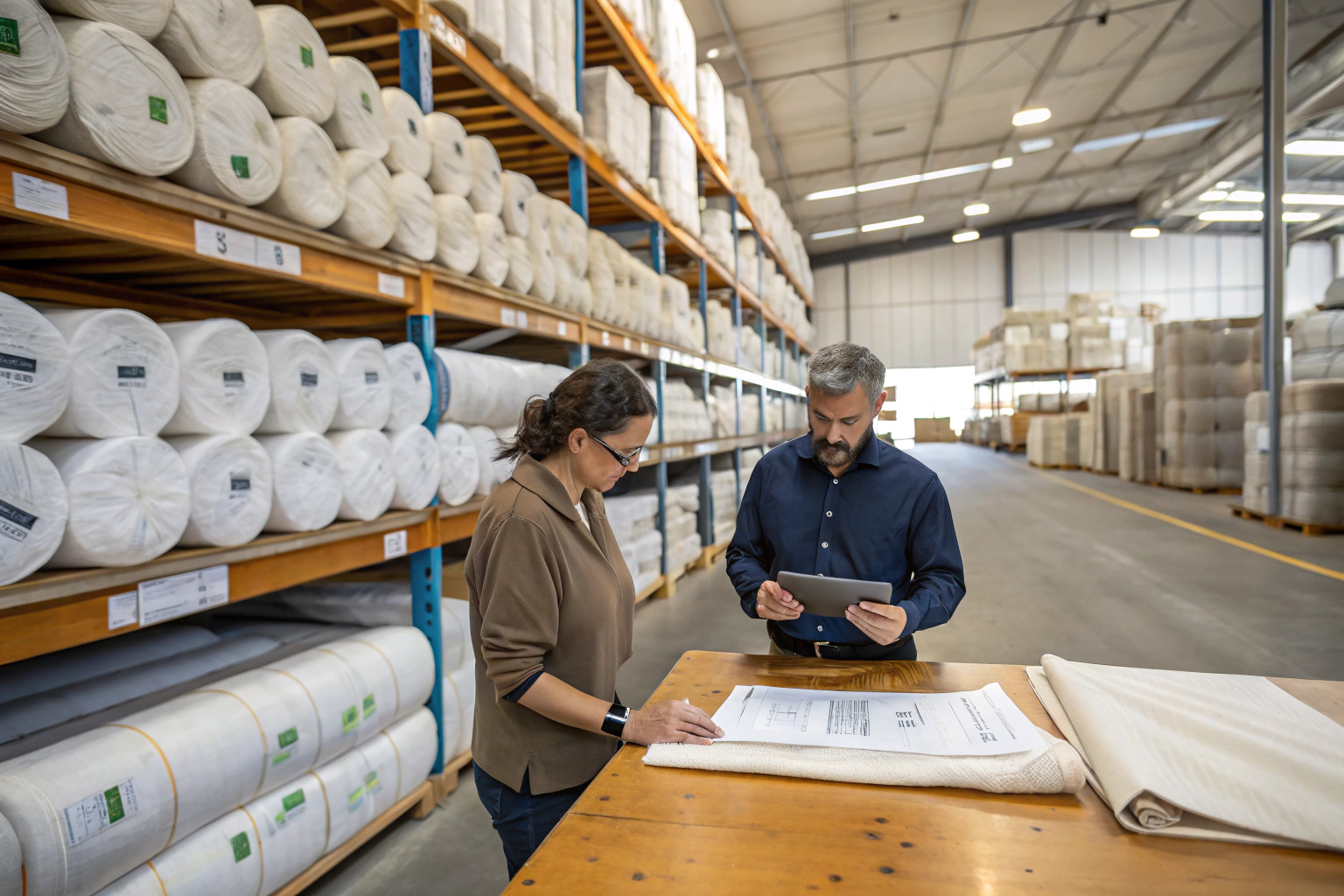
We provide a Consigned Inventory Management program. When your territory agreement is signed, we don’t just put your name on a list. We physically tag and allocate specific greige goods and finished rolls in our Keqiao warehouse to your account. You can view this live stock through a secure partner portal login. You see the exact yardage ready for you. When you need an urgent restock of a best-selling 7oz natural color, you don’t wait 30 days for dyeing. If it’s in your consigned stock, we can ship within 72 hours. We also optimize the full container load (FCL) consolidation for you. Instead of paying premium less-than-container-load (LCL) rates, we help you fill a 20ft or 40ft container, mixing your linen with other accessories from our cluster to hit the perfect minimum volume. We arrange everything to the port of your choice (FOB Shanghai/Ningbo), or we can even organize DDP (Delivered Duty Paid) if you prefer a hands-off approach.

Can You Hold Safety Stock in Your Warehouse for My Key Accounts?
Yes. And this is a game-changer for winning uniform or large-scale retail contracts. If you are pitching a national spa chain that needs a specific custom-dyed charcoal cotton-linen for their staff tunics, they will want a guarantee of continuity. They need 5,000 yards now, and another 3,000 yards in six months. If the dye lot doesn’t match, the gig is up.
We reserve "Gray Stock" for these programs. We take your forecast, weave the greige fabric, and hold it in a climate-controlled storage room. It’s reserved under your account number. When the reorder comes, we just dye and finish the exact same base lot. The hand-feel and shade will be identical to batch one. For a distributor in Texas we’ve been talking to, we ran a simulation on this with their biggest potential client, a regional scrubs manufacturer. We reserved 10,000 meters of greige 55/45 linen-cotton, specifically lot #B-2239, with a "Do Not Sell" label physically pinned to the pallet. The distributor showed that pallet on a video call to the client. They won the contract based on that supply chain security. That’s the power of having a deep manufacturing base. If you are mapping out how to manage linen fabric inventory for US distribution partners, this reservation system is the only way to guarantee repeat business.
What Is the Standard Lead Time for Distributor Reorders?
Speed is your competitive advantage against direct-import competitors. If a local designer runs short of fabric mid-production, they don’t care about factory holidays; they need a solution tomorrow. Our partnership lead times are structured to be brutally fast. For your pre-allocated, consigned stock items, we ship within 3-5 business days of receiving your purchase order. That’s just the picking, packing, and export doc preparation time.
For custom dyes or fresh production outside of your consigned stock, the lead time is 25-30 days. That’s significantly faster than the standard 40-45 days because we prioritize distributor POs in our scheduling software. Your order jumps the queue. We also offer a "Rush Sample" service. If your client needs a 50-meter trial roll for a photo shoot, we can air-freight it. The sea freight transit time to the US West Coast is about 12-15 days, and to the East Coast about 25-30 days. We work closely with freight forwarders to book space on Matson’s fast ship to Long Beach. I’m always direct about the transit times because a realistic timeline keeps your client happy. When you are developing your custom linen fabric wholesale reorder lead time partner protocol, our prioritization makes all the difference.
How Do We Market and Sell the Cotton-Linen Line Together?
Having the fabric is one thing. Selling it is another. You might be a one-person operation, or you might have a small team. Not everyone has a professional photographer or a copywriter who understands the nuance of flax fiber. We don’t just leave you with a container of fabric and a "good luck." We provide a full Digital Marketing Toolkit that you can white-label or co-brand. Because if your clients don’t see the beauty of the linen, they won’t buy it. Marketing is the fuel for distribution. Without high-quality assets, the fabric just looks like beige cloth in a bad iPhone photo.
Our partnership package includes access to high-resolution, ghost-mannequin product shots and macro texture videos. You get pre-written, technically accurate SEO copy that explains the bio-polishing process, the pilling resistance, and the organic certification. You also get a set of physical marketing materials: a leather-bound lookbook with A4-sized swatches and a branded fabric hanger set with our QR codes. This QR code, when scanned by your customer, leads to a digital "fabric passport" showing the test reports and factory floor behind the specific batch. This is our co-branding strategy. You sell as the local expert, backed by the visual evidence of our factory quality. It gives you the credibility of a multinational without the overhead.

What Content Assets Will I Receive to Sell to Designers?
I’ll give you the exact list because this is the stuff that saves you 20 hours a week. You receive a Dropbox folder with: 1) 50+ stylized flat lay images of our cotton-linen in different settings (raw, washed, draped). 2) Short 15-second video loops of the fabric moving in the wind or being crushed by hand to show the recovery. 3) A digital "Tech Pack PDF" for each SKU, listing the exact weight, weave, shrinkage, and FR capabilities. 4) Sample social media captions formatted for Instagram and LinkedIn. 5) A 2-page "Sell Sheet" brochure you can print locally.
A distributor in the UK printed that sell sheet on linen-textured paper and mailed it to 200 interior designers. He got a 15% response rate. We also host quarterly Zoom training sessions for your sales team. I do a deep dive into a specific fabric, like our coated linen, so your people can answer technical questions on the spot. We essentially act as your outsourced R&D department. If you’re exploring what is the best marketing content for wholesale linen fabric distributors, it’s these "plug-and-play" assets that close the gap between a sample and a sale.
Can We Collaborate on a Co-Branded Trade Show Booth?
Absolutely. Trade shows are expensive, but they’re where the serious buyers are. If you take a booth at a US show like Texworld New York or Functional Fabric Fair, we want to be there with you. We offer a Co-Marketing Fund. Based on your annual volume, we provide a credit towards your booth design costs. We will ship you a complete showroom display kit: a pull-up banner, a pop-up backdrop with consistent branding, and a curated "touch wall" of our 30 best-selling swatches.
More importantly, I or one of my senior textile engineers will physically attend the show with you if the timing and scale make sense. There is nothing more powerful than a US buyer seeing the distributor next to the mill owner. It closes the trust loop instantly. For a partner in Düsseldorf, we stood in their booth for three days. I answered the deep technical questions about the dyeing process, while they focused on the sales relationship. They tripled their order book compared to the previous year. When you plan your co branded fabric trade show strategy with mill support, you aren’t just a reseller. You become the domestic arm of a global mill. That’s an unassailable market position.
Conclusion
Becoming a US distributor for our cotton-linen isn’t just about buying fabric at a discount. It’s about acquiring a competitive weapon. We’ve laid out the full blueprint: the territory protection that stops channel conflict dead in its tracks, the quarterly pricing lock that shields you from commodity swings, the consignment stock that turns your warehouse into a just-in-time delivery machine, and the co-branded marketing assets that make you look like a Fortune 500 textile house. We’ve given you the qualification checklist, the logistics map, and the marketing playbook. The entire structure is designed to let you focus purely on selling and relationship building, while we handle the complex manufacturing, the quality control, and the R&D.
We are actively screening for a handful of partners who understand the value of a premium flax blend and have the local network to bring it to market. This is a long-term play. We don’t churn through partners. We grow with them. If you have the storage, the existing account base, and the hunger to dominate a territory with a top-tier product, I want to start a conversation. To request our Partnership Prospectus and set up a private video tour of our dedicated distributor stock area, contact our Business Director, Elaine. You can email her directly at elaine@fumaoclothing.com. Let’s see if we are the right fit to build this market together.