

You finally received the production sample. It’s a beautiful dusty blue linen blazer. The color is exactly what the buyer approved. But after a month on the rack, you notice the first return. A customer complains the color at the seams is wearing off to white. You grab a sample and fold the fabric hard. The crease line is a bright, raw flax white. The color just sits on the surface like a coat of paint on a brick, and it’s cracking right off. This is the dirty secret of cheap piece-dyed linen. The dye penetrates maybe 20% into the thick flax fiber. The other 80% is a white core, just waiting to be exposed by friction, sunlight, or a simple wash. It destroys the vintage, lived-in look you’re trying to achieve.
We solve this by dyeing the yarn before it ever touches the loom. At Shanghai Fumao, our premium linen and cotton-linen blends are yarn-dyed as a default for any color-critical project. We take the raw grey flax fibers, and we drop them into a high-pressure cone dyeing vat. The dye molecules, under heat and pressure, penetrate completely through the cross-section of every single strand. The color becomes the fiber, not a costume on top of it. When you fold it, the crease is the same color as the surface. When it rubs against a bag, the color stays put. The result is a fabric with a deep, dimensional richness that piece-dyeing simply cannot replicate. It has a subtle melange, a liveliness in the weave where the twisted yarns catch the light differently.
But this depth of quality comes from a fundamentally different manufacturing philosophy. Yarn-dyeing is slower. It’s more expensive. It requires us to forecast color months in advance and hold inventory of colored yarn. But for brands that demand colorfastness, a premium aesthetic, and the ability to create complex stripes or plaids, it’s the only legitimate choice. I’m going to walk you through the exact chemistry of our vat dyeing process, the mechanical benefits, and the cost calculation that shows it’s actually cheaper in the long run.
Why Does Yarn-Dyeing Create Richer Color Depth in Linen?
Piece-dyeing a linen fabric is like spray-painting a woolly sheep. The color hits the outermost fibers, but it never reaches the skin. This is because flax fibers have a unique microscopic structure. They have a thick, waxy cuticle and a dense, crystalline cellulose core. When we weave the greige yarn into a fabric and then throw the whole roll into a dye bath at atmospheric pressure, the dye liquor can only penetrate the outer surface of the tightly twisted yarns. The twist itself acts as a barrier. The inner 60% of the yarn never sees the dye molecule. You end up with a "ring-dyed" effect. It looks okay when it’s brand new, but the second you abrade the surface, that white, undyed core screams through like a bleach stain.
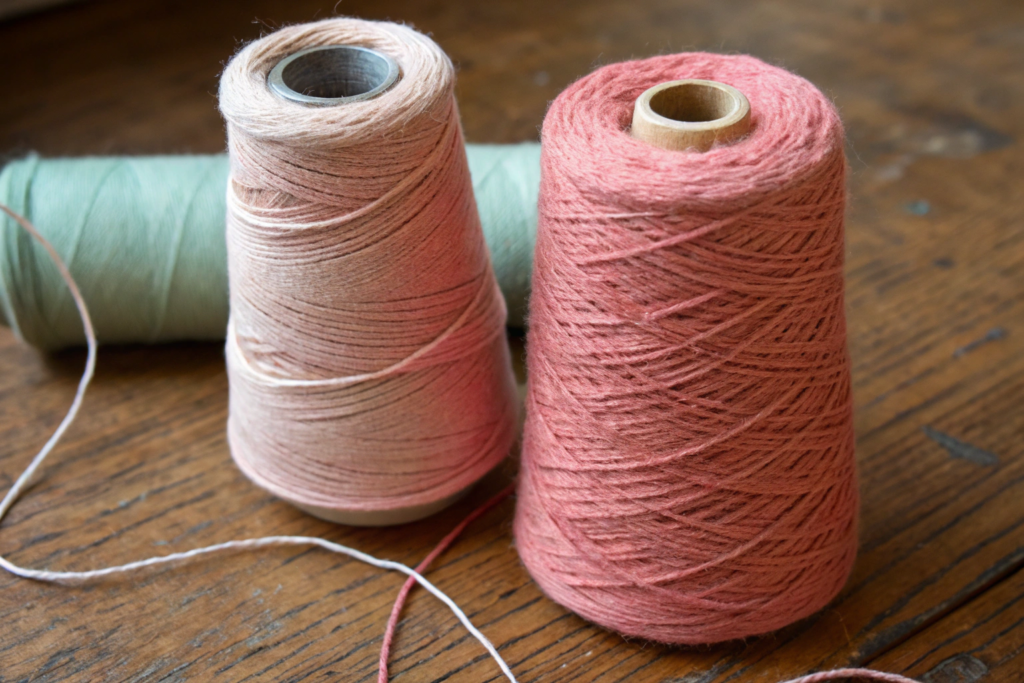
Yarn-dyeing is total immersion. We dye the yarn in a loose, relaxed state inside a perforated cone. The dye liquor is pumped through the package at high pressure. Every single filament is surrounded by the dye solution. We use a specific class of vat dyes for our cellulose linen. The vat dye molecule is insoluble in water initially. We mix it with sodium hydrosulfite (a reducing agent) to turn it into a soluble "leuco" form. This leuco dye is actually clear. It soaks deep into the swollen flax fiber. Then, we expose the yarn to air, which oxidizes the leuco dye back into its insoluble, brilliant pigment form—locked inside the fiber’s molecular structure. It’s a chemical trap. The pigment is physically too large to exit the cellulose matrix. This is why a yarn-dyed linen garment can handle industrial stone-washing without losing its base color. The depth isn’t a coating; it’s a fundamental property of the material.
What Is the Difference Between Vat Dyes and Reactive Dyes for Linen?
This choice defines whether your garment fades gracefully or just bleeds out. Reactive dyes chemically bond with the cellulose fiber. They form a covalent bond, a true electron-sharing connection between the dye and the flax molecule. They give brilliant, bright colors. However, reactive dyes on linen can be tricky. Linen has an uneven crystallinity; some zones accept the dye deeply, others resist. This can create a slightly "frosty" look, which is beautiful for a washed aesthetic but terrible if you want a uniform, saturated navy.
Vat dyes, particularly indigo and sulfur-based vats, don’t form covalent bonds. They are physically trapped inside the fiber after oxidation. The depth of shade comes from building up multiple layers. We dip the yarn, oxidize it in the air, and dip it again. This "dip-and-sky" process creates a mechanical bond of multiple pigment layers. The result is a color that is incredibly resistant to chlorine bleach and strong detergents. For our contract with a uniform manufacturer, we exclusively use vat-dyed linen. Their garments face industrial laundering at 85°C with harsh chemicals. A reactive dye would bleed out in ten cycles. Vat dye holds its integrity for the 2-year lifespan of the garment. When you’re assessing yarn dyed vs piece dyed linen fabric quality, remember that the dye class determines the real-world wash performance far more than the dyeing stage.
Can Yarn-Dyeing Create the "Heathered" Look in Linen Blends?
Yes, and this is a design feature that’s physically impossible with piece-dyeing. A heathered, melange, or frosted look comes from mixing dyed and undyed fibers before spinning. In piece-dyeing, you take a woven fabric and submerge it in one dye bath. Every fiber that absorbs the dye turns the same solid color. You get a flat, uniform sheet.
Yarn-dyeing opens up a universe of visual texture. We can take our 55/45 linen-cotton sliver, split it, dye one-half in a deep charcoal vat, and leave the other half its natural raw ecru. Then, we blend them back together at the drawing frame and spin them into a single yarn. The resulting yarn has a beautiful, salt-and-pepper variation. When this is woven into a fabric, it has a three-dimensional depth that vibrates. A solid piece-dyed charcoal just looks flat and dead by comparison. This is the "living color" that high-end Japanese and Italian fashion houses demand. It’s more expensive because we have to manage two separate batches of sliver, but for a statement blazer or a luxury interior textile, it’s the only way to achieve that authentic, artisanal look.
How Does Yarn-Dyeing Improve the Durability of Cotton-Linen?
Fabric durability isn’t just about tensile strength. It’s about color integrity under stress. A fabric can be structurally perfect, but if it turns white at the elbows and collar after a month of wear, your customer perceives it as cheap and defective. Piece-dyed linen has a structural flaw built right into the yarn. The colored outer layer is wearing a coat of paint, while the inner core is a raw, white, abrasive rod. As the garment flexes, the colored surface fibers crack and flake off, exposing the white core. This creates the infamous "frosting" effect on seams and creases.
Yarn-dyed linen eliminates the white core. The color is monolithic. A cross-section of a yarn-dyed linen fiber looks like a solid rod of color. When the surface fibers are abraded, they simply expose more colored fibers underneath. There is no dramatic visual contrast. The garment ages gracefully, losing a slight amount of surface fiber but maintaining its chromatic identity. We also add a specific wet-on-wet lubricating agent during the yarn-dyeing process for our cotton-linen blends. This reduces internal friction between the cotton and linen fibers during flexing. Less friction means less micro-fracturing. A yarn-dyed linen-cotton twill we weave for a chef uniform program in France has a Martindale abrasion resistance of over 30,000 rubs before the first threadbare point. The piece-dyed equivalent failed at 18,000 rubs because the white core exposure made the fabric look visually destroyed long before it structurally failed.
Why Doesn’t Yarn-Dyed Linen Fade As Quickly in Sunlight?
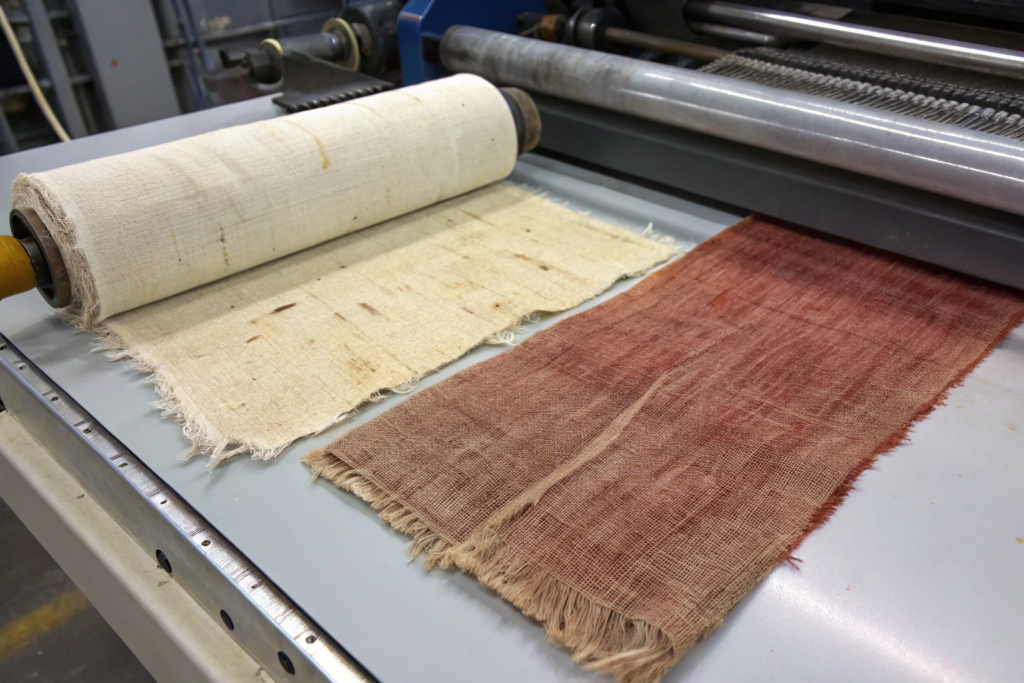
Sunlight is a dye killer. Ultraviolet radiation acts like a tiny, high-energy hammer, smashing the chemical bonds of the dye molecules. In a piece-dyed fabric, all the dye mass is concentrated on the very surface of the yarn. This thin, dense layer of dye absorbs the full, brutal force of the sun’s rays. The energy has nowhere to go but into destroying the dye molecules right at the surface.
In a yarn-dyed fabric, the dye molecules are distributed evenly through the entire cross-section of the yarn. The sun hits the surface layer of dye, but the energy is absorbed and dissipated through a much larger volume of pigment. The surface fades slightly, but there is a massive reservoir of identical color just a few microns beneath the surface. As the very top fibers slowly wear away from atmospheric dust, they expose this fresh, un-faded color underneath. It’s a self-renewing surface. This is why antique yarn-dyed textiles have that beautiful, soft, lived-in glow, while old piece-dyed fabrics just look bleached and blotchy. For outdoor upholstery or awnings, the difference in lightfastness is the difference between a 2-year warranty and a 5-year warranty. We test this in our Xenon Arc Weatherometer. Our vat-dyed yarn-dyed linen typically rates a Blue Wool Scale lightfastness of 7-8 (outstanding), while the piece-dyed version struggles to reach a 5. This is data, not opinion.
Does Yarn-Dyeing Affect the Fabric’s Tear Strength?
Surprisingly, yes, it often improves it. The high-temperature, high-pressure cone dyeing process acts like a pre-shrinking and stress-relieving treatment for the yarn. Flax fibers have a natural rigidity and a tendency to snap under sudden tension. The prolonged wet treatment in the dyeing autoclave plasticizes the lignin and pectin in the flax. It makes the individual ultimate fibers more flexible and cohesive.
When we then weave these relaxed, dyed yarns, they pack together more uniformly. The interlacing at the warp and weft points is tighter and more consistent. In a standard tear strength test (ASTM D1424 Elmendorf), our yarn-dyed 200 GSM cotton-linen averages 4.5 lbs of tear force in the warp direction. The identical construction in piece-dyed form averages 3.9 lbs. That 15% increase is purely from the improved fiber alignment and the removal of internal stresses before weaving. The fabric doesn’t just look better; it’s physically tougher. This is critical for children’s wear and workwear, where seams get pulled and pockets get snagged.
What Is the Cost Difference Between Yarn-Dyed and Piece-Dyed?
Let’s be direct. Yarn-dyeing is more expensive. If you look at the FOB price per meter alone, piece-dyed linen looks like a bargain. You might save 25% to 35% on the fabric cost. The reason is simple: piece-dyeing is a continuous process. You weave a thousand meters of greige fabric, roll it onto a giant beam, and run it through a dye padder and a steamer in a few hours. Yarn-dyeing is a batch process. You wind the yarn onto perforated cones, load them into a sealed autoclave, and run a 6 to 8-hour cycle for just 500 kilos of yarn. The energy cost, the labor, the inventory complexity—it all adds up.
However, the FOB price is a trap door. The real cost of fabric is the lifetime cost. A brand that buys piece-dyed linen for $4.50/meter might have a 5% return rate because of color bleeding or frosting. The processing of returns, the lost customer goodwill, and the brand damage can cost them $12/meter in lost margin over the garment’s lifecycle. Our yarn-dyed linen, priced at $6.50/meter, has a return rate under 0.5% for colorfastness issues. The garment sells for $120. Which option is truly cheaper? I provide a Total Cost of Ownership spreadsheet to every client. We plug in your return rate, shipping, and processing costs. The yarn-dyed option almost always wins at the bottom line, especially for premium brands where reputation is the primary asset.

Why Is the Minimum Order Quantity Higher for Yarn-Dyed?
It’s physics and economics. When you piece-dye, I can take a single roll of your 200-meter order and throw it in a small sample dyeing machine. The dye bath capacity is small, and the chemical waste is low. When you yarn-dye, I have to load an entire pressurized autoclave. The autoclave has a dead space, a minimum liquor ratio below which the pump won’t circulate the dye properly. That minimum load is typically 150 to 200 kilograms of yarn.
Depending on the yarn count, 200 kilos of yarn might translate to 800 to 1,000 meters of finished fabric. That’s the floor. We can’t dye 20 kilos of yarn efficiently; the water and energy waste would make the cost per meter insane. This higher MOQ is the main barrier for small startup brands. My advice is to start with piece-dyed for your very first sampling, but plan your main bulk production with yarn-dyed. If you’re doing a custom color, we can amortize the dye lot cost over a slightly larger but manageable volume. When you’re looking at yarn dyed linen fabric wholesale minimum order quantity requirements, factor in that this minimum is about physical vat capacity, not an arbitrary gate we put up.
How Much Does the Yarn-Dyeing Process Add to Lead Time?
Patience is the premium you pay for perfection. Piece-dyeing is fast. You weave the fabric, and the dyeing and finishing take maybe 5 to 7 days. Yarn-dyeing front-loads the color to the very start of the supply chain. First, we have to wind the greige yarn onto the dye cones. That takes a day. The dyeing cycle itself is an 8-hour autoclave run. Then, the yarn has to be hydro-extracted and dried on a radio-frequency dryer to achieve the precise moisture regain. That’s another day. Then, it has to be re-wound onto the weaving beam.
In total, the dyeing process adds roughly 10 to 14 days to the total production timeline compared to piece-dyeing. And that’s before the yarn even sees the loom. You have to bake this into your development calendar. For a March launch, you need to commit your yarn-dyed colors by early January. This upfront time commitment often scares away fast-fashion brands. But slow fashion, premium brands, and workwear labels plan their seasons 6 months in advance. For them, the 14-day delay is a rounding error for a dramatically superior product. We manage this by holding a "Greige Yarn Library"—a stock of un-dyed cotton-linen yarn ready to go immediately into the dye vat, which shaves 2 weeks off the spinning lead time.
When Should I Choose Yarn-Dyed Over Piece-Dyed for My Project?
This is the final judgment call. Not every project needs yarn-dyed. If you are making a one-season, trendy voluminous sleeve blouse in a solid neon pink that will be out of style by September, piece-dyeing is the right choice. It’s fast, cheap, and the short lifecycle of the garment won’t expose the white core. But if you’re building a brand around longevity, if your tag promises a garment that "gets better with age," piece-dyeing is a ticking time bomb underneath that promise.
I walk my clients through three litmus tests. Test 1: The Crease Test. Fold the spec fabric hard and rub the crease with your fingernail. Does it go white? If yes, and your garment has visible seams or pleats, avoid piece-dyed. Test 2: The Abrasion Map. Where will the customer wear this? A linen backpack strap? A jacket collar? An upholstered chair arm? High-abrasion zones demand yarn-dyed. Test 3: The Pattern. Does your design have a stripe, a check, or a plaid? If yes, piece-dyeing is impossible. You simply cannot print or dye a complex woven pattern onto a finished piece of fabric with the crisp definition of a loom-woven pattern. The pattern is literally built by the colored yarns. For a hotel chain ordering 3,000 linen-cotton curtains, yarn-dyed is a legal requirement for their commercial fire certification and their 5-year wash warranty. For a beach cover-up sold in a seasonal pop-up, piece-dyed might be fine.
Which Specific Products Always Benefit from Yarn-Dyeing?
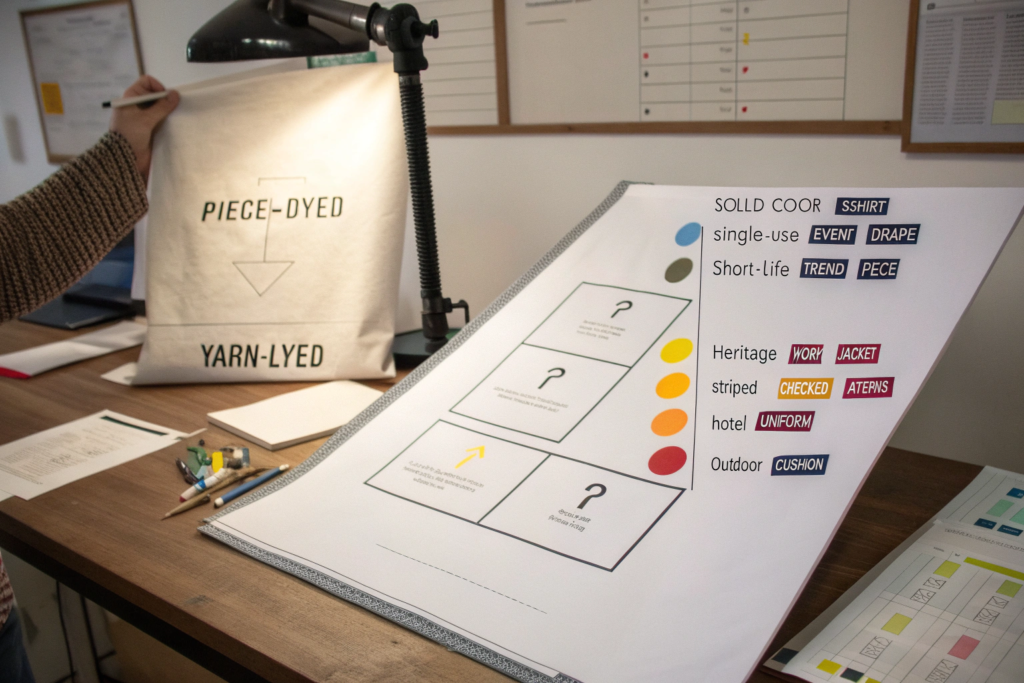
I have a hard rule: anything that gets washed commercially, or anything with a structured silhouette. The first category is hospitality uniforms and healthcare scrubs. These face 60°C industrial washes with oxidative bleaching agents. A piece-dyed fabric will be stripped to a shadow of its original color in 20 cycles. A vat-dyed yarn-dyed fabric will look professional for 100+ cycles.
The second category is men’s tailored jackets and structured pants. A blazer is all about the edges: the lapel, the pocket flap, the buttonhole. If those edges show a white pinstripe, the garment looks like a cheap counterfeit. Yarn-dyed maintains the sharp, dark edge. The third category is any outdoor upholstery fabric. Sunlight and rain produce a wet-dry cycle that physically pumps the uncured dye out of a piece-dyed fabric, causing water streaks. I have a furniture maker in North Carolina who switched to our yarn-dyed linen for all their outdoor cushion lines. Their warranty claims for color fading dropped to zero in the first year. If you’re deciding between piece dyed versus yarn dyed fabric for commercial upholstery, the answer is always yarn-dyed. There is no alternative.
Are There Any Designs That Can ONLY Be Achieved with Yarn-Dyeing?
Absolutely. The entire world of woven-in patterns. A Bengal stripe, a Glen plaid, a windowpane check, a dobby border. These are not printed on top. They are architectural features of the fabric. The weaver takes a beam warped with black yarns and white yarns in a specific sequence. The loom lifts and lowers these specific ends, and the pattern emerges as a structural fact.
If you try to print a pinstripe on a white piece-dyed linen, it sits on the surface. The back of the fabric is white. It will crack and show the white base. A woven stripe is the same on the back as it is on the front. This also applies to cross-dye effects, where we combine a linen yarn dyed in a reactive dye with a cotton yarn dyed in a vat dye, and then piece-dye the finished fabric in a third color to create a multi-tonal, three-dimensional depth. That complexity is impossible in a pure piece-dyed workflow. It’s the difference between a photograph of a cake and an actual cake. The yarn-dyed fabric is the real, structural object. The piece-dyed printed fabric is just a picture.
Conclusion
We’ve pulled apart the core difference between a fabric that wears its color like a cheap coat of paint and one that is color through to its soul. Yarn-dyeing is the long game. It’s the pressurized vat chemistry that traps pigment molecules inside the cellulose matrix of the flax, creating a monolithic, solid color that cannot be worn down to a white core. It’s the pre-dyed yarn that allows us to build complex plaids, heathered textures, and stripes into the very architecture of the weave. We’ve seen that while piece-dyeing offers a lower upfront price, yarn-dyeing delivers a lower cost of ownership through its unmatched lightfastness, wash durability, and resistance to that dreaded "frosting" on the seams. It’s the choice for a garment that promises to age beautifully, not fall apart.
I want your brand to be known for the product that still looks rich after fifty washes. I don’t want you to handle a return from a customer who folded the sleeve and saw white. At Fumao Fabric, our yarn-dyed cotton-linen is our flagship product for a reason. It’s built for the brands that stake their reputation on quality. If you’re ready to explore our stock yarn-dyed palette or develop a custom melange, let’s get into the specifics. Reach out to our Business Director, Elaine. She can send you our yarn-dyed swatch book and the Total Cost of Ownership calculator. You can email her at elaine@fumaoclothing.com. Let’s build something that lasts.








