You just finalized the fabric order. The quality is perfect. The price per meter is locked in. You’re feeling good. Then, the freight forwarder sends you the dimensional weight calculation. Your heart drops. Your beautiful, airy cotton-linen rolls are mostly trapped air, and the shipping cost just crushed your profit margin. You’re paying to ship volume, not weight. Those fluffy, bulky bolts are eating up container space and inflating your LCL (less-than-container-load) rates. I’ve had a Canadian home textile brand almost cancel a repeat order because the freight cost on the bulky linen was 40% higher than they forecasted. The product cost was fine, but the logistics were a silent killer.
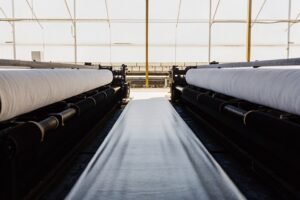
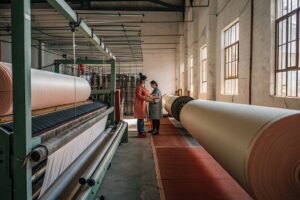
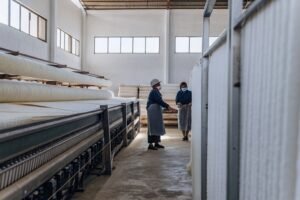
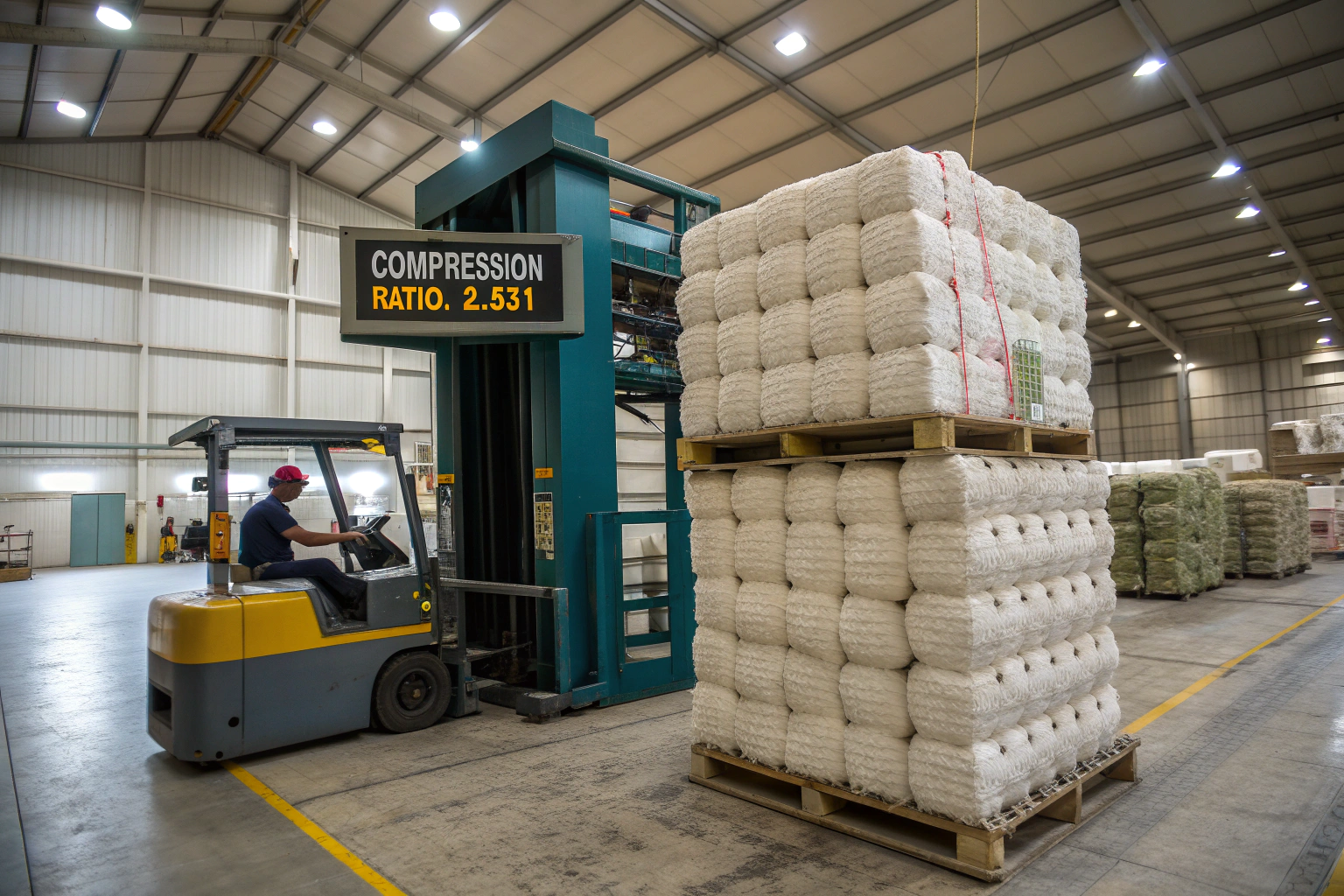
We absolutely can compress your cotton-linen fabric, and we do it every day for our export clients. We have a 50-ton hydraulic baling press right in our finishing facility. It takes a standard 100-meter roll of our 200 GSM cotton-linen and crushes it down to half its normal diameter. The air is forced out. The fabric settles. The roll goes from a floppy cylinder to a dense, flat, vacuum-packed brick. This directly slashes the CBM (cubic meters) you declare on the bill of lading. The beauty is, since cotton-linen is a natural fiber with excellent recovery memory, we can compress it without permanently creasing or damaging the fabric structure. When you open the bale at your warehouse and let it relax for a day or steam it, it bounces right back to its original drape and texture.
But compression isn’t a mindless "smash it flat" button. You need to know how we protect the fabric edges, how we time the relaxation period, and what the cost-benefit ratio is for different order sizes. There’s a science to compressing linen without creating hard-set wrinkles that require repressing. I’m going to explain our exact V-Board folding technique, the vacuum sealing process, and when you should choose flat-pack over roll-pack. Let’s squeeze those logistics costs down.
How Much Space Can Be Saved by Compressing Linen Rolls?
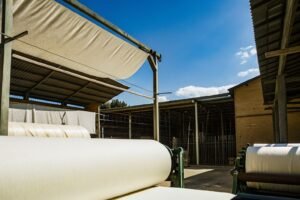
The numbers don’t lie. A typical rolled bolt of our 55/45 cotton-linen, with a 200 GSM weight, is full of trapped air. The fibers are naturally springy. Linen has a high modulus of elasticity; it doesn’t like to lie flat naturally. So, a 100-meter roll on a standard cardboard tube has a diameter of about 40 cm. That’s a volume of roughly 0.05 cubic meters per roll. If you are shipping 200 rolls in a container, that’s 10 cubic meters of air and springback. You are literally burning cash to ship atmospheric gas across the Pacific Ocean.
By running that roll through our hydraulic flat-press, we reduce the diameter from 40 cm to about 18 cm. The fabric compresses from a circle into a dense rectangle. The volume per roll drops to roughly 0.02 CBM, a 60% reduction. We effectively halve the volume. On a mixed LCL pallet, this is the difference between paying for 5 CBM and paying for 2 CBM. I’ve seen this save our clients upwards of $800 on a single pallet to the US East Coast. For full container loads (FCL), it often means the difference between stuffing a 20-foot container (max 28 CBM) and being forced into a more expensive 40-foot container. The freight saving usually exceeds the small compression fee we charge by a factor of 5 or 6 to 1. It’s the easiest financial win in the entire sourcing process.

What Is the Exact Compression Ratio for Cotton-Linen?
For safety and fabric integrity, we use a specific ratio. We don’t just crank the hydraulics to maximum. For our standard cotton-linen blends, we apply a compression ratio of 2.5:1 to 3:1. This means a stack that was originally 1 meter high compresses down to about 33-40 centimeters. We measure this by the pressure gauge on the press, usually holding at 8-10 MPa of pressure for about 30 seconds before we strap the bale.
Why not compress it further? Linen has a "crush point." If you go to a 5:1 ratio, you risk fracturing the flax fibers, causing permanent whitish crease lines called "bruises" that will never steam out. We’ve done destructive testing to find this limit. We compressed a heavy 300 GSM cotton-linen canvas at 4:1. When we opened it, the fold lines were visible as a surface texture flaw. So we stick to a conservative, safe range that achieves the economic saving without damaging the fabric. When the bale is opened, a simple tumble in a low-heat dryer or hanging in a humid room for 24 hours completely relaxes the fiber memory. If you’re calculating how to save space with compressed cotton linen fabric rolls, the 2.5:1 ratio is your sweet spot.
Does Rolling vs. Flat-Packing Affect the Compression Efficiency?
It’s a massive difference. Rolling fabric on a tube is convenient for cutting tables but disastrous for freight. A circle is the least efficient geometric shape for filling a cube; there’s air in the center of the tube, and air in the four corners around the rolls. Flat-packing is the professional approach for high-volume shipping.
We use a machine that folds the fabric in a precise "book-fold" pattern with a V-board (a protective cardboard shell) on the top and bottom. Then we lay it flat and press it. The result is a perfect rectangular prism. Rectangles stack with zero dead space. A pallet of flat-packed compressed cotton-linen is a solid block of fiber, with no gaps. We just switched a UK upholstery brand from rolled to flat-packed. They ship about 5,000 meters a month. Their pallet count went from 10 pallets to 4 pallets for the exact same fabric weight. The sea freight saving was instant, but they also saved on warehouse racking space. It’s the only way we ship bulk orders now.
What Does the Vacuum Packing Process Involve at Fumao?
Compression is the first step. Vacuum sealing is the insurance policy. If you just strap a pressed bale and send it on a 30-day ocean voyage, the fabric is going to bounce and vibrate on the ship. It will slowly, gradually, suck air back in and expand. By the time it arrives at the port, that dense brick has turned into a loose, floppy package. The cube has grown during transit, and you might get a chargeback from the carrier for exceeding the declared volume.
Our standard export preparation for cotton-linen is Mechanical Press + Vacuum Sealing. After we flatten the fabric, we immediately slide the bale into a heavy-duty, 150-micron polyethylene bag. We use an industrial Busch vacuum pump to evacuate 95% of the air. The atmospheric pressure outside the bag acts as a permanent clamp. The bale becomes rock-hard, with the consistency of a block of wood. We then tape-seal the vacuum port. This serves three functions: it locks the compression, prevents any moisture absorption from the humid sea air, and protects against dust or dirt during the stuffing of the container. The fabric essentially travels in a sealed, climate-controlled micro-environment.

How Do You Prevent Permanent Creasing During Vacuum Storage?
This is the art of the process. If you vacuum seal a dry, brittle linen, those compressed folds can cross-link and become stubborn. We do two things to prevent this. First, we control the moisture content. Linen fibers have a natural regain (moisture content) of about 8-10%. If you pack it too dry (below 5%), the fiber becomes glassy and brittle, like dead grass. The creases will crack.
We condition the fabric before packing. The finished, inspected rolls sit in our humidified staging room at a consistent 65% relative humidity for 24 hours before they hit the press. This ensures the fibers are plasticized and flexible. Second, we use No-Crease Paper. Between every folded layer, our packing team inserts a sheet of soft, acid-free tissue paper. This acts as a buffer. When the vacuum bag crushes the fabric, the tissue paper takes the sharp edge of the fold, distributing the stress and preventing a "razor-sharp" crease line from forming. When you receive the bale, you cut the bag, remove the tissue, and hang the fabric. The folds relax into gentle ripples that disappear with the first steam press. A client in Los Angeles, a high-end gown designer, was terrified we’d ruin her delicate linen. We used this exact moisture-control and tissue-paper method, and she reordered without hesitation.
Can You Vacuum Seal Smaller Cut-Length Orders for Dropshipping?
Absolutely, and we do this for several e-commerce brands. If you are running a direct-to-consumer model and want us to ship a 5-meter or 10-meter cut directly to your home-sewing customer, we offer a retail-ready vacuum pack. We fold the cut-length fabric neatly around a branded cardboard backer, slide it into a clear, glossy vacuum bag, and pull the air.
This creates a premium, unboxing experience. The package is thin, solid, and protects the fabric from rain or scuffing during courier transit. It costs pennies more than a poly mailer but elevates your brand perception significantly. We print your logo on the cardboard insert. The customer gets a beautiful, compact package that they can put straight on their cutting table. It also means you pay dimensional weight fees based on a thin envelope, not a thick box. This is a huge margin saver if you use express shipping like DHL or FedEx. The vacuum sealing small quantity fabric orders for ecommerce fulfillment model is a game-changer for online fabric shops.
Does Compression Affect the Quality of the Linen Fabric?
This is the million-dollar question. You love the fabric. You don’t want it to arrive looking like a crushed paper bag. I understand that fear completely. You’ve invested in the beautiful slub texture and the soft hand-feel. If the compression destroys that, the freight saving is a false economy. The good news is in the biochemistry of the flax fiber. Linen has a "memory," but it’s a memory that can be reset with heat and moisture. It’s not a thermoplastic like polyester that you can melt into a permanent crease. It’s a natural cellulosic fiber that responds beautifully to steam.
Here’s the technical reality: The compression, when done at our controlled 2.5:1 ratio with proper moisture content, causes only "mechanical deformation," not "fiber fracture." The hydrogen bonds between the cellulose chains are temporarily broken by the pressure and re-form in the compressed shape. When you steam the fabric, the heat and water molecules break those hydrogen bonds again, and the fiber’s natural, springy "crimp" returns. Our QC lab runs a specific "Crease Recovery" test on every batch. We compress a sample for 48 hours (simulating a long transit), then release it. We apply a standard steam cycle and measure the crease recovery angle. Our spec is a minimum of 140° recovery (out of a 180° perfect flat). Our cotton-linen consistently hits 150°+. The human eye can’t detect the remaining 30° of micro-texture. The fabric looks pristine.

What If My Customer Wants a "Ready-to-Cut" Unsteamed Finish?
Some clients absolutely refuse to do any post-processing. Maybe they are drop-shipping to a home sewer who doesn’t own a steamer. In that case, we recommend a modified packing method. We call it "Low-Compression Roll-Pack." Instead of a hydraulic flat press, we use a high-tension winding machine.
This machine re-rolls the fabric onto a tube with a higher than normal tension, pulling the fabric taut and eliminating air between the layers. The roll is still a circle, but it’s a much tighter, denser circle. The volume saving is lower—about 15-20% instead of 60%—but the fabric arrives ready to cut straight off the roll with zero wrinkles. We then vacuum seal this tight roll. It’s a compromise. It costs slightly more in freight than a flat-pack, but it saves the client the steaming labor. I’d rather give you the option and let you run the cost-benefit. Most commercial cut-and-sew factories prefer the flat-pack because they steam everything anyway before cutting. The home-sewer market prefers the ready-to-cut roll-pack.
How Long Should the Fabric "Rest" After Opening the Bale?
Patience is the final ingredient. When the fabric arrives, it’s been squeezed for weeks. The fibers are in a deep sleep. You can’t just unroll it and immediately cut a skin-tight pattern. It will "grow" slightly as it absorbs air. We include a handling instruction sheet with every compressed bale. The instructions are simple: open the bag, remove the tissue, unroll the fabric loosely, and let it sit in your cutting room for a minimum of 24 hours, ideally 48 hours.
This resting period allows the fibers to reach equilibrium with the ambient humidity. The fabric "blooms" back to its natural thickness. If you cut too early, the pieces may relax later and become slightly larger than the pattern. We also recommend a quick, gentle steam ironing to reset the fold lines permanently. For our 55/45 linen-cotton, a standard industrial steam table with a vacuum suction base will flatten a compressed piece in under 10 seconds per meter. It’s incredibly fast. We filmed a video time-lapse of a compressed bale relaxing. In 24 hours, the fabric went from a 3mm thick, compressed board to a 12mm thick, soft textile. It’s actually quite beautiful to watch. This rest period is the only step between you and perfect fabric.
How Should I Calculate the Total Cost Savings of Compression?
The compression fee is a line item. The freight cost is another. You need to know the net number. Is this actually putting cash back in your pocket, or are you just shuffling costs around? I’ve made this transparent for our clients with a simple formula. The goal is to show you the landed cost reduction, not just a smaller CBM number. Because if the compression cost is higher than the freight saving, we shouldn’t do it. But that’s rarely the case.
Here’s how we calculate it together. First, find the pre-compression CBM for your order. A standard 100-meter roll of our 200 GSM cotton-linen is 0.05 CBM. Multiply that by your number of rolls. Second, get your freight forwarder’s LCL rate per CBM (say, $120 per CBM for US West Coast). Third, calculate the post-compression CBM. That 0.05 CBM roll compresses to 0.02 CBM. Fourth, calculate the new freight charge. The difference is your gross saving. Then, subtract our compression fee, which is a flat rate per roll (usually around $1.50 to $2.00 per roll, depending on the complexity of the packing). The net result is almost always a saving of 50% to 60% of your freight cost for that specific item. We provide a "Freight Savings Simulator" spreadsheet to all our clients. You just plug in your forwarder’s rate, and it spits out the exact saving.

Does Compression Reduce Customs Duties or Just Freight?
This is a sharp question that many people miss. For the vast majority of countries, including the US, customs duty on woven fabrics is calculated on weight (kilograms) or value (FOB invoice), not volume (CBM). The HTSUS classification for linen-cotton woven fabric is usually Chapter 5309, and the duty rate is a percentage of the transaction value. Compression does not change the weight or the value, so it does not directly reduce your customs duties.
The saving is purely on the freight side, which is the volume-based charge. However, there is a small indirect saving. Because the bales are vacuum-sealed and rigid, they are much less likely to get damaged or snagged by a forklift. Less damage means fewer write-offs and insurance claims. I’ve seen a pallet of compressed bales survive a container that was partially flooded (the water pooled on the floor, but our sealed bags protected the fabric). So, the primary saving is freight CBM, and the secondary saving is risk reduction and lower insurance premiums. We always declare the actual pre-compression weight and full value on the commercial invoice; the compression is simply a packing service.
Is There a Minimum Order Quantity for Compression to Be Worth It?
If you’re buying a few rolls for a sample run, the math doesn’t add up. The setup time for the hydraulic press and the vacuum machine has a fixed cost. For very small quantities, like 1 to 5 rolls, the compression fee might equal the freight saving. At that point, it’s neutral, and you might prefer the fabric to arrive ready-to-cut.
The break-even point is usually around 10 to 15 rolls. Once you cross that threshold, the saving on volume starts to compound rapidly. For a full pallet (say, 50 to 80 compressed rolls), the saving is massive. For a full container, compression is an absolute no-brainer. You can potentially upgrade your order quantity and still fit it in the same container budget. I always advise our smaller startup clients to skip compression on their very first sample order. Use the first order to get a feel for the fabric. But on the first bulk production run, absolutely compress it. The freight saving will effectively pay for the fabric sampling and development costs. It’s a strategic tool for scaling your business.
Conclusion
Saving money on freight isn’t about negotiating harder with your forwarder; it’s about making the product smaller before you give it to them. We’ve walked through the entire compression ecosystem: the 60% volume reduction achieved by our hydraulic flat-press, the protective vacuum sealing that locks that compression in place for the 30-day ocean voyage, and the biochemical reality that cellulose fibers bounce right back to life with a bit of steam and a 24-hour rest. We’ve seen how flat-packing beats rolling every time for cube efficiency and how the math stacks up to put significant dollars back on your bottom line.
Don’t let the air in your beautiful fabric steal your margin. Let’s pack it down, seal it up, and ship it smart. I want your goods to arrive safely, compactly, and ready to make you money. If you are placing a bulk order or simply want to run the freight saving numbers on your next shipment, reach out to our Business Director, Elaine. She can send you our Freight Savings Simulator and arrange a trial compression on your next sample. You can reach her at elaine@fumaoclothing.com. Let’s compress those costs.