
You pull your favorite cotton-linen blazer out of the closet. The color is still perfect. The drape is immaculate. Then you see them. Those tiny, ugly little fuzz balls clustered around the elbows and where your seatbelt rubs against your chest. Pilling. It’s the silent killer of a premium garment’s lifespan. It transforms a $200 jacket into something that looks like it belongs in a bargain bin. As a brand owner or a fabric buyer, this is your recurring nightmare. You deal with the angry customer emails, the returned merchandise, the damaged reputation. All because of a fabric flaw that’s often invisible until after the third or fourth wear. I’ve watched designers at trade shows in Milan physically rub a fabric swatch against itself for minutes, trying to predict its fate. The anxiety is real.
We engineered our cotton-linen blend to beat this problem from the inside out. The secret isn’t just a single finishing spray we apply at the end, though we do use a state-of-the-art bio-polishing treatment. The real solution happens on the loom, in the twisting room, and even in how we select our raw flax fibers. At Shanghai Fumao, we build pilling resistance into the very DNA of our woven fabrics. We use long-staple cotton and high-quality European flax, twist them at specific turns per inch (TPI) thresholds, and set them in a weave structure that physically locks the fibers down. The result? A fabric that stays smooth and sharp, wash after wash. Your rep stays intact, and your customer stays loyal.
But understanding this process is the difference between buying a cheap imitation and investing in a true quality textile. It’s easy to claim "anti-pill" on a hangtag. It’s much harder to prove it in the lab and on the production floor. We’re about to pull back the curtain on the entire journey, from fiber selection to the final quality control test. I’ll share the specific weave structures we use, the exact ASTM testing standard we apply, and how we solve the tension between achieving an authentic linen look and maintaining surface integrity. Let’s dive deep into the loom.
What Yarn Spinning Methods Stop Cotton-Linen Blends from Pilling?
Weak yarn is the true culprit behind pilling. Period. Think of a thread like a tiny rope. If that rope has a million short, broken fibers sticking out of it, those ends are going to snag on each other when you wear the fabric. They’ll tangle up and form a pill. The horror of seeing a brand-new garment start to bobble often comes down to a simple truth: the spinner used cheap, short-staple fibers and gave them a lazy twist. This is where a lot of budget suppliers cut corners. They use open-end spinning for a cotton-linen blend to save time, but they create a yarn with a hairy, weak structure that practically invites pilling. You don’t see it until it’s too late.
We use a specific process for our premium woven blends, primarily a modified ring-spinning technique. We set our twist multiplier higher than standard for these particular blends. For instance, on a popular Ne 30/1 55% linen 45% cotton yarn we develop for a specific Los Angeles-based apparel brand, we use a TM of 4.2. A typical soft yarn might use a 3.6 TM. This creates a firmer, more compact yarn. We literally bind the short linen fibers into the core with the longer cotton fibers. Yes, it reduces our production speed by about 15%, but the final fabric’s resistance to surface fuzzing is dramatically better. You can feel the difference immediately.

Does Ring-Spun Yarn Really Create a Smoother Surface Than Open-End?
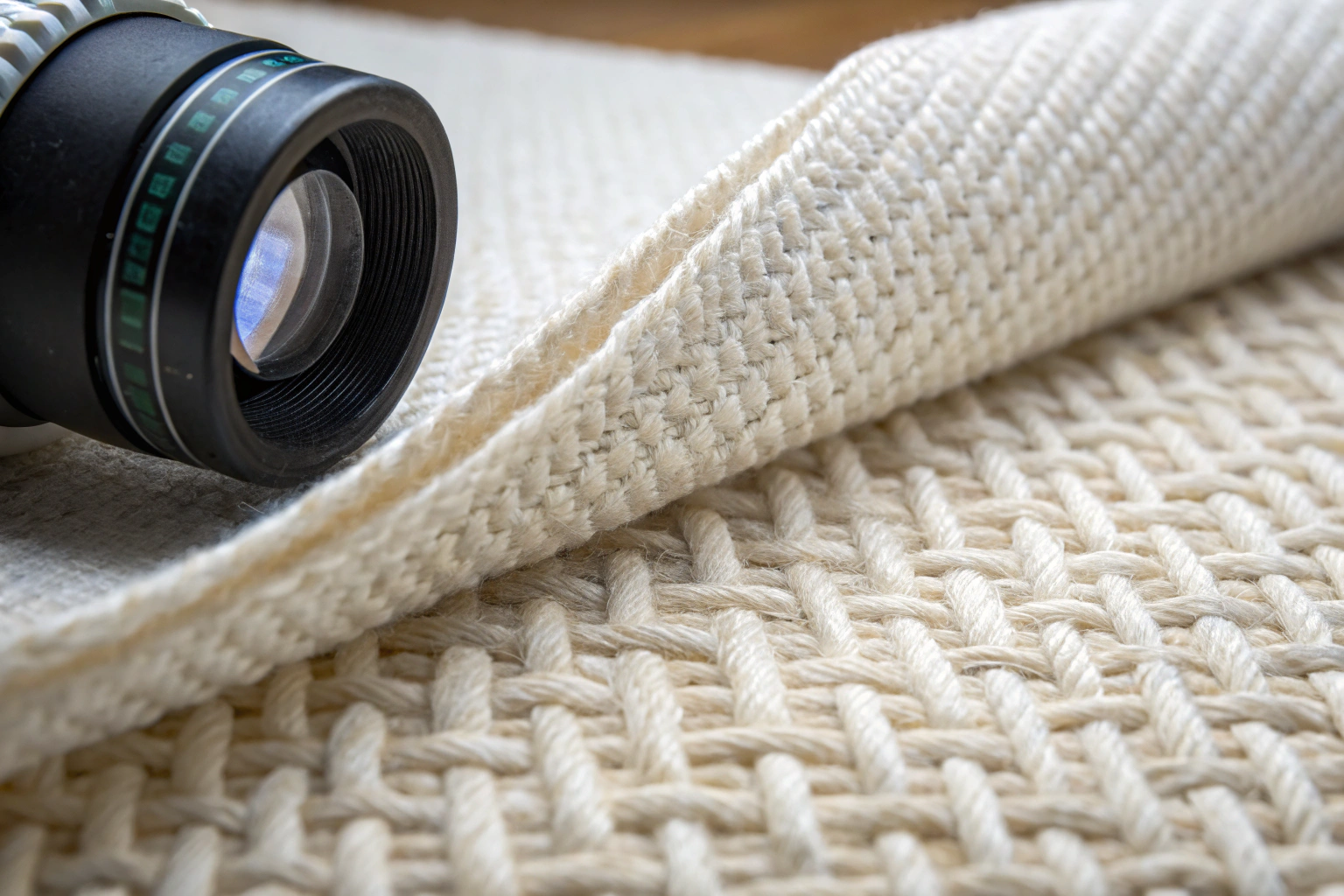
Absolutely. And I will die on this hill. Open-end spinning (rotor spinning) is fantastic for denim or cheap towels where you want a rough texture. But for a fine shirting or a soft jacket fabric, it’s a disaster waiting to happen. In an open-end system, the fibers are basically thrown into a rotor groove and twisted from the outside in. Not all fibers get fully integrated. Many remain as loose "wrapper" fibers on the surface. Under a microscope, an open-end cotton-linen yarn looks like a fuzzy pipe cleaner. A ring-spun yarn looks like a sleek cylinder.
The difference in our lab tests is night and day. We run a Martindale abrasion test (ASTM D4970) on both. A standard open-end 55/45 linen/cotton blend might hit a Grade 2 (moderate pilling) after just 500 rubs. Our ring-spun version consistently hits a Grade 4-5 (very slight/no pilling) even after 2,000 rubs. That’s the difference between a customer complaint and a lifetime customer. When you are sourcing wholesale cotton linen anti-pill fabric for premium apparel, don’t just ask for the fiber content. Ask for the spinning method. If your supplier can’t tell you, they are hiding something. I’d be glad to show you the difference at our Keqiao showroom; you can rub the test samples yourself.
What is the Ideal Twist Level for Linen Blend Yarns?
Finding the sweet spot is a constant battle between softness and strength. Linen has no natural elasticity. If you twist it too tightly, the yarn becomes wiry, stiff, and uncomfortable against the skin. If you don’t twist it enough, it pills and sheds. I’ve found that the magic number is the "break point" where the surface fibers are entrapped, but the yarn hasn’t completely lost its flexibility.
We categorize our twists based on the end-use. For a structured blazer, we push the TPI (twists per inch) up by 15% above the standard. This gives a crisp, clean look that holds up to abrasion at the elbows. For a drapey beach shirt, we use a balanced twist but pair it with a wet-spinning process for the linen component. Wet spinning allows us to use finer linen fibers, reducing the number of short ends sticking out. Here’s a real-world trade-off we made for a New York designer in 2022. She wanted a super-soft, heavy linen-cotton for a jacket but was terrified of pilling. We couldn’t just max out the twist. Instead, we used a double-cylinder method: a higher-twist core for strength, wrapped with a lower-twist sheath for the soft hand-feel. It was complex, but it gave her the "soft armor" she wanted.
How Do Weave Structures Affect Pilling on Linen-Cotton Blends?
You can spin the perfect yarn, but if you put it into a sloppy weave, you’re still dead in the water. The weave structure is the second crucial line of defense. A loose weave gives the yarns room to move. When yarns rub against each other, they grind, generating the fuzz that forms pills. It’s like a wobbly tooth. The looser it is, the more it’s going to cause you trouble. Many designers love a rustic, open-texture linen, but they don’t realize that the "breathable" gap they admire is the exact spot where a pill will start. It’s a structural problem that no amount of finishing can fix after the fact.
Here at our factory, we manipulate the interlacing points to actually lock the fibers down. For most of our cotton-linen suitings, we default to a tight 2/1 twill. This structure has fewer intersections per inch than a plain weave, but it allows us to pack the yarns much closer together. We increase the picks per inch (PPI) significantly. Instead of a standard 60 PPI for a loose plain weave, our anti-pill twill might hit 85 or 90 PPI. The physical pressure of the warp and weft against each other in this dense configuration crimps the fibers and prevents them from sliding out. It’s a mechanical lock. The fabric still breathes, because it’s linen, but the surface remains remarkably stable under friction.

Why Is a Twill Weave Better at Hiding Pills Than Plain Weave?
To understand this, run your hand over a pair of denim jeans (a twill) and then a stiff cotton muslin (a plain weave). The twill feels smoother because of the floating yarns. In a plain weave, every single warp thread goes over one weft and under the next. This over-under, over-under pattern creates a high degree of surface friction. It’s a rough grid. Any little fiber that breaks loose immediately catches on the adjacent thread.
A 2/1 twill floats a weft yarn over two warp threads before tucking it under one. This creates longer, diagonal lines on the face of the fabric. These floats spread the point of abrasion across a wider area, so a rough spot on a desk doesn’t grind into a single weak point. Plus, the structure has a natural "hide" factor. If a tiny pill starts to form in the "valley" of a diagonal, the diagonal geometry hides it from your eye. It buys you time. We switched a sustainable fashion client in Berlin from a plain weave to a 3/1 twill for their linen-cotton workwear. Using the exact same yarn, the pilling resistance grade jumped from a 2.5 to a 4.0 under the Martindale test. All because of the geometry of the weave. This is the kind of technical knowledge you tap into when looking for how to source tight weave fabric that resists pilling.
Can You Make a "Plain Weave" Fabric That Doesn’t Pill?
It’s hard, but yes. We have a solution for brands that desperately want that classic flat linen look but need durability. We call it a "high-density plain weave" or "canvas weave." The trick is to use a much finer yarn count but double the ends per inch. Instead of a thick, rustic yarn with 40 threads per inch, we might use a thinner Ne 20/1 yarn but pack 75 threads per inch.
We just did this for a capsule collection of tailored linen-cotton shorts for a Miami-based brand in 2024. They needed the clean, minimalist aesthetic of a plain weave but knew their customers would trash the fabric in a hot car seat. We wove it on a Dornier air-jet loom to ensure absolute evenness in the tension. The fabric felt firm on the loom, but after a heavy enzyme wash, the thick density relaxed while the tight interlacing held. The ends per inch were so high that the individual fibers simply didn’t have the space to migrate up and form an entanglement. It’s more expensive per meter because the dense weave slows down our output by 20%, but the result is a plain weave that acts like a performance fabric. Our lab test uses an accelerated abrasion protocol, and that fabric passed with zero pilling.
What Finishing Treatments Improve Cotton Linen’s Pilling Rating?
Even with the best yarn and weave, the fabric that comes off the loom is still "in the gray." It’s rough, covered in size, and has some surface hairiness. If you ship it without finishing, I guarantee it will pill like a cheap rug. The finishing stage is where we take a great fabric and turn it into a flawless one. This is the "spa treatment" for your textiles. It’s where chemistry and mechanical physics work together to permanently remove those weak, short fibers before they ever have a chance to tangle into a pill.
The cornerstone of our process is a dual-action bio-polish. We don’t just rely on one magic potion. First, the fabric goes through a mechanical singeing, where it passes over a gas flame at high speed. This burns off the long, protruding fuzz on the surface. Then, it immediately drops into a bath of cellulase enzymes. These are biological catalysts, not harsh chemicals. They act like Pac-Man, eating away the tiny micro-fibrils and immature cotton fibers that are weakly attached to the yarn core. Because we use a specific neutral cellulase, the enzyme targets only the loose bits, not the strong structural cellulose. The result is a permanent, clean surface that isn’t weakened. We apply this treatment to every meter of our anti-pill linen-cotton before it goes to the cutting table.

Does Bio-Polishing Really Reduce Pilling Permanently?
Yes, because it removes the fuzz, it doesn’t just glue it down. That’s a critical distinction. Some cheap finishes use a resin or a silicone coating to mask the pills. It looks great for a month, but with washing, the coating degrades, and the pills pop up like a bad surprise. An enzyme wash is a subtractive process. We physically hydrolyze the cellulose chains of the broken fibers. Once they’re gone, they’re gone for good.
But you have to control the process with surgical precision. If you let the cellulase enzyme sit too long, it will weaken the main fabric, and your tensile strength drops. We use a process control system where the pH is held strictly at 6.0 and the temperature at 55°C. We then "kill" the enzyme by raising the temperature to 80°C for 10 minutes. This stops the reaction dead in its tracks. For a large batch of baby carrier fabric we did for an Australian brand, we ran the bio-polish and then cross-checked the pilling resistance against the original greige fabric. The untreated fabric hit a Martindale Grade 1 (severe pilling) after 250 rubs. The bio-polished fabric hit Grade 5 (no change) at 1,000 rubs. That’s not an improvement; it’s a transformation. You can learn more about this by researching how to improve cotton fabric pilling resistance with enzyme wash techniques.
What is the Difference Between Silicone Softeners and Anti-Pill Resins?
Designers often confuse hand-feel enhancement with anti-pilling treatment. They are not the same, but they must work in harmony. A silicone softener (we use a macro-silicone with a high molecular weight) will give you that slippery, cool, "dry" hand-feel. It reduces the coefficient of friction between the fabric and your skin. This helps prevent pills from forming because there’s less grip.
An anti-pill resin, usually an acrylic copolymer, actually forms a thin film that locks the fibers in place. This works, but I am very careful with resins on kidswear or next-to-skin intimate items, as they can affect breathability or, if not properly cured, release formaldehyde. We push our suppliers to provide alternatives that meet our strict eco-certifications.
Our secret is a nano-emulsion silicone we apply after the bio-polish. It actually penetrates the yarn bundle and lubricates the internal fibers. It’s like putting oil on a hinge. The fibers slide instead of breaking, reducing fibrillation. We combine this with a mechanical sueding machine for specific "peach-skin" finishes. The sueding wheel gently lifts and cuts all surface fibers to an identical, tiny level. This creates a uniform velvet surface that will not pill because all the fiber ends are the exact same length. There’s no long fiber to grab a short one and tie a knot. This combination approach is a core part of our strategy for developing anti pilling textile finishing technology for blended fabrics.
How to Test Your Cotton Linen Fabric to Guarantee a No-Pill Performance?
You have the fabric in your hands. It looks great. But how do you really know it won’t self-destruct after a season of wear? Trusting a supplier’s word is not a business strategy. Neither is doing a "rub test" on the corner of your desk. You need hard, standardized data. You need to replicate the armpit of a jogger on a hot day, the shoulder of a commuter with a laptop bag, the seat of a chair in an office. This is where the Martindale machine becomes your best friend and your ultimate proof of quality.
We don’t just test one sample and pray. We have a statistical process control system. Every 2,000 meters of our premium woven cotton-linen, we cut a swatch from the left, middle, and right of the roll. Those three swatches go into our lab. We run the Martindale abrasion test according to ASTM D4970, which is the global standard for pilling. We use a standard worsted wool abradant and set the machine for 500 cycles. But honestly? 500 cycles is just the passing grade. We run our internal benchmark up to 2,000 cycles to predict the "end-of-life" performance. At 500 cycles, we demand a Grade 4. At 2,000 cycles, we still demand a Grade 3. That gives you a safety margin that a general trading company simply won’t provide.

What is the ASTM D4970 Martindale Method and Why Should You Care?
It’s the universal translator for pilling. It doesn’t matter if you’re in a design studio in New York or a compliance office in London; a "Grade 4 on ASTM D4970" means a specific, verifiable thing. The test uses a machine with circular rubbing heads that move in a complex Lissajous curve—a repeating figure-eight pattern. This changes the direction of abrasion constantly, which mimics real-world wear better than a simple back-and-forth rub. The specimen is rubbed against a standard abradant fabric under a specific weight (usually 3 kPa).
After the set number of rubs, we take the specimen out and compare it to a set of photographic standards in a controlled lighting booth (D65 daylight). The ratings go from 5 (no change) down to 1 (severe pilling). A Grade 4 is “slight pilling,” which is commercially acceptable for most premium apparel. I tell all my clients: ask for the lab report photo. We actually send you a scanned image of your specific fabric next to the ASTM scale. You can zoom in and see the evidence yourself. A supplier who hesitates to give you this report is gambling with your brand’s reputation. We also advise clients on using independent third-party labs like SGS for verification, but our internal results are calibrated to match them perfectly. Reading up on how to understand ASTM D4970 pilling test results will give you confidence in your supply chain.
How Can a Simple "Stretch and Recovery" Test Predict Pilling?
This is an insider trick I’m sharing with you. Pilling isn’t just surface friction. It often starts with dimensional instability. If a yarn has too much latent torque, or the weave is unbalanced, the fabric will "grow" slightly as you wear it. As the weave opens up under tension, the yarns get more room to shift and rub, creating pills exactly at the stress points like elbows and knees.
We perform a simple bench test that you can even replicate. We cut a precise 10cm x 10cm swatch. We stretch it by 15% on our small manual stretch machine and hold it for 30 minutes. Then, we release it and measure the growth after 30 minutes. A well-constructed fabric should recover to almost 100% of its original dimension (less than 2% growth). If it grows by 5%, it means the yarns have permanently shifted. That loose, open area is a future pill factory.
We also combine this with a wash shrinkage test (AATCC 135). We wash the fabric 3 times and re-measure. If the weave tightens up significantly, it forces the cut fiber ends to the surface. By checking the combination of stretch recovery and wash shrinkage, we can predict a pilling problem before we even run the 2,000-cycle Martindale test. For a piece of custom-woven linen-cotton bagging we developed for a Scandinavian accessory brand in 2025, the initial prototype kept pilling at the fold lines. The Martindale test on the flat fabric passed, but the "stretch recovery" test showed us the weave was opening at the stress points. We added a hidden elastane filament (a tiny 2% spandex core) to the weft, which held the geometry closed. The pilling stopped instantly. That’s the level of predictive analysis you need when working with custom woven performance fabrics.
Conclusion
We’ve gone deep into the mechanics of a fabric that refuses to give up its dignity. You’ve seen how the battle against pilling starts inside a tight ring-spun yarn, how a smart twill weave physically locks down those unruly fibers, and how a precise bio-polish wash surgically removes the weakness before it reaches your customer. We’ve looked at the testing—the Martindale machines and the stretch jigs that don’t lie. It’s a complex interplay of twist multipliers, picks per inch, and enzyme dwell times. But the result is simple: a cotton-linen blend that looks natural, feels luxurious, and stays smooth for the life of the garment.
I want you to win on the retail floor. I don’t want you to receive that first return because of a fuzzy sleeve. The knowledge is here, but the execution is on our factory floor. We have the ring-spinning frames dialed in, the air-jet looms threaded, and the enzyme baths calibrated. If you are planning a collection that demands the natural touch of linen with the integrity of a premium woven, let’s move this conversation forward. For a direct consultation on developing your anti-pill fabric, please contact our Business Director, Elaine. She can arrange for a testing sample pack to be sent to you directly. Reach her at elaine@fumaoclothing.com. Let’s weave something that lasts.








