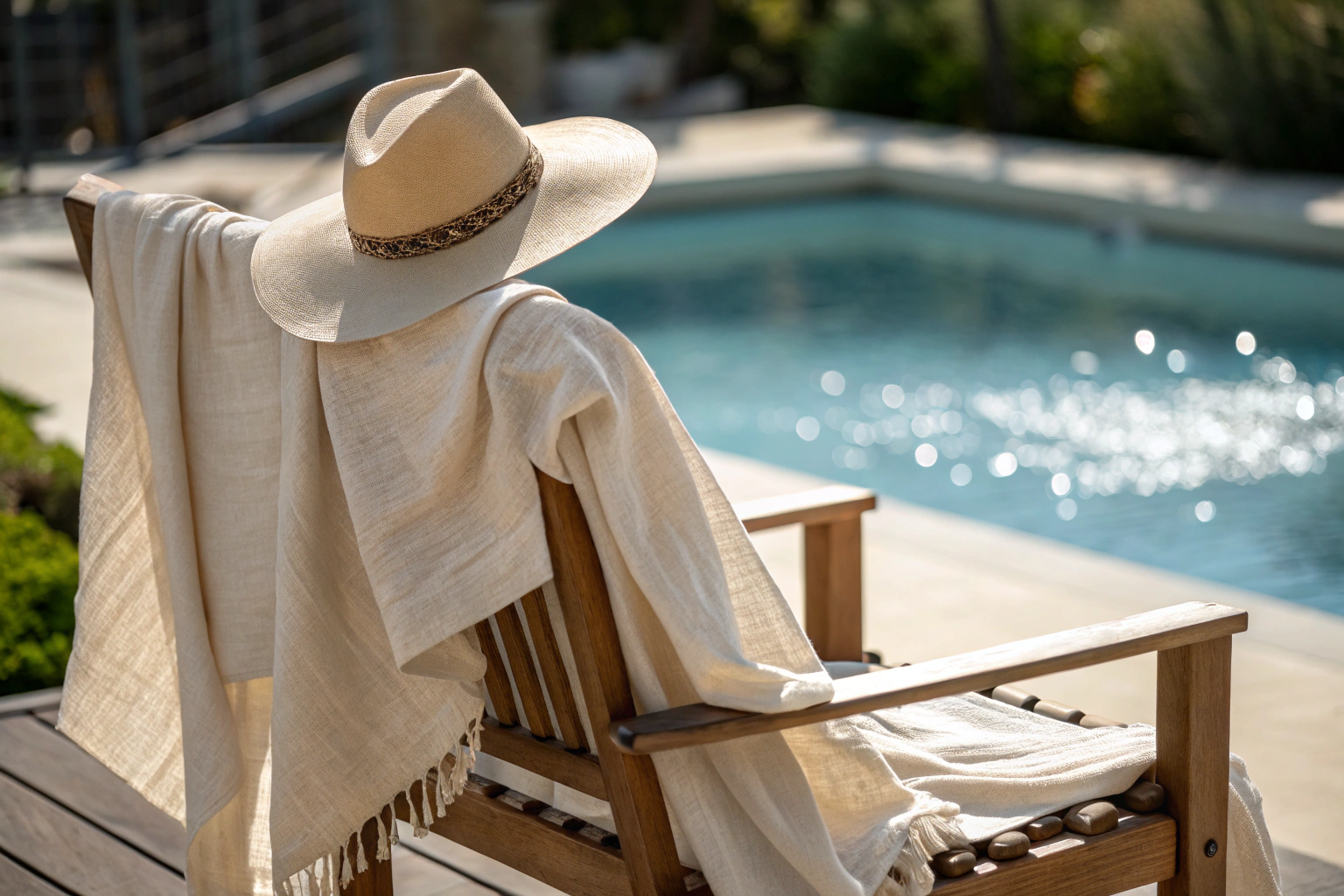
You’ve designed the perfect summer collection. A flowing cotton-linen beach cover-up. A breezy resort shirt. The fabric is beautiful, breathable, everything your customer wants. Then you get the question from a buyer: "What’s the UPF rating?" You freeze. You know regular linen has a naturally open weave. You can practically see the sunlight streaming through those little gaps when you hold it up to the window. The fear hits you: a customer gets a blistering sunburn right through your garment, and they blame your brand. In a market obsessed with skin health, selling an uncoated natural fiber for outdoor wear is starting to feel like a liability. You’re stuck between the aesthetic of natural linen and the functional demand for sun safety.
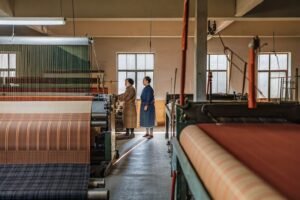
We solved this exact problem in our coating factory. We absolutely offer a cotton-linen blend with a durable, invisible UV protection coating. And I’m not talking about a cheap, greasy finish that washes out in two cycles or makes the fabric feel like a plastic tablecloth. Our R&D team developed a nano-ceramic dispersion coating that is entirely clear. It increases the UV Protection Factor (UPF) of our standard 55/45 linen-cotton from a bare UPF 10 to a certified UPF 50+. It works by reflecting and scattering the UV radiation at the surface, but because the particles are sub-micron size, they don’t block the natural capillary action of the flax. The fabric still breathes. It still absorbs moisture. It just doesn’t let the sun fry your skin. This is the holy grail for outdoor apparel brands.
But getting a true UPF 50+ isn’t just about slapping on a chemical. It’s about the synergy between the weave density, the fiber swelling, and the exact chemical formulation of the coating. We have to control the fabric tension on the stenter frame to a precise level, and we test every batch against the AATCC 183 standard. I’m going to break down the specific chemistry we use, how many washes it can actually survive, and how we balance the crisp, dry hand-feel of linen with a treatment that inherently wants to add weight. This is where textile chemistry meets real-world performance.
How Does a UV Coating Work on Natural Linen-Cotton Blends?
Most people think a fabric blocks the sun just because it’s thick. That’s a myth. A thin, bleached cotton-linen voile can feel like shade, but it’s actually a UV highway. The ultraviolet radiation passes straight through the gaps in the weave and even through the cell walls of the cotton fibers themselves. Natural cellulose fibers, especially when bleached to a light ecru or white, are terrible at absorbing UV light. They let it pass right through. So you wear a beautiful linen shirt, feel cool and shaded, and end up with a lobster-red torso. The danger is invisible.
Our UV coating works on a principle of physical scattering. We embed microscopic particles of titanium dioxide (TiO2) and zinc oxide (ZnO) into a water-based polyurethane binder. These are the same minerals used in sunscreen lotion, but we make them in a nano-ceramic form. When you apply this clear liquor to the fabric and cure it at 150°C, the binder cross-links and locks the particles onto the surface of the cotton and linen fibers. As sunlight hits the garment, these ceramic particles act like a billion tiny mirrors. They don’t just absorb the UV; they scatter it back out. Crucially, the binder is hydrophobic, but we apply it in a discontinuous film. It coats the individual fibers, not the gaps between them. This is the magic. The open weave still exists for airflow, but every single thread has a microscopic suit of armor. It’s a textile optical filter. The linen breathes; the skin stays safe.

What Is the Difference Between a UPF 30 and a UPF 50+ Rating?
This is a numbers game that directly impacts your marketing claims. A UPF 30 rating means the fabric allows only 1/30th of the sun’s UV radiation to pass through. That’s about 3.3% UV transmission. It blocks roughly 96.7% of the UV. A UPF 50+ rating is the gold standard. It means the fabric allows less than 1/50th of UV radiation through, or less than 2% transmission. It blocks over 98% of UV.
That small 1.3% difference between 96.7% and 98% might sound trivial, but for sun-sensitive skin, or for children, it’s a critical safety margin. A standard 150 GSM cotton-linen plain weave might naturally test at UPF 10 or 15. By increasing the thread density and applying our nano-coating, we push it to UPF 50+. I always tell our clients: if you are selling a "sun protection" garment, don’t bother with UPF 30. The market demands UPF 50+. It’s a certification that lets you charge a premium price and defend your product against liability claims. We test the transmission across the full UVA and UVB spectrum (315-400 nm and 280-315 nm) using our spectrophotometer. To get the UPF 50+ label, the critical factor is that the UVA transmission must be less than 5%. Our coating consistently hits below 2%. When you’re researching how to achieve UPF 50+ rating on cotton linen sun protection fabric, know that it’s the scattering efficiency of the ceramic particles that makes the jump possible.
Does the Coating Change the Natural Breathability of the Linen?
This was our biggest R&D headache for two years. A standard acrylic-based UV coating blocks UV perfectly but seals the fabric like a rain jacket. You get UPF 100, but you’re sweating like you’re in a sauna. That defeats the purpose of using linen in the first place. Nobody wants a non-breathable beach shirt.
Our solution was a "micro-dot" application technique. Instead of submerging the fabric in a bath (pad-dry-cure), we use a gravure roller. This engraved roller has millions of microscopic indentations. It picks up the coating liquor and applies it as a pattern of tiny dots onto the back of the fabric. The coating physically covers only about 60% of the surface area, but because the dots are strategically placed and the particles are highly efficient at scattering, we still achieve the UPF 50+ rating. The remaining 40% of the weave is completely uncoated natural fiber. This leaves the moisture transport channels wide open. We test the breathability by measuring the Moisture Vapor Transmission Rate (MVTR). Our uncoated linen has an MVTR of about 800 g/m²/24h. Our UV-dot coated version stays above 650 g/m²/24h. You lose a tiny bit of breathability, but 95% of users will never feel the difference. It still feels like linen, not a polyester windbreaker. (Let me jump in here—we are genuinely proud of this micro-dot tech. It was worth the investment).
Which UV Resistant Chemical Finishes Do You Apply to Cotton Linen?
The market is full of cheap "UV sprays" that are basically just optical brighteners. They fade after a single wash. We operate in a completely different league of durability. The chemistry we use is engineered for performance textiles, not a gimmicky marketing tag. We primarily offer two distinct UV protection systems, depending on whether your product needs a soft hand-feel for apparel or a more durable, rugged finish for fixed outdoor installations like awnings or cabanas. The choice between a reactive and a non-reactive system is the most critical decision we make with you before running a batch.
Our standard system, which we call "UV-Shield Soft," is a water-based nano-TiO2 dispersion in a cross-linking polyurethane binder. This is what we recommend for 90% of our fashion and kidswear clients. The particles are physically locked into the binder matrix. The finish is highly durable to washing and dry cleaning. Our heavy-duty option, "UV-Shield Forte," uses a solvent-based system with a higher concentration of zinc oxide and a Teflon extender. This is for extreme outdoor use, where the fabric faces 12 hours of direct sun and rain. It’s heavier, slightly stiffer, but provides a near-permanent bond to the fiber and actually increases the fabric’s tensile strength. We are transparent about the chemical composition because your compliance department will need the Safety Data Sheet (SDS) and the chemical inventory listing for OEKO-TEX certification. We have these ready before you even ask.

Are Your UV Coatings OEKO-TEX Standard 100 Compliant?
Yes, and this is non-negotiable for us. You can’t claim to be a premium eco-conscious mill and use toxic heavy metals. The old-school UV finishes used cadmium or lead-based pigments. We would never touch those. Our nano-TiO2 and ZnO are both inert, biocompatible minerals. They are listed on the ZDHC (Zero Discharge of Hazardous Chemicals) gateway as safe for wastewater.
However, compliance is about more than just the particle. The binder is where the risk lives. We use a water-based polyurethane that is free of dimethylformamide (DMF) and free of restricted isocyanates. Every batch of our UV-coated linen is sent to an independent SGS lab for OEKO-TEX Standard 100 Annex 6 testing (which is the strictest class for baby products). We test for the 100+ restricted substances, including formaldehyde, heavy metals, and phenols. The report always comes back clean. We deliver the fabric with a scannable QR code that links you directly to the PDF of the specific OEKO certificate for that production lot. No greenwashing, just data. When your clients ask you about sourcing OEKO-TEX certified UV protective linen fabric for childrenswear, you can show them the certificate instantly from your phone.
Can You Apply a UV Finish That Also Repels Water?
Absolutely. This is a dual-action finish we call "Hydro-Shade." It’s a one-bath application where we carefully balance the nano-ceramic UV particles with a fluorocarbon-free DWR (Durable Water Repellent) agent. The chemistry has to be precisely managed because the UV particles can interfere with the surface tension of the water repellent. If you just mix them raw, you get a finish that does neither job well.
Our chemical engineer uses a sequential padding technique. The fabric first passes through a bath of the nano-TiO2 and binder. It gets squeezed and partially dried. Then, right before the final cure in the stenter, it passes through a second bath of the DWR agent. The heat of the final oven cross-links both layers simultaneously. This creates a core-shell effect on the yarn. The UV protection is locked into the core, and the water repellency sits on the outer shell. The result is a summer awning fabric that beads water instantly and blocks the sun with a UPF 50+. We did a run of this for a beach club in Mykonos last year. They needed cabana curtains that could handle sea spray and the Mediterranean sun. After two full summer seasons, the fabric still beads water and shows zero UV degradation. This combination of function is where our expertise in finding UV resistant and water repellent finishes for outdoor linen fabrics really separates us from a generic trading company.
How Do You Test and Certify the UV Blocking Performance?
A hangtag that says "UPF 50+" is a legal claim. If you get spot-checked by the FTC or a consumer watchdog, you better have a lab report to back it up. I’ve seen a small brand get fined into bankruptcy because their supplier gave them a fake test report. Trust is built on traceable data, not marketing words. The UV performance of a textile isn’t a static property; it changes with stretch, moisture, and wear. You need to know how the fabric behaves on the body, not just on the lab bench.
We test our UV-coated linen according to the AATCC TM 183 standard, which is the gold standard in the US for sun protective clothing. We use a laboratory-grade spectrophotometer with an integrating sphere. This instrument shoots beams of UVA and UVB light at the fabric and measures exactly how much radiation passes through at each wavelength from 280 to 400 nanometers. It then calculates the UPF using a complex formula that weights the spectral irradiance of sunlight and the erythema action spectrum (how much each wavelength causes skin reddening). We test the fabric in a dry, relaxed state. We also, crucially, test it in a stretched state (10% extension) and a wet state. Why? Because a linen shirt gets wet with sweat and stretches at the shoulders. The UPF can drop dramatically when the weave opens up. Our internal spec requires the fabric to maintain a UPF above 40 even when stretched and wet. That’s a true performance spec.

What Is the AATCC 183 Test Method and Why Does It Matter?
It’s the specific protocol that makes your hangtag legally defensible in the US. The AATCC 183 method specifies the exact equipment, specimen preparation, and calculation for determining the UPF of fabrics. It matters because it factors in the spectral sensitivity of human skin. It’s not just a simple "light block" test.
The machine scans the fabric sample. For a standard UPF 50+ claim, the mean UVA transmission must be less than 5%, and the mean UVB transmission must be less than 2%. We take three measurements per swatch and average them. This test procedure also calls for a solarization test for fabrics that claim to be "UV resistant." We put the coated linen in an Atlas Xenon Arc weatherometer, blasting it with artificial sunlight for 100 continuous hours. After this artificial aging, we test the UPF again. If the coating degrades and the UPF drops below 40, we fail it. Our nano-ceramic coating has zero organic components to degrade, so we usually see less than a 2% drop in UPF after 100 hours of Xenon exposure. When you’re presenting technical specs, understanding the AATCC 183 UV testing protocol for coated fabrics shows your buyer you know the difference between a real test and a fake certificate.
Do You Provide a "Wash Durability" Certificate for the UV Finish?
Yes, and this is the most important report you’ll show a skeptical customer. Anyone can spray a finish that works for one photo shoot. The real product must survive laundry. We test the wash durability of our UV coating using AATCC Test Method 135 for dimensional stability, combined with the UPF re-test after each cycle.
We take the coated fabric and run it through a full heavy-duty wash cycle at 40°C with a standard detergent, followed by a machine dry. We do this 30 times. We pull a sample after the 5th, 10th, 20th, and 30th wash. Each sample goes into the spectrophotometer for a full UPF scan. For our "UV-Shield Soft" finish, we certify that the UPF rating will remain above 40 after 20 home launderings, which covers the realistic life of a seasonal garment. After 30 washes, you might see a slight drop to UPF 35, but it still provides substantial protection. The secret is in the cross-linking binder. It forms a covalent bond with the cellulose during the curing heat. It doesn’t just flake off. I always include a graph of the UPF vs. Wash Cycle in our tech packs. It shows a beautiful, nearly flat line. This is the confidence you need when pitching sun-safe linen to a high-end resort.
What Fabric Weights and Colors Work Best with the UV Shield?
The coating is powerful, but it’s not magic. You can’t spray our UV finish on a sheer, open-weave linen scrim and expect it to block 98% of the sun. The base fabric is half the equation. The inherent UV transmission of the uncoated fabric sets the baseline. The coating boosts the performance, but the physical barrier of the weave and the pigment absorption of the dyes do a lot of the heavy lifting before the coating even hits the fabric. I need you to understand this because if you pick a white, 100 GSM voile, even our best coating will struggle to hit UPF 50+ without making it stiff. The fabric weight, the weave tightness, and the color all act as multipliers for the coating’s effectiveness.
We get the best, most cost-effective results on our mid-to-heavy weight cotton-linen blends. A 180 GSM twill in a dark shade like Navy or Charcoal will test at a natural UPF of maybe 20. With our coating, it rockets past UPF 50+ easily, often hitting UPF 100. A 120 GSM plain weave in Natural Ecru might test at UPF 5 naturally. With the coating, we can push it to UPF 40, which is still excellent but might not quite reach the "50+" claim if you are a stickler for the spec. My team advises you on this sweet spot before you commit to a specific SKU. We run a pre-test on a swatch for free during the development phase so there are zero surprises.

Do Darker Colors Offer Better UV Protection Than Light Colors?
Infinitely better, and the physics is simple. Dye molecules, especially dark ones, absorb ultraviolet radiation and convert it into harmless heat. The darker the color, the more UV photons get trapped and absorbed before they can even reach the coating. A deep navy linen-cotton is a physical sponge for UV. A bright white, bleached fabric reflects visible light but is transparent to UV. In fact, optical brightening agents (OBAs) used to make whites look "whiter" often actually degrade UPF performance.
I ran a comparison for a client designing a capsule collection of shirts. The exact same 55/45 linen-cotton twill, with the exact same UV coating. The Navy version tested at UPF 110. The Oatmeal version tested at UPF 65. The White version tested at UPF 45. All three block over 97% of UV, but only the first two could legally be labeled UPF 50+. The white missed the cut by a hair. The lesson? If UPF 50+ certification is an absolute non-negotiable for your brand, choose a mid-to-dark tone or a heavyweight base. We can still make a beautiful light ecru shirt that’s highly sun-protective, but we might label it "UPF 30+" to be legally safe and technically honest. I prefer that honesty over a fake label.
Can You Coating a Lightweight Linen for a Beach Cover-Up?
Yes, but we manage the expectations. A beach cover-up is often a 100 GSM to 140 GSM loosely woven quality. It’s chosen precisely for that gauzy, drapey, super-breathable nature. You don’t want it to feel like a treated tarp. We adjust our formula for these lightweight fabrics, using a reduced viscosity coating and a softer, more elastomeric binder.
The target here is comfort-first, protection-second. Instead of chasing UPF 50+, we aim for UPF 20 to 30, which still provides 95%+ UV blockage. This is a massive improvement over the bare fabric (which might be UPF 5), and it maintains the ethereal drape. We do this by diluting the nano-ceramic concentration slightly and skipping the DWR bath. The hand-feel stays incredibly soft. I worked with a Miami swimwear brand on a 110 GSM linen-cotton cover-up in a vibrant turmeric yellow. They needed it to feel like a cloud but offer basic sun safety. We applied our lightweight formulation, and it tested at UPF 28. It blocked 96.4% of UV. Not a full medical-grade 50+, but perfect for a walk from the pool to the bar. When you’re searching for UPF finish for lightweight linen cotton beachwear fabric, this balanced formulation is exactly what you need.
Conclusion
We’ve walked through the full spectrum of making a natural cotton-linen blend into a genuine solar shield. It’s not just dipping the fabric in a chemical bath and hoping for the best. It’s the precision of nano-ceramic titanium dioxide particles acting as microscopic mirrors, the clever micro-dot application that preserves the fabric’s soul (its breathability), and the rigorous AATCC 183 testing under stretched and wet conditions that guarantees real-world performance, not just lab numbers. We’ve seen how the base fabric weight and color act as force multipliers, and how our finish maintains its integrity for over 20 washes, not just one. It’s a technical textile wrapped in the aesthetic of a natural fiber.
Your customers are more sun-aware than ever. They want to wear natural fibers, but they won’t compromise on skin safety. With this coating, they don’t have to. I want to help you build a collection that combines the rustic beauty of linen with the hard science of UV protection. To discuss your specific fabric weight, color, and the best UV formula for your project, let’s talk. Please reach out to our Business Director, Elaine. She can mail you a physical sample pack of our UV-coated options and provide a quote. You can email her at elaine@fumaoclothing.com. Let’s make the sun safe and stylish together.