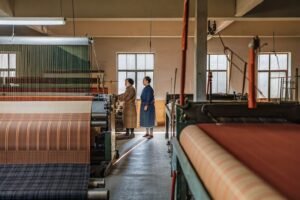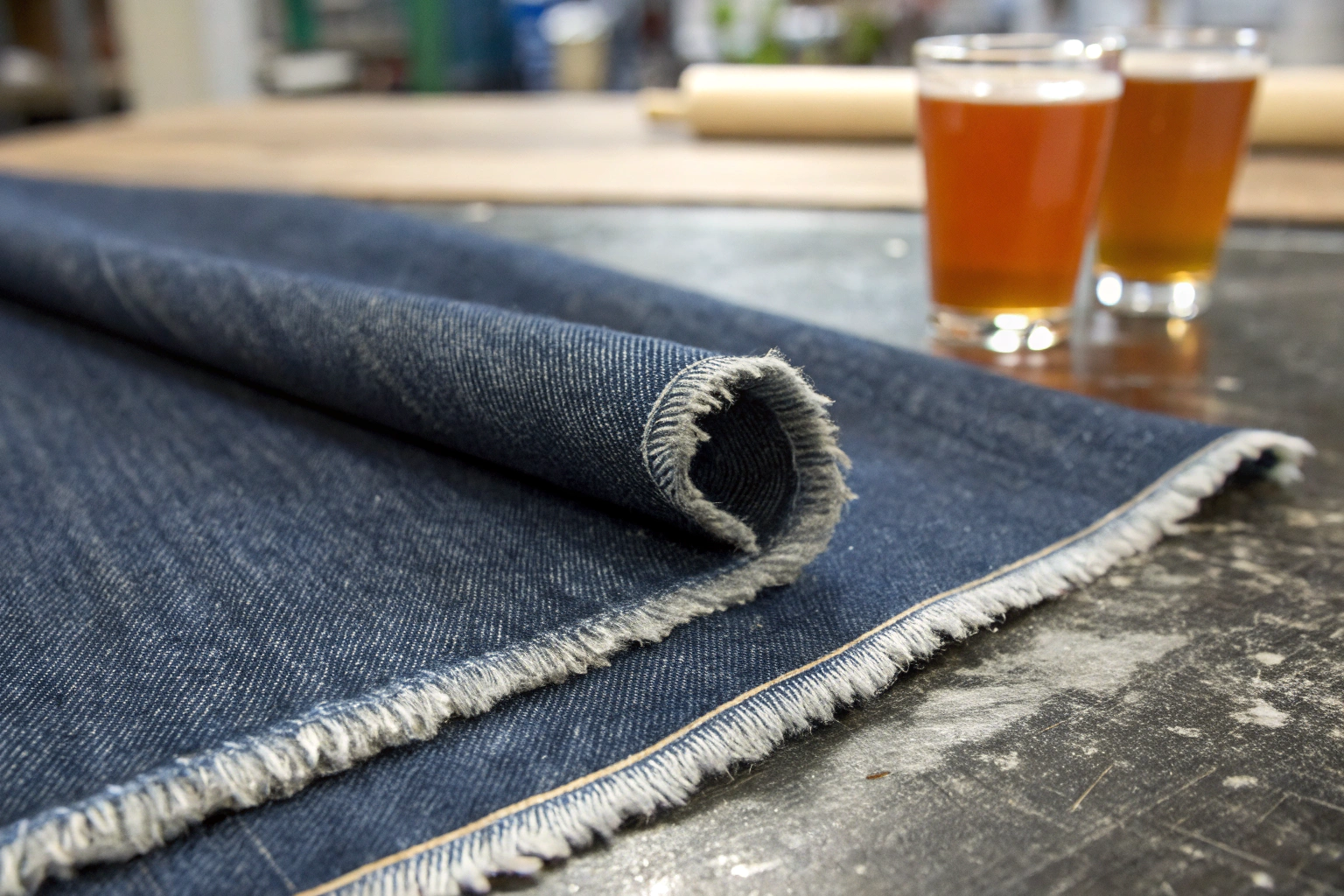
You finally found it. A cotton-linen denim with the perfect weight, the perfect slub character. It has that crisp, dry hand-feel you love. But on the cutting table, it’s as stiff as a board. The drape is non-existent, and that deep indigo blue rubs off on your hands, your pattern paper, everything. You ship it raw, and your customers complain the jeans scratch their legs. You try to pre-wash it with a generic cheap stonewash, and the seams blow out, the fibers weaken, and the beautiful natural linen texture turns into a fuzzy, linty mess. You’re stuck between a fabric that’s too rigid to love and a wash process that seems designed to destroy it. I’ve watched a Melbourne-based denim brand almost give up on a linen blend entirely after a disastrous industrial laundry test. The failure rate was 25%.
We do enzyme washes right here at Shanghai Fumao, and we do them precisely for this specific fabric. It’s not an afterthought. It’s a core part of our service for the cotton-linen denim we weave. We use a neutral cellulase enzyme formula that is a biological scalpel. It surgically eats the cotton fuzz and the surface indigo without attacking the strong, long linen bast fibers. The result is a soft, lived-in drape with high-contrast, bright abrasion points that show off the linen’s natural texture, not destroy it. The hand-feel becomes like a vintage denim jacket you’ve worn for ten years, but the fabric integrity remains intact. You get the aesthetic and the comfort without sacrificing the tensile strength.
But "an enzyme wash" isn’t a single, magical button we press. It’s a matrix of time, temperature, pH, and mechanical action. Depending on whether you want a subtle rinse, a high-contrast "bleached" look, or a fully abraded vintage finish, the recipe changes dramatically. We’re going to walk through the exact lab parameters we dial in, how we prevent the classic problem of back-staining, and why this specific finish is the secret to selling a premium cotton-linen denim at a higher price point. This is the post-weaving alchemy that separates commodity fabric from a designer textile.
How Does an Enzyme Wash Differ from a Traditional Stonewash?
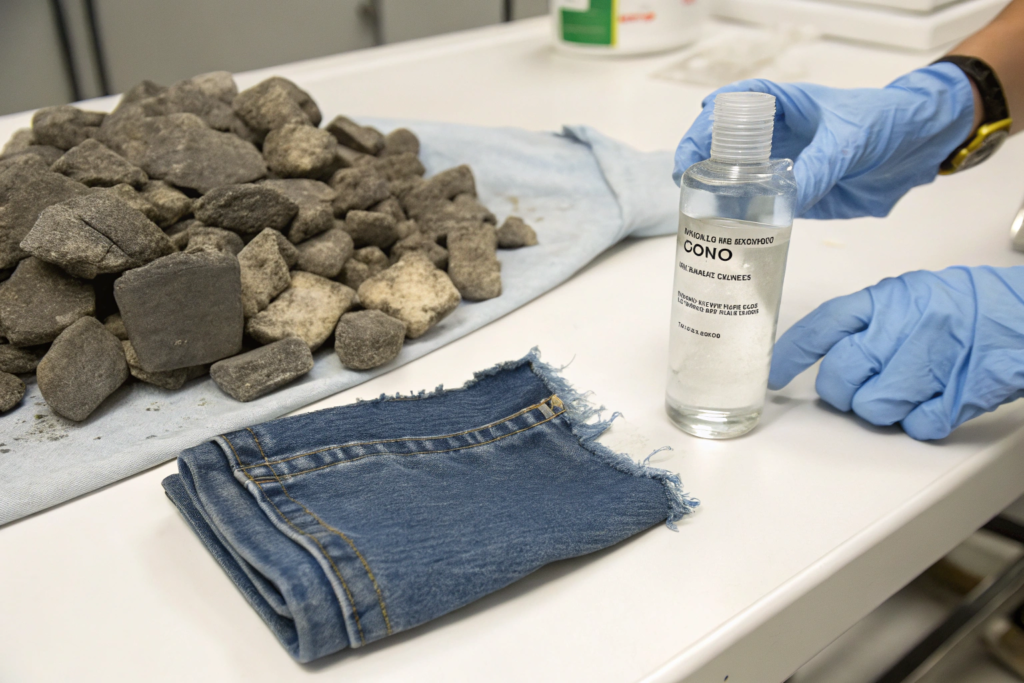
Stonewashing is a violent act. You take a 200-kilo washing machine and you fill it with heavy, abrasive volcanic pumice rocks. You throw your beautiful linen-cotton denim in, and you basically beat it senseless. The stones physically hammer the indigo off the surface and smash the rigid fibers until they soften. It works, but it’s a brute. The problem with linen in a stonewash is that linen doesn’t have the cotton’s ability to recover from a beating. Those rigid flax fibers fracture. The stones create micro-cracks in the warp threads. You end up with a weak, torn-up garment and a machine full of toxic sludge and stone dust. We stopped running pure stonewashes years ago. The environmental drain and the fabric damage just weren’t worth it.
An enzyme wash is a biological polish. We use a liquid concentrate of cellulase enzymes—proteins that act as a catalyst to break down cellulose. Cotton is 99% cellulose. Indigo dye sits on the surface of that cotton. The enzyme nibbles away the tiny, protruding cotton fibrils, loosening the indigo dye and releasing it. Crucially, the linen fibers (flax) have a different molecular structure and a higher lignin content. The specific neutral cellulase we source from a Danish biotech partner is engineered to be selective. It prefers the amorphous cellulose of cotton over the crystalline structure of linen. So it etches the soft cotton weft and warp, creating a peach-skin softness, while leaving the strong linen framework largely intact. It’s a weight-loss program that targets only the unwanted fuzz, not the muscle.
Does an Enzyme Wash Destroy the Strength of Linen Fibers?
This is the question that keeps me up at night, and it’s why we calibrate everything. Yes, a careless enzyme wash can dissolve your fabric into a wet paper towel. I’ve seen it happen in cheap laundries that dump a high-concentration acid cellulase into the machine and walk away. Acid cellulase is aggressive and fast. On a cotton-linen blend, it will preferentially rip through the cotton cellulose so fast that the weave loses its structure. The seams will actually pull apart under their own weight.
We use a neutral cellulase, which has a much gentler, controlled hydrolysis rate. The reduction in tensile strength is a non-negotiable control point for us. Before we ship any enzyme-washed denim, we cut a warp strip and test it on our tensile strength machine. For our 8oz cotton-linen, the raw fabric might have a warp tensile strength of 85 lbs. Our contract with the buyer specifies a maximum 10% strength loss. If our enzyme wash drops it below 76.5 lbs, that batch is rejected. We control this by temperature. We run the wash at exactly 55°C. When the desired fade is hit, we don’t just drain the machine; we jack the temperature up to 80°C in a "super-kill" cycle. The heat permanently deactivates the enzyme protein, stopping the degradation instantly. When you’re learning how to safely enzyme wash cotton linen blends without damage, know that temperature kill is the step that separates pros from amateurs. You have to denature the protein completely.
Why Do Enzyme-Washed Denims Show More "Character" Than Stonewashed?
Stone abrasion is random and dumb. It’s uniform. A rock hits a spot, it fades. It hits another, it fades. You get a flat, one-dimensional wash. Linen denim has a naturally slubby character—thick and thin yarns that weave into an uneven surface. An enzyme wash is intelligent. It targets the high points of that slub. Because the enzyme is a chemical in solution, it penetrates every fiber equally, but it reacts more visibly on the protruding slubs where the surface area is exposed.
This creates an incredible "ring-spun" effect, even if the yarn is open-end. The peaks of the slubs go bright white, while the valleys of the twill line stay dark indigo. It visually enhances the linen’s natural irregularity. We did a run for a high-end Japanese streetwear brand looking for a "vintage sashiko" look. A stonewash just made their cotton-linen look dirty and gray. Our enzyme formula, paired with a slight silicone softener at the end, made the slubs pop like a 3D texture. It’s that depth of character that you simply can’t get from bashing it with rocks. If you’re trying to understand why enzyme washed linen denim wholesale fabric sells at a premium, it’s that visual depth that lets a designer charge $300 for a pair of jeans instead of $80.
What Types of Enzyme Washes Do You Offer for Cotton-Linen Denim?
Every brand has a different story. The guy making heritage workwear wants his jacket to look like it survived a decade in a coal mine, completely broken in. The woman designing elegant, wide-leg summer trousers just wants the stiffness gone and a subtle, dusty blue hue. You can’t satisfy both with a single "enzyme wash" setting. That’s why we categorize our finishes. We don’t just sell you the fabric; we tailor the exact recipe of the wash based on the end-use and the customer’s vibe. It’s a collaborative process between you, our textile engineer, and the dyeing master.
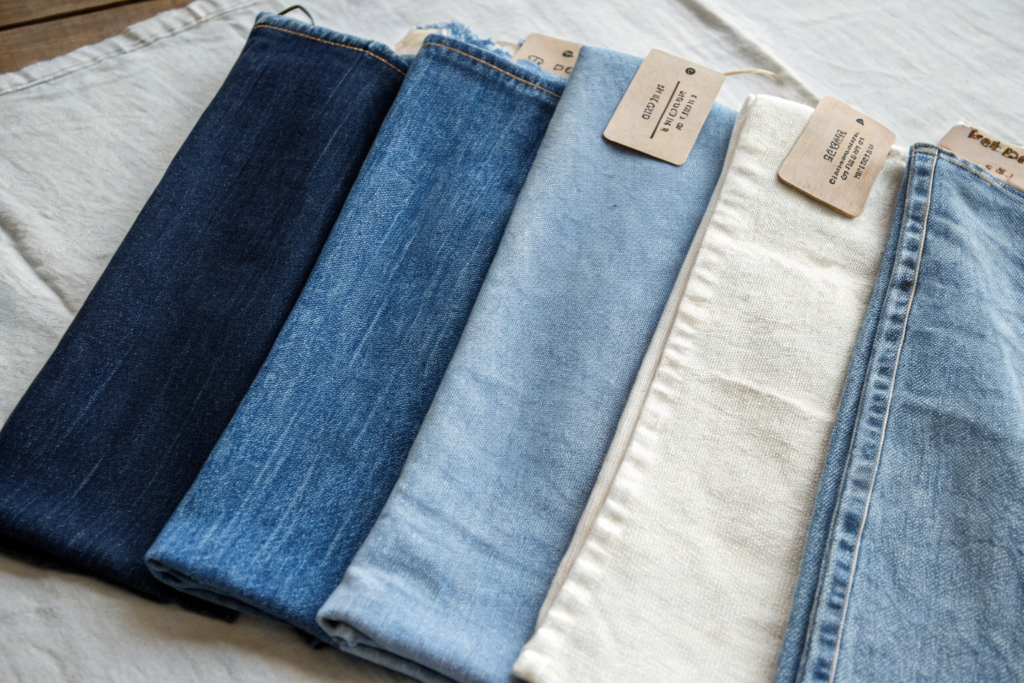
We break our enzyme washes into four distinct tiers. The Light Rinse is a 15-minute cycle in a cold enzyme bath. It simply removes the surface starch and loose indigo, giving a 5% shade change and removing the rigid "sizing" hand-feel. The Medium Contrast is our bread and butter. A 30-minute cycle with a dash of pumice stones (just a few, for mechanical agitation) that breaks the surface tension and highlights the slubs, giving a 20% shade reduction. The Heavy Vintage is a 45-minute marathon, often combining the enzyme with special sponges or a "snow wash" technique to get an aggressive, non-uniform frosty look. Finally, we offer a Super-Soft Bio-Polish, where we skip the aggressive fade and run a longer, gentler tumbling cycle purely to soften the hand-feel without losing much indigo depth. Each level changes the cost and the timeline slightly, but the control is completely in your hands.
When Should I Choose a Heavy Enzyme Wash Over a Light Rinse?
Choose the heavy wash if your design is about texture as the main selling point. If the linen content is above 30% and you want that wavy, puckered, almost seersucker-like surface where the weave has visibly opened up, you need the heavy wash. The prolonged mechanical tumbling relaxes the linen fibers, causing them to expand. When the garment dries, the linen stays slightly expanded while the cotton contracts, creating a permanent, gorgeous slub texture that a light rinse will never achieve.
But there is a trade-off. A heavy wash means more indigo loss. The fabric will look significantly lighter and more "sky blue" than the original dark navy. You also lose more tensile strength. For a pair of relaxed-fit beach pants, that’s fine. For a tightly fitted moto jacket with a lot of seam stress, I usually advise against the full vintage treatment. I remember a specific project for a Texas-based boutique in 2023. They wanted our 10oz cotton-linen denim in the darkest possible indigo, but with the softness of a T-shirt. You can’t have both extremes. A heavy wash destroys the dark dye. So we invented a "tumble-only" bio-polish for them. We ran the fabric over Teflon rollers, dry, in a heated tumbler for an hour with zero water. It broke the stiffness mechanically, kept the indigo dark, and gave a soft, dry hand-feel. We had to adapt the standard recipe completely. This is the kind of customization you get when you ask experts about what is the best enzyme wash finish for cotton linen denim.
Can You Create a "Vintage Look" Without Damaging the Linen?
Yes, and the secret is using an enzyme spray instead of a full dip. Putting the whole garment in a bath saturates every fiber. If we want targeted fading on the thighs, the seat, and the waistband, we use a robotic spray system in our finishing unit. We mix the neutral cellulase with a thickening agent, turning it into a gel. Then, a laser-guided spray nozzle applies the enzyme gel precisely to the high-wear zones. We let it sit for 10 minutes, then activate it with a blast of steam.
This localized activation creates a hyper-realistic wear pattern. The non-sprayed areas remain raw and dark, giving a maximum contrast of almost 40% shade difference. Because the enzyme only hits 30% of the garment surface, the overall structural integrity of the linen stays completely intact. The back yoke is as strong as the raw fabric, while the knee area is soft and faded. We prototyped this for a Vancouver-based designer making selvedge-style jeans from our 12oz cotton-linen. The spray technique gave them that authentic "honeycomb" fade at the back of the knee that usually takes six months of raw wear. We could replicate it in 15 minutes, with only a 4% strength loss localized to the back knee area. This is the advanced technical capability you tap into when exploring how to get vintage enzyme fade effect on denim fabric without compromising quality.
| Wash Type | Process Time | Indigo Loss | Hand-Feel | Best For |
|---|---|---|---|---|
| Light Rinse | 15 min | ~5% | Crisp, de-sized | Subtle prep-wash, minimal shrinkage |
| Medium Contrast | 30 min | ~20% | Soft, slub-enhanced | Standard jeans, jackets, skirts |
| Heavy Vintage | 45 min+ | ~40% | Extremely soft, puckered | Distressed looks, relaxed-fit styles |
| Super-Soft Bio-Polish | 40 min (low agitation) | ~10% | Peach-skin, smooth | Comfort-focused apparel, baby/toddler wear |
How Do You Control Color Consistency in a Denim Enzyme Wash?
You approve a wash sample. It’s beautiful. The contrast is perfect. Then, the bulk shipment arrives, and it’s two shades lighter. Or worse, one sleeve of a jacket is noticeably bluer than the other. Color inconsistency is the Achilles’ heel of enzyme washing. It’s a biological process. Enzymes are living proteins, and they behave slightly differently depending on the water hardness, the ambient temperature, and even the specific lot of indigo dye used on the yarn. You can’t just set a timer and walk away. You have to fight batch-to-batch variation with obsessive measurement and a "right-first-time" dyeing philosophy.
We don’t rely on a visual eyeball test. That’s useless under different warehouse lighting. We use a spectrophotometer. Before we wash a single meter of your bulk order, we run a lab-scale mini-vat with exactly 500 grams of fabric. We measure the color coordinates (Lab* values) of the raw and washed sample on the spectrophotometer. The Delta E (ΔE) color difference calculation tells us exactly how far the shade has moved. Our standard pass/fail for bulk is a ΔE of less than 1.0. That’s an invisible difference to the human eye. For every bulk wash vat (500 meters), we cut a swatch from the beginning, middle, and end of the roll. If any swatch shows a ΔE above 1.0 compared to the approved standard, that entire batch goes to the "shade sorting" room. We then build a shade band, grouping similar minor variations together. You never get a "light left leg, dark right leg" garment because we separate and label the minor shade lots.

Why Does Pre-Scouring the Fabric Matter for Even Fade Results?
Raw denim is dirty. It arrives at our wash house covered in starch (sizing), spinning oils, and paraffin waxes from the loom. If you don’t remove this gunk completely before the enzyme bath, the enzyme can’t reach the cellulose evenly. It’s like trying to paint a greasy wall. The result is "cloudy" fading—uneven, blotchy patches where the oil blocked the enzyme action.
Our pre-scour process is non-negotiable. We run the dry denim through a bath of a non-ionic detergent and a wetting agent at 60°C for 20 minutes. We check the scouring efficiency by measuring the "drop absorbency." We drip a single drop of water on the scoured fabric. If it doesn’t absorb instantly (under 1 second), the fabric still has hydrophobic residues, and we scour it again. I can’t tell you how many "bad wash" complaints we trace back to a lazy scour, not the enzyme itself. For our cotton-linen denim, which often has more natural wax from the flax fiber, we add a specific pectinase enzyme to the scour bath to digest the linen’s natural gum. This ensures the cellulase in the next bath hits a perfectly hydrophilic, clean canvas. If you’re investigating how to get consistent color on enzyme washed denim lots, start by demanding proof of a proper pre-scour. Ask for the absorbency test data.
How Do You Prevent "Back-Staining" on the White Linen Weft?
Back-staining is the redeposit of loose indigo dye back onto the white linen weft yarns during the wash. You want the warp to fade from dark blue to light blue. You do not want the weft (the inside yarn) to turn a dull, dirty gray-blue. A stained weft kills the "bright white" pop of the linen slub. It makes the entire fabric look muddy.
Our weapon against back-staining is an anti-redeposition polymer. This is a dispersing agent that we add to the enzyme bath. As the enzyme knocks the indigo particles loose, this polymer encapsulates them immediately, creating a tiny protective shell around the dye particle. It keeps the indigo suspended in the water, preventing it from electrically bonding back to the white cotton-linen weft. We then drain the entire liquor at a high temperature before the rinse cycle. For a specific batch of 7oz cotton-linen we did for a Miami resort-wear line, the weft was a pure, bright flax color. The brand’s biggest fear was a "dirty" wash. We doubled the concentration of the dispersing agent and added a mechanical shaker to the vat. The weft came out perfectly creamy white against a sky-blue warp. We check this under a D65 lightbox. The CIE whiteness index of the weft must not drop by more than 5 points compared to the raw fabric. This level of precision is why our R&D team invests so much in developing an anti back staining solution for dark denim enzyme washes.
What Shrinkage Control Do You Apply Post-Enzyme Wash on Denim?
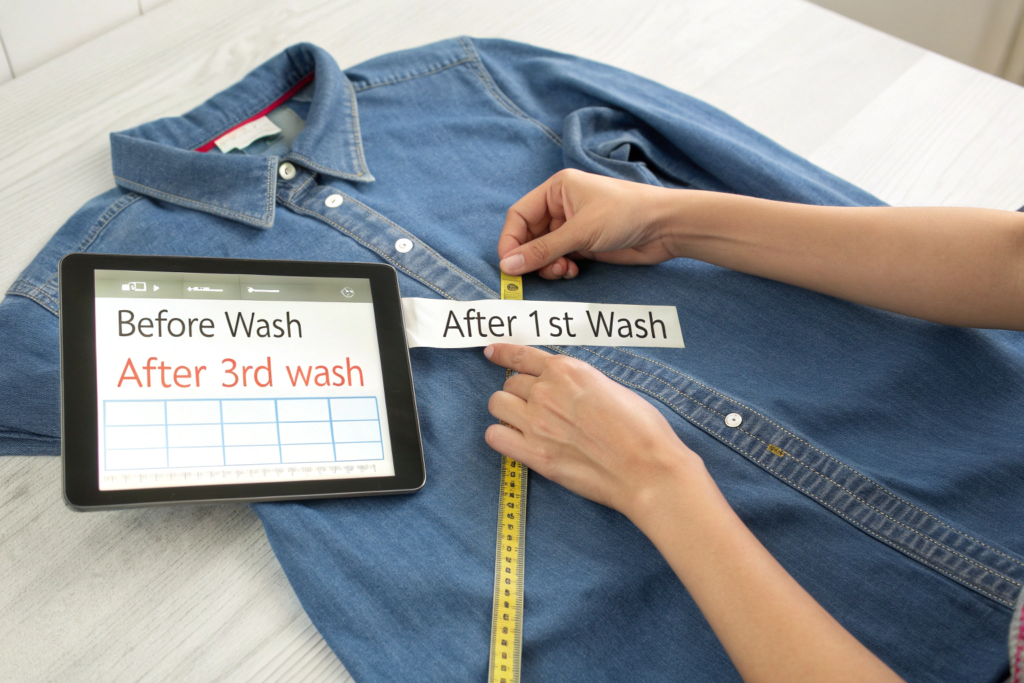
You’ve nailed the color. The hand-feel is divine. You cut and sew a beautiful pair of linen-denim pants. The customer loves them, throws them in a warm wash, and pulls them out two inches shorter. The waist is suddenly too tight. You, as the brand, now have a chargeback and a return. Shrinkage is the hidden landmine in every washed denim program. Cotton-linen blends can be especially volatile because linen has a higher water retention capacity than cotton. It swells dramatically and then contracts during drying, causing progressive shrinkage even after multiple home launderings. It’s a nightmare if it’s not controlled.
We don’t guess the shrinkage. We force it to happen here, on our floor, before a single cut is made. Our standard is a "Full Sanforization" or a high-tension compressive shrinkage process, followed by a relaxed tumble dry. For enzyme-washed denim, the wash itself provides some relaxation, but that’s not enough. After the enzyme wash, we feed the fabric through our Monforts sanforizing machine. This giant steam-heated rubber blanket physically compresses the warp yarns. It literally crams them closer together so they don’t have space to shrink later. We guarantee a residual shrinkage of less than 2% in both warp and weft. If you need it fully pre-shrunk for a "raw hem" unwashed look after sewing, we can even run a final "tumble-home" dry cycle that takes residual shrinkage to under 1%. We supply you with the exact shrinkage data printout, rolled into the core of the fabric bolt.
Does the Enzyme Wash Help Stabilize the Linen Blend’s Shrinkage?
Partially, yes, and it’s a clever trick we use. Linen shrinks because the flax fibers absorb water, swell, and then the friction of the weave locks them in a shorter position when they dry. An enzyme wash gently etches the cotton component, as we’ve discussed. But it also has a "relaxation" effect on the linen. The cellulase enzymes create micro-cracks in the cotton, which releases the tension within the yarn bundle. This allows the linen fibers to relax into a more stable, less reactive state.
We call this a "pre-stress relief." The fabric finds its natural equilibrium in the industrial vat instead of your customer’s washing machine. However, it’s not a magic standalone solution. The enzyme relaxes the fabric, but it doesn’t mechanically compact it. A garment made from only enzyme-relaxed denim, without a final sanforization, can still shrink 4-5% in length when subjected to a hot home dryer. The heat resets the linen’s memory. So we use the enzyme as Step 1 to soften the structure, and the Sanforization as Step 2 to physically lock in the dimensions. For a UK-based brand ordering 3000 meters of our cotton-linen for a dress line in 2024, this two-step process was the only reason they approved bulk. Their spec allowed only 1.5% shrinkage. We hit 1.2% consistently across the entire order. Understanding how to control residual shrinkage after enzyme wash denim production is critical for brands with tight tolerance requirements.
What Test Methods Do You Use to Certify the Shrinkage?
We follow the AATCC Test Method 135, which is the global standard for dimensional stability of woven fabrics after home laundering. We take a precisely cut 10-inch by 10-inch marked square on the finished, washed fabric. It goes into a front-loading washing machine with a full ballast load at a 40°C normal cycle with standard detergent. Then, it goes into a tumble dryer at a cotton setting. We repeat this three full cycles. Three cycles, because the first wash tells you about relaxation shrinkage, but the third wash reveals progressive shrinkage. Linen often shows progressive shrinkage up to 5 washes.
After the third cycle, we lay the swatch flat on our calibrated measuring table, without any stretching. Using a precision shrinkage ruler, we measure the distance between the original benchmarks. The percentage of change is our certified residual shrinkage. We also provide a "skew" measurement, which is the twisting of the fabric. Linen blends are prone to torque if the yarn wasn’t balanced. We measure this by checking the diagonal displacement of a corner. Our pass rate is less than 3% skew. I always tell my clients: ask for the full AATCC 135 report, not just a "pre-shrunk" label. A real report will show you the data for all three cycles. If you need to build your technical file, you can read up on the AATCC 135 shrinkage testing protocol for washed denim fabric to understand the benchmarks we hit.
Conclusion
We’ve unraveled the full process of transforming a rigid, raw cotton-linen denim into a finished masterpiece. You’ve seen that enzyme washing isn’t just about making fabric soft—it’s a precision biological art. It’s the difference between beating your fabric to death with rocks in a stonewash and using a targeted cellulase enzyme to surgically sculpt the texture, highlighting the bright linen slubs against the indigo cotton. We’ve covered the critical control points: the neutral pH chemistry that protects the linen’s strength, the spectrophotometer data that guarantees batch-to-batch color consistency, the anti-redeposition polymers that keep the white weft bright, and the compulsory sanforization that locks in the shrinkage before you cut the pattern. From a light rinse to a heavy vintage spray, the power is in the recipe.
You shouldn’t have to cross your fingers and hope the wash comes out right. You should demand data and know the specific enzymes being used on your valuable fabric. My team lives in this detail. We document every wash recipe, every tensile strength test, and every Lab* color coordinate. If you have a vision for a cotton-linen denim garment that needs the perfect broken-in soul without the broken-down fibers, let’s run a sample for you. To discuss your specific wash requirements and to get a sample card of our enzyme wash effects, reach out to our Business Director, Elaine, at elaine@fumaoclothing.com. Let’s dial in your perfect wash recipe together.