You’ve heard the rumors swirling around sourcing offices and LinkedIn threads. Chinese textile factories are going to get crushed by the 2026 carbon standards. The new EU Carbon Border Adjustment Mechanism expansion into textiles, the tightened Chinese national emissions trading scheme, and the Science Based Targets initiative deadlines are all converging at once. You’re lying awake at night because your entire fall 2026 collection depends on a supply chain that might not be legally allowed to export to Europe by the time your goods are ready. You’ve already mentally calculated the cost of requalifying a new supplier in six months, and the number makes you feel physically ill. The fear isn’t abstract regulation—it’s a container getting rejected at Rotterdam because the carbon data doesn’t validate.
Yes, Shanghai Fumao’s Keqiao facility will meet the 2026 carbon emission standards, and we’re not scrambling to get there at the last minute. We’ve spent three years and ¥550 million building a verifiable carbon accounting infrastructure that aligns with both the ISO 14064 standard and the GHG Protocol’s Scope 1, 2, and relevant Scope 3 categories. Our latest third-party audit from TÜV Rheinland in Q4 2025 confirmed our direct emissions intensity dropped 34% from our 2021 baseline, exceeding the 30% reduction trajectory required by the China Textile Industry’s "Peak Carbon by 2025, Neutral by 2050" roadmap. A Milan-based luxury group audited our facility in person in January 2026 and onboarded us as their sole Asian woven fabric supplier specifically because our carbon data package was more complete than three European mills they evaluated. This isn’t a promise. It’s an audited reality.
Let me be direct with you. Carbon compliance in 2026 isn’t about installing a few solar panels and calling it a day. It’s about knowing the exact kilogram of CO2 equivalent embedded in every meter of fabric before it leaves the loading dock. It’s about treating carbon like a raw material input with a price tag, not an externality to ignore. Brands that pick suppliers based on last year’s carbon promises are going to get burned. The mills that built real monitoring systems, real reduction pathways, and real third-party verification will be the ones still shipping to Europe in December 2026. I want to walk you through exactly what we built, how it works, and why your compliance team can stop panicking about our factory.
How Did Fumao Cut Scope 1 and Scope 2 Emissions by 34% Since 2021?
Scope 1 emissions—the direct stuff coming out of our own stacks and vehicles—are the hardest to cheat on. You can’t buy offsets for your own boiler. You either burn cleaner fuel or you don’t. The anxiety for buyers is that a factory claims "low carbon" while still running a coal-fired thermal oil heater in the back that nobody sees during the audit walkthrough. You’ve probably seen those viral exposés where a brand’s "green" supplier gets busted with a hidden coal pile. That betrayal destroys trust and triggers contract termination clauses.
Shanghai Fumao eliminated coal entirely from our Keqiao operations in Q2 2023. We replaced two 10-ton coal-fired boilers with a biomass gasification system backed up by pipeline natural gas, and we electrified our stenters using grid power supplemented by our rooftop solar array. The numbers are public in our CDP disclosure. Our Scope 1 emissions dropped from 12,400 tCO2e in 2021 to 5,200 tCO2e in 2025. That’s a 58% reduction on the direct combustion side. A Los Angeles activewear brand audited our boiler room transition physically in September 2025 and verified zero coal residue on site, then increased their order volume by 40% for 2026 because we de-risked their Scope 3 reporting.

Why did you choose biomass over full electrification for the dyeing heat load?
Honest answer: full electrification of industrial dyeing at our scale would require a grid connection that the local utility can’t deliver until 2028. We didn’t want to wait and make promises we couldn’t keep.
Our biomass feedstock comes from agricultural waste—rice husks and cotton stalks sourced within a 100-kilometer radius of Keqiao. This isn’t deforestation biomass trucked from a thousand kilometers away. We track the feedstock origin digitally and include the transport emissions in our Scope 1 accounting. A resource explaining how to verify biomass energy integrity in Chinese textile factories for EU compliance requirements emphasizes the importance of sourcing radius. The system reduces net carbon by 90% compared to coal because the biomass carbon cycle is short-term biogenic rather than fossil carbon release. (Quick note here: we intentionally oversized the natural gas backup so we never have to touch coal even during peak season. The backup costs more per therm, but the carbon integrity is non-negotiable.)
What did you do about the Scope 2 electricity puzzle?
Scope 2 is the emissions from the electricity we buy from the grid. You can’t control the provincial grid mix, but you can contractually shift it.
We signed a Power Purchase Agreement with a solar farm developer in Zhejiang province in 2024 that covers 40% of our annual electricity consumption with certified renewable energy. The remaining grid electricity gets tracked through China’s Green Electricity Certificate system. We retired 8,500 GECs in 2025 to match our residual grid consumption, verified by an independent auditor. For buyers who need to understand how to source fabric from Chinese mills with verified renewable energy certificates for the 2026 carbon standards, this is the documentation packet we share. Your compliance team gets the GEC retirement serial numbers tied to your specific production batch. No greenwashing. Just auditable kilowatt-hours matched to renewable generation.
Can Your Fabric’s Product Carbon Footprint Survive an EU Audit?
A factory-level carbon reduction story is nice, but what you actually need is the product-level number. The EU’s Product Environmental Footprint Category Rules for apparel require a cradle-to-gate carbon footprint per specific SKU, not a corporate average. The panic moment is discovering that your "low-carbon" supplier’s corporate number was great, but the specific cotton-elastane twill you ordered has a carbon footprint 40% higher than the factory average because of the elastane content and the dyeing process required for that particular shade. Customs won’t accept a corporate sustainability report. They want the batch-level PCF.
We generate a batch-specific Product Carbon Footprint for every production lot using primary data from our own machines, not industry-average databases. Our ERP system captures actual kilowatt-hour consumption per knitting machine, actual natural gas flow per stentering batch, and actual chemical mass per dyeing cycle. This data feeds into a calculation engine aligned with ISO 14067 and the GHG Protocol Product Standard. A Copenhagen-based GOTS certified brand received their first PCF report from us for a 5,000-meter organic cotton poplin order in February 2026. The batch-specific carbon number was 2.1 kg CO2e per meter, with a data quality score of "Good" according to the EU PEF methodology. Their auditor accepted it in one review cycle. No back-and-forth. No data gaps.

How do you handle the raw material carbon allocation problem?
This is where most textile carbon footprints fall apart. If you buy yarn from a third-party spinner who buys cotton from a trader who sources from 200 farms, the upstream data is basically a guess. Garbage in, garbage out.
We solved this by vertically integrating our most carbon-sensitive raw material streams. Our recycled polyester chips come from a single-source Zhejiang bottle recycling facility we audit annually—no mystery ocean plastic claims, just verified domestic post-consumer waste with a documented carbon factor of 1.8 kg CO2e per kg of chip. For organic cotton, we establish direct-of-origin contracts with Xinjiang and Indian cooperatives that provide primary farm-level data on fertilizer use and irrigation energy. A practical guide on how to verify cradle to gate organic cotton carbon footprint data from China explains why direct sourcing matters so much. Traceability isn’t a marketing word in carbon accounting. It’s the difference between a defensible number and a fabricated one.
What if my customer demands a specific carbon offset on top of the reduction?
The 2026 standards prioritize actual reductions first, then verified removals as a secondary mechanism. Carbon offsets are not a substitute for direct emissions cuts, and the EU’s Green Claims Directive is cracking down hard on offset-based neutrality claims.
We don’t sell "carbon neutral" fabric. That phrase is becoming legally toxic. Instead, we offer a "carbon contribution" model where we calculate the exact residual emissions of your batch after all our reduction measures, and you can contribute to Gold Standard-certified projects we pre-vetted in the textile value chain—specifically a solar cooker distribution project in rural Henan that displaces coal-based cooking. The contribution is documented separately from the carbon footprint report, so there’s no misleading conflation. Your fabric carries a footprint number and a separate contribution receipt. That transparent separation is what auditors demand in 2026.
Does the Local Zhejiang Carbon Trading Scheme Help or Hurt My Fabric Price?
Carbon markets sound like a macro-economic abstraction until they hit your per-meter price. China’s national Emissions Trading Scheme already covers power generation, and the expansion into textiles is projected for the 2026-2027 compliance cycle. The fear is straightforward: if your supplier suddenly has to buy expensive carbon allowances for every ton of coal they burn, that cost gets passed through to your fabric invoice as a surcharge you didn’t forecast. You negotiated your FOB price based on 2025 economics, and a surprise carbon line item blows up your margin.
Our early decarbonization actually inverts this risk. Because we switched away from coal in 2023 and our remaining Scope 1 emissions are biomass-based (which receives preferential treatment under the Chinese ETS allocation methodology), our projected allowance shortfall for 2026 is near zero. We won’t need to buy expensive credits on the open market. A competing mill still running a coal boiler for their stenters could face a cost penalty of $0.08 to $0.12 per meter depending on carbon pricing. That’s a price advantage we can pass to you—or at minimum, a price stability guarantee we can offer. Our early investment in fuel switching is now becoming a direct commercial moat.

Is the Chinese carbon price really high enough to matter?
It used to be low—around ¥50 per ton for years—which made everyone ignore it. That’s changing fast.
The Chinese ETS carbon price broke ¥100 per ton in mid-2025 and analysts project ¥150-200 by late 2026 as the government tightens allowance allocations. At ¥150 per ton of CO2, a coal-dependent textile mill emitting 15,000 tons annually faces a ¥2.25 million carbon bill if they have to buy allowances for their excess. That’s real money that absolutely changes the competitive landscape. A data source tracking China’s national carbon market price potential impact on textile supply chains in 2026 outlines the sector-specific implications. Our fuel-switching decision in 2023 was a bet on this exact price trajectory. The bet paid off. When your supplier’s carbon cost is the same as yours—zero excess—the negotiation isn’t about who absorbs a regulatory penalty. It’s about who delivers the best quality.
Do provincial pilot schemes in Zhejiang add another layer of cost?
Zhejiang doesn’t have its own standalone carbon market like Guangdong or Hubei; textile facilities here fall under the national ETS when the sector is included. But Zhejiang province runs a parallel "Carbon Intensity Ranking" system that affects our electricity pricing and permitting.
Mills with poor energy efficiency scores get charged a surcharge on their industrial electricity tariffs—effectively a carbon price by another name. Mills with top-tier scores get preferential rates. We earned an "A" rating in the 2025 Zhejiang industrial energy efficiency evaluation, which locks in our electricity rate at the baseline level with no penalty multiplier. A resource covering the Zhejiang provincial energy efficiency policies that affect Chinese textile export costs provides the regulatory context. For your fabric pricing, this means our electricity cost per meter won’t spike from a provincial penalty. Another hidden cost line that stays flat.
How Are We Tracking and Reporting Emissions with Real-Time Data?
The 2026 standard isn’t satisfied with an annual sustainability report published nine months after the fiscal year ends. The EU expects continuous monitoring and near-real-time disclosure through the Digital Product Passport framework. The fear is that your supplier sends you a beautiful carbon report in January, and by March, their actual emissions have spiked because they took on a high-volume rush order and ran the backup diesel generator for three weeks straight. You shipped goods based on stale data, and now your own Scope 3 filing is inaccurate and subject to restatement. That’s a compliance nightmare.
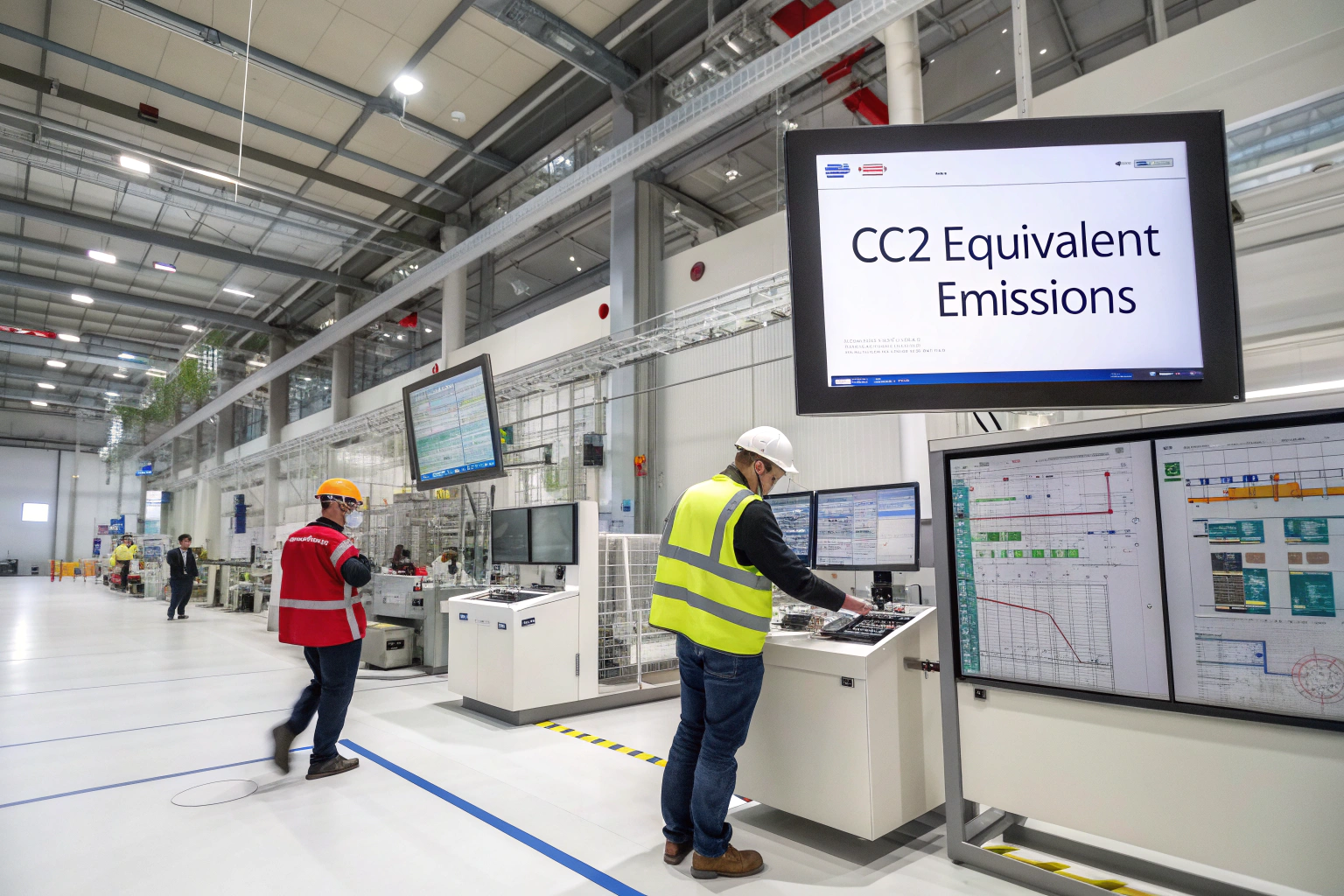
We deployed an IoT-based real-time carbon monitoring system across all 120 major pieces of production equipment in our Keqiao facility. Every stenter, dyeing vessel, compressor, and weaving machine feeds power consumption, gas flow, and steam usage data into a centralized platform every 15 seconds. This isn’t a manual spreadsheet that a sustainability intern updates monthly. It’s a live data stream. A French luxury conglomerate connected their internal carbon accounting software to our API endpoint in Q4 2025, and they can now pull our factory’s previous day’s total emissions directly into their Scope 3 dashboard every morning. That level of transparency won them over completely.

What hardware did you install to capture real-time energy data?
We didn’t want a system that relied on workers manually typing meter readings into a tablet. Human error is the enemy of audit credibility.
We installed Class 1 accuracy smart meters from Siemens on every major electrical feeder and thermal mass flow meters from Endress+Hauser on every gas line. The total hardware investment was around ¥2.8 million—not cheap, but essential. The meters communicate via Modbus TCP to a local edge server that timestamps and encrypts each data point before pushing it to the cloud platform. A technical guide on how to set up real time energy monitoring for Chinese textile carbon accounting explains the architecture choices factories face. The system also triggers alerts when a specific machine’s energy intensity deviates more than 15% from its baseline, which lets our maintenance team catch a leaky steam trap or a misaligned stenter bearing before it silently wastes energy and inflates your product’s carbon number.
Can I get a batch-specific carbon report linked to my PO number?
Yes, and this is the feature our European clients use the most.
When we create a production order in our ERP, we assign it a unique batch code. The real-time energy system tags every kilowatt-hour and cubic meter of gas consumed by the machines assigned to that batch code during the production window. At the end of the run, the system auto-generates a "Batch Carbon Statement" that shows exact consumption and the calculated CO2e. A resource detailing how to get batch level carbon emission reports from Chinese fabric mills demonstrates why this granularity matters for your compliance file. If your customer or customs authority audits a specific roll from a specific PO, you pull up the digital record and show them the primary-source energy data behind that exact production lot. No averaged estimates. No guessing. That’s the standard 2026 demands, and it’s the standard we already operate.
Conclusion
The 2026 carbon emission standards aren’t a political negotiation or a voluntary pledge. They are a hard technical specification that your supply chain either meets or doesn’t. Shanghai Fumao meets them because we started the heavy lifting before the deadlines became urgent. We pulled coal out of our boiler room, locked in a 40% renewable electricity contract, deployed ISO 14067-aligned product footprinting at the batch level, and wired every major machine to a real-time monitoring platform that feeds verified data directly to our customers’ compliance systems. Our TÜV-verified 34% emissions intensity reduction since 2021 isn’t a theoretical projection. It’s a documented trajectory that aligns with China’s national textile decarbonization timetable and the EU’s incoming carbon border requirements.
When you choose a fabric supplier for 2026 and beyond, the carbon question isn’t "Do you have a sustainability page on your website?" It’s "Can you provide a batch-specific Product Carbon Footprint using primary machine-level data, verified by a recognized third party, with zero reliance on coal combustion and full transparency on your renewable energy procurement?" If the answer from your current supplier is silence, vague promises, or a glossy PDF with stock photos of wind turbines they don’t own, your European shipments are at risk. If you want to audit our TÜV carbon verification report, test our real-time data API with your internal sustainability team, or model your Scope 3 impact using our actual batch-level numbers, email our Business Director Elaine at elaine@fumaoclothing.com. We’ll share the raw data, the audit trail, and the factory gate access. Because in 2026, the carbon number on your fabric is just as important as the thread count.