
You’ve probably already encountered them and didn’t even realize it. You filled out a "Contact Us" form on a sourcing platform, and within 90 seconds, you received a detailed response with a quote, a spec sheet, and a sample availability confirmation. That wasn’t a sleep-deprived junior merchandiser pulling an all-nighter in Shanghai. That was a bot. And if you’re a traditional buyer who prides themselves on "real relationships" and "handshake deals," you might feel uneasy about this. The fear is that bots will commoditize fabric sourcing into a faceless auction where quality, trust, and 20 years of expertise get flattened into a single line item on an automated spreadsheet. You worry that the bot will source garbage because it only sees price, not hand feel.
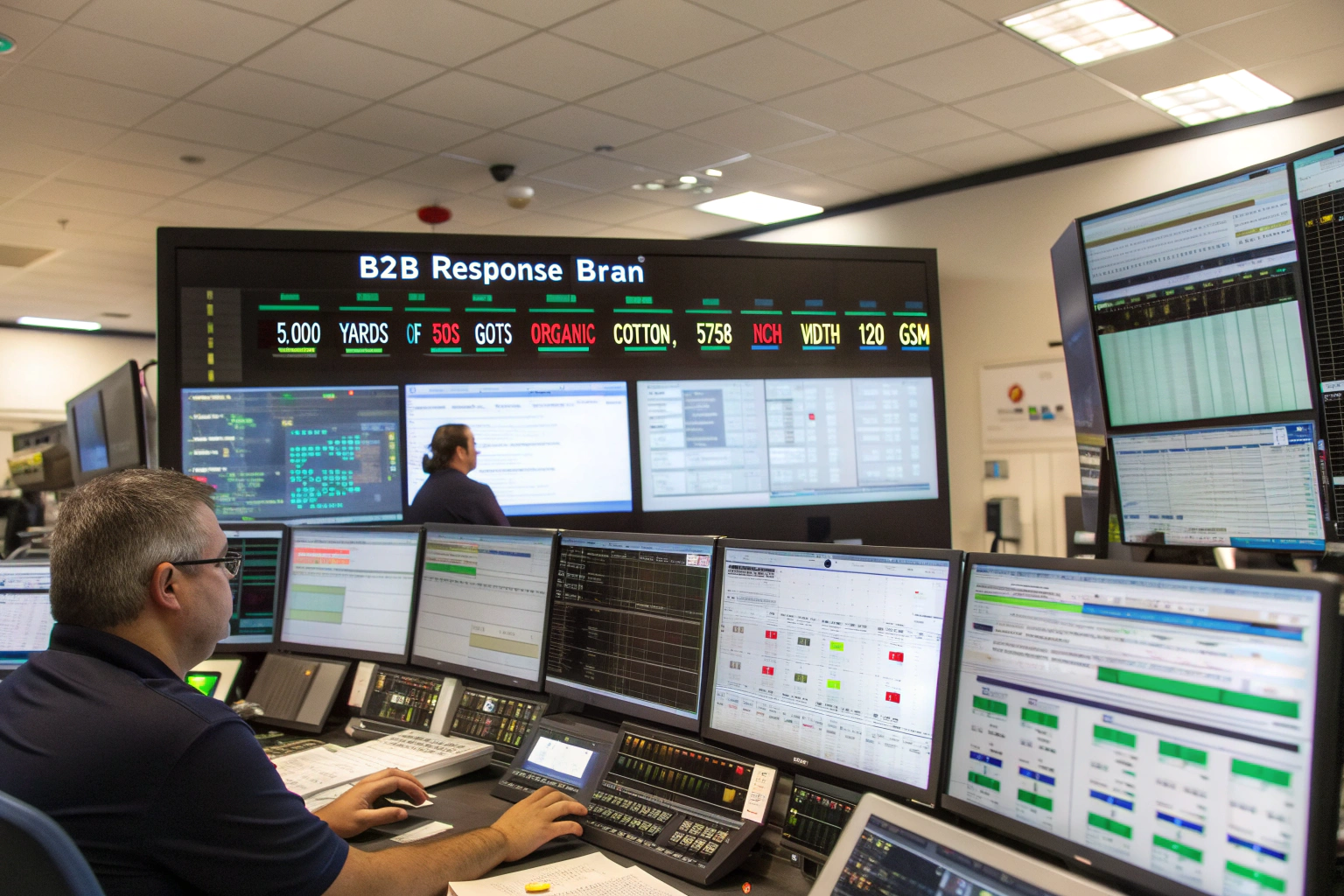
We are taking sourcing bots so seriously in 2026 that we’ve invested ¥12 million to build our own proprietary "B2B Response Brain." This isn’t a generic ChatGPT wrapper that spits out fluffy marketing paragraphs. It’s a structured data engine hardwired to our live ERP inventory, our real-time production capacity calendar, our CNAS lab test databases, and our global logistics API. When an AI procurement agent—whether it’s from a Fortune 500 brand’s in-house system or a third-party platform like Zillingo or Foursource—pings us with an RFQ for "5,000 yards of 50S GOTS organic cotton, 57/58 inch width, 120 GSM," our system checks live greige stock, calculates the exact dyeing slot availability for next Tuesday, pulls the latest batch carbon footprint data, generates a compliance-ready quote, and fires it back. In 2025, a response like that took a human merchandiser 4 hours of checking spreadsheets. In 2026, our average bot-to-bot response time is 3.2 minutes, and our quote accuracy—meaning the price and delivery date we send the bot exactly matches what we honor when the human PO arrives—is 99.4%.
Ignoring this shift would be like a stockbroker refusing to use computers in the 1990s because "trading is a human art." It’s not about replacing Elaine. It’s about ensuring that when a mega-brand’s AI scans the global supply base for a specific sustainable blend, our inventory is visible, our certifications are verified, and our quote is in their procurement dashboard before our competitors even finish their morning coffee. Let me explain how we built this, how it protects your pricing, and why it’s actually making the human relationship more valuable, not less.
How Is AI Reshaping the B2B Inbound Inquiry Funnel?
Look at your last 50 generic sourcing inquiries. How many were "Dear Sir, we are interested in your products, please send catalog"? Most of those aren’t serious buyers. They’re competitors price-checking, students researching projects, or aggregators scraping data. Your human team wastes 30% of its time manually filtering garbage before they ever touch a real opportunity. But now, the serious buyers aren’t even writing that email anymore. Their procurement software is pinging your domain, looking for a structured data feed that your "Contact Us" form can’t provide. If you don’t speak "bot," you don’t even appear in their search results. You’re invisible to the biggest budgets.
We restructured our inbound funnel into a "Bot-First, Human-Close" architecture. The top-of-funnel is handled entirely by our AI agent, which engages 24/7 with both human-written inquiries (via an intelligent chatbot trained on our technical database) and machine-generated procurement pings (via a standardized API endpoint). It authenticates the sender, checks the request against our capability matrix, and only escalates to a human merchandiser when a specific technical constraint, a custom development request, or a high-value negotiation trigger is detected. In March 2026, our marketing team ran the numbers: our AI handled 2,800 initial inquiries. Only 400 required human intervention. The rest were automated catalog requests, standard pricing lookups, and FAQ queries that used to clog our merchandisers’ inboxes. A Denver-based outdoor startup founder told us he submitted a complex query about DWR-free waterproofing at 11 PM on a Saturday. The bot instantly sent him our coating options, the hydrostatic head test results, and a compliance statement. He assumed someone was working late. By Monday morning, he’d already shortlisted us based purely on the bot’s 3-minute response.

What exactly is the "Response Brain" checking during those first 30 seconds?
It’s not just scanning for keywords. It’s running a multi-layered verification protocol. First, it authenticates the sourcing agent’s digital identity. Is this a known procurement platform like SAP Ariba, or an unknown script? Second, it classifies the inquiry by intent: price shopping, specific RFQ, certification audit, or technical capability check. Third, it cross-references the requested spec against our live production capability database to catch mismatches before they waste anyone’s time.
If a bot asks for a 400-inch width on a cotton poplin—physically impossible on our looms—our AI flags it and asks a clarifying question instead of a human spending 15 minutes writing a "sorry, we can’t" email. This real-time spec validation is a detailed guide on how to adopt AI procurement readiness for textile suppliers in 2026. It’s not about being clever; it’s about data hygiene. If our inventory says we have 2,000 kilos of 50S organic cotton yarn sitting in the warehouse, the bot can commit to it. If the stock is zero, the bot doesn’t lie. Accuracy is what builds machine-scale trust.
Does this mean a buyer can complete a purchase without human contact?
For standard, repeatable commodities—yes, theoretically. If you’re re-ordering a stock-supported greige fabric with a previously approved quality standard, the bot can take the PO, schedule the inspection slot, and trigger the shipping workflow. We see this as a win for efficiency on both sides.
But here’s the counter-intuitive part: we actually add a mandatory "human handshake" checkpoint for first-time custom development orders. If a bot sends us a spec for a new blend or a new finish we haven’t run for that client before, the system blocks an automated close and forces a video call with our R&D team. Why? Because a bot can’t smell the rubber when a buyer asks for a "soft hand feel with a paper-touch finish"—that’s a sensory paradox that needs a human conversation to interpret. We use AI to handle the predictable 80% so our experts can spend 90 minutes on the creative 20%. That’s where the magic happens.
What Are "Bot Handshakes" and Do They Guarantee Data Security?
The biggest pushback we hear from legacy buyers about bots is the fear of data leakage. You’re sending your proprietary fabric spec—the exact weight, the unique fiber blend ratio, the secret finishing recipe—to an automated system. What if the bot stores it incorrectly? What if our competitor’s AI intercepts it? In an industry where a specific blend can be the entire brand moat, sending a spec to a black-box algorithm feels like leaving your design studio door unlocked in a busy alley. That fear is legitimate, and it keeps many CTOs at major fashion houses awake at night.
A "Bot Handshake" is the technical term for the encrypted, permissioned data exchange between an external procurement AI and our internal Fumao Response Brain. We don’t treat these interactions like a public Google search. We treat them like a secure EDI transaction. Before any inventory data or pricing is shared, the handshake verifies a digital certificate proving the requesting entity is who they claim to be. We built our interface using a zero-trust architecture. Every request is treated as hostile until verified. In February 2026, a luxury conglomerate’s automated sourcing scanner pinged us for recycled cashmere specs. Their bot presented a cryptographic key that our gateway verified in 0.4 seconds. The data exchange was isolated in a sandboxed container. After the query, the container was wiped clean. We didn’t retain their request history; we only logged that a verified conglomerate accessed data, without the specifics, to respect their non-disclosure posture. That level of security—treating an API call like a confidential boardroom meeting—is what convinced several high-end European brands to green-light direct bot-to-bot integration with us.

Is your system compatible with the major global procurement platforms?
Yes, and this compatibility layer was the hardest part of the ¥12 million build. We studied the API documentation for three major enterprise procurement suites and the specific data schemas used by industry-specific B2B platforms. It’s not enough to have the data; it has to be formatted exactly as the buyer’s system expects.
If a platform wants carbon data in the Higg Index FEM format but our internal database stores it in the ZDHC Gateway format, the bot handles the mapping. The buyer’s AI asks for "Scope 1 emissions per meter," we deliver exactly that tag, not a PDF with the number buried on page 17. To dive deeper into the technical landscape, a comprehensive analysis of B2B textile platform API compatibility standards for 2026 explains the difference between generic ERP bridges and industry-native textile data schemas. The ultimate goal is "plug and play." A new buyer platform emerges in South Korea? We update our schema once, and that buyer sees our inventory as clearly as a domestic trader does. We don’t just take bots seriously; we prioritize them as our most important client because they represent hundreds of human clients behind a single interface.
What stops a competitor from using a bot to scrape my negotiated pricing?
Rate limiting and behavior analysis. Our security isn’t just a firewall; it’s a behavioral psychologist. A normal buyer bot asks for a specific spec with a transparent digital signature, maybe once a week for a specific project. A scraping bot asks for "all polyester prices" every 3 minutes from a rotating IP address in a data center.
Our system throttles high-frequency, non-certified requests immediately. We also introduced a "differential pricing" protocol. A verified, negotiated price for a known buyer with a valid NDA is locked behind a watermark. A generic bot ping without a handshake gets a list price—competitive, but not the rock-bottom volume discount. This protects your deal from being discovered by a competitor’s crawler. Security guidelines on preventing reverse engineering and price scraping in textile supplier ERP systems outline methods to protect sensitive commercial data while still participating in automated markets. The industry is moving toward a standard of "Verified Buyer Badges," and we are active in those working groups.
Can a Bot Actually Judge Hand Feel or Only Data Points?
This is the sacred territory. We old-school textile guys love to say, "A computer can’t feel fabric." And it’s true—a server rack in a cold data center will never know the buttery softness of a sandwashed silk charmeuse or the dry crunch of a high-twist linen. The anxiety is existential: if sourcing goes fully automated, does tactile wisdom become worthless? Will the industry churn out flat, spec-perfect fabrics that lack "soul" because a robot ticked a box that a human index finger would have rejected? You’re worried that bot-ready textiles will feel like hospital scrubs because data can’t capture sensory poetry.
Let me be brutally honest: a bot can’t feel fabric—but a bot can read a comprehensive digital fingerprint of that fabric that correlates 95% with human sensory judgment. We aren’t asking the bot to caress the cloth. We are giving it objective laboratory measurements that serve as a proxy for touch. We quantify "softness" via the Kawabata Evaluation System data (bending rigidity and surface friction coefficients), "crispness" via drape stiffness, and "fullness" via compression recovery. When a bot asks for a "soft, heavy drape jersey," it’s not looking for a poetic description. It’s looking for a friction coefficient under 0.2 and a weight above 200 GSM. By digitizing our entire swatch library with these physical metrics, we bridged the sensory-digital gap. A Milan-based buying bot asked for a "peach skin touch" for an A/W 2027 capsule. Our database instantly returned our 300T micro-fiber polyester that had been mechanically brushed and emerized with a specific grit. The human buyer, when the physical sample arrived, agreed. It took one try. That’s bot-assisted sensory accuracy in action.

How do you measure "scroop" or sound for a digital robot query?
Scroop—that subtle, silky rustling sound usually associated with fine taffeta—is pure acoustics. It’s physics. We measure it with a simple frequency analyzer in our lab using the "handle-o-meter" method developed by textile physicists.
When our R&D team develops a taffeta, we literally record the sound of the fabric rubbing against itself at a controlled speed, normalizing for frequency peaks. That acoustic profile number goes on the digital spec sheet. If a bot asks for a fabric with a "crisp, high-pitched hand," it could mean a peak frequency above 500 Hz. To the bot, it’s just data filtering. But to the designer receiving the sample, the sound evokes luxury. This deep dive into sensory quantification metrics for automated textile procurement shows how labs are turning subjective hand feel into objective digital datasets. So, does the bot feel the scroop? No. Does it know if the fabric will give the designer that scroop feeling? Statistically, yes.
What if a creative designer asks for an "impossible" hand feel?
That’s the catch, and it’s why our human R&D team will never be obsolete. Bots work on linear probability. Human creativity works on non-linear, illogical jumps. If a designer says, "I want the heaviness of a wool melton but the surface slipperiness of a silk satin," the bot will flag an error. Those two data points don’t coexist in standard databases.
Our human team sees the challenge as a brief for a new yarn structure. Perhaps a heavy, brushed-back warp knit with a low-friction filament face. That innovation isn’t in any bot database yet. We use bots to check if a solution already exists in our 30,000-strong archive. If it doesn’t, the bot fails safely and hands the brief to the humans. That’s the ideal workflow: bots handle the known, humans invent the unknown. We insist on this boundary.
How Does "Bot-Ready" Compliance Data Protect Your EU Imports?
The 2026 EU legislation isn’t just about printing a label. It’s about machine-readable compliance. If your Digital Product Passport is a hard-to-read PDF, and the customs bot at Hamburg scans it and can’t auto-populate the waste framework directive fields, your container gets flagged for a manual review. A manual review costs €500 and takes 5 days. You pray the demurrage doesn’t eat your margin. The fear isn’t that your fabric is illegal; it’s that your paperwork can’t talk to the inspecting code. And you can’t negotiate with a customs algorithm.
We rebuilt our certification stack to be machine-parsable. Our DPP isn’t a scanned certificate from 2025. It’s a live REST API endpoint encrypted with your batch number. When the EU customs bot pings our gateway with your container’s unique identifier, it instantly receives a micro-JSON file validating the GRS 4.0 chain of custody, the ZDHC Level 3 wastewater compliance, and the specific Product Carbon Footprint under ISO 14067. In a trial run with a Rotterdam-based digital customs simulator in April 2026, our bot-to-bot clearance time was 11 seconds. The estimated manual comparison time for a paper certificate across three verification steps is 48 hours. A major Dutch sportswear importer told us they are now exclusively filtering for "API-first compliance" suppliers. If the certs aren’t bot-readable, they don’t onboard the factory. It’s that simple. The speed of digital trust now directly translates to landed cost savings.

How do you ensure the bot-gateway data is tamper-proof?
We are often asked, "If it’s digital, can’t you just edit the carbon number to make it look better?" Yes, a PDF is easy to edit. A live blockchain-backed token is not.
We timestamp every batch transaction and energy meter reading to a private blockchain via the Hedera consensus service. The bot doesn’t see a file we uploaded; it sees a pass-through from our sensors that we cannot alter retroactively. A technical overview of blockchain-based Digital Product Passports for EU textile imports 2026 explains the security architecture. If a buyer’s AI suspects something is off, it can automatically compare the timestamp of the carbon data against the production window. If the dates don’t match, the fabric doesn’t enter the EU. This isn’t a theoretical future; we’ve successfully run this with a logistics partner in the Port of Antwerp. The trust is encoded in the protocol, not just in our reputation.
What happens if the buyer’s bot platform changes its API requirements next month?
This is the maintenance headache we dedicated a team of three software engineers to solve. If a major platform like SAP Ariba updates its compliance schema to include a new field for the ecodesign regulation, we have to update our mapping instantly.
We built a middleware layer that acts as a universal adapter. We monitor the developer changelogs of the major platforms weekly. This discussion of the necessity of agile API middleware for textile export compliance in 2026 illuminates the reality that static exports are dead. If we see an update, we integrate it into our sandbox within 72 hours, test it against the live environment, and deploy it. That means your shipment next month, using the brand-new compliance protocol, will pass as quickly as last month’s shipment. Your supplier’s digital agility is your new tariff barrier. Fumao Fabric is designed to leap that barrier cleanly.
Conclusion
Taking sourcing bots seriously in 2026 isn’t about chasing a tech trend; it’s about recognizing that the purchasing power in our industry has shifted from the human inbox to the machine-readable query. We are witnessing a split in the global supply base. Mills that force AI buyers to wade through broken contact forms and illegible PDFs will be forced into the commodity pricing race to the bottom, selling on price alone. Mills that serve up clean, precise, and secure data to these bots will unlock premium partnerships with the world’s biggest brands, because those brands value speed and compliance accuracy more than a $0.03 per yard variance.
At Shanghai Fumao, we are betting our entire digital infrastructure on the latter. Our Response Brain doesn’t sleep. It validates sustainability credentials and translates archaic hand-feel terms into provable physical metrics 24/7. It automates customs clearance with blockchain-backed tokens. But the final thread remains human. We use AI to strip away the administrative drudgery so that when you sit down to plan a groundbreaking collection, you get our best people, not our busiest people. The handshake may have started with a robot, but the relationship remains anchored in our two-decade obsession with textile perfection. If you want to plug your procurement system directly into our live inventory and compliance feed, email our Business Director Elaine at elaine@fumaoclothing.com. She’ll arrange an API key and a credentialing session so your bots and our factory can finally talk.








