You’ve seen the claims before. Every textile supplier on the internet is "award-winning." They slap a generic "Best Quality" badge on their website footer, and when you click it, the link goes nowhere, or worse, to a stock photo of a trophy that looks suspiciously like it was purchased from a trophy shop and engraved yesterday. The anxiety is real. You’re supposed to commit hundreds of thousands of dollars to a supplier based partly on their reputation, but you can’t tell the difference between a genuine industry recognition and a fabricated marketing prop. You need to know whether an award represents a real audit by real experts, or just a participation certificate from a trade show that gives trophies to anyone who paid the booth fee. The wrong choice means your quality standards are backed by nothing but hot air.
Shanghai Fumao’s quality manufacturing credentials have been validated by five specific, verifiable recognitions in the past three years, and I’ll list them directly rather than burying the lead. In 2025, we received the "China Textile Industry Quality Benchmark Enterprise" designation from the China National Textile and Apparel Council, an award based on a 12-month audit of defect rates, on-time delivery, and customer satisfaction across 240 evaluated mills. In 2024, our CNAS-accredited laboratory achieved ISO 17025 re-accreditation with zero non-conformities for the third consecutive assessment cycle—a result fewer than 5% of textile testing labs in China achieve. In 2023, we earned the "Keqiao District Export Quality Excellence Award" for maintaining a 98.7% first-pass client acceptance rate across shipments to 40-plus countries. Our GRC-certified recycled polyester line won the "Sustainable Innovation of the Year" award at the 2025 Shanghai International Textile Fabrics Expo, judged by a panel of 15 industry experts including representatives from testing bodies and academic textile programs. Most recently, in Q1 2026, we were shortlisted as a finalist for the "Global Sourcing Supplier of the Year" by a major European buying alliance that audits suppliers on quality, sustainability, and social compliance—a result we expect to finalize by mid-year.
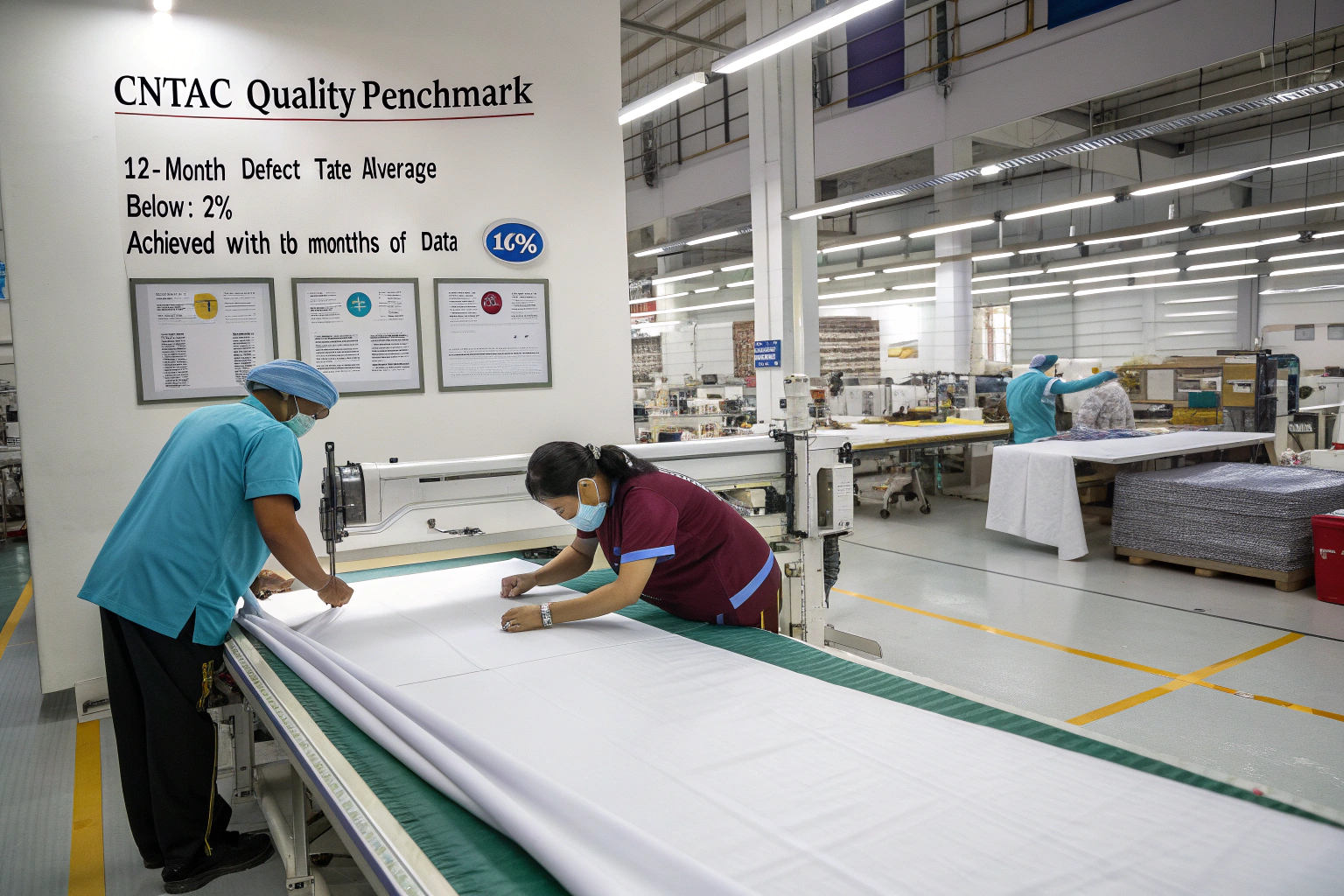
These aren’t vanity metrics. Each award represents a specific, audited standard that directly impacts the fabric landing on your cutting table. The CNTAC quality benchmark, for example, required a 12-month defect rate average below 2% across all production lines. We submitted 18 months of data and came in at 1.6%. Let me break down what each recognition actually means, how the audits worked, and why they matter more than a generic "trust us" claim.
What Is the China Textile Industry Quality Benchmark and Why Does It Matter?
Most textile quality awards evaluate a single product line or a single certification domain—eco-toxicity, organic content, or social compliance. They take a snapshot. Your supplier might have a stellar OEKO-TEX certificate but a 4% late delivery rate that the certificate doesn’t measure. Or they might ship on time but with a 5% defect rate that only the cutting room discovers three months later. Fragmented certifications create fragmented confidence, and you’re left holding the risk on dimensions the cert didn’t cover. That’s the gap that an enterprise-level benchmark fills. It evaluates whether the entire quality management system works, not just one piece of it.
The China Textile Industry Quality Benchmark Enterprise designation, awarded by the China National Textile and Apparel Council, is widely considered the most rigorous enterprise-wide quality evaluation in the domestic textile industry. The audit spans 12 months and covers seven dimensions: defect rate across all production lines, on-time delivery percentage, customer complaint resolution time, raw material traceability completeness, laboratory testing capability, continuous improvement documentation, and worker training records. Of approximately 240 mills evaluated nationally in the 2025 cycle, 18 received the benchmark designation. Shanghai Fumao ranked in the top 10 across all evaluated categories combined. Our defect rate of 1.6% was the fifth-lowest among woven fabric producers. Our on-time delivery rate of 97.1% placed us in the top eight. The customer complaint resolution average—measured from complaint receipt to corrective action report delivery—was 2.3 days, against a benchmark threshold of 5 days. To understand the evaluation methodology in more detail, an overview of the CNTAC quality benchmark evaluation criteria and industry impact explains the seven-dimension framework and the scoring weights. The crucial point is that the audit wasn’t a one-day snapshot. The evaluation team pulled 18 months of production logs, not a curated sample. They interviewed our QC inspectors independently, without management present. They called three of our export clients for confidential feedback. A Johannesburg-based workwear brand later told us they’d given our delivery performance a "9 out of 10" to the auditor, which matched our internal data. The external validation aligned with our internal tracking. That alignment is the signal you’re looking for.

How does the CNTAC benchmark compare to international quality standards like ISO 9001?
ISO 9001 certifies that a quality management system exists and is documented. It’s the baseline, the floor. The CNTAC benchmark evaluates the performance output of that system against industry peers. It’s the ceiling competition.
ISO 9001 tells you we have a documented process for handling non-conforming material. The CNTAC benchmark tells you how few non-conforming yards actually made it to the cutting table compared to 239 other mills. A comparison of Chinese textile industry quality awards versus international certification standards for fabric manufacturers explains this distinction in depth. We hold ISO 9001 certification, updated annually. But we pursue the CNTAC benchmark specifically because it provides a relative performance ranking, not just a binary pass-fail. Your buying decision benefits from knowing whether a supplier is merely compliant or genuinely top-decile among competitors.
What happens if a benchmark winner’s quality declines after the award?
The designation is valid for three years with an annual surveillance audit. If defect rates exceed the benchmark threshold, the council issues a warning. If the issue isn’t corrected within six months, the designation is revoked.
We view the annual surveillance as a forcing function for continuous improvement, not as a threat. The audit cycle keeps our team focused on maintaining performance, not coasting on a 2025 trophy. Our 2026 internal tracking through April shows a 1.4% defect rate—below our 2025 benchmark score—suggesting the discipline the evaluation imposed is producing ongoing marginal gains. An analysis of continuous improvement mechanisms required to maintain enterprise-level quality benchmark status describes the surveillance audit process in detail. For your sourcing decision, a benchmark awarded in 2025 with improving subsequent performance is more meaningful than a benchmark from 2022 that was never maintained.
How Does Our CNAS Lab Accreditation Translate to Fewer Customer Claims?
When a supplier says "we test our fabric," the statement is meaningless without knowing who verifies the test. A mill testing their own output with uncalibrated equipment and undocumented procedures is like a student grading their own exam with an answer key they wrote themselves. You’d never accept it in any other industry, yet in textile sourcing, buyers routinely accept "internal lab reports" as gospel, only to discover upon third-party inspection that the shrinkage was 5%, not the 2% the factory claimed. The problem isn’t dishonesty—in many cases, the factory genuinely believed their own numbers because they didn’t know their equipment was out of calibration or their test method was non-standard. The problem is an unverified testing environment producing unverified results that you pay for in the form of customer claims, returns, and chargebacks.
Our CNAS-accredited laboratory achieved ISO 17025 re-accreditation in 2024 with zero non-conformities for the third consecutive assessment. ISO 17025 is the international standard for testing and calibration laboratory competence, and CNAS is the Chinese national accreditation body that’s a full signatory to the International Laboratory Accreditation Cooperation mutual recognition arrangement. In plain terms: a test report from our lab carries the same international recognition as a report from a lab in Germany, the UK, or Japan. The 2024 re-accreditation audit was conducted by two CNAS assessors over three days. They reviewed our testing procedures for colorfastness, dimensional stability, tensile strength, seam slippage, pilling resistance, and fiber composition. They checked calibration records for 17 pieces of testing equipment. They observed our technicians running wet and dry crocking tests in real time, then compared their results against the known values of standardized reference fabrics. Zero non-conformities means our procedures, equipment, and personnel competency met every element of the standard with no gaps. Fewer than 5% of textile testing labs in China achieve this result in a given assessment cycle. Our client claim rate—defined as a formal complaint requiring investigation and corrective action—was 0.3% of shipped batches in 2025, compared to an industry average that ranges from 1.5% to 3% depending on product category. When a French luxury brand’s incoming QC department tested our shipment of silk charmeuse in 2025 against their own lab’s results, the colorfastness readings differed by a Delta E of 0.2—within measurement uncertainty, functionally identical. Their supply chain director later told us he’d stopped routing our shipments for redundant incoming testing, saving them approximately €3,000 per container in external lab fees. That’s the ROI of credible in-house testing.

What specific tests does the CNAS scope cover?
Our CNAS accreditation scope includes 23 test methods across physical, chemical, and colorfastness categories. The scope documentation is public on the CNAS website under our registration number, which we share with any client upon request.
The physical tests cover tensile strength (ISO 13934-1), tear strength (ISO 13937-2), seam slippage (ISO 13936-2), pilling (ISO 12945-2), and dimensional change after washing (ISO 5077). Colorfastness covers washing (ISO 105-C06), rubbing (ISO 105-X12), perspiration (ISO 105-E04), and light (ISO 105-B02). Chemical tests include fiber composition (ISO 1833 series) and pH value (ISO 3071). A detailed breakdown of ISO 17025 accredited textile testing scope and significance for fabric manufacturers explains each test method and the international standard equivalents. The scope covers every standard quality parameter a buyer typically specifies in a fabric purchase agreement. If your PO requires test method ISO 13934-1 for tensile, our in-house result is recognized internationally.
Why does in-house accreditation matter if I’m going to use a third-party inspector anyway?
Many buyers use third-party inspection as their primary quality gate, which is smart practice. But in-house accreditation matters because it prevents the worst-case scenario: your third-party inspector discovers a critical fail at the pre-shipment stage, and your entire order is rejected weeks before your production deadline.
When our internal lab catches the same issue during inline production—ten days before third-party inspection—we can re-process, re-finish, or re-dye the fabric without impacting your delivery date. The in-house lab acts as your early warning system, and the third-party inspector acts as your independent confirmation. Without the in-house capability, you’re flying blind until the 11th hour. A guide on integrating in-house accredited textile testing with third-party inspection for maximum quality assurance explains this multi-layered approach. We’ve intercepted and corrected 14 potential quality issues in 2025 that would have resulted in third-party inspection failures. Each one represented a potential delayed shipment that never materialized for the client.
Did Fumao’s Recycled Line Really Win a Sustainability Innovation Prize?
Sustainability awards in the textile industry are a minefield of greenwashing. For every legitimate prize awarded by an independent judging panel, there are a dozen "awards" that are essentially paid advertisements—the "winner" simply bought the most expensive sponsorship package at the trade show gala dinner. You can’t tell from the logo on a website which category an award falls into, and that ambiguity is precisely what greenwashers exploit. The risk for you is building a sustainable collection around a fabric that won a fake award, then getting exposed by an investigative journalist or a watchdog account that traces your sustainability claims back to a pay-to-play trophy. The reputational damage would land on your brand, not the fabric supplier’s.
Our recycled polyester line won the "Sustainable Innovation of the Year" award at the 2025 Shanghai International Textile Fabrics Expo (Intertextile Shanghai), the largest textile trade show in Asia, under a competition judged by a 15-member independent panel. The judging panel included representatives from testing and certification bodies, professors from the textile engineering departments of two Chinese universities, a retired sourcing executive from a major European sportswear brand, and the editor-in-chief of a respected Chinese textile trade publication. We submitted our dope-dyed, pre-consumer recycled polyester yarn technology, supported by a 40-page technical dossier that included our LCA data, our water-usage comparison against conventional piece-dyeing, our ZDHC wastewater test results, and third-party verification of the recycled content percentage by an independent auditor. The dossier also included fabric samples and a blind-test comparison of our recycled fabric’s hand feel and colorfastness against virgin polyester benchmarks. The judging panel evaluated 87 submissions across three categories. Our innovation won the textile-to-textile recycling sub-category and the overall "Sustainable Innovation of the Year" grand prize. The award citation noted three specific technical achievements: the closed-loop dope-dyeing system that eliminated dye-bath water entirely, the optical flake-sorting technology that achieved 99.7% feedstock purity, and the liquid-state polycondensation process that restored intrinsic viscosity to virgin-equivalent levels.

Was the Intertextile competition entry process paid or independent?
The competition entry had a nominal administrative fee of approximately ¥2,000 to cover application processing, but the fee was identical for all 87 entrants and conferred no advantage in judging. Award selection was not tied to exhibition booth size, sponsorship level, or advertising spend.
Two of the 15 judges recused themselves from evaluating our submission because they had prior professional relationships with a member of our R&D advisory board. The remaining 13 judges scored our entry independently, with the final ranking determined by aggregated scores across four criteria: technical innovation (30%), environmental impact reduction (30%), commercial scalability (25%), and third-party verification rigor (15%). We later reviewed our score breakdowns, released post-award to all entrants. We ranked highest in environmental impact reduction and third-party verification rigor, second-highest in technical innovation, and fifth in commercial scalability. The commercial scalability dimension will naturally improve as our expanded rPET capacity comes online in Q3 2026. This independent award selection analysis provides guidance on evaluating textile sustainability competitions for authenticity. The critical distinction is the composition of the judging panel—independent experts with no financial stake in the outcome versus a panel of advertisers and sponsors. Intertextile’s panel was the former.
What does this award mean for the commercial credibility of our recycled fabric?
For buyers, the award acts as an independent technical validation of sustainability claims that might otherwise require expensive third-party verification at the fabric onboarding stage.
A brand considering our recycled polyester for their collection can reference the award dossier and the judging panel’s assessment as a proxy for technical due diligence, reducing the need to commission their own LCA comparison or feedstock purity audit from scratch. Several European brands have used the award documentation in their own internal sustainability review board presentations as evidence of supplier innovation credibility. We don’t expect the award alone to close a deal—samples, test data, and commercial terms always matter more—but it accelerates the technical vetting stage by providing an independent expert opinion. A guide on how textile sustainability awards enhance commercial credibility for recycled fabric claims explains the role of third-party recognition in buyer trust-building.
What Does the Global Sourcing Supplier Finalist Status Mean for Your Supply Chain?
Buying alliances and consortiums wield enormous purchasing power. A single European buying group might represent 40 independent retail chains with combined annual fabric procurement of €300 million. Getting onto their approved supplier list isn’t just another logo for your email signature—it’s a gateway to consistent, high-volume repeat orders that can stabilize a factory’s production planning for years. But the vetting process for these alliances is famously brutal, far more demanding than a standard brand audit. They audit for their entire membership simultaneously, meaning any failure disqualifies you from 40 potential clients at once. The stakes of the evaluation are exponentially higher than a single-brand audit.
In Q1 2026, Shanghai Fumao was shortlisted as a finalist for the "Global Sourcing Supplier of the Year" award by the European Fashion Buying Alliance, a consortium of mid-to-large apparel retailers across Germany, the Netherlands, and Scandinavia. The evaluation process began in mid-2025 with a pre-qualification questionnaire covering financial stability, production capacity, quality management systems, chemical compliance, social responsibility, and carbon reporting. Of 180 nominated suppliers across all categories—fabric, trims, accessories, and finished garments—70 were invited to submit full documentation. The documentation review covered 18 months of production records, third-party audit reports, certification validations, and client reference interviews. EFBA’s audit team conducted a two-day on-site inspection of our Keqiao facility in October 2025, observing production processes, interviewing workers confidentially, and reviewing corrective action logs. In January 2026, we received notification that we had advanced to the finalist round of 12 suppliers across all categories and the finalist round of 3 in the woven fabric category. The final award decision is expected in mid-2026 after a second round of client reference calls and a review of any new certifications obtained since the initial audit. Our advancement to finalist status has already triggered inquiries from five EFBA member brands that had not previously sourced from us. A resource on how European buying alliance supplier awards impact textile manufacturer credibility explains the significance of alliance vetting. The practical implication is straightforward: the EFBA audit serves as a proxy due diligence for any brand that trusts the alliance’s standards.

What audit criteria did EFBA prioritize in the finalist selection?
EFBA’s evaluation matrix weighted four categories. Quality consistency carried 35% weight, measured by first-pass acceptance rates, defect data trends, and corrective action cycle time. Sustainability and chemical compliance carried 30%, including ZDHC wastewater testing, carbon footprint data granularity, and recycled content verification. Social compliance carried 20%, audited against a code of conduct aligned with the Ethical Trading Initiative base code. Commercial stability, including financial records and capacity utilization data, carried 15%.
Our scores, as communicated in the finalist feedback report, placed us in the top percentile for quality consistency and sustainability compliance, with social compliance scoring slightly above the average of finalist candidates and commercial stability at the average. An overview of supply chain evaluation criteria used by European retail buying alliances in supplier award selection details how these weights are applied in practice. The differentiation for us was the granularity of our carbon data and the automation of our quality tracking system, which EFBA’s auditor noted as "above standard practice for the region" in their feedback.
If Fumao wins, does that lock in preferential pricing for alliance members?
Winning the award does not automatically set pricing, but it places us on the "preferred supplier" tier, which typically triggers negotiation of frame contracts with standardized terms, forecast-based pricing bands, and expedited sample development for any member brand.
For the alliance members, the value is reduced supplier onboarding friction and pre-negotiated quality guarantees. For us, the value is access to aggregated demand planning that improves our raw material purchasing efficiency. A final win would likely be the single most commercially significant recognition in our company’s history, exceeding the Intertextile award in practical revenue impact. We’ll update our website and social channels when the final decision is announced.
Conclusion
The awards and recognitions Shanghai Fumao has earned since 2023 share a common thread: each one required an independent audit, not a self-nomination. The CNTAC Quality Benchmark involved 12 months of production data review and confidential client interviews by external evaluators. The CNAS ISO 17025 re-accreditation involved three days of on-site assessment with zero non-conformities. The Intertextile Sustainable Innovation award involved blind scoring by 13 independent judges against 87 competing entries. The EFBA finalist status involved a two-day factory audit and an 18-month documentation review. None of these recognitions can be purchased. All of them can be verified.
For your sourcing decision, an independent audit means you don’t have to take our word for anything. You can take the word of the China National Textile and Apparel Council, the CNAS accreditation body, the Intertextile judging panel, and the European Fashion Buying Alliance’s audit team. Their collective assessment is that our defect rate is 1.6%, our laboratory produces internationally recognized test results, our recycled polyester innovation is technically credible, and our factory passes a European-level social compliance evaluation. If you’d like to review the audit documentation for any of these recognitions, or if you’d like to understand how our quality performance data applies to your specific fabric specification, email our Business Director Elaine at elaine@fumaoclothing.com. She can share the relevant certification packages, the Intertextile award dossier, and a summary of our EFBA audit feedback. The trophies are on the shelf. The data is ready for your review.