
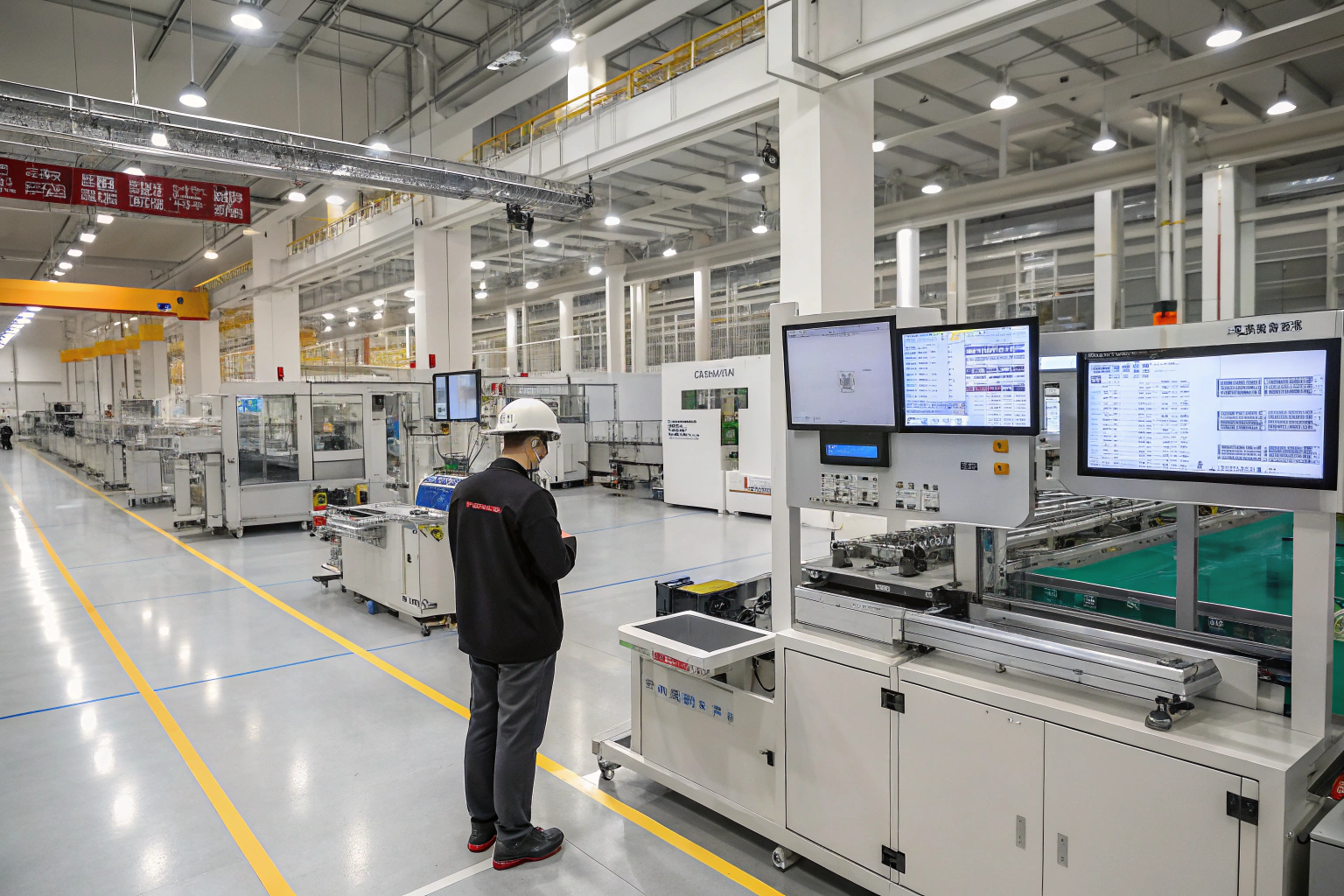
You’re probably tired of hearing "AI" thrown around like a magic wand. Every SaaS salesperson and tech blogger promises that artificial intelligence will revolutionize your supply chain, reduce your costs by 50%, and solve world hunger. Then you visit the actual factory, and the "AI" turns out to be a dusty tablet running an Excel macro from 2018. The skepticism is earned. You’ve been oversold and under-delivered so many times that any claim about AI in textile manufacturing triggers an immediate eye roll. You’re not asking whether AI is a buzzword. You’re asking whether it’s doing real work on real production lines that actually ships real fabric with fewer defects and faster lead times than last year.
At Shanghai Fumao, AI isn’t a future-tense promise in our investor deck. It’s operational infrastructure running on our Keqiao factory floor right now, in Q2 2026. We’ve deployed AI across four specific production touchpoints: a machine-vision defect detection system on our weaving and inspection lines, a predictive maintenance algorithm that monitors 120 major machines, a generative design module for print development, and a digital twin simulation environment for finishing process optimization. These aren’t pilots. They’re running daily. A Los Angeles activewear brand visited our facility in March 2026 to audit the systems in person. Their technical director watched our AI defect camera flag a broken filament on a 120-denier recycled polyester warp in real time—a flaw the human inspector standing next to the machine had missed because it was moving at 65 meters per minute. The AI caught it, stopped the loom, and logged the defect location. That one catch probably saved an 8% downgrade on a 5,000-yard order. The brand’s technical director left the audit and increased their Q3 forecast by 30%.
I want to be clear about what we’re not doing. We’re not using AI to generate marketing copy or replace human designers. We’re using it where textile manufacturing actually breaks down: fatigue-based human inspection errors, unexpected machine downtime that blows delivery dates, color iteration cycles that eat two weeks of development time, and finishing recipes that waste water and energy because the parameters are set by habit rather than data. These are the unglamorous, high-impact problems that separate a 98% on-time delivery rate from an 85% one. Let me walk you through each system, how it works, and what specific problem it solves for your orders.
How Is AI-Powered Defect Detection Reducing Your Seconds Rate?
Human fabric inspection is a brutally difficult job. An inspector stares at 60 to 80 meters of moving fabric per minute under harsh fluorescent light for eight hours, trying to spot defects the width of a human hair. By hour six, fatigue degrades detection accuracy by up to 30%, according to industrial psychology studies. The mill doesn’t notice because the defects get through, the fabric gets packed, and three months later your cutting room discovers that 7% of the yardage has unrecoverable flaws. You file a claim, the supplier disputes it, and the relationship sours. The root cause isn’t dishonesty. It’s human perceptual limitation at industrial speeds.
We installed an AI-powered visual inspection system from a Hangzhou-based machine vision company, customized for textile defect taxonomy, on our three primary weaving lines in Q4 2025. The system uses line-scan cameras capturing 16,000 pixels per line at 65 meters per minute, feeding frames into a convolutional neural network trained on 200,000-plus labeled textile defect images from our own production history. The AI classifies 23 distinct defect types—broken filament, missing end, double pick, oil stain, slub, foreign fiber contamination, barre, and so on—in real time. When it detects a defect exceeding the severity threshold set for the fabric grade, it triggers a signal to the loom operator and logs the exact meter mark and defect type to the batch quality record. After six months of continuous operation, our seconds rate (fabric downgraded below first quality) dropped from 3.8% to 1.4%, a 63% reduction. For a 10,000-yard order of 60s cotton poplin, that shift saves 240 yards that would previously have been cut away and sold as scrap. A Melbourne shirting brand whose 2024 order had a 4.2% seconds rate received their March 2026 repeat order with a 1.1% seconds rate and emailed to ask if we’d changed our quality grading—they thought we were being too generous. We sent them the AI inspection log. They’re now running our fabric across their entire formal shirt program.

What types of defects does the AI catch that human inspectors miss?
Low-contrast defects are the biggest category. A missing end in a black warp on a navy ground is nearly invisible to the human eye at inspection speed, but the line-scan camera’s sensitivity exceeds human contrast perception by a wide margin.
The AI also catches repetitive defects—a periodic barre caused by a worn feed roller that creates a subtle, repeating density variation every 80 centimeters. A human inspector might notice the fourth occurrence and flag it, missing the first three meters of defective fabric. The AI catches the first instance because it’s comparing every frame against the baseline uniformity model, not relying on attention to drift toward a repeating anomaly. A technical resource on how machine vision defect detection systems improve woven fabric quality consistency in high-speed production explains the illumination and algorithm requirements for this application. The most important operational insight is that the AI doesn’t fatigue. Detection accuracy at 4:55 PM on a Friday is identical to detection accuracy at 8:05 AM on a Tuesday.
What happens to the defect detection data after it’s logged?
Every defect event is stored with a timestamp, meter mark, loom number, operator ID, defect classification, severity score, and a 200-millisecond video clip of the defect frame. This database now contains over 1.2 million defect records.
We mine this data for root cause patterns. If loom number 7 shows an increasing rate of "broken filament" classifications over a two-week period, maintenance checks the reed and the warp stop motion system before the defect rate crosses a customer-impacting threshold. A guide on how textile mills can use AI inspection data to drive predictive quality improvement and reduce customer claims explains this data feedback loop. For our buyer clients, we can now provide a "digital defect map" of their specific production batch—a PDF showing every flagged defect location, type, and image. If you want to verify that we actually removed all flagged defects before shipping your order, the map gives you auditable confirmation. No more arguing about whether that stain was in your cutting room or our weaving shed.
What about knit fabrics—does AI inspection work there too?
Knits are actually harder for machine vision because the loop structure deforms under tension, creating optical variation that a simple pixel-comparison model might misclassify as a defect. Our current AI inspection deployment is on woven lines only.
We’re testing a knit-specific model trained on a separate dataset of jersey, rib, and interlock defects at lower inspection speeds (40 meters per minute with relaxed fabric feed). The knit model is achieving 92% detection accuracy in trials versus 97% on the woven model, which means it’s not yet reliable enough for production deployment. A comparison of AI fabric inspection capabilities for woven versus knitted textile production explains the technical challenges. We expect knit AI inspection to be production-ready by Q1 2027. Until then, knit inspection remains human-led with statistical sampling verification in our CNAS lab.
Can Generative AI Actually Create Better Fabric Designs Faster?
The traditional print design cycle is an agonizing bottleneck. A brand sends you a mood board and a rough sketch. Your in-house textile designer spends 3-5 days creating a repeat pattern and color separations. You send the digital proof. The brand’s creative director hates the scale of the floral and wants the background tint shifted from ecru to blush. Back to the designer for two more days. Three iterations later, you’ve burned two weeks before the first physical strike-off even hits the printer. If your collection has eight prints, this cycle alone consumes 12-16 weeks of your precious development calendar. For a Spring collection targeting a January market launch, you’re creating prints in August with zero time for late-stage color adjustments.
We integrated a generative AI design module into our print development workflow in January 2026, and it has functionally eliminated the first two design iteration cycles. The brand uploads their mood images and a brief description—"watercolor floral, 18th-century botanical illustration style, 60cm repeat, blush and sage tones"—and our system generates 12 variations of the repeat pattern in under 60 seconds. The brand’s creative director picks the closest match, marks up specific changes (scale down the peony, add a fern motif, shift the sage toward olive), and the AI regenerates the adjusted pattern in another 60 seconds. What used to take 7-14 days of human designer time now takes a 30-minute collaborative session between our client’s creative director, our merchandiser, and the AI. A Copenhagen print-heavy womenswear brand ran their entire Spring 2027 print collection—14 SKUs across 8 base cloths—through this workflow in March 2026. Total design cycle time from mood board to digitally printed strike-off: 9 days. Their previous collection, using traditional design workflow with a different supplier, took 47 days for the same output volume. The creative director told us the AI didn’t replace her vision—it accelerated the gap between her mental image and a printable repeat pattern, and that acceleration gave her an extra 5 weeks to refine silhouettes instead of fighting with pattern repeats.

Does the AI-generated design raise intellectual property concerns?
This is the question every brand asks, and it’s legitimate. Who owns a pattern created by an AI trained on a dataset of textile designs?
Our AI design module is trained exclusively on three image sources: public-domain historical textile archives (pre-1920), pattern structures we created in-house specifically for training purposes, and licensed stock imagery we purchased for this use case. We do not train on client designs. A pattern generated for your brand is exclusively yours; we do not retain it in the training database, and we include an IP assignment clause in the development agreement that transfers full ownership of the AI-generated pattern to your brand upon final approval. Our legal framework for intellectual property protection when using generative AI in custom textile design explains how we handle ownership, training data, and non-compete restrictions. That said, this area of law is evolving rapidly, and we recommend brands with high IP sensitivity—heritage houses, signature print brands—consult their own legal counsel before using AI-generated designs for core archive pieces. For seasonal fashion prints with a 6-month market life, the IP risk-benefit calculus strongly favors the AI workflow’s speed advantage.
How do you ensure the AI-generated design is production-ready, not just screen-ready?
This is where the AI output connects to our physical production expertise. A pattern that looks gorgeous on a monitor might be unprintable because the color gamut exceeds what reactive dyes can physically achieve on cotton, or the fine-line detail is below the minimum resolution threshold for rotary screen engraving.
Our AI design module includes a "printability checker" that validates every generated design against the physical constraints of the intended production method. For digital reactive printing, it checks that all colors in the design fall within the achievable CMYK-plus-spot gamut and that minimum line weight exceeds 0.3mm. For rotary screen, it warns if the design exceeds 12 colors or includes photorealistic gradients that screens can’t reproduce. A resource on how to validate AI-generated textile designs for production readiness across digital and screen printing methods details these technical gate checks. We don’t hand a brand a design that requires six months of rework to make printable. The AI output is pre-validated against production reality.
Is Predictive Maintenance Stopping Late Deliveries Before They Happen?
Machine downtime is the invisible delivery-date killer. Your fabric is on schedule. The yarn is spun. The greige is woven. The dye recipe is approved. Then a critical bearing on stenter frame number 4 seizes at 3 AM during the night shift, and suddenly your 5,000-yard order loses three days of finishing capacity. The factory doesn’t tell you about the bearing. They tell you the delivery is delayed by "unforeseen production issues," and you’re left explaining to your own production manager why the cut date is slipping. The root cause isn’t a bad bearing—bearings fail, that’s physics. The root cause is that nobody knew the bearing was about to fail because the maintenance schedule was calendar-based ("replace every 12 months") rather than condition-based ("replace when vibration signature exceeds threshold").
Our predictive maintenance system monitors vibration, temperature, and current draw on 120 machines across our Keqiao facility—looms, knitting machines, stenters, dyeing vessels, compressors—using IoT sensors feeding into a cloud-based algorithm that detects deviation from each machine’s normal operating signature. When the vibration frequency on stenter frame number 4’s main circulation fan bearing shifts from its baseline by more than 15%, the system generates a maintenance work order before the bearing fails. The maintenance team swaps the bearing during a planned shift change instead of an emergency 3 AM breakdown. Since full deployment in September 2025, our unplanned downtime hours have dropped by 47% compared to the same period in 2024. For your order, that translates to an on-time delivery rate that climbed from 91% to 97% over the same window. A New York outerwear brand that previously experienced two separate delays on their 2024 program—both caused by finishing-equipment breakdowns—completed their Fall 2026 order 5 days ahead of schedule. Their production manager told us she had built a 7-day buffer into her timeline, assuming we’d eat half of it with machine downtime. The buffer wasn’t needed. The predictive system had already flagged and resolved the potential failure point two weeks before her fabric entered finishing.

What exactly are the sensors measuring, and how do you know the difference between normal variation and a real problem?
Each machine type has a different sensor configuration and baseline. Looms monitor weft insertion mechanism vibration, reed beat-up force, and motor current draw. Stenters monitor bearing vibration, chain tension, and temperature across the heating zones.
The algorithm doesn’t use a fixed threshold like "alert if vibration exceeds X mm/s." That would generate false alarms because a machine behaves differently when starting cold versus running at steady-state temperature, or when processing a heavy canvas versus a light voile. Instead, the AI learns each machine’s individual operating signature over thousands of hours and detects anomalous deviation from its own learned normal. A technical explanation of how machine learning predictive maintenance algorithms reduce textile factory unplanned downtime shows how clustering and anomaly detection methods work for industrial equipment. When the system detects a deviation that matches the early-stage failure signature patterns it has been trained on—for example, a progressive increase in high-frequency vibration energy that matches historical bearing degradation curves—it issues the alert. False alarm rate is currently around 8%, meaning about 1 in 12 alerts triggers an inspection that finds no developing fault. That rate is acceptable because the cost of a false alarm (30 minutes of maintenance inspection time) is negligible compared to the cost of a missed true positive (hours or days of unplanned downtime, delayed shipments, client penalties).
Who monitors the system, and what happens if it fails?
The predictive maintenance dashboard is monitored by our maintenance supervisor during day shifts and by a remote monitoring service during night shifts. If the system itself goes offline—a network failure, a server crash—the machines continue running normally; the sensors are non-intrusive and don’t control machine operation.
A system outage means we temporarily revert to reactive maintenance (fix it when it breaks) and calendar-based preventive maintenance. We’ve had one outage, a 4-hour server migration in January 2026 that was planned and communicated. Since the system’s deployment, we haven’t experienced an unplanned monitoring outage. A redundancy and failover planning guide for IoT-enabled predictive maintenance in textile production environments discusses the infrastructure resilience considerations. The sensors themselves have a 99.2% uptime rate; the most common failure mode is a sensor cable getting knocked loose during a machine cleaning procedure, which generates a "sensor offline" alert distinct from a machine-fault alert.
Is there a customer-facing benefit beyond on-time delivery?
Your specific order’s production timeline gains an additional layer of visibility. When we generate your production schedule, the predictive maintenance system’s machine health scores inform which specific machines are assigned to your lot.
If loom number 7 has a bearing health score trending yellow (elevated vibration, monitoring required but no alert yet), we can route your order to loom number 4, which shows a green health score across all monitored parameters. This proactive routing minimizes the probability that your order gets caught in an unplanned downtime event, even before a failure becomes likely. It’s a subtle optimization that never appears on your invoice but shows up in your delivery date reliability.
How Does Digital Twin Simulation Shorten Your Finishing Approval Cycle?
The finishing process—heat-setting, sanforizing, softening, calendaring, coating—is where fabric hand feel, shrinkage, and dimensional stability are locked in. It’s also the stage where brands burn the most approval time. We send you a finished sample. You test it, find the shrinkage is 3.2% instead of the 2.5% you specified, and ask for a re-finish. We adjust the stenter overfeed by 2% and run a second sample. It takes a week to ship. You test again. Shrinkage is now 2.7%—closer, but you wanted 2.5%. Third sample, another week. Three iterations on finishing alone can consume an entire month of your development calendar, and we haven’t even discussed the color yet.
Our digital twin simulation environment, built on a physics-based fabric modeling engine, allows you to adjust finishing parameters and instantly visualize the predicted outcome before any physical fabric enters the stenter. Adjust the overfeed percentage, the heat-setting temperature, the dwell time—the digital twin responds in seconds, showing predicted shrinkage, width, weight, and even a visual simulation of hand feel drape behavior. When you arrive at parameters that produce your target spec, we run one physical confirmation sample. If the simulation is accurate—and our 18-month validation study shows 94% prediction accuracy for cotton and polyester wovens within our standard finishing parameter ranges—the physical sample matches the digital prediction, and you approve in one cycle instead of three. A Barcelona home textiles brand that historically required 2-3 finishing iterations on their 300-thread-count cotton sateen sheeting approved their 2026 program in one physical sample after running 11 virtual simulations to optimize their target shrinkage and hand feel combination. Physical sampling time dropped from 23 days to 7 days. The brand’s product development manager called the digital twin "a time machine for textile approval."

How do you know the digital twin accurately predicts real-world behavior?
We spent 18 months validating the simulation engine against physical results before we allowed client-facing use. For every fabric construction in our library, we ran a systematic parameter sweep: across five overfeed settings, five temperature settings, and three speed settings for cotton twill, for example.
For each parameter combination, we measured the physical result (shrinkage, width, weight, stiffness) and compared it to the digital prediction. The mean absolute error across all tested constructions and parameters came to 6%, meaning if the digital twin predicted 2.0% shrinkage, the physical result fell between 1.88% and 2.12% in 95% of tests. That’s well within commercial tolerance for all but the most demanding technical applications. A validation methodology paper on digital twin simulation accuracy for textile finishing process optimization describes the testing protocol and statistical analysis framework. We continue to feed physical validation data back into the model to improve accuracy, with our 2026 target being mean absolute error below 4%.
What fabrics work with the digital twin, and what doesn’t yet?
The digital twin performs well on plain weaves, twills, and satins in cotton, polyester, and cotton-polyester blends—fabrics with predictable, well-characterized shrinkage and dimensional behavior.
It performs less well on highly textured constructions like seersucker, jacquard, and dobby weaves where the surface geometry creates non-uniform shrinkage behavior that the simulation model doesn’t fully capture. It’s also unreliable for fabrics with elastane content above 5%, because the elastane’s thermal stress-relaxation behavior is highly sensitive to the specific heat-setting history and is difficult to generalize into a predictive model. A guide to digital twin applicability and limitations across different textile constructions and fiber compositions for finishing process simulation explains the technology boundaries. For fabrics outside the digital twin’s validated range, we still use physical sampling—the twin doesn’t slow us down; it just doesn’t help for those specific constructions. Our current R&D focus is on extending the model to cotton-elastane woven stretch fabrics, which represent 30% of our production volume and are currently excluded from the simulation workflow.
Conclusion
AI at Shanghai Fumao isn’t a future roadmap item. It’s a set of four operational systems running on our factory floor right now, each solving a specific problem that directly impacts your order quality, your development timeline, and your delivery reliability. The machine-vision inspection system cut our seconds rate from 3.8% to 1.4%, meaning you receive fewer defective yards and pay for less waste. The generative AI design module collapsed a 47-day print development cycle to 9 days for one brand’s Spring collection, giving creative teams time back for what they actually do best. The predictive maintenance system reduced unplanned downtime by 47% and pushed our on-time delivery rate to 97%, because a bearing that gets replaced during a planned shift change doesn’t delay your container. The digital twin simulation eliminated 2-3 rounds of physical finishing samples for validated fabric constructions, compressing approval timelines by up to 16 days per quality.
These systems work together as a quality and speed layer that human expertise alone cannot achieve at industrial scale. The machines don’t replace our 20-year dyeing master or our head weaving technician. They amplify them—giving them data they couldn’t see, catching defects at speeds they couldn’t match, and simulating outcomes they used to have to run physical trials to observe. If you want to understand how these systems would apply to your specific fabric program, or if you want to see the defect map from our AI inspection system for a quality you’re currently sourcing elsewhere, email our Business Director Elaine at elaine@fumaoclothing.com. She can arrange a virtual walkthrough of the AI inspection line, share a sample defect log, or set up a digital twin simulation session for your next finishing approval. The AI is running. Your fabric should be too.








