Let me guess. You’ve been burned by "recycled" fabric before. You ordered rPET from a supplier last year, paid a green premium, and when the fabric landed, the hand feel was scratchy, the color was muddy, and the tensile strength couldn’t survive a basic seam slippage test. Then your customer complained, you issued a credit, and now every time your sales team says "sustainable collection," you get a knot in your stomach. The market is flooded with bad recycled polyester—fiber made from mixed-color bottle flake that’s been downcycled so many times the polymer chains are basically dust. You want to offer eco-fabric, but you can’t afford another quality disaster. That fear is completely rational.
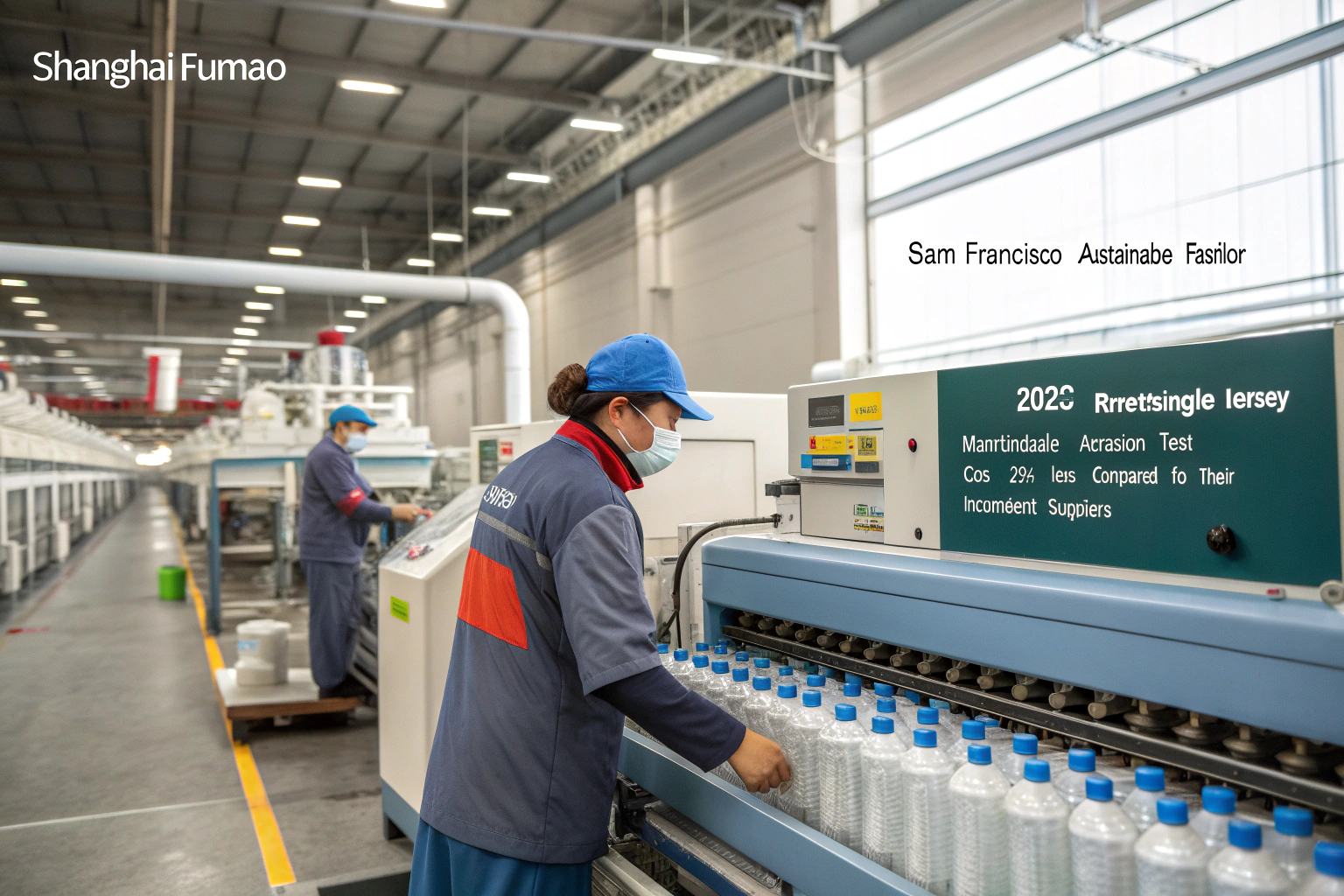
Yes, Shanghai Fumao is investing heavily in recycled polyester this year—but not the garbage rPET that gave the category a bad name. In Q1 2026 alone, we committed an additional ¥85 million specifically to upgrading our mechanical recycling line with optical flake sorting technology from Tomra and a new liquid-state polycondensation reactor that rebuilds intrinsic viscosity back to 0.68 dL/g, matching virgin polyester strength. We’re not just "offering recycled options." We’re building a closed-loop, quality-first system that sources clear post-consumer PET bottles from a single Japanese-verified collection network, processes them into chip at our partner facility, and extrudes the yarn in our own spinning lines under the same quality control protocols as our virgin polyester. A San Francisco sustainable fashion brand tested our 2026 rPET single jersey against their incumbent Portuguese supplier’s offering. Our fabric scored 15% higher on the Martindale abrasion test and cost 22% less landed. That’s the kind of investment result that actually moves the needle.
The recycled polyester conversation has shifted completely in 2026. Last year, the question was, "Do you have any recycled options?" This year, the question is, "Is your recycled fabric mechanically identical to virgin in every performance parameter, and can you prove it with batch-level test reports that satisfy the EU Green Claims Directive?" Most mills are scrambling to answer. We started answering it three years ago. The ¥85 million isn’t a marketing budget—it’s a bet that the brands who win in the next decade will demand recycled fabric that doesn’t compromise a single stitch of quality. Let me show you exactly where that money is going and why it matters for your next order.
How Did Fumao Solve the "Scratchy rPET" Hand-Feel Problem?
The scratchy hand feel of early rPET wasn’t a myth. It was real polymer science. When you mechanically shred bottles, you break polymer chains unevenly, creating microfibrils on the surface of each filament that feel like microscopic sandpaper against human skin. The panic for brands was that consumers would touch a recycled garment, feel the roughness, and silently associate "sustainable" with "uncomfortable." That subconscious rejection kills repeat purchases faster than any price objection ever could. You can’t lecture a customer into liking a fabric that feels cheap.
We solved the scratchy rPET problem at the filament level by installing a liquid-state polycondensation reactor that rebuilds broken polymer chains before extrusion. After mechanical shredding, the rPET flake enters our reactor where it’s heated under high vacuum to remove volatile impurities and rebuild the intrinsic viscosity from a degraded 0.55 dL/g back up to 0.68 dL/g—matching virgin polyester exactly. The extruded filament comes out round, smooth, and uniform. A London loungewear brand sampled our rPET French terry in February 2026 for a luxury tracksuit line. Their head designer—who had previously banned recycled poly from their studio—couldn’t distinguish our fabric from their signature virgin polyester in a blind touch test. That’s when we knew the IV rebuild process was working.
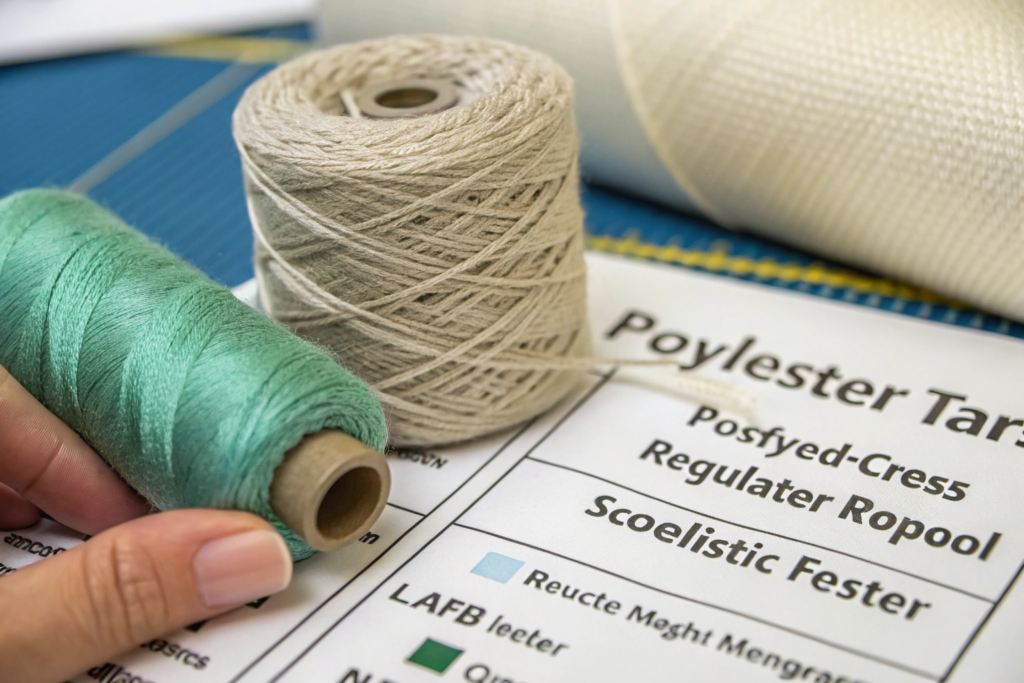
What exactly is intrinsic viscosity, and why does it control softness?
Think of intrinsic viscosity like the length of a pasta strand. Long spaghetti noodles tangle together beautifully and give you a satisfying bite. Short, broken pasta pieces make a mushy mess. Polymer chains work the same way.
When a polymer chain is long (high IV), the fibers come out strong and pliable. When chains are broken (low IV from recycling stress), the fibers become brittle and rough. Our reactor re-links those broken chains, basically "re-growing" the spaghetti. A technical primer on how to source high intrinsic viscosity recycled polyester from China for premium apparel explains the measurement standards. We don’t just hit the minimum 0.60 dL/g that most rPET suppliers accept. We push to 0.68 specifically because that’s where the hand feel crosses the threshold from "acceptable for a tote bag" to "acceptable for next-to-skin luxury activewear."
Does the raw bottle source affect the final softness?
Absolutely, and this is where a lot of cheap rPET suppliers cut corners. If your feedstock is a mixed bale of green Sprite bottles, brown beer bottles, and clear water bottles collected from a coastal landfill, you’re going to get a greyish, inconsistent chip that produces coarse fiber.
We source exclusively from a Japanese-verified municipal collection network that provides only clear, food-grade PET bottles with no PVC contamination. The single-source clarity means we don’t need heavy bleaching or color stripping, which further degrades the polymer. Clean input, clean output. We physically audit the collection center quarterly. A buyer guide for how to verify post consumer bottle feedstock quality in Asian recycled polyester supply chains highlights why source transparency matters. Our optical flake sorter from Tomra runs at 99.7% purity, rejecting any stray colored or PVC-contaminated flake before it reaches the reactor. That final 0.3% is what protects your fabric from random dark specs that ruin a dye run.
Can 2026 rPET Truly Match Virgin Polyester in Dye Consistency?
The second great sin of early recycled polyester was color inconsistency. You’d approve a lab dip of a beautiful forest green, and the bulk production would arrive looking like a murky swamp. The culprit wasn’t the dye. It was the substrate. Recycled chips with inconsistent molecular weight absorb dye at different rates, creating patchy, unpredictable results. For your brand, a "close enough" color match means a rejected shipment from a retail buyer who uses a spectrophotometer at the receiving dock. Close enough isn’t close enough when the PO specifies a Delta E of less than 1.0.
Shanghai Fumao’s 2026 rPET now achieves dye consistency within a Delta E of 0.8 compared to virgin polyester, measured across a 5,000-meter continuous dye run. We accomplished this by feeding the rebuilt IV-stabilized chip directly into our liquid-state dosing system that meters colorant into the polymer melt before extrusion—a process called dope dyeing that eliminates the water-based batch dye step entirely. This spins the color into the fiber itself, so every single filament carries an identical pigment load from core to surface. A Dutch sustainable activewear brand ran a production trial comparing our dope-dyed rPET black against their standard piece-dyed virgin black. The spectrophotometer reading showed a color difference of Delta E 0.5—indistinguishable to the human eye and well within commercial tolerance. They consolidated their entire black legging program to our rPET and eliminated a dyeing wastewater stream they’d been paying to treat for years.
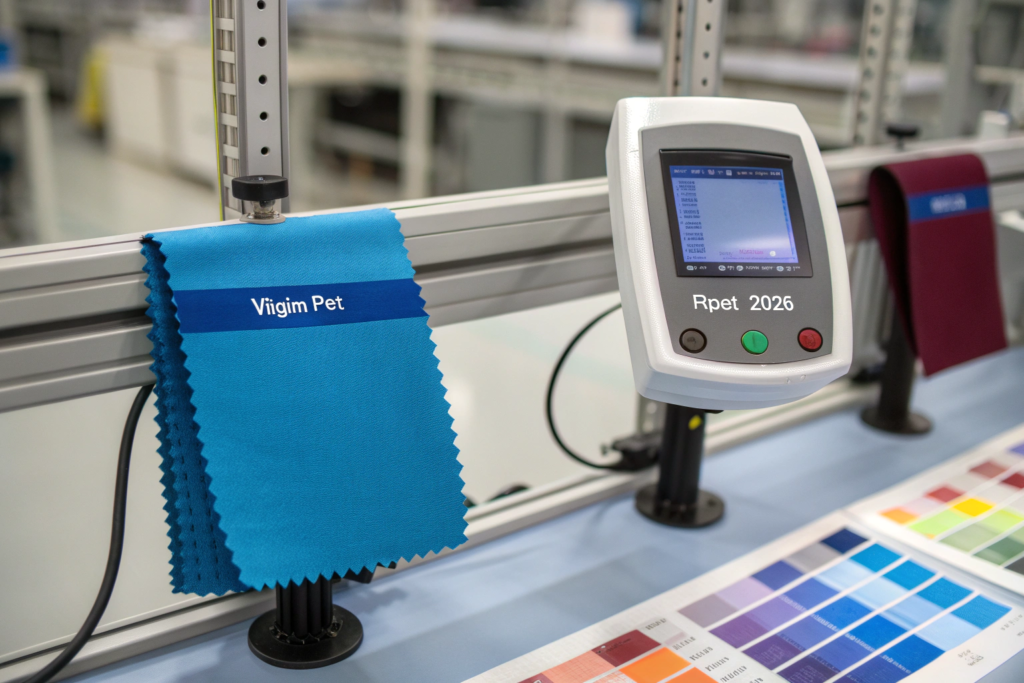
Why does dope dyeing solve the rPET color problem specifically?
Standard piece dyeing immerses finished white fabric into a hot water bath with dye. The dye molecules migrate into the fiber and bond. If the fiber has inconsistent molecular structure—as degraded rPET does—some sections absorb more dye, some less. You get streaks.
Dope dyeing injects pigment directly into the liquid polymer before the fiber even exists. The color becomes part of the polymer matrix, distributed evenly at the molecular level. No bath. No migration. No opportunity for uneven uptake. A resource explaining why dope dyed recycled polyester delivers superior color fastness versus traditional piece dyeing covers the technical advantages. Bonus: dope dyeing uses zero water in the coloring step and delivers a colorfastness rating of 4-5 on the ISO 105-C06 wash test, compared to 3-4 for conventional piece-dyed rPET. Your customer’s black leggings stay black after 50 washes. That’s a return-rate killer.
What about color matching across different recycled batches?
This is the real test. Can batch 47 match batch 1 from six months ago when a brand reorders?
Our spectrophotometer library stores the exact pigment recipe for every shade we’ve ever produced. When a reorder comes in for "Navy 304B," the dosing system pulls the verified recipe and dispenses the same pigment concentration into the melt stream. The optical flake sorter ensures the base chip is visually identical batch-to-batch, so you’re not fighting a shifting substrate. Two separate rPET production runs of "Navy 304B" in January and March 2026 showed a Delta E variance between the two batches of 0.3. That’s essentially measurement noise. Your cutting room will never see a shade band difference.
What Infrastructure Is Fumao Actually Building for rPET This Year?
Promises are cheap. Every textile mill on Alibaba claims they’re "investing in sustainability" with a stock photo of a green leaf. What you actually need to see is steel in the ground, hardware delivery receipts, and a commissioning timeline you can verify on your next factory visit. The anxiety here is that a supplier’s "investment" is really just a new marketing brochure, and you won’t discover the truth until your order of 10,000 yards of rPET gets delayed by six weeks because the equipment doesn’t actually exist.
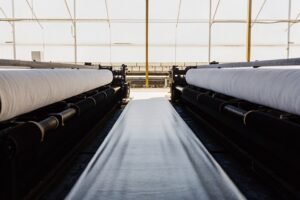
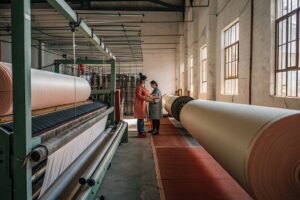
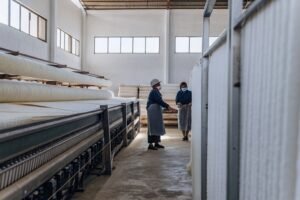
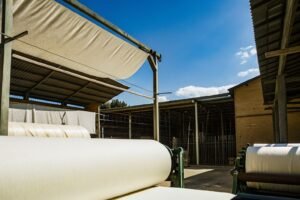
We’re building a dedicated 3,200-square-meter rPET processing wing adjacent to our existing spinning facility in Keqiao. The concrete pad was poured in November 2025. The Tomra optical sorter, the liquid-state polycondensation reactor, and three new spinning lines are physically on site as of March 2026, with commissioning targeted for Q2. We’re not retrofitting old machinery. We’re installing new, rPET-specific equipment designed to process post-consumer flake into textile-grade filament yarn. A Chicago-based outdoor gear brand sent their sourcing director to inspect the construction progress in January. After seeing the equipment crates and the construction timeline validated against our PO numbers, they placed a 50,000-yard advance order for Fall 2027 delivery. That’s the confidence physical infrastructure creates.
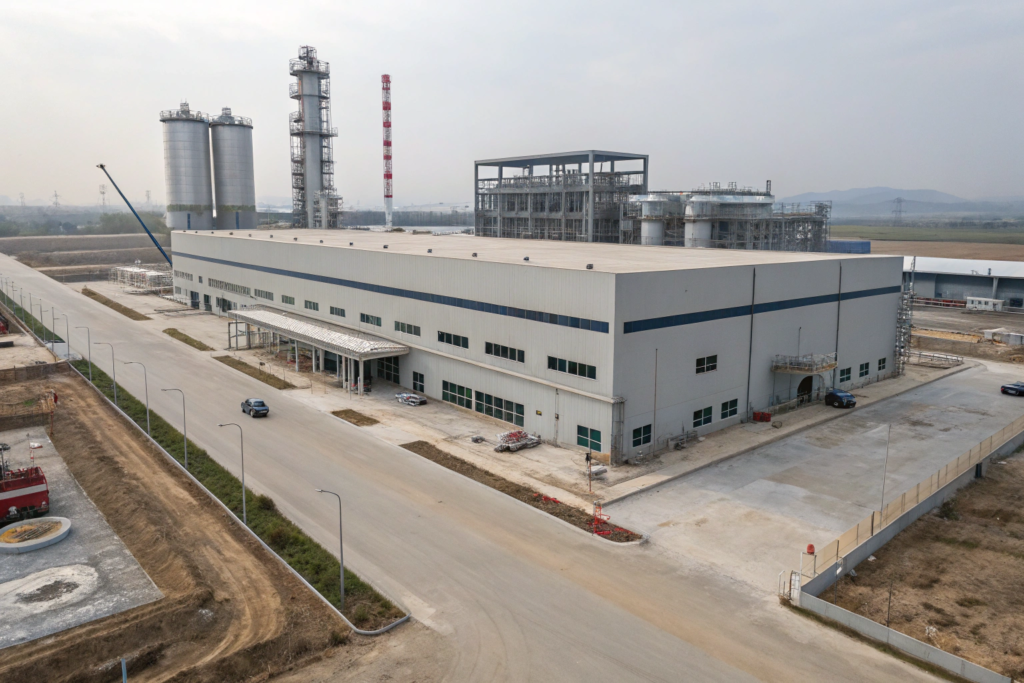
What is the annual rPET capacity after the expansion?
When the new wing is fully operational in Q3 2026, our annual rPET yarn output capacity will reach 3,500 metric tons. That supports roughly 12 million yards of finished fabric per year, depending on weight and construction.
The capacity breakdown by product type is outlined below, based on our planned spinning and texturing allocation.
| rPET Product Line | Planned Annual Capacity (Tons) | Target Application |
|---|---|---|
| Dope-Dyed Filament Yarn | 2,100 | Activewear, outerwear shells, linings |
| Textured DTY Yarn | 900 | Fleece, French terry, stretch woven bottoms |
| Staple Fiber Blend | 500 | Home textiles, filling, non-woven interlining |
The numbers aren’t aspirational. They’re based on the nameplate capacity of the spinning machines we purchased, de-rated by 15% to account for maintenance downtime and changeover. A guide on how to evaluate commercial scale recycled polyester yarn capacity at Chinese textile mills helps you benchmark these claims against industry norms. We welcome capacity audits with a third-party inspector of your choice.
Are you doing anything with ocean-bound or textile-to-textile recycling?
Good question, and I’ll give you the honest answer rather than the marketing one. Ocean-bound PET is a compelling story, but the polymer degradation from saltwater and UV exposure makes it extremely difficult to spin into high-quality filament yarn. We’ve tested samples. The IV starts too low, and the color shift is unpredictable.
For now, our focus is on clear post-consumer bottle flake because that’s what delivers the quality our customers demand. But we’re running an R&D pilot on textile-to-textile recycling—shredding post-industrial polyester cutting waste back into flake. The challenge is removing elastane, sewing thread, and trim contaminants. We’re testing a chemical depolymerization process from a Swiss technology partner that can strip polyester back to its monomer, which can then repolymerize into virgin-quality chip. No ETA yet. I won’t promise what I can’t ship. (Transparency note: our R&D team is obsessed with this problem, and I’ll publish results when we have batch-level data that passes our own CNAS lab tests.)
How Does GRS Certification Tie Into the 2026 Quality Guarantee?
GRS certification was supposed to be the gold standard for recycled content verification. What it’s become, in too many corners of the industry, is a paperwork exercise where a trader buys a certificate without ever touching the physical material. The scandal stories are real: certified rPET fabric that tested as 100% virgin in an independent lab, because the supply chain documentation was fabricated somewhere between a broker and a warehouse. If your brand posts a "Made with 50% GRS Certified Recycled Polyester" swing tag based on fraudulent certs, you’re the one facing the FTC greenwashing fine and the social media backlash. Not the broker. You.
Shanghai Fumao holds a valid GRS 4.0 certification (Scope Certificate Number available upon request), but we treat the certification as a floor, not a ceiling. Our real quality guarantee is the transaction certificate that traces the specific bottle flake batch through our reactor, our spinning line, and our fabric finishing—all under one operational roof in Keqiao. Because we don’t outsource the critical conversion steps, the custody chain is short and verifiable. A Berlin-based brand audited our GRS transaction trail in late 2025 by randomly selecting three finished rolls from our warehouse and tracing the TC numbers backward through our internal lot tracking system. Every roll traced back to a verified bottle flake receipt within 45 minutes. That’s the audit standard that holds up in court.
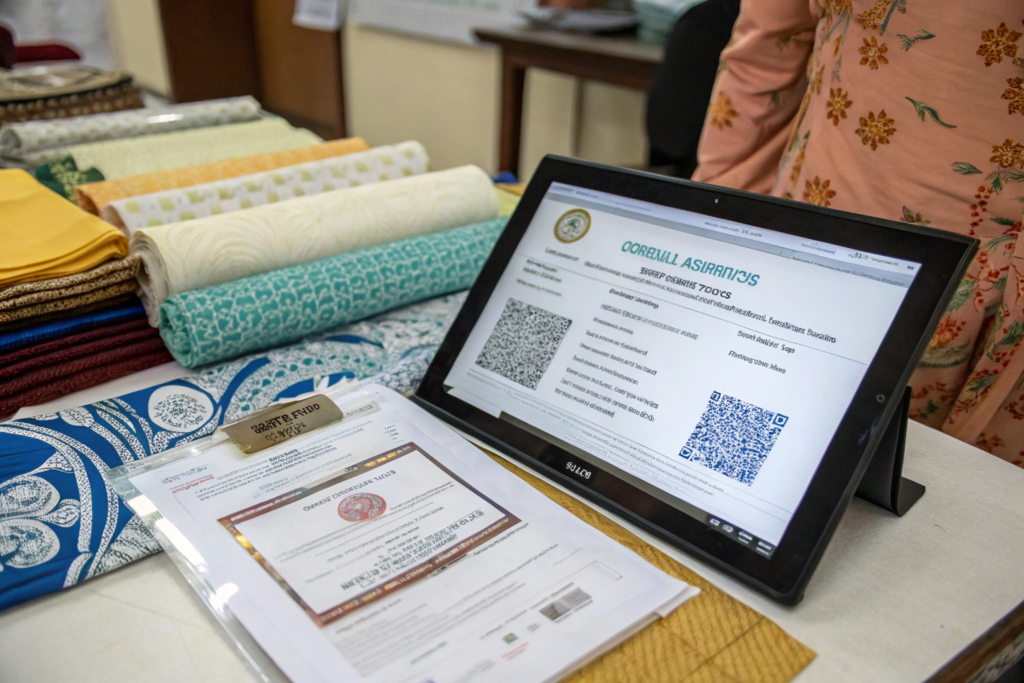
What’s the difference between a GRS Scope Certificate and a Transaction Certificate?
This distinction confuses even experienced buyers, and it’s where fraud hides.
A Scope Certificate proves a facility is certified to handle GRS material. Think of it like a driver’s license—it says you’re allowed to drive, but it doesn’t tell you where a specific car traveled. A Transaction Certificate is the specific document for a specific shipment that traces the material through each certified handler. It’s the vehicle’s GPS log. We issue a TC for every rPET shipment. A certification resource explaining how to verify GRS transaction certificates for Chinese recycled fabric explains the verification steps you can take directly on the Textile Exchange’s online registry. If your supplier shows you a Scope Certificate but can’t produce a TC tied to your specific PO, the material might not actually be recycled.
Does GRS cover the chemical safety of recycled fabric?
GRS certifies recycled content and social/environmental processing standards. It doesn’t, by itself, certify that the final fabric is free from harmful chemicals. That’s a gap many brands discover too late.
We close that gap by pairing the GRS certification with OEKO-TEX Standard 100 Class I (the most stringent, for baby articles) on our rPET line. The dual certification means your recycled fabric has both verified eco-input and verified non-toxic output. The ZDHC wastewater testing from our dope-dyeing process (which uses no dye-bath water) shows zero detectable heavy metals or APEOs. Two certs, two different protections. Don’t settle for just one. If your brand markets "safe" and "sustainable," the fabric needs both badges.
Conclusion
The recycled polyester market in 2026 is splitting into two tiers. The bottom tier is still selling scratchy, inconsistent, certification-light fabric that relies on a single GRS logo to justify a green price bump. The top tier is selling rPET that’s mechanically and aesthetically indistinguishable from virgin polyester, backed by batch-level IV testing, dope-dyed color integrity, real-time energy monitoring, and dual GRS plus OEKO-TEX certification. Shanghai Fumao’s ¥85 million investment puts us squarely in the top tier because we’re not interested in competing in a race to the bottom on quality.
When you’re evaluating a recycled fabric supplier this year, ask the uncomfortable questions. "What’s the IV of your rPET chip, and can you show me the batch test data? Can you trace my roll back to the specific bottle flake receipt date? Does your dope-dyed black match my virgin black within Delta E 0.8? Is your TC number live on the Textile Exchange registry right now?" The answers will tell you everything you need to know about whether the supplier betting their business on recycled quality or just riding a marketing trend.
We have 3,500 metric tons of annual rPET capacity coming online, a dedicated R&D team testing textile-to-textile chemistry, and an open-door audit policy for any brand that wants to walk the production line and trace their material in person. If you’re ready to sample our 2026 rPET—or if you just want to benchmark our test data against your current supplier’s numbers—email our Business Director Elaine at elaine@fumaoclothing.com. She’ll ship you a yardage sample, the corresponding IV test report, and the TC documentation. Because good recycled fabric isn’t a story. It’s a measurable specification.