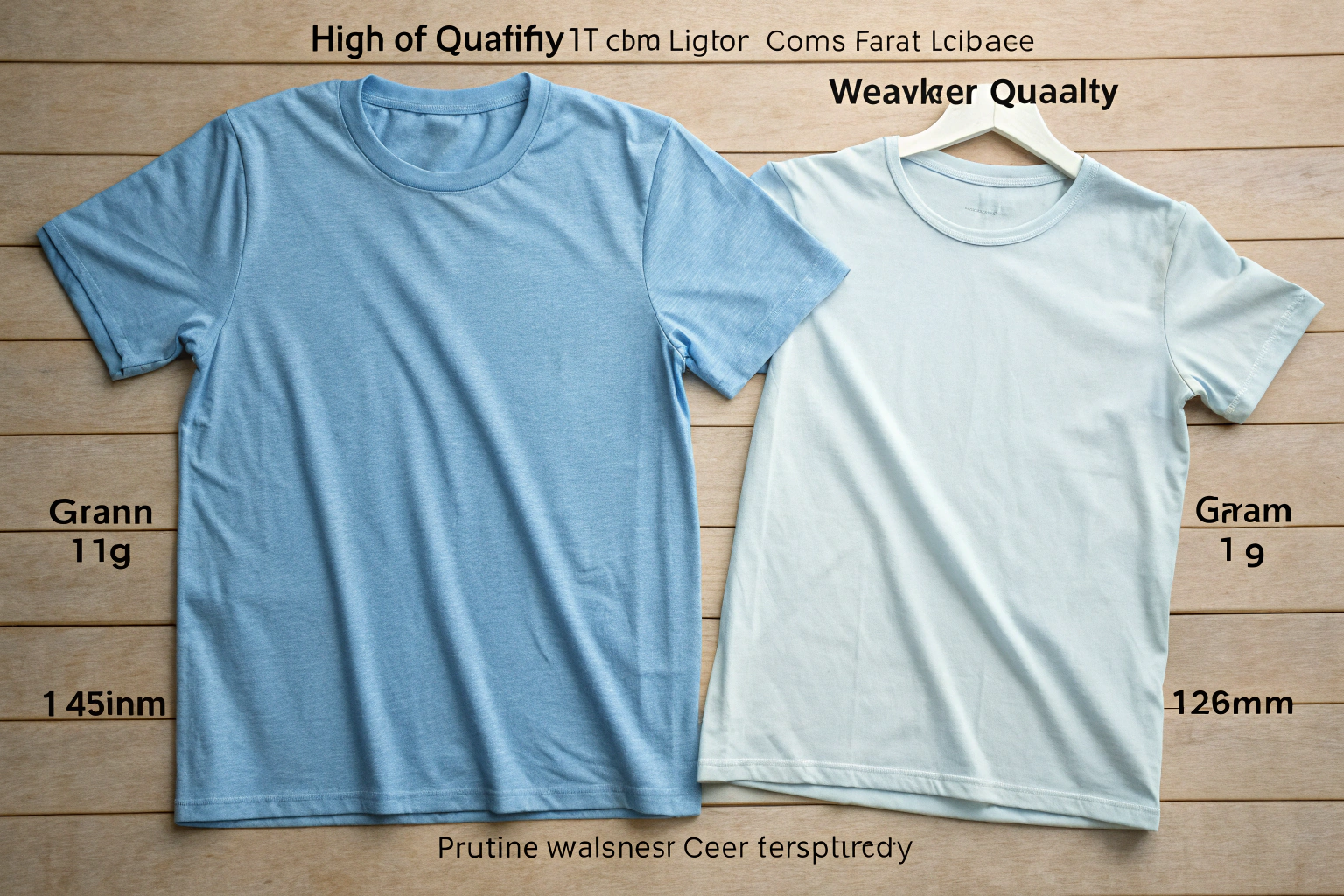
You’ve probably felt the disappointment yourself. You pull a new t-shirt over your head, and it feels… off. It’s thinner than the sample you approved, flimsier than the version you sold to your customer last season. Or you ordered a "heavyweight" hoodie, but the fabric drapes like a wet paper towel. The color is right, the stitching is fine, but the soul of the garment—its weight, its substance, its structural integrity—is missing. Someone, somewhere in the supply chain, shaved weight off the fabric to save a few cents per yard, and the evidence is now in your hands, irreversible and unsellable. That’s not a sewing defect. That’s a GSM cheat, and it’s the most common hidden downgrade in textile manufacturing.
GSM stands for grams per square meter, the fundamental metric for fabric weight and density. It measures exactly what the term implies: the mass in grams of a one-meter-by-one-meter piece of fabric. A lightweight cotton voile might be 70 GSM. A standard t-shirt jersey is typically 160-180 GSM. A heavy winter sweatshirt fleece is 300-400 GSM. At Shanghai Fumao, we treat GSM not as a rough estimate, but as a binding specification with a tolerance band of plus or minus 3%, which is tighter than the industry standard of plus or minus 5%. We enforce that band with inline weight monitoring at three stages: greige fabric off the loom, finished fabric off the stenter, and final QC inspection before packing. A Portland-based outdoor brand switched their entire flannel shirting program to us in early 2026 after their previous supplier’s "180 GSM" twill measured 162 GSM on their incoming inspection—a 10% weight shortfall that made the shirts feel insubstantial and sparked customer returns. Our first shipment of the identical spec measured 178 GSM, within 1.1% of target. Their returns dropped. Their reorder came in at triple the volume.
GSM is the honest number in a dishonest game. Yarn count can be manipulated. Fabric width can be stretched temporarily. But mass per unit area, measured dry and relaxed, doesn’t lie. It tells you exactly how much fiber is in that fabric, and fiber is cost. When a supplier under-delivers on GSM, they’re not cutting a corner. They’re stealing fiber from your product and pocketing the difference. I want to explain why this metric matters so much, how we control it, and how you can verify it yourself before a light-weight disaster lands on your loading dock.
What Does GSM Actually Tell You About Fabric Quality?
Fabric quality discussions get lost in poetic language. "Buttery soft." "Substantial hand." "Luxurious drape." These words mean something to a designer, but nothing to a testing lab, and they mean wildly different things to different people. Your "substantial" might be my "too heavy." Without a number, you’re negotiating a feeling, and feelings get misinterpreted across cultures, languages, and time zones. The result is a bulk shipment that "doesn’t feel like the sample," and a dispute that nobody can resolve because nobody defined the specification in measurable terms at the start.
GSM anchors quality to physics. It gives you an objective, repeatable number that bypasses subjective vocabulary entirely. More fundamentally, GSM directly correlates with three performance characteristics that determine whether your garment satisfies or disappoints your customer. Opacity: a 120 GSM cotton voile will be semi-sheer; a 200 GSM cotton poplin will be fully opaque. This matters acutely for white shirting and summer dresses where a see-through failure generates immediate returns. Durability: higher GSM within a given fiber and weave type generally means more fiber per unit area, which translates to better abrasion resistance and longer garment life. A 300 GSM French terry sweatshirt will survive more wash cycles before developing holes than a 220 GSM version of the same construction. Thermal performance: GSM is the primary driver of insulation value in single-layer fabrics. A 400 GSM fleece is meaningfully warmer than a 300 GSM fleece, and if your customer expects warmth and receives a lightweight fabric, they’ll complain regardless of what the marketing copy said. A Denver-based workwear brand we onboarded in 2025 had previously used a competitor’s "340 GSM" cotton canvas that measured 305 GSM at their receiving inspection. The jackets felt flimsy. Warranty claims for premature abrasion at the elbows spiked. Our replacement fabric shipped at 338 GSM against a 340 GSM target. The warranty claim rate in the 12 months since dropped 60%. The GSM number on the spec sheet was the difference between a disappointed customer and a loyal one.
How does GSM differ from thread count or yarn denier?
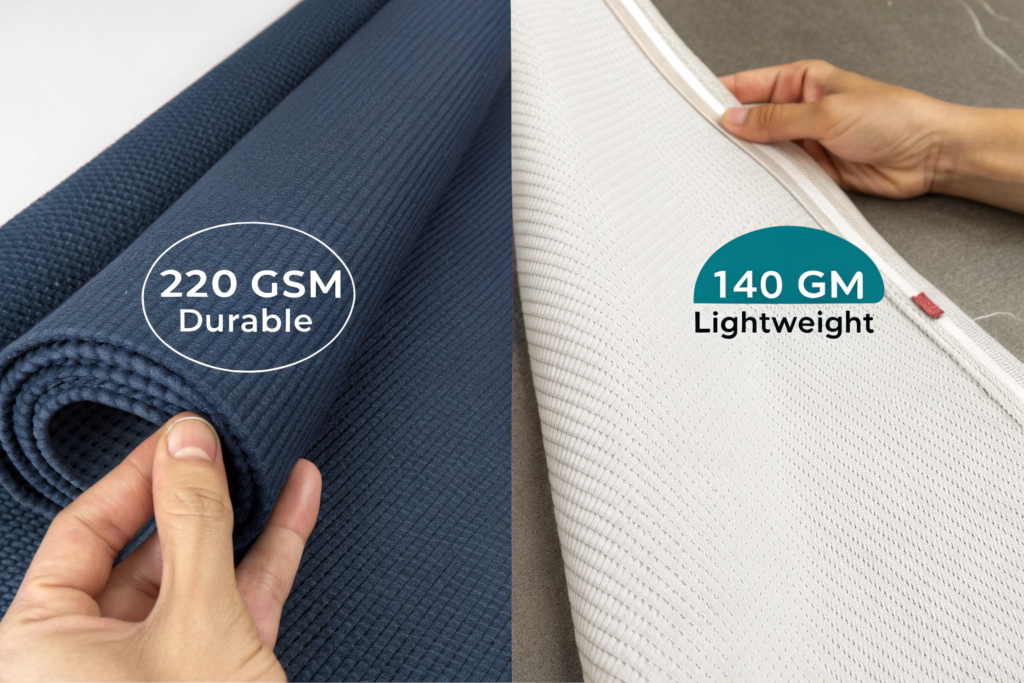
Buyers often confuse these three metrics, and suppliers sometimes exploit that confusion to obscure weight shortfalls. GSM is the final, integrated measure of fabric weight. Thread count (for woven fabrics) or stitch density (for knits) measures how many yarns fit into a given length, but says nothing about how thick or heavy each individual yarn is. Yarn denier or yarn count (Ne, Tex, etc.) measures the linear density of the yarn itself, but says nothing about how tightly those yarns are packed together.
A fabric can have a high thread count but low GSM if it uses very fine yarns tightly packed. A fabric can have low thread count but high GSM if it uses coarse, heavy yarns loosely packed. GSM integrates yarn size and packing density into one number. A textile education resource on the relationship between fabric GSM, yarn count, and weave density explains how to decode these interacting variables. When a spec sheet specifies all three—GSM, yarn count, and thread count—you have a fully defined fabric. When only thread count is specified, the weight is undefined and subject to interpretation, which usually means "subject to cost reduction."
What is a normal GSM range for common apparel fabrics?
GSM expectations vary by fabric type and end use, but knowing the typical ranges helps you spot a spec that doesn’t make sense before you order.
| Fabric Type & Application | Typical GSM Range |
|---|---|
| Lightweight voile / lawn (dresses) | 60 – 90 |
| Standard cotton shirting poplin | 110 – 140 |
| Midweight cotton twill (chinos) | 200 – 280 |
| Heavy cotton canvas (workwear) | 300 – 450 |
| Lightweight jersey (t-shirts) | 130 – 160 |
| Midweight jersey (premium t-shirts) | 180 – 210 |
| Heavyweight fleece (hoodies) | 300 – 400 |
| Woven wool suiting | 180 – 250 |
| Denim (lightweight to heavyweight) | 200 – 450 |
A GSM under 100 for a structured shirt or over 500 for a non-industrial fabric should trigger a conversation with the supplier about whether the specification is realistic for the intended design. Our merchandising team flags outlier GSM requests to the R&D group for feasibility review before quoting.
Why Do Some Mills Deliver Inconsistent GSM Even When You Pay for "Heavy"?
You specified 250 GSM. The purchase order says 250 GSM. The sample was 250 GSM. Then the bulk arrives, and random spot checks reveal 230 GSM, 242 GSM, and one roll that’s actually 262 GSM. The average might be close to spec, but the variation is wild, and your cutting room doesn’t work with averages. They work with the roll on the table right now, and if that roll is 8% underweight, that batch of garments will feel different from the batch cut from a heavier roll. Your customer tries on a medium in the store, likes it, buys a different medium online, and returns it because "the fabric feels cheaper." The variation is the villain, not the average.
GSM inconsistency almost always traces back to one of three root causes: uncontrolled yarn tension during knitting or weaving, uneven finishing processes, or deliberate overstretching. Yarn tension varies when a mill runs different machines at different speeds without recalibrating the take-up rate. A fabric knitted at high tension comes off the machine narrower and denser; knitted at low tension, it’s wider and looser. If both get stretched to the same finished width during finishing, the loose one ends up thinner and lighter. Uneven finishing happens when a stenter frame has temperature variation across its width, or when the dwell time isn’t consistent roll to roll. The fabric’s residual shrinkage varies, and the post-wash GSM varies accordingly. Deliberate overstretching is the most cynical cause: a mill stretches the fabric laterally to hit the width spec, which thins it out and reduces the GSM, saving fiber cost that goes straight to their margin. The fabric looks fine on the inspection table because width and color match the spec. The weight shortfall only shows up on a scale, and many buyers never check. A Los Angeles streetwear brand’s 2024 fleece order from a competitor measured GSM ranging from 380 to 430 against a 400 GSM spec. The 380 GSM rolls produced hoodies that felt flimsy and generated customer returns; the 430 GSM rolls were fine, but the cutting yield suffered because the fabric was denser and consumed more yardage per unit. The brand’s production manager told us the inconsistency cost more in returns and yield loss than the dollar amount they saved on the cheaper unit price. Our fleece production for the same brand in 2025-2026 has held a GSM band of 388 to 412 against the same 400 GSM spec.
How do you test for overstretching specifically?
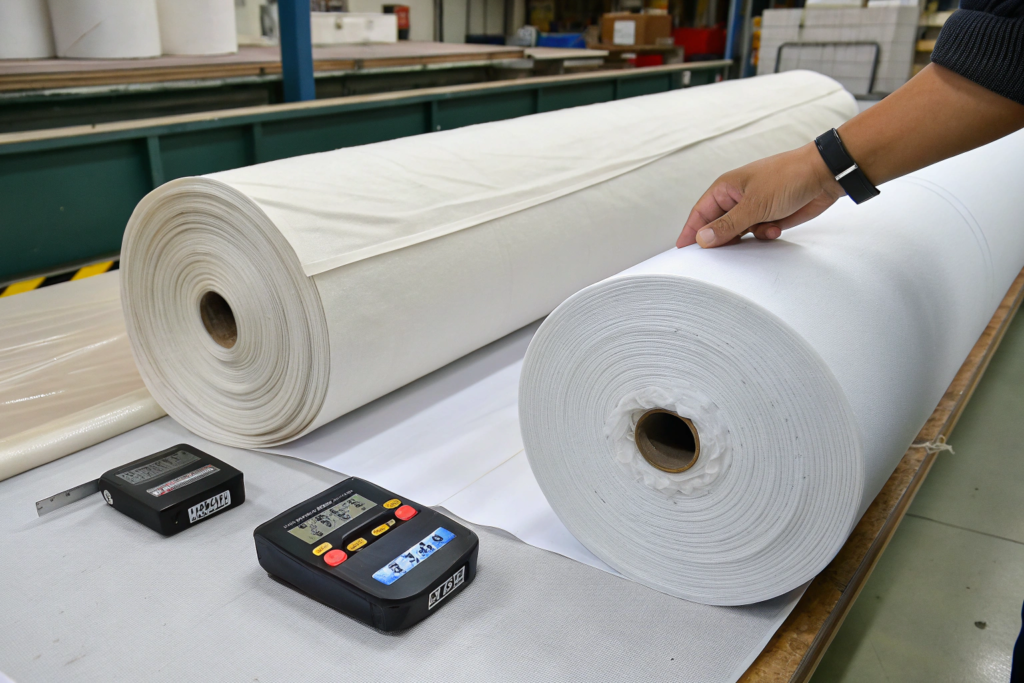
Overstretching during finishing leaves a signature that a simple scale check won’t catch by itself. The stretched fabric typically has lower GSM at the edges (where the stenter pins gripped) and higher GSM in the center, or exhibits a "trampoline" behavior where the fabric recoils after relaxation.
Our CNAS lab tests for overstretching using a "relaxed GSM" protocol. We cut a sample, let it rest flat and undisturbed for 24 hours in standard atmosphere (20°C, 65% relative humidity), then measure GSM. If the relaxed GSM is more than 2% below the inline GSM measured immediately after finishing, the fabric was overstretched and will likely shrink in width and gain weight when laundered by the consumer. A technical explanation of fabric relaxation shrinkage testing and its relationship to GSM accuracy describes this effect. We reject any batch where the relaxed GSM drops more than 3% from the target, even if the inline GSM reading looked fine. The consumer washes the garment, and the fabric relaxes to its true dimensions. We design for post-wash reality, not pre-shipment window dressing.
Does atmospheric moisture affect GSM?
Yes, and this is a source of dispute that honest mills and honest buyers can resolve with standardized conditioning. Cotton and other cellulosic fibers absorb atmospheric moisture, which adds weight. A cotton fabric measured in humid Guangzhou in August can measure 4-5% heavier than the same fabric measured in dry Denver in January.
All our GSM measurements referenced in specifications and test reports are taken under standard atmospheric conditions for textile testing: 20°C plus or minus 2°C and 65% plus or minus 4% relative humidity, as specified in ISO 139. The sample is conditioned in this atmosphere for 24 hours before measurement. A guide to standardized textile testing atmosphere requirements for accurate GSM measurement provides the ISO and ASTM standard references that we follow. If you’re measuring GSM at your own facility and the result differs from our test report, the first question is environmental: what was the temperature and humidity? A discrepancy under 5% is likely atmospheric. A discrepancy over 5% is likely a real weight difference.
How Does Fumao’s Inline Inspection System Catch GSM Drift Before It Ships?
The traditional GSM check is a lagging indicator. A QC inspector pulls a sample from a finished roll, cuts it with a circular die cutter, weighs it on a scale, and records the result. That’s one data point from one roll measured 15 minutes ago, while 30 more rolls were produced in the interim. If roll number 5 was light, rolls 6 through 35 might also be light, and nobody knows until the batch is complete, packed, and irreversibly wrong. Catching GSM drift after production means you’re not preventing a problem. You’re documenting a failure.
We installed inline GSM sensors on our two primary stenter frames in Q2 2025, and the system has transformed weight control from reactive sampling to real-time process management. The sensors use beta radiation transmission—a low-energy radioactive source on one side of the fabric and a detector on the other. The attenuation of the beam as it passes through the fabric is proportional to the mass per unit area, calibrated against a known standard foil. The sensor scans continuously across the fabric width at a speed synchronized with the stenter’s production rate, generating a GSM reading every 50 milliseconds. Our QC supervisor watches a dashboard that displays a running GSM trend line with a green band representing the plus or minus 3% tolerance zone. If the trend drifts toward the edge of the band—even before it crosses—the stenter operator adjusts overfeed or width settings to nudge the GSM back toward center target. A Amsterdam-based sustainable fashion brand whose lightweight organic cotton poplin order ran through the inline system in March 2026 received a batch where the GSM across 120 rolls varied from 133 to 139 against a 136 GSM target. The band was 2.2%, well within our 3% tolerance. The previous batch from a different supplier, produced without inline monitoring, varied 126 to 146 against the same spec—a 14.7% spread. The inline system eliminated the outlier rolls at both the light and heavy extremes, and the brand’s production manager told us the cutting yield was the best they’d seen on that fabric quality in three years.

What exactly does a beta gauge measure that other sensors can’t?
Beta radiation gauges are the workhorse of inline weight measurement across the nonwovens, paper, and film industries, but they’ve been slow to penetrate woven and knit textile production because of the higher vibration and wider width of textile finishing lines.
The advantage of beta transmission over optical or infrared methods is that beta radiation’s interaction with matter depends almost entirely on mass per unit area, not on fiber type, color, moisture content, or surface texture. A dark cotton twill and a light polyester taffeta of the same GSM will produce the same beta attenuation reading, which means the sensor doesn’t require recalibration for every new fabric quality. We maintain one calibration curve per base fiber type (cotton, polyester, cotton-poly blend, viscose) with a simple offset adjustment for blend ratios. A technical overview of beta transmission gauges for textile production weight monitoring explains the physics and the practical implementation considerations. The main limitation is safety compliance: beta sources require radiation shielding, operator training, and periodic regulatory inspection. Our system operates under a license from the Zhejiang provincial environmental protection bureau, with quarterly radiation surveys and dosimeter monitoring for all operators who work within the designated control zone.
What happens when a roll is flagged for being out of spec?
The inline system doesn’t just flash an alert. It physically marks the out-of-spec zone on the fabric with a small, washable sticker at the selvedge, and logs the meter mark in the batch quality record.
When the roll reaches final inspection, our QC team unrolls to the flagged zone and takes a physical GSM measurement with a calibrated die cutter and analytical balance to confirm the inline reading. If confirmed out of tolerance, the affected section is cut out and the roll is downgraded to second quality or cut into smaller rolls that exclude the defective segment. The customer never receives the flagged section. Our out-of-tolerance flagging rate since deploying the inline system has averaged 0.7% of total production yardage, meaning fewer than 1 in 140 yards is flagged and removed. The system isn’t catching major problems; it’s catching marginal drift that would have produced a slightly inconsistent hand feel across an otherwise acceptable batch.
What Can a Buyer Do to Verify GSM Claims Before They Ship?
The bulk delivery has arrived. The container is sitting at your warehouse, and the trucking fee is already paid. You’re holding a fabric swatch in your hand, and it feels light. Now what? Do you reject the shipment based on a feeling? Do you pay for a third-party lab test that takes a week while your cutting room sits idle? The moment of GSM truth should happen before the container leaves the factory, not when it’s sitting on your receiving dock with thousands of dollars of freight cost already sunk. You need a verification protocol that is fast, cheap, reliable, and executable by someone who is not a textile engineer.
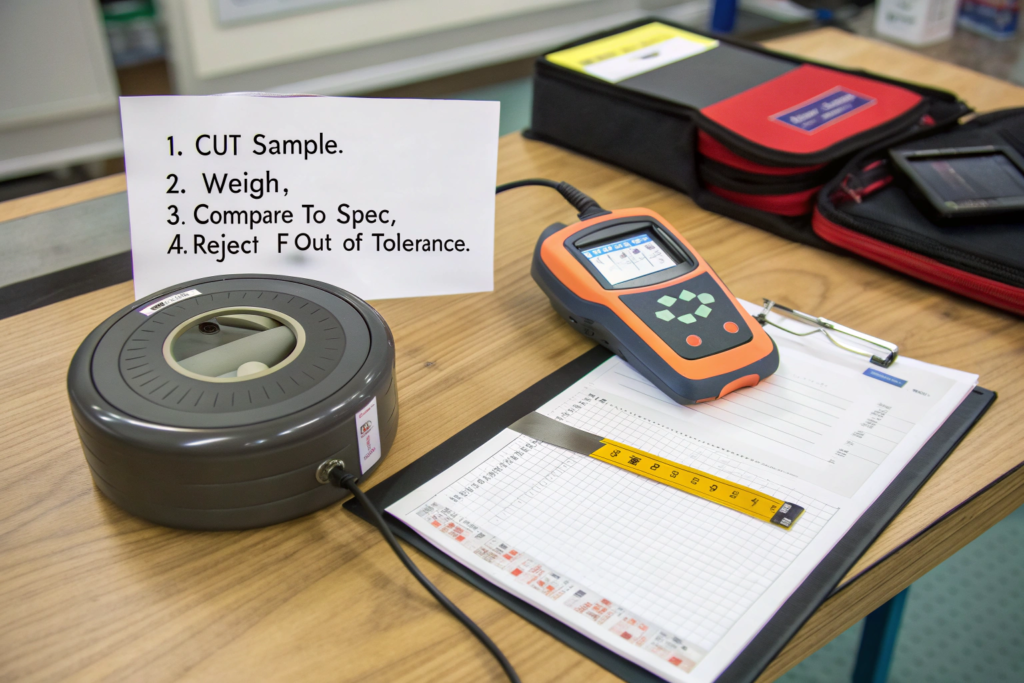
You can verify GSM claims before shipment with a simple protocol that requires three tools and about 20 minutes of your time, or the time of a third-party inspector working on your behalf. First, invest in a GSM cutter kit. This is a circular die that cuts a precisely known area—usually 100 square centimeters—and costs about $50-80 on industrial supply sites. Pair it with a digital pocket scale accurate to 0.01 grams, which costs $25-40. Multiply the scale reading by 100 (because the die cuts 1/100th of a square meter), and you have your GSM reading. Second, condition the fabric sample before cutting. The sample should rest flat in a room-temperature environment for at least 4 hours, preferably 24, to normalize moisture content. If you’re in a particularly humid or dry environment, the reading will diverge from the lab-conditioned reading, but for a go/no-go check on a shipment, this conditioning is sufficient to detect major drift. Third, take multiple samples. Cut samples from the beginning, middle, and end of at least three randomly selected rolls from different positions in the shipment lot. Average the readings and check the range. The average should be within 5% of the spec (3% if you’ve agreed to a tighter tolerance). The range between the heaviest and lightest sample should not exceed 5% of the target GSM. A wider range indicates process control problems even if the average looks fine. A Sydney-based startup founder we onboarded in 2025 bought a GSM cutter and scale for $80 total after his first shipment from a different supplier measured 14% under spec and was rejected. He’s tested every shipment from every supplier since—including ours—and told us the $80 investment has saved him an estimated $12,000 in rejected fabric over 18 months. He tested our first shipment to him, found GSM at 1.5% over spec, and emailed us to say "it’s nice to get a shipment that’s slightly heavier than I paid for instead of 10% lighter." The kit paid for itself 150 times over.
What is the relationship between GSM and fabric yield?
GSM directly determines how many linear meters you get per kilogram, which drives your garment costing. For a given fabric width, a higher GSM means fewer meters per kilogram, which means more fabric weight per garment, which means higher freight cost and potentially higher duty if duty is charged on weight.
A fabric at 200 GSM, 150cm width weighs 0.3 kilograms per linear meter (200 grams/sqm x 1.5 meters = 300 grams). A fabric at 180 GSM, same width, weighs 0.27 kilograms per linear meter. Over a 5,000-meter order, the 200 GSM shipment weighs 1,500 kilograms. The 180 GSM shipment weighs 1,350 kilograms—150 kilos lighter. If the supplier delivers 180 GSM against a 200 GSM spec, you’re paying for 10% less material than you budgeted, and your garment will weigh 10% less, which may not sound catastrophic, but the structural integrity loss in a garment designed for a specific weight is often the invisible culprit behind poor drape and premature wear. A practical guide on calculating fabric consumption and costing using GSM explains the math in detail. We include weight-per-linear-meter on every packing list so your production team can verify yield assumptions without cutting into rolls.
Can you use a postal scale and a smartphone calculator if you don’t have a GSM cutter?
A GSM cutter is the gold standard because it eliminates the area measurement variable. But in a pinch, yes, you can jury-rig a measurement that will catch gross underweight fraud.
Cut a precise 10cm x 10cm square from the fabric using a ruler and a sharp rotary cutter, or trace a 10cm square template. Measure the actual dimensions with a ruler to confirm they’re within 1mm of target. Weigh the square on a scale accurate to 0.1 grams or better. Multiply by 100. This is your approximate GSM. The method is less accurate than a die cutter because the edges may fray or the square may not be perfectly dimensionally accurate, but it will detect a 10% GSM shortfall—and a 10% shortfall is the difference between "acceptable variation" and "you’ve been cheated." A DIY guide on measuring fabric GSM without professional equipment for small brands and startups provides templates and step-by-step instructions. We encourage every first-time buyer to test a sample from their first shipment. If our GSM is off by more than 3%, the shipment is eligible for a replacement or credit. If it’s within 3%, you’ve verified our spec and can trust the process for future orders.
Conclusion
GSM is the textile industry’s most honest number because it’s the hardest to fake without getting caught. A mill can doctor a hand feel with softeners that wash out. They can print a color that fades. They can stretch a width that shrinks back on the first wash. But a scale doesn’t lie, and a GSM cutter doesn’t care about marketing language. It simply tells you how much fiber is in the fabric, and fiber is what you’re paying for. At Shanghai Fumao, we’ve invested in inline beta gauge monitoring, relaxed-state conditioning protocols, and a QC system that flags and removes any roll section outside a plus or minus 3% band because we know that fabric weight variations are not trivial cosmetic issues. They’re structural integrity issues that determine whether your customer’s garment drapes properly, wears durably, insulates adequately, and matches the sample that won you the purchase order in the first place.
When you’re comparing supplier quotes and one is 15% cheaper than the others, ask yourself: what’s the GSM? The cheaper quote might be a 160 GSM fabric quoted against a 200 GSM spec, and the price difference isn’t a better deal—it’s less fiber. The scale will tell you the truth. If you want to verify our GSM claims with a sample shipment, or if you’d like to see the inline monitoring data from a production run of the fabric quality you’re considering, email our Business Director Elaine at elaine@fumaoclothing.com. She can send you a sample pack with a copy of the corresponding GSM test report, the inline sensor trend data, and a GSM cutter kit recommendation so you can verify the numbers yourself. The scale is on the table. The fabric is ready.