As a fabric supplier, I’ve noticed a common frustration among our US clients. You want the efficiency of a single partner who can handle everything from the initial yarn selection to having the finished fabric arrive at your warehouse, but you often find yourselves managing multiple vendors, dealing with communication gaps, and facing unexpected logistical hurdles. This fragmented process eats into your profit margins and delays your production timelines. The question then becomes, is there a supplier that can truly offer a seamless, integrated solution from concept to delivery?
Partnering with Fumao Fabric for one-stop customization means you get a single point of contact and accountability for your entire fabric sourcing journey. We manage every step internally or through our vetted, co-located partner factories, from sourcing raw materials like GOTS certified organic cotton and recycled polyester to weaving, dyeing, finishing, rigorous quality inspection, and finally shipping DDP (Delivered Duty Paid) to your door in the US. This eliminates the complexity of coordinating between different entities and gives you complete cost and timeline transparency from the very beginning.
Let me walk you through exactly how this partnership works, breaking down the key stages and the tangible benefits you can expect.
What does true one-stop fabric customization involve?
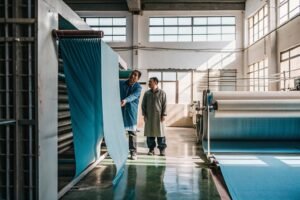
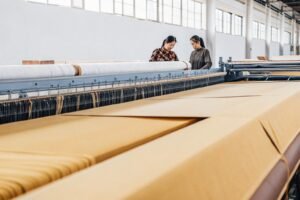
Many suppliers claim to offer one-stop services, but the reality often involves outsourcing key stages, which leads to communication breakdowns and quality inconsistencies. At Fumao, our one-stop model is built on a foundation of integrated infrastructure and centralized project management. It means we have direct control or long-term, exclusive partnerships with facilities for every single step of the process, all located within the Keqiao textile cluster. This geographic proximity is a game-changer for speed and coordination.
True one-stop customization is not just a service list; it’s an operational philosophy. It means when you place an order for a custom 400T nylon taffeta with a waterproof PU coating, you are not just buying fabric. You are engaging a system. Our team manages the entire chain: we procure the specific nylon filaments, oversee the weaving at our factory, coordinate the dyeing at our partner facility just minutes away, send it to our coating factory for the PU treatment, and then route it to our inspection house for a final check before packaging. You have one dedicated project manager who provides updates at every stage, eliminating the need for you to call five different factories. This is how we achieved a 98% on-time delivery rate for our North American clients last year. Understanding the scope is the first step to seeing the value beyond the price per meter.
How does integrated control streamline communication?
Imagine you need to adjust the color saturation after seeing a lab dip. In a fragmented model, your message goes from you to a trader, then to a dyeing master, and back through the same chain, with high risk of miscommunication. In our integrated model, you communicate the change directly to your project manager, who walks the revised Pantone code directly to the dyeing factory floor the same day. This direct line cuts down decision time by over 70%. We’ve built our operations around this principle. For instance, in early 2023, a sportswear brand from California was developing a new line of moisture-wicking polyester jerseys. They were concerned about the precise shade of their signature "electric blue" and the consistency of the wicking finish. Because our R&D lab, weaving, and finishing units are in constant communication, we were able to produce three iterative samples in under a week, each with minor adjustments based on their feedback, until the color and performance were perfect. They didn’t have to explain their requirements to a new contact at each stage; their project manager was the constant, ensuring their vision was accurately translated. This is the power of integrated control. For those looking to understand how to better manage such complex supply chains, resources like how to improve communication with overseas textile suppliers can offer additional insights.
What are the tangible cost benefits of a consolidated supply chain?
The financial advantages go far beyond a simplified invoice. Consolidation means we eliminate multiple mark-ups from sub-contractors. More importantly, it reduces hidden costs that plague fragmented sourcing: costs of delayed shipments, costs of re-producing faulty goods from an uncoordinated supplier, and costs of your own time spent on project management. Let’s break down a real cost scenario:
| Cost Factor | Fragmented Model (3+ Suppliers) | Fumao One-Stop Model |
|---|---|---|
| Communication Overhead | High (Your team manages multiple contacts) | Low (Single point of contact) |
| Shipping & Logistics | Multiple international shipments, consolidated by a 3PL | Single domestic-to-international shipment |
| Quality Risk | High (No single point of accountability) | Low (Integrated QC across the chain) |
| Sample Development Cost & Time | Higher cost, 1-2 weeks | Lower cost, 3-5 days |
A client from Texas in 2023 was sourcing a custom jacquard upholstery fabric. By using our one-stop service, they saved approximately 12% on the total landed cost (FOB + Logistics + Duties) compared to their previous model of using separate weaving and finishing houses. This was primarily due to reduced logistics fees and avoiding a $5,000 loss they would have incurred from a dyeing mistake that was caught and rectified internally by our QC team before the fabric ever left our ecosystem. Understanding the full financial picture is crucial, and learning about calculating total landed cost for imported fabrics from Asia is a vital part of that process.
How does your R&D process work for new fabrics?
The journey of a new fabric begins with your idea. Our R&D process is designed to be collaborative and rapid, turning your concept into a tangible, high-quality sample in record time. We kick off every new project with a deep-dive consultation, either virtually or at our showroom in Keqiao. We don’t just take your brief; we question it to fully understand the application, target price point, desired hand-feel, technical performance needs, and sustainability goals. This initial alignment is critical to avoid costly missteps later.
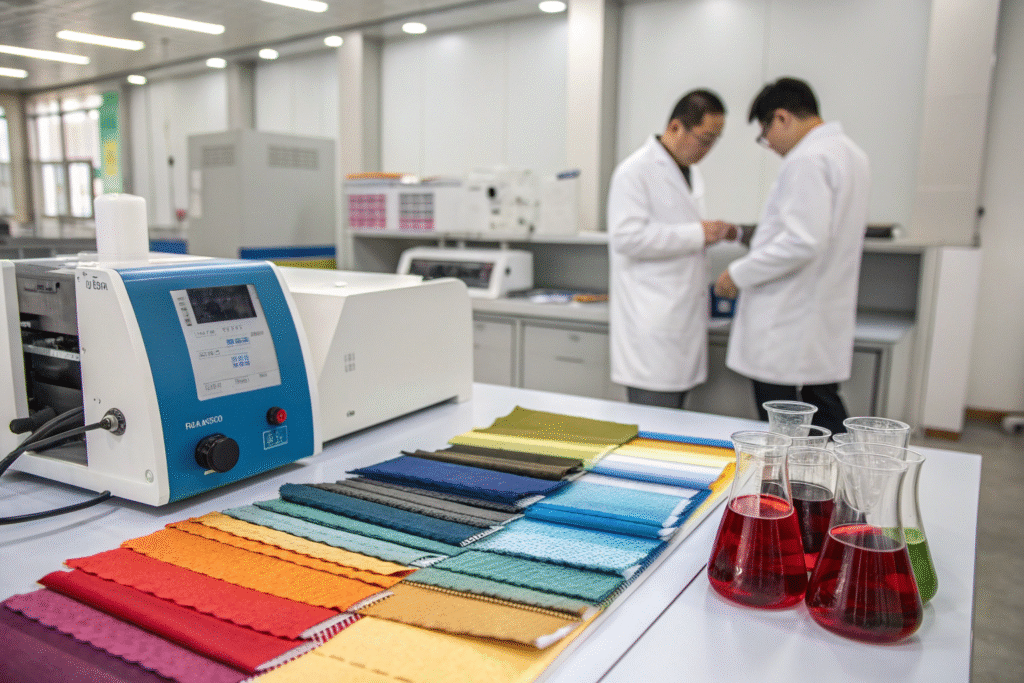
Once we have a clear direction, our 20+ R&D experts spring into action. Leveraging our in-house CNAS-certified lab and AI-driven trend analysis tools, we propose specific fiber blends, constructions, and finishes. For example, a startup from New York approached us in late 2023 to create a unique blend of BAMSILK (bamboo silk) and Tencel™ for a luxury loungewear line. They wanted a fabric that was ultra-soft, breathable, and had a beautiful drape. Within 48 hours of our initial call, we had prepared three different blend ratios and sent them digital swatches and technical data. They selected one, and we produced a full 5-meter lab sample for their evaluation within the week. This speed is possible because we control the sample development process end-to-end, from sourcing the specialty yarns to the pilot-scale weaving and finishing. (Here I have to interject, our sample speed is a real game-changer for our clients.)
How can you participate in the fabric development process?
Your involvement isn’t just welcome; it’s essential. We facilitate this through our digital platform. After the initial consultation, you gain access to a private project portal where you can track the sample’s progress, view high-resolution photos at different stages, and provide immediate feedback. We don’t work in a black box. For the New York loungewear startup, they were able to request a slight increase in the fabric’s weight after feeling the first physical sample. We adjusted the weave density and sent a revised sample in just three days. This iterative, collaborative loop ensures the final product is exactly what you envisioned, if not better. We provide you with all the technical data from our tests—colorfastness, shrinkage, tensile strength—so you can make informed decisions. This level of transparency builds trust and demystifies the development process. To get the most out of such collaborations, it’s helpful to understand key questions to ask when developing custom technical fabrics.
What is the role of your CNAS-certified lab in R&D?
Our CNAS-certified lab is the backbone of our R&D and quality assurance. It’s not just a testing facility; it’s an innovation hub. During development, we use the lab to pre-validate concepts before we even produce a sample. For instance, if you need a fabric with UPF 50+, we can simulate the result based on the fiber type, weave structure, and dye formula, saving us time and resources. When we produce a sample, it undergoes a battery of tests against international standards like AATCC and ISO. This means the performance data you receive with your sample—for attributes like pilling resistance, moisture-wicking efficiency, or abrasion resistance—is reliable and accurate. This data-driven approach de-risks your investment. A client from Seattle developing high-performance workwear used our lab data to confidently pass their own internal compliance checks, speeding up their time-to-market by a month. The lab ensures that "innovation" at Fumao isn’t just a buzzword; it’s a measurable, repeatable process. For brands looking to ensure quality, knowing about international textile testing standards for importers is fundamental.
How do you ensure consistent quality from yarn to shipment?
Consistent quality is the non-negotiable result of a controlled, one-stop supply chain. Our philosophy is to "build quality in" at every stage, rather than just "inspecting it out" at the end. This process starts with our raw material inspection. Every batch of yarn, whether it’s organic cotton or recycled polyester, is checked for consistency, strength, and conformity to specification before it’s ever loaded onto our looms. This proactive approach prevents defects from being woven into the fabric in the first place.
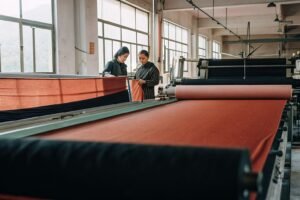
Our quality control is a continuous thread running through the entire production process. We have stationed QC personnel at every partner factory—weaving, dyeing, printing, coating. They are our eyes and hands on the ground, conducting inline checks. They monitor for issues like loom tension during weaving, evenness of dye uptake during coloration, and consistency of coating application. This real-time monitoring allows for immediate corrections. For a large order of printed satin for a European fast-fashion retailer in 2024, our inline QC at the printing factory spotted a slight misalignment in the print roller early in the run. The issue was corrected within an hour, preventing a massive waste of fabric and ensuring the bulk order matched the approved sample perfectly. This multi-layered QC system is why we can guarantee a 98% client pass rate on final inspection.
What does your final pre-shipment inspection cover?
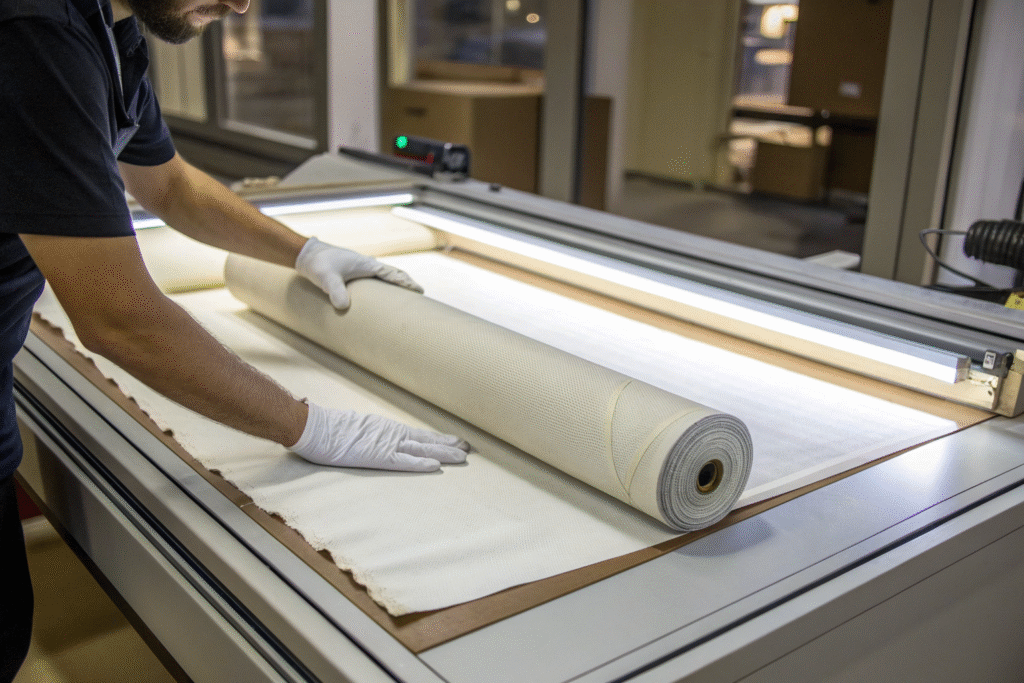
The final pre-shipment inspection at our dedicated inspection facility is the last and most rigorous checkpoint. We unroll and examine every single meter of fabric over a backlit inspection table. Our inspectors, trained to the 4-point system, look for any and all defects: slubs, holes, stains, color deviations, weaving errors, and coating inconsistencies. Each defect is marked and graded. We don’t just give a pass/fail; we provide you with a detailed inspection report that includes photos of any major defects. This report is your assurance of quality before the fabric is even packed.
Furthermore, we have integrated advanced QR code tracking. Each roll has a unique code that, when scanned, provides you with a digital passport of that specific piece of fabric. You can access its full history: composition, yarn origin, dye lots, and all the test results from our CNAS lab for physical properties and colorfastness. This level of traceability is unprecedented for most fabric suppliers and provides you with absolute peace of mind and simplifies your own compliance documentation. It’s a system we developed after understanding the pain points of brands that need to know managing textile compliance for US apparel brands.
How does your system prevent common quality disasters?
Common disasters, like color shading between batches or inconsistent performance, are prevented by standardization and control. Because we manage the dyeing and finishing in a limited number of partner facilities, we can enforce strict standard operating procedures (SOPs). Our recipe for a specific color is locked in and followed precisely for every batch. The dyeing parameters—temperature, time, chemical ratios—are digitally controlled for repeatability.
Let me give you a concrete example. A common nightmare is "barre," a subtle stripe effect in knitted fabrics caused by tension variations. In 2023, we worked with a Miami-based activewear brand that had previously suffered massive losses from barre in their poly-spandex knits. By controlling the knitting, dyeing, and finishing under our integrated system, we standardized the yarn tension, heat-setting temperature, and relaxation process. The result? We delivered over 50,000 meters of fabric across multiple production batches with zero barre defects. Their design director told us it was the most consistent knit fabric they had ever sourced from Asia. This is the power of a prevention-focused system, not just a detection-focused one.
How does your DDP shipping model simplify logistics?
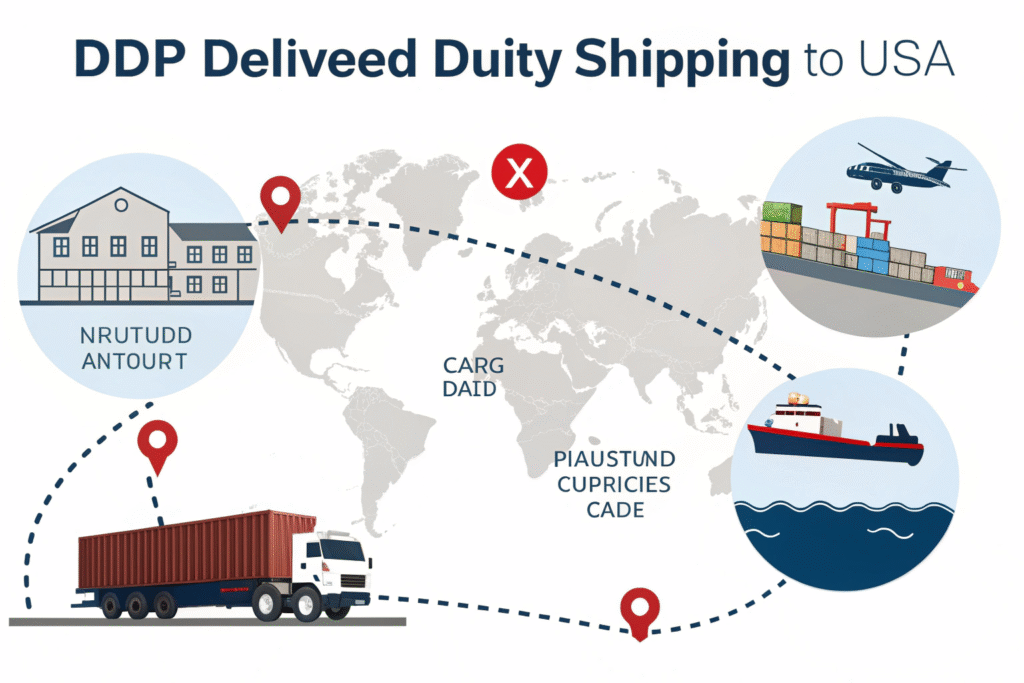
For our US clients, navigating ocean freight, customs clearance, and final delivery is often the most stressful part of the process. Our Delivered Duty Paid (DDP) model is designed to take that burden completely off your shoulders. When you buy from us on DDP terms, you get one all-inclusive price that covers the cost of the fabric, all export/import formalities, international freight, insurance, and duties/taxes right up to the delivery of the goods to your designated warehouse in the US. You know the total cost upfront, with no surprises.
We leverage our scale and long-term partnerships with major freight forwarders to secure reliable and cost-effective shipping space. Our logistics team handles everything: booking the container, managing the port documentation, and coordinating with our partners on the US side for customs brokerage and final trucking. We provide you with real-time tracking, so you know exactly where your shipment is from the moment it leaves our warehouse in Keqiao until it arrives at your dock. This model is particularly advantageous in the current volatile shipping market, as we absorb the risk and complexity of fluctuating freight costs and schedule changes.
How do you mitigate US tariff uncertainties?
This is a critical question for every importer. Our DDP model is your primary shield against tariff uncertainty. Since we quote you a fixed price that includes all estimated duties and taxes, the risk of cost fluctuation due to tariff changes falls on us, not you. This provides you with budget certainty for your production planning. Furthermore, our diverse product portfolio and agile supply chain offer strategic flexibility. For instance, if a particular synthetic fabric faces high tariffs, our R&D team can often develop an alternative blend or source different yarns that achieve a similar performance and hand-feel but fall under a more favorable tariff code. We actively monitor trade policies and advise our clients on the most cost-effective sourcing strategies. This proactive approach saved one of our clients in the outdoor apparel sector thousands of dollars in 2023 when we helped them transition to a new recycled nylon source that was not subject to the same tariff pressures.
What is your track record for on-time US delivery?
Timeliness is a core part of our value proposition. While no one can control weather or port congestion with 100% accuracy, our integrated model and logistics expertise give us a significant advantage. By controlling the production timeline tightly, we reduce the risk of missing the vessel cutoff. Our historical data shows a 95%+ on-time delivery rate to major US ports (LA/Long Beach, Newark) over the past 24 months. A key factor is our "Silk Road Keqiao" initiative, which gives us priority access to container booking and streamlined customs pre-clearance processes from the local port. For a recent order from a Chicago-based uniform company, we faced a potential 2-week delay due to a sudden port strike. Because we have established relationships with multiple carriers, our logistics team was able to swiftly re-route the shipment through an alternative port with only a 4-day delay, which the client could easily absorb without disrupting their production line. This level of logistical resilience is what sets us apart. For businesses building their supply chain, understanding comparing FOB vs DDP for clothing importers is a crucial step.
Conclusion
Partnering with Fumao Fabric for your one-stop customization needs is fundamentally about reducing complexity, de-risking your supply chain, and accelerating your time to market. It’s a shift from dealing with a simple vendor to collaborating with a true extension of your own team. We bring to the table integrated control from yarn to finish, a collaborative and rapid R&D process, a multi-layered quality assurance system that builds quality in, and a simplified DDP logistics model that delivers peace of mind along with your goods. The result is not just high-quality fabric, but a predictable, efficient, and transparent sourcing experience that allows you to focus on what you do best: designing and selling great products.
If you are ready to experience a simpler, more reliable way to source fabrics, we would be thrilled to discuss your next project. For a personalized consultation on how we can partner to produce your clothing line, please reach out to our Business Director, Elaine. She and her team are ready to provide you with a comprehensive quote and walk you through our process. You can contact Elaine directly at elaine@fumaoclothing.com. Let’s weave your success story together.