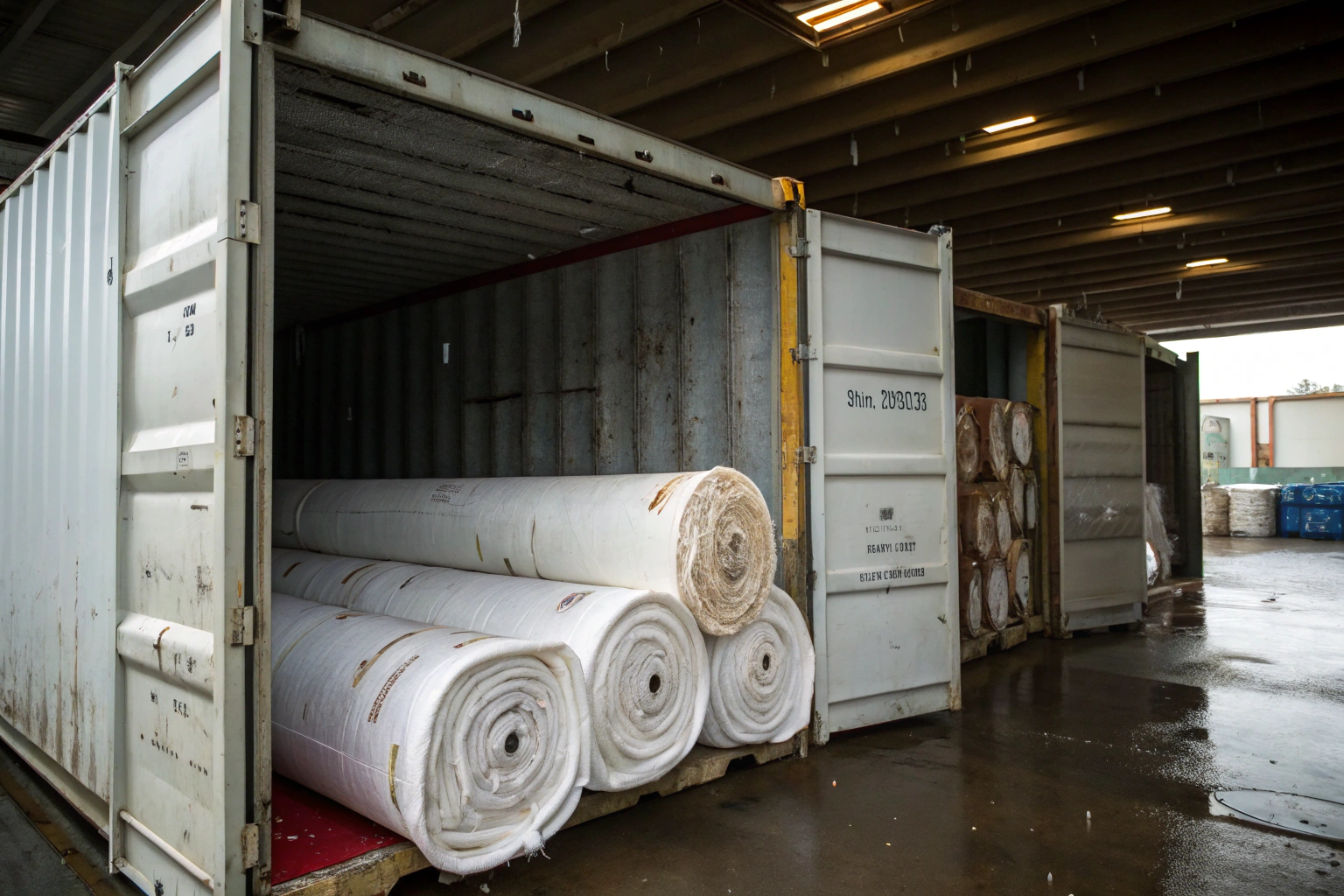
You waited eight weeks for your custom cotton-linen shirting. The container finally arrives at your warehouse. You cut the seal, open the doors, and your stomach drops. The top layer of rolls is wet. Condensation drips from the ceiling of the container. Three rolls have visible mold spotting on the outer layers. The fabric you needed for next week’s cutting is ruined. You feel sick. You wired $18,000 for this order. Are you about to eat that loss? I have seen this panic in a buyer’s voice. A furniture brand in Texas called me in 2023 with exactly this scene unfolding on their loading dock. The fear is real, but the situation is solvable if you know the right steps.
If your custom cotton linen order from Shanghai Fumao arrives damaged, you are protected by a layered system of pre-shipment inspection, marine cargo insurance, and a clear post-delivery claims process. The first step is to document the damage immediately with timestamped photos and a written notation on the delivery receipt before the truck leaves your dock. The second step is to notify us within 48 hours so we can open an insurance claim and determine whether a replacement order needs to go into production immediately. You will not be left holding damaged goods with no recourse.
A damaged shipment is a logistics failure, not a relationship failure. How we handle it together determines whether it becomes a permanent loss or a temporary delay. Let me walk you through exactly what to do from the moment you open that container, how our insurance works, and how we make it right.
What Should I Do Immediately If My Fabric Arrives Damaged
The first hour after you discover damage is critical. What you do in that hour determines how smoothly the insurance claim goes and how fast we can get replacement fabric into production. The instinct to panic is normal. The discipline to document is what saves you. I train every client on this procedure before their first shipment because the steps are simple but time-sensitive.

Do I Need To Note The Damage On The Delivery Receipt?
Yes, and this is the single most important step. When the truck driver hands you the delivery receipt to sign, do not sign it clean. Write a detailed notation of the visible damage directly on the receipt before signing. Write something like "Container seal broken, 3 rolls wet with mold, full inspection pending." This notation creates a legal record that the damage existed at the time of delivery, not after you moved the goods into your warehouse.
If you sign the delivery receipt without noting the damage, the shipping line and the insurance company can argue that the damage occurred after delivery and deny your claim. The driver may pressure you to sign quickly. Do not rush. Inspect the exterior of the container before the driver leaves. If possible, open the doors and look inside. Take photos of the container exterior, the seal if broken, and the interior condition. Attach those photos to your email to us. The notation on the delivery receipt plus the timestamped photos create an evidence package that makes the insurance claim straightforward. For a comprehensive checklist of all the steps you should take, you can read about the procedure for documenting freight damage upon delivery for international textile shipments to protect your cargo claim rights. The first hour of diligence pays for itself many times over.
How Quickly Do I Need To Notify Fumao Fabric?
Notify us within 48 hours, but preferably within 24. As soon as you have documented the damage and the truck has left, send an email to Elaine with the subject line "URGENT: Damage on Order #XXXXX." Attach the photos of the container, the damaged fabric rolls, and a photo of the annotated delivery receipt. Describe what you see: how many rolls are affected, the type of damage, whether the fabric appears salvageable or completely lost.
We need this notification quickly for two reasons. First, most marine cargo insurance policies require the insured party to notify the insurer within a specific window, often three to five business days, for a claim to be valid. Second, if the fabric is beyond salvaging and you need a replacement order, we want to get that new order onto the production schedule immediately. The sooner you tell us, the sooner we can solve the problem. A buyer who waits two weeks to mention the damage in passing during a call about a new order will find the insurance process much harder. Time is the enemy of a clean claim. To understand the full communication protocol, you can explore best practices for communicating shipment damage to your textile supplier and opening an insurance claim within the required notification window. Fast action preserves your options.
How Does Marine Cargo Insurance Protect My Fabric Order
Marine cargo insurance is the safety net that catches the loss when the physical shipment goes wrong. Every shipment we send, whether on FOB, CIF, or DDP terms, is covered by an all-risk marine cargo insurance policy unless you explicitly instruct us otherwise in writing. This insurance covers physical loss or damage to the fabric during transit from our factory to your destination port. It covers water damage, container collapse, theft, fire, and general average events. It does not cover inherent vice, such as fabric that degrades because of a defect in the fabric itself, but it covers the external perils of ocean and land transit.

What Does All-Risk Marine Insurance Actually Cover?
All-risk marine cargo insurance covers physical loss or damage from any external cause during the insured transit. The key word is "external." If a container roof leaks during a storm and seawater soaks the top rolls, that is covered. If a forklift operator at the port punctures a roll with the tines, that is covered. If the container is stolen from the port, that is covered. If the ship catches fire and the entire container is lost, that is covered.
The policy covers the full commercial invoice value of the goods, plus the freight cost, plus a percentage for lost profit, typically 10%. This means if the fabric is a total loss, you recover the full amount you paid for the fabric and the shipping, plus a margin to cover the lost opportunity. The deductible is typically low or zero for total loss events. Partial loss, such as three rolls damaged out of fifty, is calculated on a proportional basis. The insurance company surveys the damage, determines the percentage of loss, and compensates that percentage of the insured value. To understand the fine print of what is and is not covered, you can read a guide to the scope of all-risk marine cargo insurance coverage for textile import shipments and common exclusions. Knowing the coverage boundaries helps you file a stronger claim.
Who Pays For The Replacement Fabric While The Claim Processes?
The insurance claim takes time. The insurer needs to investigate, appoint a surveyor, review the documentation, and issue payment. This can take four to eight weeks. Your cutting room cannot wait eight weeks for replacement fabric. Your production deadline does not move. We solve this problem by separating the insurance process from the replacement process.
If the damage is clearly documented and the cause is an insured peril, we begin production on a replacement order immediately, without waiting for the insurance payout. The replacement order is a new purchase order with a new production timeline. You pay for the replacement order according to our standard payment terms. The insurance payout, when it arrives, reimburses you for the lost original order. This means you need the working capital to float the replacement order during the claim period. I understand this is a financial strain, and I am transparent about it. The alternative is to wait for the insurance payout and then place the replacement order, but that guarantees a long production delay. For buyers who cannot float the replacement cost, we can discuss a negotiated arrangement where we split the replacement cost and apply the insurance payout to the balance. Every situation is different, and we handle it case by case. For a deeper look at this financial dynamic, you can explore how textile suppliers and buyers manage replacement production timelines while awaiting marine cargo insurance claim settlements. The goal is to keep your production moving.
What Is Fumao Fabric’s Replacement And Remake Policy
Damage from transit is one category of problem. A fabric defect that we missed during inspection is another. Our replacement and remake policy distinguishes between these two root causes because the responsibility lies in different places. Transit damage is a logistics issue covered by insurance. A manufacturing defect is a quality issue covered by us. Both result in a solution, but the path is different.

What If The Fabric Has A Manufacturing Defect, Not Transit Damage?
If you open the container, the fabric is dry and the packaging is intact, but you find a weaving defect, a dyeing shade variation, or a finishing problem that makes the fabric unusable, that is a manufacturing defect. The procedure is different from transit damage. You do not file an insurance claim because insurance does not cover inherent product defects. You file a quality complaint directly with us.
Send us photos and a detailed description of the defect. If possible, cut a swatch showing the defect and courier it to our QC department. We compare the defect to our pre-shipment inspection records. Our CNAS lab tests the fabric against the approved specifications. If we confirm the defect is our responsibility, we issue a credit memo for the defective yardage or we produce a remake order at our cost. The remake goes onto the production schedule with priority status. We do not wait for a claim investigation. We own the mistake and we fix it. The time from confirmed defect to replacement shipment is typically the standard production lead time, expedited where possible. For guidance on how to document a defect claim properly, you can read about how to file a textile quality complaint with a Chinese fabric mill for manufacturing defects and negotiate a fair remedy. A well-documented claim gets resolved faster.
How Do You Decide Between A Credit And A Physical Replacement?
The decision depends on your immediate need and the nature of the defect. If the defect affects only a portion of the yardage and the remaining fabric is usable, a credit for the defective portion makes sense. You keep the good fabric, you get your money back for the bad fabric, and you order a smaller replacement piece if needed.
If the entire batch is unusable, or if you need the full yardage for a single production run where a partial shipment does not help, a full physical replacement is the right solution. We produce the same specification again and ship it to you. The cost of the replacement fabric and the shipping is on us. You do not pay twice for our mistake. The decision between credit and replacement is yours to make based on your production reality. We provide our assessment of the defect, but you tell us what you need to keep your cutting room running. I believe this is the only fair way to handle a quality failure. The mill that made the error should absorb the cost of the fix, and the buyer should choose the form of the fix that minimizes the disruption to their business. To understand the factors that influence this decision, you can explore the options for fabric defect remedies including credit notes and replacement production in textile supply agreements. The right remedy is the one that gets your business back on track fastest.
How Do You Prevent Damaged Shipments In The First Place
The best damage claim is the one that never happens. We invest heavily in packaging and loading procedures designed to withstand the brutal physical environment of ocean transit. A container at sea experiences vibration, temperature swings from freezing to 120 degrees Fahrenheit, humidity near 100%, and the occasional 30-foot wave. Fabric that is not properly prepared for this environment will arrive damaged. We prepare every shipment as if it will face the worst conditions the Pacific Ocean can throw at it.

What Packaging Materials Do You Use For Ocean Freight?
Every roll of fabric receives three layers of protection. The first layer, directly against the fabric, is a sealed polyethylene bag. This is a moisture barrier. It prevents the fabric from absorbing humidity from the container air, and it prevents condensation from dripping onto the fabric if the container undergoes a temperature swing. The bag is heat-sealed, not taped, to ensure a complete seal.
The second layer is a heavy-duty woven polypropylene outer cover, sometimes called a "jumbo bag" or "container liner." This cover is abrasion-resistant. It protects the inner polyethylene bag from rubbing against other rolls, against the container wall, or against the forklift tines during loading. The third layer is not on the individual roll but inside the container. We place industrial desiccant strips, essentially giant silica gel packs, along the container walls and ceiling. These strips absorb airborne moisture and reduce the dew point inside the container, preventing condensation from forming when the ship passes from a cold climate into a warm, humid one. This three-layer system is more expensive than simply wrapping rolls in a single layer of plastic film, but it eliminates the most common causes of transit water damage. For a detailed look at the materials and methods, you can read about ocean freight packaging best practices for rolled textile goods to prevent moisture and handling damage during transit. The packaging is your fabric’s only defense.
How Do You Load A Container To Minimize Movement And Chafing?
A container at sea is a moving environment. The ship pitches and rolls. A loosely loaded container allows the rolls to shift, rub against each other, and chafe through their packaging. We load containers with a specific method designed to create a solid, immobile block of cargo. The rolls are loaded on their ends, vertically, in rows that fill the width of the container. Spaces between rolls are filled with inflatable dunnage airbags that expand to lock the rolls in place.
The load plan ensures that there are no gaps where a roll can tip or slide. The door end of the container is secured with a heavy-duty timber brace or a steel cargo bar to prevent any backward movement during transport. We photograph the loading process at multiple stages—empty container, half-loaded, fully loaded, door closed with seal number visible—and we include these photos in your shipment documentation. These photos are also critical evidence for an insurance claim because they prove the goods were in good condition and properly secured when they left our facility. The loading procedure is the last physical interaction we have with your fabric before the ocean takes it. We treat it with corresponding seriousness. To see what this looks like in practice, you can explore standard container loading and cargo securing procedures for textile exports to prevent shifting and damage in transit. A properly loaded container is a thing of beauty and a source of peace of mind.
Conclusion
A damaged shipment is a stressful event, but it is not a financial disaster when you have the right systems in place. If your fabric arrives damaged, document the damage on the delivery receipt, photograph everything, and notify Elaine within 48 hours. Our marine cargo insurance covers the financial loss from transit damage, and we begin a replacement order immediately so your production timeline does not stall while the insurance claim processes. If the damage is a manufacturing defect, we take ownership of the error and provide either a credit or a physical replacement at our cost, your choice. And our packaging and loading procedures are designed to prevent these problems before they start, with triple-layer moisture protection and container-loading methods that eliminate movement and chafing. You are not alone in this. You have a partner who has navigated these situations before and who has the infrastructure to resolve them.
Before your first order ships, ask Elaine to walk you through our damage prevention and claims process in detail. She will send you a one-page document that outlines exactly what to do at the delivery dock, who to contact, and what information to collect. Print it out and keep it in your shipping file. When a problem occurs, and in international trade they occasionally do, you will know exactly what to do and who to call. Email elaine@fumaoclothing.com with the subject line "Shipping Protection Information." Let us make sure you are prepared before there is ever a problem.