You finally receive the container. You cut the bolt seal. You pull out the first roll of your custom-printed satin, and there it is—a dark, wet stain running through the core. The plywood pallet has collapsed, and the fork tines punctured three layers of fabric. Your heart sinks. You call the freight forwarder. They blame the shipper. You call the shipping line. They point to the "shipper’s load and count" clause. If you’re on standard FOB terms, this is the moment you realize the system is designed to leave you holding a $5,000 soaking wet rag. I’ve been exporting textiles from China for two decades, and I can tell you that damage claims are where most supplier relationships die.
At Shanghai Fumao, we don’t walk away from a damaged shipment. Our damage support protocol is a three-phase response: containment, replacement, and root-cause elimination. First, we push for an immediate salvage operation—separating the wet goods from the dry, or the torn rolls from the intact ones—often within 24 hours of notification. Second, we trigger a replacement order from our safety stock or prioritized production queue. And third, while the new goods are being made, we go to war with the carrier using the unboxing video, the warehouse receipt, and our cargo insurance policy to recover the value. You don’t fight the bureaucracy alone; we do it for you.
But the real support starts long before the container gets forklifted. It’s in the way we pack the pallets, the type of insurance we pre-negotiate, and the legal liability we assume under our DDP shipping terms. If you understand how damage happens and what your supplier is contractually obligated to do, you can stop a bad situation from becoming a catastrophic one. I’m going to walk you through exactly what we do when water, compression, or tare destroys your fabric, and how our quality control before loading prevents most damage from ever happening in the first place.
What Are the Most Common Types of Fabric Damage During International Shipping?
If I had to rank the enemies of fabric in a shipping container, moisture sits at number one. It’s called "container sweat" or "container rain." When a sealed metal box travels from the humid port of Shanghai to the colder waters off the California coast, the temperature differential causes the warm air inside to condense into water droplets on the underside of the roof. Those droplets then drip down onto the cartons, creating the dreaded "waterfall stain" on the top layers. I’ve seen entire rolls of viscose become moldy within 48 hours because someone skipped the desiccant bags to save $15.
Physical compression is the second killer. Heavy rolls of denim stacked directly on lighter cartons of silk chiffon will crush them into creases that no amount of steaming can remove. Then there’s the pallet collapse—when a cheap fumigated pallet snaps under the weight during a rough ocean swell, causing the entire stack to shift and tear against the container wall. And finally, there’s fork tine puncture. This happens when a warehouse operator at the port misjudges the pallet depth, or the pallet is too narrow, and the steel fork slides right into the fabric core. This isn’t just a tear; it usually means hydraulic fluid or dirt contaminates the fabric, rendering it unusable for apparel.

How Does Container Sweat Cause Hidden Water Damage to Textiles?
Container sweat is sneaky because the outside of the carton might look dry, but the inside has absorbed moisture like a sponge. When the water vapor condenses at the dew point, the corrugated cardboard wicks that moisture directly into the fabric selvage. By the time you unroll it, you see a yellow or brown "tide mark" along the edge. For cellulosic fibers like Tencel or linen, this moisture activates mildew spores that were dormant in the fiber. The fabric doesn’t just stain; it starts to rot, and the tensile strength drops.
To fight this, we use container desiccants—not the little silica gel packets you find in a shoebox, but heavy-duty calcium chloride strips that hang from the container ceiling and can absorb up to 2 liters of water vapor each. We calculate the placement based on the how to calculate correct desiccant usage for preventing container rain damage in textiles. For a 40-foot High Cube container loaded with bamboo fabric, we typically deploy 12 to 14 strips. We also insist on a "floating floor" method where we lay a layer of kraft paper and a polyethylene sheet under the pallets to stop ground moisture from wicking up. These steps cost about $60 extra in materials, but they prevent a $3,000 claim for moldy goods. That’s math I’m happy to do.
Why Does Pallet Collapse Lead to Fabric Tearing and Forklift Punctures?
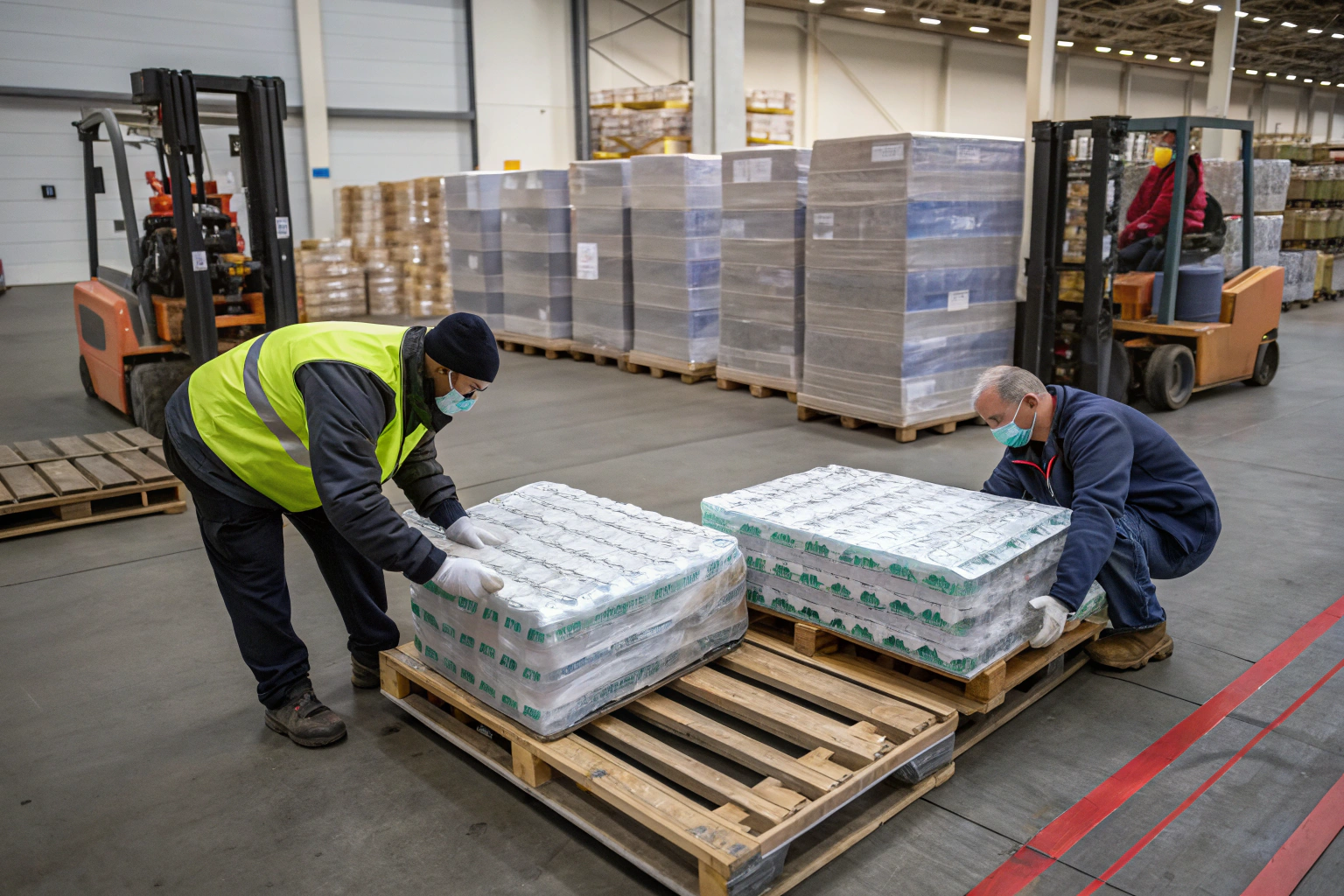
A pallet is the skeleton of your shipment. If the skeleton breaks, the flesh gets torn. The issue usually starts with a wrong pallet specification. A standard grocery pallet can’t handle a 1,000 kg stack of compacted polyester rolls that shifts during a voyage. We use heat-treated, four-way entry export pallets with a minimum dynamic load capacity of 1,500 kg. But even a strong pallet fails if the stacking pattern is wrong. You have to interlock the cartons like masonry bricks; a column stack without "tying in" the corners will topple when the ship rolls.
When a pallet collapses inside the container, the rolls spill into the central aisle. The container now becomes an unsecured shrapnel pit. When the port crane lifts the container off the ship and tilts it slightly to drive it to the chassis, those loose rolls slam against the back doors. That’s when fork tines cause the most damage. A good forklift driver knows to look for loose cargo, but they can’t see through a steel door. We strap every stack with heat-sealed polyester strapping and use edge board protectors to stop the straps from cutting into the fabric. It’s a method derived from how to stabilize export pallets to prevent shifting damage in ocean freight containers. We treat every container as if it’s going to sail through a typhoon, because sometimes, it does.
How Does Fumao’s Insurance and Claims Process Handle Shipment Damage?
When damage happens, the clock starts ticking. Most standard cargo insurance policies require you to file a claim within 3 days of delivery. If you wait a week to inspect, the insurer can reject your claim outright. This is where our process kicks in. The moment you report damage, my team pulls up your shipment’s unique file, which contains the pre-loading photos we took in our packaging factory. We have pictures of the pallets before they entered the container, showing the strap tension and the carton condition. This establishes a baseline of "shipped in good order."
We then file a claim with the cargo insurer on your behalf. This is crucial. If you are shipping under our DDP terms, the insurance certificate lists Shanghai Fumao as the beneficiary or has been endorsed over to you. Our logistics coordinator handles the formal notice of loss, provides the commercial invoice and the packing list, and schedules the cargo surveyor. We don’t let the claim stall. In a recent case from March 2025, a shipment of our recycled polyester jacquard to a client in Canada arrived with a crushed corner. We filed the claim within 5 hours of the photo evidence, got the surveyor there in 48 hours, and dispatched a replacement batch within 10 days. You don’t wait for the insurance check to clear before we fix your problem. We fix it and fight the carrier on the backend.

What Steps Do We Take to Replace Your Damaged Fabric Without Killing Your Timeline?
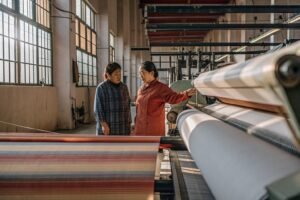
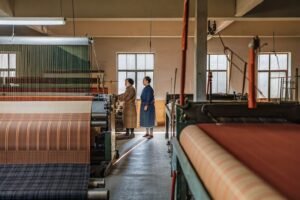
Replacement is where our vertical integration saves your production schedule. If a generic trading company ships you damaged fabric, they have to go back to their supplier, negotiate a discount on a reorder, and ask you to wait. They don’t hold stock. We do. Our large-scale weaving facility and cooperative dyeing plant maintain a "safety buffer" of our best-selling bases—think 40s combed cotton jersey, plain weave Tencel twill, and semi-dull polyester pongee. If your damaged goods were one of these core bases, we can pull from this buffer and ship within 3 days of the damage confirmation.
If your order was a custom-developed jacquard or a specialized water-repellent finish, the buffer won’t apply. But we still don’t push you to the back of the line. We activate a "damage priority slot." This means our production planner in Keqiao inserts the replacement order into the weaving queue ahead of new purchase orders. We don’t charge you extra for this expedite; it’s part of our liability for failing to deliver goods in prime condition. This capability hinges on our how to expedite replacement fabric orders from China after shipment damage. We’ve cut the replacement lead time for a complex printed rayon challis from 28 days to 15 days by compressing the knitting and scouring stages. It stings our efficiency metrics a bit, but it keeps your factory running.
Does Fumao’s Quality Inspection Provide Evidence to Support a Damage Claim?
Insurance adjusters are skeptics. They love to argue that the damage was "pre-existing" or that the packing was "insufficient." Our weapon against this argument is our documented loading inspection, which we call the "container consolidation report." As part of our service, our QC team films a 360-degree video of the container interior after loading. This video captures the condition of the floor, the walls, the door seals, and the placement of the desiccants. It’s a timestamped record that proves the container was clean, dry, and intact before the shipping line received it.
We also include a "shipping sample" in every container. This is a small, sealed A4-sized swatch that represents the exact dyelot of the shipment. We keep an identical swatch in our office. If the fabric arrives with a water stain, the insurer might claim it’s a dyeing defect that just looked like water. We can send both swatches—the one we kept and the one that traveled in the container—to a third-party lab like SGS for a moisture content analysis. The difference tells the story. This forensic approach, rooted in how to document container loading inspection evidence for textile cargo insurance claims, gives the adjuster no room to wriggle out of paying. It turns a "he-said-she-said" into a "the data says."
How Do Our DDP Shipping Terms Change the Liability for Damaged Goods?
If you bought the goods under EXW (Ex Works), the moment the truck picks up from our factory gate, the risk is yours. If the truck crashes on the way to the port, it’s your claim to file, your headache. This is the single biggest reason we push our clients toward DDP shipping. Under DDP (Delivered Duty Paid), the risk does not transfer to you until the goods are physically unloaded at your named place of destination. If a container of our chiffon rolls gets rained on at a transshipment hub in Busan, it’s our insurance policy that covers it, not yours.
This responsibility structure forces us to care deeply about logistics choices that a FOB supplier ignores. Because I hold the risk until the final mile, I am obsessive about the truckers I contract in the U.S. I don’t just pick the cheapest guy; I pick the one who has air-ride suspension to minimize vibration creasing and who doesn’t double-broker the load to an unknown driver with a leaking tarp. When Shanghai Fumao ships DDP, a damaged delivery isn’t "your problem" that I generously help with; it’s legally "my problem" that I am contractually obligated to solve. That distinction changes everything about how we pack, monitor, and recover.

Who Pays for the Damage When a Container Leaks Under DDP Terms?
Under DDP, we pay. It’s that simple. The seller bears all costs necessary to bring the goods to the destination point, and that includes the cost of replacing goods destroyed in transit. This is why we carry an "all-risk" cargo insurance policy with a coverage limit of 110% of the invoice value. The extra 10% covers the freight and incidental costs, so you aren’t out-of-pocket for shipping a product you never received. I tell my clients: if the truck delivering your fabric to a warehouse in New Jersey gets rear-ended and catches fire, you do not pay us a second time. We file the claim, we absorb the deductible, and we ship the replacement.
This makes DDP the why DDP incoterms offer better cargo damage protection for textile importers. The financial incentive aligns perfectly. I want to avoid damage at all costs because any claim, even a fully insured one, costs me time, administrative labor, and a slight premium increase. Your standard FOB supplier has no such incentive; they got paid the moment the container crossed the dock rail in Shanghai. When the risk is on my books until your warehouse door opens, I suddenly become very interested in pallet strength, desiccant placement, and container vent settings. That’s the behavioral magic of DDP.
How Does Fumao Ensure the Final Mile Trucking Doesn’t Ruin the Shipment?
We’ve had a shipment survive a typhoon in the South China Sea only to get wrecked on the I-95 by a trucker who didn’t tarp the flatbed when a thunderstorm hit. The final mile is lethal because it’s the least controlled segment. Many freight forwarders use a "spotted bid" system where the job gets passed to the lowest-bidding driver with an aging truck. We don’t play that game. We maintain a curated network of three drayage carriers in the LA/Long Beach area and two in the New Jersey/Newark area who we’ve audited personally.
These carriers must provide liftgate service if your dock is not standard height, and they must use air-ride trailers for any fabric roll over 50 meters in length to prevent the "bouncing" that crushes the bottom layers. We also stipulate a "no hand-unloading of heavy rolls" clause. A single worker trying to roll a 60kg denim bolt off the back of a truck can lose control, and that bolt will slam into the pavement, collecting gravel and tearing the outer meters of fabric. The driver must use a pallet jack. We enforce these rules through a best practices checklist for residential and commercial final mile fabric delivery to avoid damage. If a carrier violates them and causes damage, they are back-charged for the full cost. Our carrier contract gives us teeth that a one-off importer simply doesn’t have.
What Packaging Standards Does Fumao Use to Prevent Shipment Damage Before It Starts?
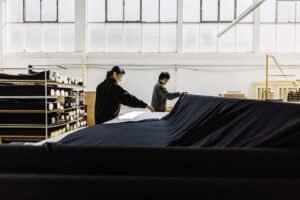
Packaging is the armor. Too many factories skimp here, using a single layer of thin polyethylene bag and hoping for the best. We’ve built a packaging hierarchy based on the fabric’s fragility. A heavy denim gets a different treatment than a delicate silk organza. Our packaging factory in Keqiao operates a dedicated line for export packing, where the humidity is controlled to below 60% RH to prevent the bags from sealing in ambient moisture. We consider packaging not as an afterthought, but as the final and most critical quality process before the goods leave our hands.
The core principle is "isolation and compression." We isolate the fabric from moisture, light, and physical impact, and we compress it in a way that stabilizes the roll core. Every roll gets a waterproof inner wrap, a silica gel pouch inside the wrap, and a heavy-duty polywoven outer bag with a thickness of at least 0.12mm. The rolls are then stacked on their ends (vertical) for woven fabrics to prevent flat-spotting, or laid horizontally for knits to prevent stretching. We print a "fragile" and "keep dry" pictogram on every carton, but we pack as if nobody will ever read it. This belt-and-suspenders approach is what keeps the insurance adjuster bored and your cutting table busy.

How Does Fumao’s Vacuum Sealing Process Protect Your Fabric from Moisture?
For our high-end natural fibers and our bamboo silk, we use vacuum-sealed packaging. This isn’t just sucking air out; it’s about creating a physical barrier against the container sweat I mentioned earlier. We lay the folded fabric piece flat on a moisture-free foam board, insert it into an aluminum foil barrier bag, and then use a vacuum nozzle to evacuate 95% of the air before heat-sealing the opening. The result is a brick of fabric that water cannot penetrate, even if the carton disintegrates around it.
This technique cuts the cubic volume by up to 20%, which also saves on freight, but the moisture protection is the main event. A vacuum-sealed bag prevents the "pumping effect" where the roll breathes in humid air during the day and expels it at night as the temperature changes. For a shipment of our Tencel satin to a client in humid Singapore, we vacuum-packed the entire lot. When the container was opened, the outer cartons were damp with sweat, but the fabric inside the foil bags was bone dry, with a moisture content of 6.8%—exactly as it left our stenter. This is a how to vacuum seal delicate fabrics for ocean freight to prevent transit moisture damage strategy that has saved us hundreds of thousands of dollars in potential claims.
What Pallet Configurations Do We Use for Different Types of Woven vs. Knit Rolls?
Woven and knit fabrics have totally different structural personalities, and they demand different pallet configurations. Woven goods, like our cotton poplin and linen sheeting, are dimensionally stable. We can stack them vertically on specialized roll cradles that grip the cardboard core. This prevents the weight of the roll itself from causing "flat spots" on the lower side. A flat spot is a permanent deformation that creates a repeating crease mark every meter or so in the fabric. For a fashion house cutting a tailored blazer, that crease is a death sentence.
Knits, like our 2×2 rib and single jersey, are alive. They want to stretch and sag. We lay them horizontally on pallets, with a full sheet of honeycomb cardboard between each layer of rolls to distribute the weight. We never stack more than five layers high for knits, even if the container has headroom, because the bottom layer will compress into a pancake. We also wrap a stretch film around the entire pallet with a tension of 40%, enough to bind the load without squeezing the soft rolls. This specification comes from our how to choose the right pallet configuration for shipping woven versus knitted fabric rolls guidelines, which we’ve refined through years of trial and error. Honestly, we learned some of these lessons the hard way, back in 2018 when a shipment of our premium cashmere blend arrived looking like crushed velvet instead of a smooth knit. We lost money on that one, but we fixed the system.
Conclusion
Damage in shipping is inevitable over a long enough timeline, but a damaged business relationship doesn’t have to be. The support Shanghai Fumao provides when a shipment goes wrong is the true test of our partnership. We don’t hide behind a "shipper’s load and count" stamp or point you to a 1-800 number for an insurance company that will take 90 days to deny your claim. We contain the damage immediately, lean on our safety stock or fast-track production to replace the goods, and deploy a forensic documentation package to make the carrier or insurer pay. And with our DDP terms, the financial risk of that damage sits squarely on our shoulders until the fabric is safely in your hands.
This level of support is built into our packaging standards, from vacuum-sealed moisture barriers to air-ride truck requirements. It’s a system we’ve built brick by brick over 20 years of watching what the ocean and the ports can do to a beautiful piece of cloth. If you’re tired of suppliers who treat a delivery as "done" the second it leaves the factory gate, we should talk. You deserve a partner who fights for your order as if it were their own.
Don’t let the fear of transit damage stop you from stocking the fabrics your collection demands. Reach out to our Business Director Elaine for a transparent conversation about our packing and insurance protocols. She can walk you through the specific protection layers we’d apply to your order and explain the true peace of mind that comes with a DDP shipment. Email her directly at elaine@fumaoclothing.com. Let’s ensure your next shipment arrives in the same pristine condition it leaves our factory floor.