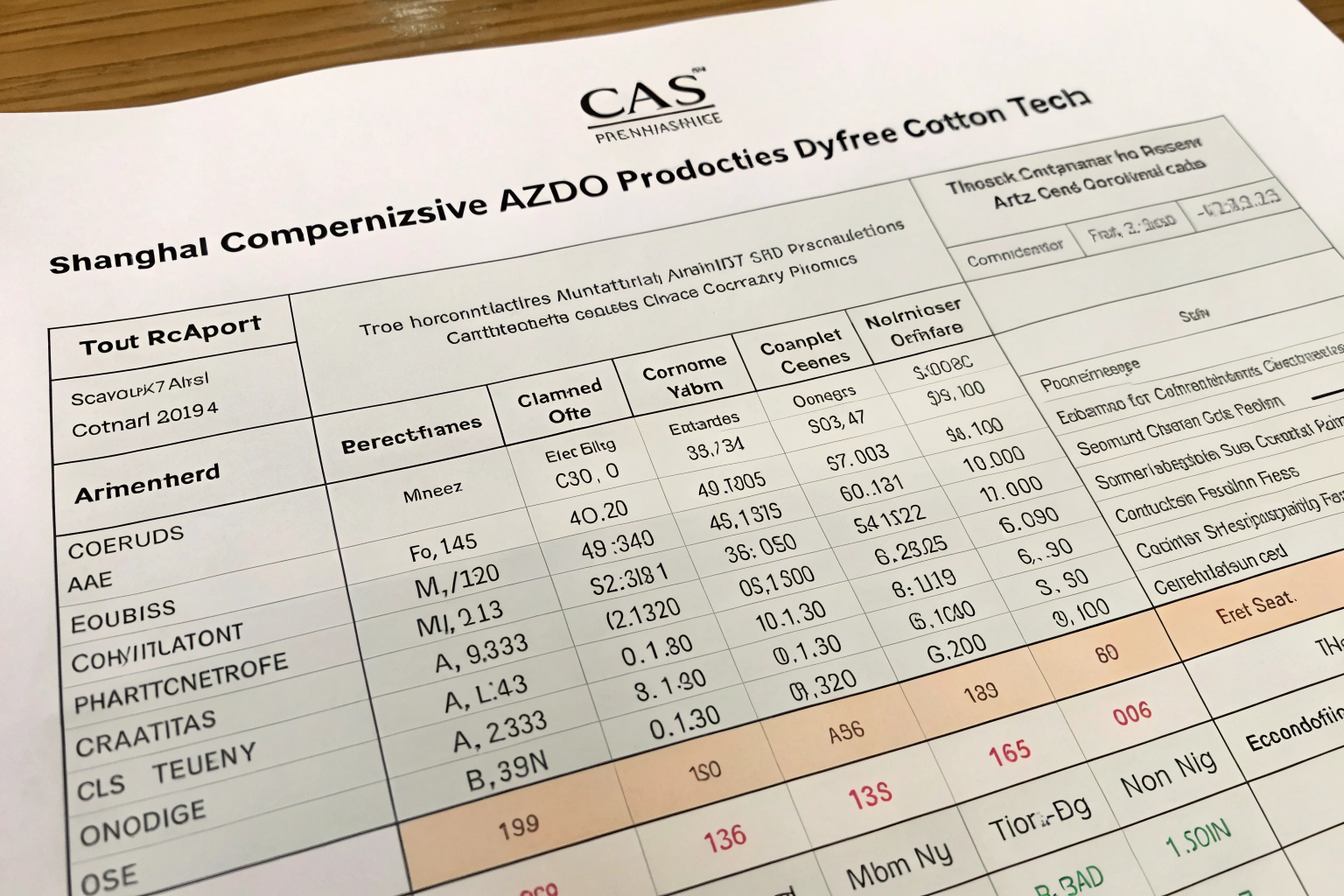
You land a purchase order from a Scandinavian childrenswear brand. The designs are approved. The price is agreed. Then the compliance document request arrives. It is a 30-page restricted substances list with one requirement highlighted in bold: "All dyestuffs must be azo-free with third-party laboratory test reports." Your previous supplier sends you a one-line email: "Our dyes are safe, no problem." That is not a test report. That is a wish. The brand rejects your submission, and the order evaporates. I have watched this exact scenario play out with a Canadian babywear startup in 2022 who lost a $60,000 contract because their previous mill could not produce a single piece of paper with a lab signature on it.
Yes, Shanghai Fumao provides comprehensive azo-free dye test reports for every cotton production batch we ship. We test to the EN 14362-1 standard using gas chromatography-mass spectrometry (GC-MS) equipment in our CNAS-accredited internal laboratory. The test report lists all 24 restricted aromatic amines individually, with detection limits and quantitative results below the 30 mg/kg (30 ppm) regulatory threshold required by the European Union REACH Annex XVII and the US Consumer Product Safety Improvement Act. We attach this report to your shipment documents and we archive it digitally for five years.
An azo-free claim without a lab report is not a claim. It is a conversation that will lose you the order. Let me show you exactly what the standard requires, how we test for it, and what a real report looks like so you can send it to your compliance team with total confidence.
What Are Azo Dyes And Why Are They Restricted
Azo dyes are the most widely used colorants in the textile industry. They account for 60% to 70% of all commercial dyes because they are cheap to manufacture, easy to apply, and produce a brilliant range of shades from bright yellow to deep navy to jet black. The chemistry is named after the azo functional group, a nitrogen-to-nitrogen double bond that creates the color. Most azo dyes are chemically stable and perfectly safe for textile use. The problem is a specific subset of roughly two dozen azo dyes that can break down under certain conditions.

Which Substances Are Actually Banned In Azo Dyes?
The ban does not target the dye molecule itself. It targets the aromatic amines that are released when the dye breaks down. An aromatic amine is a chemical compound containing a benzene ring attached to an amino group. Some of these amines are classified as carcinogenic by the International Agency for Research on Cancer. The human risk scenario is this: a restricted azo dye in a cotton garment, in prolonged contact with human skin, can be broken down by the enzymes in sweat and skin bacteria. This reductive cleavage snaps the azo bond and releases the banned amine, which the skin can absorb.
The EU REACH regulation Annex XVII, Entry 43, lists 24 restricted aromatic amines. The list includes substances like benzidine, 4-aminobiphenyl, 2-naphthylamine, and 4-chloro-o-toluidine. These are not obscure chemicals. They are known human carcinogens associated with bladder cancer in industrial exposure studies. The regulation prohibits any textile article that comes into direct and prolonged contact with human skin from containing these amines above the detection limit of 30 milligrams per kilogram, which is 30 parts per million. The US has no equivalent standalone regulation, but the Consumer Product Safety Commission enforces similar restrictions under the CPSIA, and any cotton fabric sold into the EU market must comply. This is a hard legal requirement, not a voluntary eco-label. To see the full scope of the restriction, you can review the complete list of 24 restricted aromatic amines under REACH Annex XVII Entry 43 for azo dyes in textile products. Every designer and buyer should know what is on this list.
Are All Azo Dyes Dangerous Or Just Some?
The vast majority of azo dyes are safe. The dye industry reformulated its product lines decades ago to eliminate the problematic amines from the synthesis process. A modern reactive azo dye, manufactured by a reputable chemical company under a controlled process, does not contain the banned amines and cannot release them under any foreseeable use condition. The restriction is about a specific chemical structure, not the entire azo class.
The confusion is understandable because the language is imprecise. "Azo-free" is a marketing term, not a scientific one. What it actually means is "free of restricted aromatic amines that can be released from certain azo dyes." A cotton fabric dyed with a modern bifunctional reactive azo dye is technically azo-dyed but also fully compliant. The test does not ask, "Does this fabric contain azo dyes?" It asks, "Does this fabric release any of the 24 banned amines when subjected to a simulated sweat extraction?" The distinction matters because a supplier who says, "We don’t use azo dyes at all," is either misinformed or lying. Nearly everyone uses azo chemistry. The question is whether the specific azo dyes used are on the safe list. To understand this distinction clearly, you can explore the difference between regulated and unregulated azo dyes in textile manufacturing and why the test targets amines, not dyes. It clarifies a common point of confusion.
How Do We Test Cotton For Azo Compounds In The Lab
Testing for azo dyes is a chemical extraction procedure, not a visual inspection. You cannot look at a piece of red cotton and know whether it is safe. The banned amines are not visible. They are released only under specific laboratory conditions that simulate the reductive environment of human skin. The standard test method is EN 14362-1, which is the globally recognized protocol for detecting restricted aromatic amines in textiles.

What Is The EN 14362-1 Standard And How Does It Work?
EN 14362-1 is the European standard for the determination of certain aromatic amines derived from azo colorants in textile products. The test procedure has three main steps. First, the lab technician cuts a representative sample of the cotton fabric and places it in a sealed glass vessel with a citrate buffer solution at pH 6, which simulates the acidity of human sweat. Sodium dithionite is added as a reducing agent to chemically break any azo bonds present. The vessel is heated to 70°C for 30 minutes to drive the reaction.
Second, the resulting solution is filtered and extracted with a solvent, typically tert-butyl methyl ether, to isolate any aromatic amines that may have been released. Third, the extract is analyzed by gas chromatography with mass spectrometry detection. The GC separates the chemical compounds in the extract, and the mass spectrometer identifies each compound by its unique molecular fragmentation pattern. The instrument quantifies the amount of each amine present. The report lists the 24 banned amines by name and CAS number, with a measured concentration in milligrams per kilogram. The detection limit for each amine is typically well below the 30 ppm threshold, often in the 5 to 10 ppm range. A result reported as "not detected" means the amine was below the detection limit of the instrument. A result reported with a number below 30 ppm is technically compliant but worth investigating. For a full walkthrough of the chemistry, you can read a step-by-step explanation of the EN 14362-1 test method for azo dye analysis in cotton textiles. It demystifies what happens to your fabric sample inside the lab.
Do You Test Every Batch Or Just A Random Sample?
We test every production batch. Not every roll, but every batch defined as a single dye lot in a single color. If you order 5,000 yards of navy cotton twill, the entire 5,000 yards is dyed in one or more dye lots depending on the capacity of our dyeing vessels. Each dye lot is chemically distinct because the dye bath is freshly prepared. We pull a sample from each dye lot after finishing and send it to the CNAS lab for azo testing.
The result for that dye lot is linked to the specific rolls that came from that lot. Our QR code tracking system ties the lot number on the fabric roll to the azo test report in our database. If you ever need to pull the report for a specific roll three years later, scan the code and the report appears. This batch-level testing is more rigorous than the industry minimum, which is often a single "type test" on a pre-production sample. A type test proves the recipe is safe. Batch testing proves the actual production is safe. Recipes can be contaminated. A dye supplier can accidentally ship the wrong product. A dyeing vessel can have residue from a previous batch. Batch testing catches these real-world risks. I do not want to rely on a paper assurance from a dye supplier. I want to see the GC-MS chromatogram for the exact cotton fabric that is about to ship to your customer. For a comparison of testing approaches, you can explore the difference between type testing and batch-level azo compliance testing for textile export shipments. The frequency of testing directly correlates to the probability of catching a problem before it leaves the factory.
What Does A Compliant Azo Test Report Look Like
A real azo test report is a specific document with specific data. It is not a certificate that says "Pass" in a fancy font. It is not an email from the supplier that says "our dyes are safe." A compliant report identifies the laboratory that performed the test, lists the test standard applied, and provides quantitative results for each individual banned amine. If the document in front of you does not have a lab name, a report number, and a table of numbers, it is not a test report. It is a marketing letter.

What Information Must A Valid Report Include?
The report must include the laboratory’s name, address, and accreditation number. Our reports carry the CNAS logo and our accreditation number, which you can verify on the CNAS website. The report must state the test standard exactly: "EN 14362-1:2017 Textiles – Methods for determination of certain aromatic amines derived from azo colorants." The report must identify the sample by product name, batch number, color, and fiber composition.
The results table is the core of the report. It must list all 24 restricted amines individually. For each amine, the table must show the detection limit of the method in mg/kg and the measured result. A compliant result reads something like "Benzidine: < 5 mg/kg (Not Detected)" or "2-Naphthylamine: < 10 mg/kg (Not Detected)." The "<" symbol means the amine was below the detection limit of the instrument. A report that simply says "PASS" without listing the individual amines is not a valid EN 14362-1 report. It is a summary, and a summary cannot be verified. The report must also be signed and dated by an authorized laboratory signatory, and it must carry the laboratory’s official stamp. For a detailed breakdown of every section, you can review a guide to reading and understanding an EN 14362-1 azo dye test report for cotton and linen textiles. It teaches you to spot a real report from a fake one in 30 seconds.
How Do I Verify That The Lab Is Legitimate?
You take the accreditation number from the report and look it up. Our CNAS accreditation number is printed on the cover page of every report. You can go to the CNAS website, enter the number in the accredited laboratory search tool, and confirm that the laboratory is currently accredited for the specific test standard EN 14362-1. Accreditation is not permanent. It is renewed through regular audits. A lab that was accredited in 2020 may not be accredited in 2026. Always check the current status.
Also check the scope of accreditation. A lab may be CNAS-accredited but only for physical tests like tensile strength, not for chemical tests like azo analysis. The scope document tells you exactly which standards the lab is authorized to test. If EN 14362-1 is not on the scope list, the report is not from an accredited source, even if the lab itself is accredited for something else. This is a common trick. A supplier sends a report from a "CNAS-accredited lab" but the accreditation is for fiber identification, not chemical analysis. You need to read the fine print. I encourage every buyer to verify our lab credentials independently. I want you to trust the data, not my sales pitch. For a step-by-step walkthrough, you can learn how to independently verify a CNAS accredited textile testing laboratory’s scope and credentials for chemical compliance. It is a five-minute check that can save you from a non-compliant shipment.
How Do We Ensure The Dye Supply Chain Is Clean
Testing the finished fabric is the final checkpoint. Preventing azo contamination starts long before the fabric reaches the lab. It starts in the dye purchase order. A cheap dye from an unregulated supplier is the root cause of azo failures. I control this risk at the source by maintaining an approved dye supplier list and testing incoming dye chemicals before they enter our factory.

Where Do Your Reactive Dyes Come From?
We buy reactive dyes exclusively from three certified suppliers: Zhejiang Longsheng, Zhejiang Runtu, and Archroma. These are the largest and most technically advanced dyestuff manufacturers in China and globally. Longsheng and Runtu are public companies with their own REACH registration portfolios and ISO 17025 accredited laboratories. Archroma is a Swiss-headquartered specialty chemical company that sets the industry benchmark for sustainable dye chemistry.
Every dye shipment we receive arrives with a certificate of analysis from the manufacturer that includes a statement of azo-free compliance. We do not rely on this certificate alone. We perform incoming quality control on every new dye lot. Our lab technician pulls a sample from the drum, dissolves it, runs the EN 14362-1 reductive extraction, and tests the extract on the GC-MS before the dye is released to the production floor. This incoming inspection catches supplier errors. In 2021, we rejected a batch of black reactive dye from a supplier we were trialing because the incoming test showed a trace of 4-aminoazobenzene at 15 ppm. It was below the 30 ppm limit, but we do not accept any detectable level of a banned amine in our incoming raw materials. The batch was returned to the supplier and we did not continue the trial. This is the level of rigor required. For more on the dye sourcing landscape, you can explore how major Chinese dyestuff manufacturers manage azo-free compliance for reactive dyes used in cotton textile exports. The chemistry is well-controlled at the top of the supply chain.
How Do You Prevent Cross-Contamination In The Dyehouse?
Cross-contamination is a subtle but real risk. A dyeing vessel that was used for a non-compliant batch could leave residue that contaminates a compliant batch. We eliminate this risk by operating a strict vessel cleaning protocol and by never accepting non-compliant dyes into our facility in the first place.
All of our dyeing vessels are dedicated to our approved dye inventory. We do not offer contract dyeing services for outside clients who might bring unknown dyestuffs into our factory. The pipes, the pumps, the tanks, and the chemical storage areas contain only chemicals from our approved supplier list, all of which have passed incoming inspection. Between dye lots, the vessels are cleaned with a heated caustic soda and sodium dithionite reduction cleaning cycle, which is the same chemistry used in the EN 14362-1 test to break down residual azo compounds. This cleaning cycle chemically destroys any trace of previous dyes. The vessel is then rinsed and tested with a pH strip to confirm no cleaning chemical residue remains. This disciplined segregation between the chemical warehouse and the dyehouse floor ensures that what goes into the dye bath is exactly what we tested at the incoming gate, and nothing else. To understand how professional dyehouses manage this, you can read about standard operating procedures for preventing azo dye cross-contamination in textile dyeing facilities. Clean pipes are as important as clean chemistry.
Conclusion
An azo-free dye test report is not a bureaucratic formality. It is the chemical evidence that your cotton fabric is safe for human skin and legally compliant with the most regulated consumer markets on earth. We test every production batch to EN 14362-1, using GC-MS equipment in our CNAS-accredited laboratory, and we list all 24 restricted aromatic amines individually with quantitative results below the 30 ppm threshold. We verify our dye suppliers through incoming inspection, and we maintain a closed dyehouse with no risk of external contamination. The result is a report that you can send to your Scandinavian childrenswear client, your German workwear distributor, or your US department store compliance team, and it will pass their review without a single follow-up question.
If you need an azo test report for a current or upcoming order, contact Elaine. She will provide a sample report from a recent production batch so you can see exactly what our documentation looks like. You can share that sample with your compliance team for pre-approval before we even run your bulk order. Email elaine@fumaoclothing.com with the subject line "Azo Test Report Request." Let us provide the paperwork that backs up the promise.