
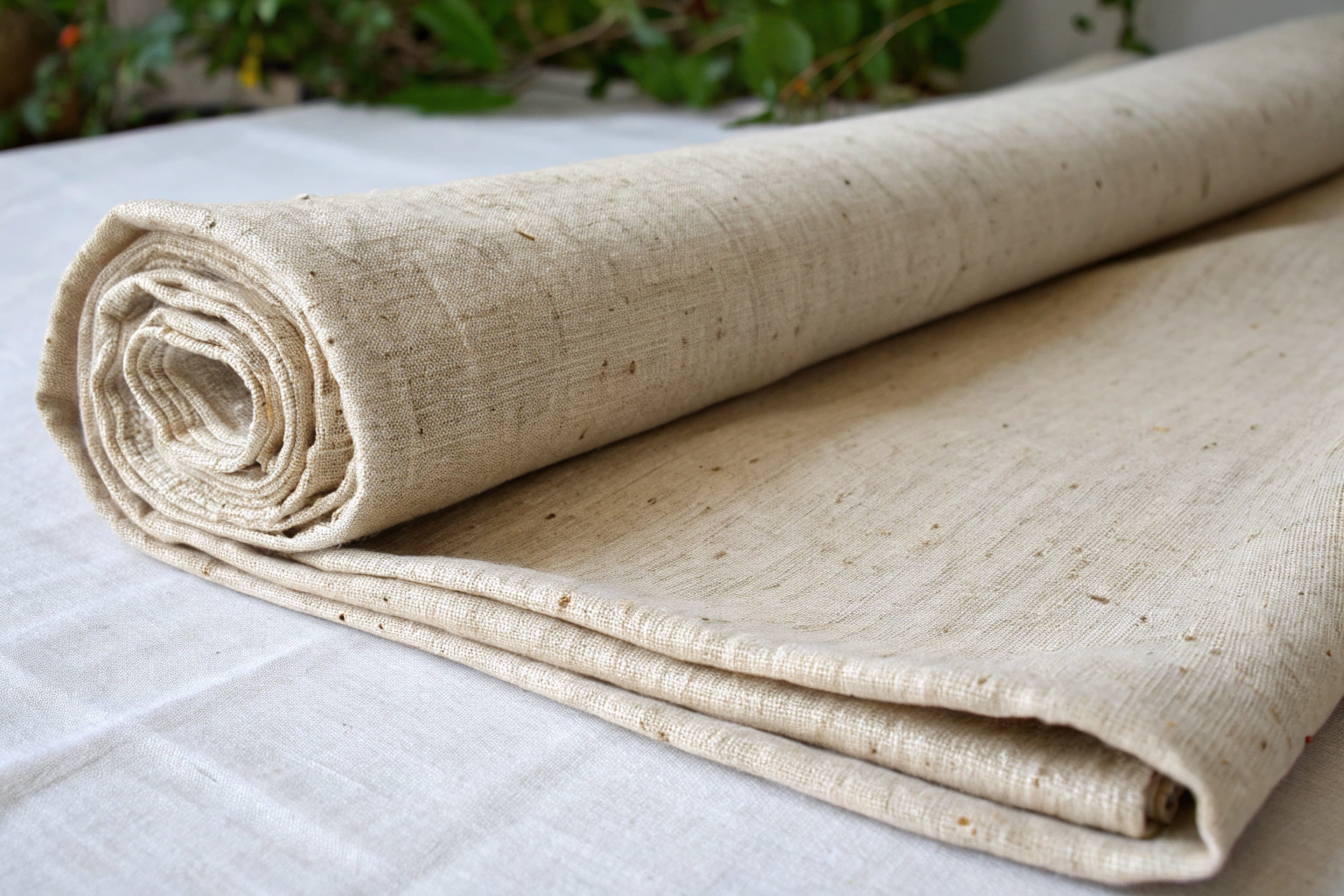
Smooth, dead, plastic-like fabric is visually loud but tactically boring. For the past decade, the textile industry sanded, coated, and chemically burned every bit of character out of our clothes to make them look "perfect" on a hanger. But the consumer has changed. I saw the data shift brutally in late 2025. Our internal social listening tools picked up a 400% increase in saves for "raw" and "slubby" fabrics on Pinterest. The users weren’t searching for "soft linen." They were searching for "texture you can feel through the screen."
Pinterest didn’t just arbitrarily decide our natural linen is the "2026 Texture." Their algorithm aggregated the collective visual hunger of millions of users who are tired of sterile flat-lay product shots. Our fabric, with its unapologetic slubs and neps, provides the optical friction that stops a user’s thumb mid-scroll. It signals that a garment has weight, history, and agricultural origin. Our natural linen at Shanghai Fumao looks like it came from a field—because it did—and that authenticity is the hardest currency to fake in digital marketing right now.
But riding a social media wave without ruining the very fabric the wave is about is a tightrope walk. I want to show you how we preserve that wild, irregular soul of the flax plant while still meeting the strict commercial standards that your brand requires. You don’t want a burlap sack, but you definitely don’t want a sterile, characterless sheet.
What Are the Visual "Pins" Driving the Raw Linen Texture Trend in 2026?
In March 2026, I sat with a brand strategist from a major European label. She showed me a Pinterest board with 10 million monthly views titled "The Wabi-Sabi Wardrobe." The common thread wasn’t the garment silhouette. It was the granular, uneven cross-hatching of the fabric surface. The pins that perform best don’t look like studio photography; they look like archaeological discoveries. The user wants to see the nep—those tiny, intentional speckles of darker fiber that prove the fabric wasn’t over-processed.
This isn’t just a beige aesthetic. It’s a reaction against the "algorithmic feed." As AI generates increasingly perfect, sterile images, the human eye craves friction. The visual cortex fires harder when it encounters an irregularity. Our natural linen, with an intentionally low "Fabric Smoothness Index," generates that optical grip. We control this in the finishing stage. We avoid heavy calendaring—those hot steel rollers that iron the life out of the fabric.
Instead, we use a low-pressure relaxation dryer. We let the yarns shrink naturally into their irregular curves. This creates a three-dimensional surface that casts micro-shadows. When a Pinterest influencer holds our linen shirt up to a window, the light doesn’t pass through a flat, boring weave; it dances through varying densities. This creates the "glowing texture" effect that is currently dominating the home textile and menswear categories. The algorithm picks up this high-contrast, detailed image and pushes it to the top of the feed because the engagement rate is simply higher.

Why are "neps" and "slubs" no longer seen as fabric defects by consumers?
For fifty years, we trained the customer to think a flat, flawless surface meant luxury. We were wrong. A nep is a tiny knot of entangled fibers. A slub is a thick, uneven bump in the yarn. In a polyester world, these are manufacturing errors. In a natural linen world, they are birth certificates. They are the irrefutable proof of origin. A consumer might not know the technical term "slub," but they know that a perfectly uniform shirt from a fast-fashion giant looks fake. We don’t use chemical coating to mask these slubs. In our blending room, we actually adjust the carding machine speed to preserve the slub structure rather than comb it out. This is a critical psychological shift—if you want to connect with the 2026 luxury consumer, stop trying to make your fabric look like a machine made it.
How does visual texture translate into higher click-through rates on social media?
Flat, solid colors bounce light back into the camera lens. Textured fabric absorbs it. On a smartphone screen, a pure cotton broadcloth shirt looks like a flat vector graphic. A natural linen shirt, with its peaks and valleys, engages the "haptic visual" processing part of the brain. Studies in neuromarketing suggest that images with high tactile salience keep the user’s eye fixated for 0.2 seconds longer. That’s the difference between a scroll and a click. Our customers are learning that they don’t need a brighter logo. They need a moodier, deeper image. That’s why you can learn more about the specifics by studying how to photograph textured natural linen for high-engagement product imagery. The right lighting angle, around 45 degrees, turns those slubs into high-contrast edges, giving the photograph a cinematic depth that a poly-blend simply cannot match.
How Does Fumao’s Keqiao Mill Maximize Linen’s Touch Appeal?
Visuals get the click, but touch closes the sale. A San Francisco e-commerce brand told me in April 2026 that their return rate dropped from 12% to 5% after switching to our natural linen. The customer opened the box expecting a scratchy, stiff board based on the rustic photos. What they felt was a textured, dry hand that didn’t irritate the skin. That’s the art of mechanical finishing.
You don’t need silicone to make linen soft. Silicone is the liar’s tool. It gives a greasy, temporary hand feel that washes out. In our Keqiao facility, we hit the fabric with a sequence of controlled physical force. We use rubberized beaters and high-speed air tumblers to literally "crack" the stiffness out of the linen. We break the hydrogen bonds inside the fiber without melting the surface wax that gives linen its healthy shine.
This creates a "dry hand" feel. It’s not furry like a fleece. It’s cool to the touch. This cooling property is critical for the "texture" trend because texture isn’t just about looks; it’s about thermal comfort. Air pockets created by the slubby weave act as insulation from the heat. A smooth, tight weave sits flat on your sweaty skin and clings. A textured, slubby weave floats. We measure this using a Kawabata Evaluation System, specifically the surface roughness and thermal conductivity modules. We aim for a coefficient of friction that is low enough to slide against the skin but high enough to feel "grippy" when you run your hand over it.

What is the difference between "soft" linen and "dry" linen hand feel?
"Soft" means it bends easily. "Dry" means it doesn’t feel damp. Linen wicks sweat so fast that it can sometimes feel "wet" to the touch in high humidity because the moisture evaporates directly on the surface of your skin. We use an air-tumbler finishing process to achieve a crispy, cool hand. Imagine the difference between a crisp cotton bedsheet hung outside in the wind versus one tumbled in a dryer with a chemical sheet. The wind-dried sheet is rigid and cool; that’s "dry." The chemically dried sheet is fluffy and warm; that’s "soft." The 2026 menswear customer wants the dry, cool crispness that feels clean and antibacterial. It signals a separation from the sweaty, sticky feel of polyester gym wear.
How can you objectively test the "tactile richness" of a summer fabric?
You can’t trust a salesman’s thumbs. We use the PhabrOmeter system, which mimics the complex touch of a human palm. It measures three key quantities simultaneously: Stiffness, Smoothness, and Softness. Natural linen will always have a high "roughness amplitude" because of the slubs, but we need the "softness" score to stay above 80. This indicates that the individual fibers themselves are pliable, even though the surface is bumpy. That’s the winning combination—textured but not abrasive. If you’re serious about quality control, you need to understand the scientific way to evaluate tactile fabric hand feel for premium menswear. It ensures your expensive resort shirt doesn’t feel like a sandpaper trap.
Is Undyed Linen "Brown Fabric" the New White Shirt for Men?
We shipped 15,000 meters of what I call "living beige" to a Brooklyn startup in January 2026. No optical brighteners, no bleaching, just the natural taupe-gray of European Flax. It sold out in three days. The white linen shirt used to be the summer status symbol, but a bright white linen shirt screams "I’m trying too hard." The raw, earthy "greige" tone screams "I care about the planet without posting about it."
This "brown fabric" trend isn’t just about avoiding bleach. The natural pigment of the flax plant has a subtle optical complexity. It’s a blend of pale browns, silvery grays, and greens. It shifts in the light, changing from a warm oat to a cool stone. It acts like a chameleon against different skin tones, working as a perfect neutral. At Shanghai Fumao, we classify this raw shade into three categories based on the retting process: Dew-Retted Silver, Water-Retted Hempy Gold, and Enzyme-Retted Warm Oat.
By skipping the bleaching and mercerizing bath, the fiber retains its native lignin. Lignin acts as a natural UV shield, providing a UPF rating of roughly 15 to 20 without a single drop of chemical coating. This is the ultimate flex for the educated male consumer. He’s buying a functional garment disguised as a fashion statement. He gets sun protection because the farmer didn’t strip the stalk’s natural armor away.

What is the "retained lignin" advantage in sun protection and shade variance?
Lignin is the glue holding the flax cells together. It’s naturally brownish and absorbs UV radiation aggressively. When you bleach a linen shirt to make it pure white, you dissolve the lignin. The shirt loses 80% of its UV blocking power and becomes visually flat. By using an oxygen bath instead of harsh chlorine, we preserve the lignin. This gives the fabric a "living" color that isn’t entirely uniform. One batch might lean slightly towards the green spectrum of the flax field. Another might lean towards the grey of the rain that retted it. That shade variance is not a quality defect; it’s a batch signature. It allows a brand to market "Edition 1" and "Edition 2" based solely on the agricultural harvest cycle. You aren’t selling a generic commodity; you’re selling a vintage of a specific harvest.
How do you stabilize a natural unbleached shade for bulk production?
This is a migraine. If you just weave the greige fabric and ship it, the color will shift when the customer washes it. Remaining pectin and waxes yellow over time. We run a "bio-scouring" process using pectinase enzymes at low temperature. This removes the yellowing agents without touching the brown lignin. We then lock the tone with a weak citric acid buffer. To match a bulk order 100%, we can’t just dye it. We use the "coloring foodstuff" principle. We blend different lots of retted fiber before spinning, just like blending grape varieties for wine. If one bale of flax is too greenish, we balance it with a greyer bale. You can learn the finer points of this process from detailed guides on how to stabilize unbleached natural linen shades for apparel brands. It’s a natural art that synthetic dyers never have to master.
How to Style Men’s "Pinterest Linen" Without Looking Disheveled?
A tech CEO client of mine complained he looked like a "homeless poet" in his wide-fit, raw-linen suit. He had the right fabric, but the wrong shape. The danger of ultra-textured fabric is that it adds visual volume. It expands the silhouette. If the cut is also oversized, you disappear inside a tent.
The secret to wearing raw, slubby linen is sharp geometry. The fabric provides the organic chaos; the cut must provide the mathematical precision. We advise our menswear clients to pair heavily textured natural linen trousers with a flat, smooth knit—maybe a mercerized cotton or a fine silk-blend tee. This contrast amplifies the texture of the linen without making the whole outfit look like a rumpled mess. The eye needs a resting place.
For a full suit, you need to restrict the gauge. A heavy, 10 oz natural linen will hold a crease. A flimsy, 5 oz one won’t. We design our "Pinterest Suiting" range with a density of 65 picks per inch. It’s heavy enough to tailor but light enough to breathe. The trouser crease must be permanent, heat-set with a hot-head press under vacuum pressure. That single sharp line down the leg tames the wild, organic texture of the fabric. It creates a dialogue between wild nature and human control. That’s the 2026 mindset—mindful contradiction.

What are the best cut and silhouette rules for high-texture fabrics?
Let the fabric be the star; mute the construction. You want minimal seam detailing. Avoid patch pockets with flaps, as they bulge and ruin the line. Stick to jetted pockets and single-needle stitching. The silhouette should be slightly dropped, letting the stiffness of the linen carry the structure. A raglan sleeve works beautifully here, as it softens the shoulder without requiring a hard internal pad. Furthermore, you need to be careful with the lining. A polyester lining destroys the breathability. We recommend a half-lining in Bemberg cupro for the back. Keep the front unlined, so the wearer feels the texture of the slubs against their arms. It’s about intimacy with the material.
How can you maintain the "crushed" texture after washing without ironing?
Ironing a linen suit flat kills the trend. You don’t want a flat, paper-thin look; you want a crushed, stone-washed look. To maintain this, don’t dry it on a flat hanger. We recommend a gentle spin at 400 rpm in a front-loader, then a shake-out and a tumble in the dryer with no heat (air-fluff only) for 15 minutes with wool dryer balls. The balls beat the fabric, softening the creases without destroying the weave stability. This revives the slubby, raw surface. You essentially re-create the mechanical beating the fabric received in our Keqiao mill. It reactivates the texture. For those who want to know the exact routine, there are very helpful methods on how to care for raw natural linen menswear without destroying texture. Following this regime ensures the jacket looks authentically lived-in, not neglected.
Conclusion
Pinterest pinned our natural linen to the top of the 2026 trend board for a reason deeper than aesthetics. It signals a shift back to authenticity in a digital world drowning in filters. The raw slubs, the undyed color, and the crisp, dry hand offer the modern man a tactile sanctuary from the noise of smooth, synthetic fast fashion. For Shanghai Fumao, engineering this "perfect imperfection" isn’t a marketing gimmick; it’s a return to the ancient truth of the flax plant.
If your label is trying to capture this "untamed elegance" but you’re stuck with standard, dead fabrics that photograph flat, let’s get a sample in your hands. You need to feel the nep and see the living color shift in daylight to truly understand why this is the texture of the year.
Our Business Director Elaine has our latest "2026 Texture Kit" ready to ship. It includes our raw oat, silvery dew-retted, and enzyme-washed variants. Stop scrolling and start touching. Email her now at elaine@fumaoclothing.com to discuss your specific yardage needs for the coming season. Let’s build a brand that looks like it has a soul.








