
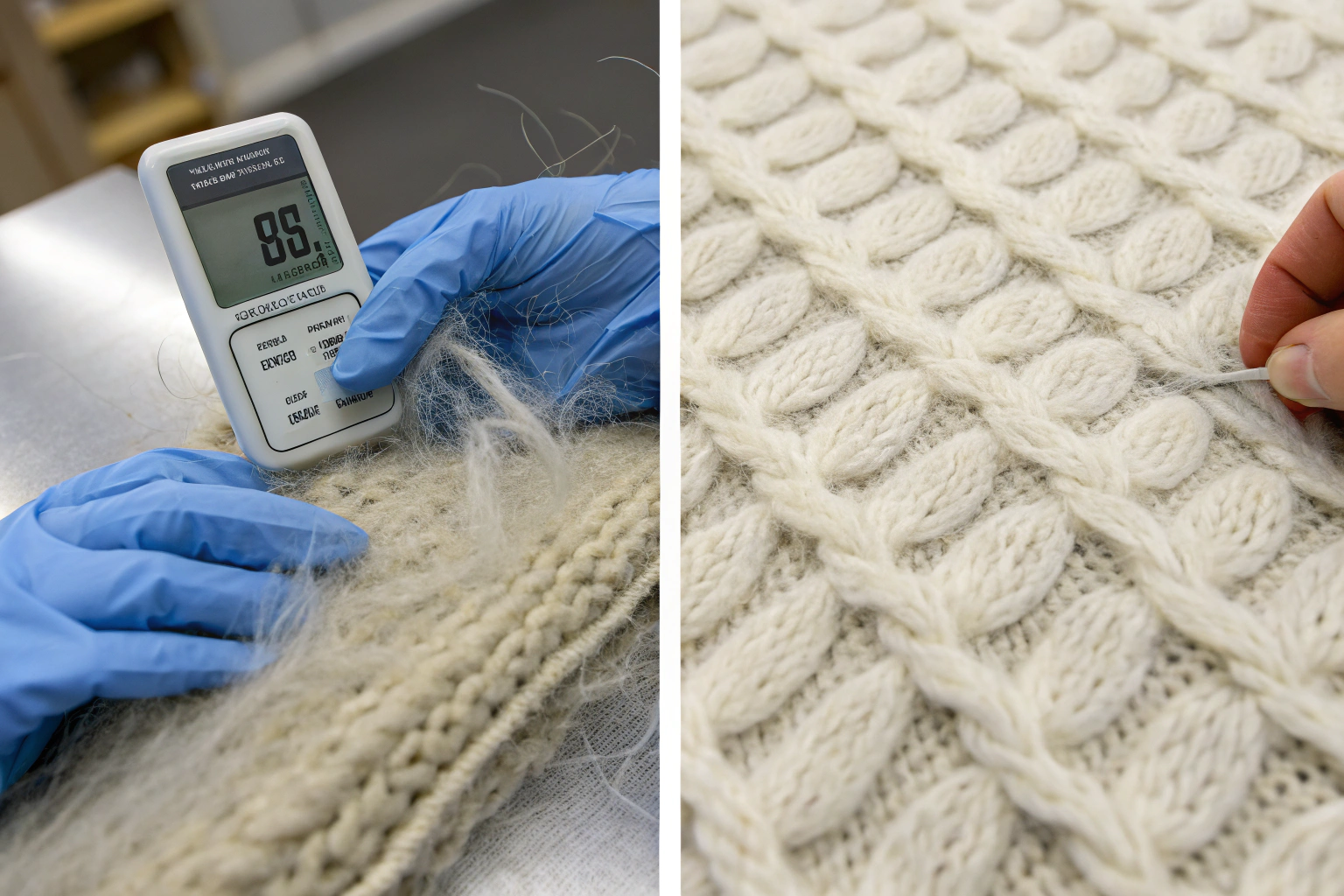
You just dropped forty grand on a container of jersey knit for your new athleisure line. The lab dips looked perfect. The bulk arrives, you cut and sew, ship it to your retailers. Three weeks later, your inbox explodes. Customers send photos of hoodies covered in those annoying little fuzz balls after just two washes. The garment looks ten years old. Returns spike. Your brand reputation takes a hit that no amount of Instagram ads can fix. That pit in your stomach? I’ve seen it happen to too many buyers who skip the pilling test to save a buck.
A pilling test is not just a box-ticking exercise on a tech pack. It is the single most honest predictor of how your knit fabric will survive real-life friction—backpacks, seatbelts, office chair armrests, even the Velcro on a baby’s diaper bag. At Shanghai Fumao, we run the Martindale and Random Tumble Pilling tests on every single knit batch before it leaves our Keqiao facility. Because if the fabric pills, your customer doesn’t blame the yarn—they blame you.
I get it. You care about the hand feel, the drape, the price per meter. But here is the truth: a beautiful knit that pills is a liability. In this article, I am going to walk you through why pilling resistance is the make-or-break spec in your sourcing checklist. I’ll share what happens inside our CNAS-certified lab, how we tweak yarn twist and heat setting to stop pills before they start, and the exact testing standards you need to put in your purchase order. Because buying fabric without a pilling test is like driving a car without brakes—it looks fine until you need it to perform.
How to Prevent Pilling in Bulk Knit Orders?
You send a purchase order for 5,000 meters of single jersey. You specify the weight, the color, the width. But what about the anti-pilling finish? Most buyers don’t realize that pilling resistance is engineered at the fiber level, not sprayed on like bug spray. You cannot fix a pilling problem in the garment wash stage. You have to kill it at the root.
Our mill learned this lesson back in 2021 with a Russian sportswear client. They ordered a polyester-viscose blend for training tops. The initial sample passed a visual inspection, but we caught a Grade 2 pilling rating in our internal pre-production test—that’s basically a failure for activewear. We backtracked to the spinning process. The solution was lowering the micronaire value of the polyester fiber and increasing the twist factor (T.P.M.) of the yarn by 12%. The final bulk fabric hit a Grade 4-5 pilling rating on the Martindale scale after 2,000 cycles.

Why Does Yarn Twist Intensity Matter So Much for Pilling?
Pills form when loose fibers migrate to the surface, tangle together, and anchor themselves to the fabric by a few unbroken fibers. A tight twist locks those short fibers inside the yarn structure. Think of it like a braid—if you braid hair loosely, strands fly out immediately. If you braid it tight, nothing moves.
In our experience with cotton-modal blends (these are huge in the loungewear market right now), we found a direct correlation between twist factor and pilling grade. Here is some real internal data from our CNAS lab comparing a 40S/1 Cotton-Modal blend:
| Twist Factor (T.P.M.) | Martindale Pilling Grade (2000 Revs) | Fabric Hand Feel |
|---|---|---|
| 3.6 (Standard combed) | Grade 2-3 (Moderate/Severe Pilling) | Very soft, slubby texture |
| 4.0 | Grade 3-4 (Slight Pilling) | Soft, good drape |
| 4.4 (Fumao recommended) | Grade 4-5 (No/Minor Pilling) | Crisp hand, smooth surface |
(Here is a pro tip: if you want that buttery soft hand feel but still need a Grade 4 rating, you can pair a high-twist yarn with a silicone softener wash. That way, you cheat the surface friction without sacrificing the structural integrity of the yarn. We do this all the time for our European fast-fashion clients.)
Which Anti-Pilling Finishes Actually Work on Polyester Knits?
Let’s be honest about "finishes." For cellulosic fibers like cotton and rayon, bio-polishing with cellulase enzymes is a game changer. It literally eats the micro-fuzz off the surface. But for polyester, which makes up the bulk of high-performance knits, heat-setting is your weapon.
We run our polyester knits through a pre- and post-heat setting process. By precisely controlling the tension and temperature during the how to stabilize knitted fabric with Stenter frame heat setting, we relax the internal stress in the filaments. If you skip this step, the fiber memory wants to curl back, which pushes tiny filament ends to the surface—pills waiting to happen. We set the Stenter machine at 195°C for 45 seconds for a typical PES/Spandex jersey. This locks the yarn geometry. Pair that with a low-pilling polyester variant, and you’ve got a fleece jacket that survives a washing machine with zero fuzz for years.
What Is the Standard Pilling Test for Exported Fabric?
When I see an inquiry email that just says "need good quality," I know I have to dig deeper. "Good quality" is subjective. But a pilling rating of 3.5? That is measurable. You cannot argue with a microscope or a Martindale machine. The key difference between an amateur buyer and a professional retail buyer is the ability to read a test report.
The global standard for pilling that we use 90% of the time is the Martindale Method. But depending on your market, you might need Random Tumble or ICI pilling box results. Picking the wrong standard is a classic blunder. If you are shipping to the EU, you better have your EN ISO 12945-2 ready. If you are shipping to the US, the retailers want to see ASTM D4970. And don’t get me started on the Japanese market—the JIS L 1076 Method A has its own quirks.

How Do I Read a Martindale Pilling Test Report Correctly?
You open the PDF from the lab and see a number. Maybe a 3. Maybe a 4. What does that actually mean for your yoga leggings?
You don’t just look at the number; you look at the number of revolutions. A Grade 4 after 500 rubs is easy. A Grade 4 after 7,000 rubs is bulletproof. I’ll never forget the time in 2022 when a Brazilian client disputed a test result. We tested a rib knit (2×2 Rib, 95% Cotton 5% Spandex). At 2,000 revolutions on the Martindale tester, we got a clear Grade 4. But the client’s third-party lab in São Paulo reported a Grade 2. Panic mode.
We traced the discrepancy back to the specimen mounting foam. The other lab used a standard foam backing, while we used the newer, softer foam specified in the latest ASTM update. The harder foam increased the friction pressure, causing earlier fiber breakage. We sent them a calibration sample, and they verified the Grade 4 using the updated foam. (This is why I tell everyone, check the lab’s accreditation. If they aren’t CNAS or AATCC accredited, don’t trust the number.)
Here is the quick-reference reality-check table I share with my junior merchandisers to avoid that mess:
| ASTM D4970 Grade | Visual Description | Fumao’s Suitability Recommendation |
|---|---|---|
| Grade 1 | Very Severe Pilling / Dense fuzz | Reject. Do not ship. Fiber/density reformulation needed. |
| Grade 2 | Severe Pilling | Reject. Only acceptable for lining if hidden. |
| Grade 3 | Moderate Pilling | Conditional. Acceptable for cheap, rough-wear only? No. We usually remake. |
| Grade 4 | Slight Pilling | Acceptable. Great for daily casual knits. |
| Grade 5 | No Change | Acceptable. Required for smooth, fine-gauge suiting knits. |
What’s the Difference Between ICI, Martindale, and Random Tumble Tests?
This is a headache for buyers. You get a quote from Shanghai Fumao showing a Martindale Grade 4, and you compare it with a Turkish mill quoting an ICI Grade 3. Is the Turkish sample better or worse? You don’t know, because you are comparing apples to orange juice.
The Martindale method rubs the fabric against the same fabric in a Lissajous figure pattern—a rubbing that goes in all directions. This mimics a shirt rubbing against itself under the armpit. The Random Tumble method, on the other hand, throws cut specimens into a cork-lined cylindrical chamber and tumbles them for 30 minutes. This mimics a fabric pilling in a tumble dryer versus standard abrasion testing methods. The ICI Pilling Box uses cork-lined boxes too, but the samples are mounted on tubes and rotated slowly.
Because Martindale uses a standard worsted wool abradant fabric in some variants, it can be less aggressive on soft cottons but harsher on coarse wool blends. Random Tumble often gives the most realistic "worst-case" scenario for fuzzy fleeces because the tumbling action generates static that pulls fibers up. If a client is selling brushed fleece hoodies, I always insist we run both Martindale and Random Tumble. If the fabric can survive 60 minutes of random tumble without forming balls of fuzz, it will survive a domestic washing machine for at least a couple of years.
Will Poor Pilling Resistance Ruin My Brand Reputation?
I’ve watched private label brands die on Amazon. Not from bad marketing, but from bad reviews. "Bobbly after one wear." "Fabric looks cheap." That is the kiss of death. They didn’t fail because the design was ugly; they failed because the garment could not maintain its "new" appearance past the return window. In the world of fast fashion and basics, the "wash-and-wear" visual is your only moment of truth.
There is an outdated belief among some merchandisers that heavy, thick knits pill less than light, fine knits. This is dangerously naive. A thick 12-gauge wool sweater can pill like crazy if the wool fibers are short and coarse. Meanwhile, a super-fine 28-gauge micro-modal jersey can stay smooth for years if it uses long-staple fibers (like 38mm+ Lenzing Modal). Pilling attacks high-traffic abrasion zones. Think of the side seams of a tee where an arm rubs, or the back of a cardigan against a leather office chair.

How Does Pilling Destroy the Perceived Value of a Garment?
You sell a premium knit polo for $89. It’s Supima cotton. It drapes perfectly out of the box. But the fiber is ring-spun with a low twist to give it that luxurious "sweater-soft" touch. After a week of commuting in a car with a nylon-webbing seatbelt rubbing across the chest, a halo of pills appears. Suddenly, that $89 polo looks visually identical to a $15 big-box store polo after similar wear.
That visual degradation is what we call the "cheapening effect." Even if the physical integrity of the garment is intact—no holes, no tears—a consumer perceives the item as "worn out." I recall a specific crisis in August 2023 when a New York brand contacted us to replace their domestic supplier for a double-knit Ponte Roma. Their previous batch had a pilling rating of 1.5 because the mill used recycled polyester sourced from low-viscosity plastic bottles without breaking strength considerations. We had to get on a plane (well, Zoom) and walk them through our recycled polyester selection, which uses a specific low-pilling chip from a Zhejiang supplier. We guaranteed a Grade 4.5 for 70% of the cost they expected to pay for that level of quality. They re-ordered three times last year.
(Note: Look, pilling isn’t always just about "cheap." Sometimes a designer wants that brushed surface, but you have to inform them of the trade-off. A heavily brushed terry fleece will shed. An angora blend will pill. It’s our job to tell you, "If you want this look, your return rate might hit 5%. If you remove the angora, it drops to 1%." That is a realistic conversation we frequently have.)
Can I Visually Inspect Fabric Pilling Before a Lab Test?
You don’t always have a lab on your desk. But you have hands and eyes. A quick field test at the showroom table can filter out 80% of the garbage before you waste $200 on a formal lab report.
I teach my clients what I call the "Sandpaper Rub Test." It’s low-tech, fast, and brutally honest. You take a swatch of the knit, fold it in half, and rub it face-on-face against itself about 20 times under heavy pressure on a desk edge. If you see excessive fuzz instantly—little ropes of fiber twisting up—don’t even bother sending it to the lab. It will fail. Also, rip a sample. Just tear it freehand. If the tear edge reveals a cloud of loose, short "fly" fibers puffing into the air, the yarn has a high short-fiber content (bad). If the tear edge is relatively clean, the staple fibers are long and well-spun.
We also use the blue felt test internally. We rub the sample on a dark blue felt pad. The amount of white or colored lint transferred gives a direct indication of the fiber cohesion. (I won’t lie, I occasionally look at how much lint falls on my black jeans when I walk through the finishing inspection area of the textile mill to gauge the general quality level of the day. It’s primitive, but it rarely lies.)
How Can Fumao Guarantee Pilling Resistance in Knits?
You are probably tired of hearing "quality control" as a buzzword. But the literal bricks and mortar of a CNAS-accredited lab are what separate a trading company that hopes for the best, from a factory that guarantees an outcome. Most suppliers claim they check quality. But at Shanghai Fumao, we don’t "check" quality; we engineer it. And for knits, the pilling metric is the hardest engineering challenge because it contradicts softness. Soft fabrics want to pill. Anti-pill fabrics can feel dry or stiff. Solving that contradiction is our entire business model.
Our quality control doesn’t start at the end of the greige rolling machine. It starts at the purchasing of the raw fiber bales. We consistently buy Lenzing-certified EcoVero and Tencel, and low-pilling DTY polyester yarns from Tongkun Group. If you try to save 5 cents a meter by using a generic polyester filament, the recycling rate might be lower, the elongation irregular, and the pilling resistance drops to a Grade 2 before you even dye it.

How Does Fumao Adjust Reactivity for Dark Vs. Light Colors?
This is where you see the wizardry. You know that a jet-black knit pills worse than a white one, right? Wait, you didn’t? Most buyers don’t realize that dark dyeing chemistry chews up the fiber surface. To achieve deep penetration, you need higher temperatures and longer durations, which degrades the fiber strength slightly, especially in cellulosic fabrics. This increases the surface fuzz.
We adjust the yarn twist specifically per color based on our pre-treatment lab. For a carbon black modal jersey, we might use a raw yarn with a twist multiplier 0.2 higher than for the optic white version of the exact same fabric. We also leverage our cooperative dyeing factory to run a "one-bath bio-polish" process. Right before the dark reactive dye is exhausted, we dose the bath with a special cellulase enzyme that prefers attacking loose, protruding fibers but is deactivated before it weakens the main yarn core. It sounds simple in theory, but the pH and temperature window there is so strict that you’re navigating a 3-minute biological window. Get the timing wrong, and the fabric loses 15% tensile strength.
We document all this stuff digitally. I’m not just spouting marketing fluff here—through our comprehensive fabric sourcing guide for fashion startups, we consistently advise new brands to ask their mills for the "bath profile chart." I’m serious, ask your current supplier for the bath profile of your last batch. If they stare at you blankly, they don’t know what’s happening to your pilling rating.
How Does Our QA Team Spot-check Bulk Before Shipping?
I trust the lab machine, but I trust my senior QC inspectors more. The machine tells you the grade against a standard felt. The human tells you if the fabric "looks like it will pill" in a specific zone. The standard protocol here, which we call the "4-Point Pilling Audit," happens 48 hours before the container closes.
We pull 3 rolls from the bulk at random—one from the beginning of the lot, one from the middle, one from the end. We run a rapid 30-minute accelerated pilling test (accelerated by doubling the weight load to 12kPa). The necessary Grade is 3.5 for clearance. If the middle roll fails, the entire dye lot is quarantined. We use a standard light source and viewing cabinet for textile pilling assessment (D65 daylight simulator) to grade the pills against an ASTM reference scale. Every inspector is tested annually in the Munsell 100 Hue Test to ensure they aren’t assessing color differently when they evaluate the pills against the fabric background. Wild, right? But if an inspector’s eyesight is off, they miss the contrast between the fabric face and the pill shadow.
We also simulate what the end-user does. We sew up a sample sleeve, attach it to an actual backpack strap, and walk around the block for 20 minutes. It’s not in the ISO standard, but it’s our standard. Friction simulation against a coarse polyester backpack strap is often more aggressive than a lab machine. If the sleeve looks good after my R&D director gets back to his desk sweating, the fabric ships.
Conclusion
Look, buying fabric is a game of millimeters and microns. The pilling test isn’t the most glamorous part of building a collection—fabrics washed in Italian rivers or hand-spun by villagers sound much better on a Kickstarter page. But a pilling log chart from a certified lab will protect your cash flow a lot better than a romantic farm story. We’ve covered why pilling happens, how the wrong yarn twist destroys a garment, the difference between a Grade 3 and a Grade 4, and the real-world friction that exposes bad fiber engineering.
The global supply chain is messy. Lags, tariffs, and peak production periods make buying fabric hard enough without worrying whether a shipment will disintegrate after two wears. That’s why we put our pilling guarantees front and center. The Martindale machines in our Keqiao lab run 24/7, rubbing away, so your brand’s reputation doesn’t get rubbed out later.
If you’ve got a knitwear concept on the table and you are terrified of seeing "Grade 2" on a pre-production sample, let’s talk about it before you cut your first meter. You want to source from Shanghai Fumao without losing sleep over pilling claims. I’m inviting you to reach out to our Business Director, Elaine, directly. She handles the technical specs for all our knit accounts and can walk you through the exact anti-pilling protocol we would apply to your specific fiber blend. Send your tech packs over to elaine@fumaofabric.com. We’ll make sure your next jumper still looks new after its first hundred outings—even against those pesky seatbelts.








