
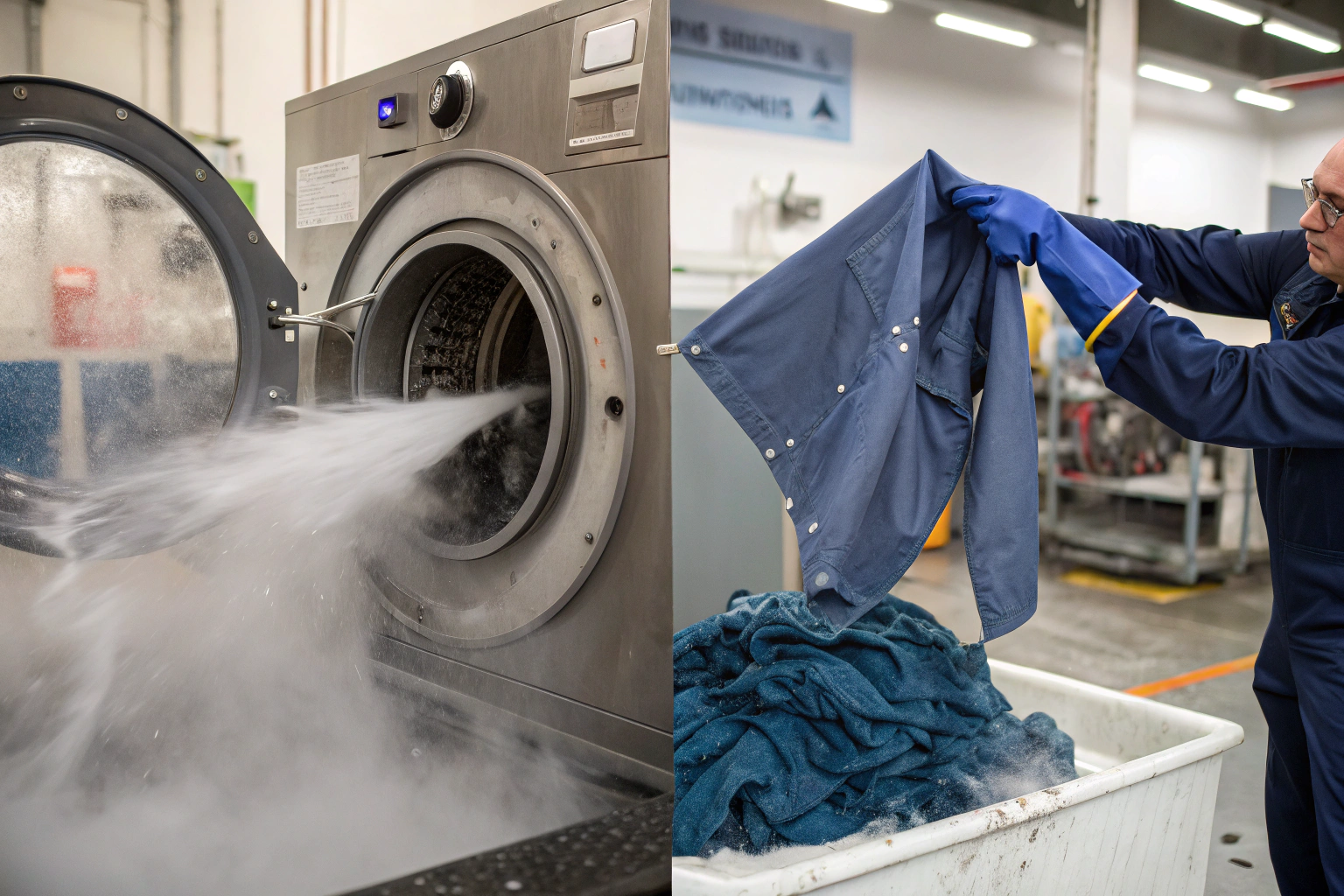
Your client runs a nationwide catering company. They need 5,000 chef jackets. You find a nice white cotton-poly twill, stitch them up beautifully, and ship them out. Three weeks later, the client sends you a photo: the jackets look like grey, misshapen rags. The seams have puckered, the fabric has thinned out, and the white is now a sad, splotchy cream. They’ve been through the industrial laundry—those brutal tunnel washers that operate at 80°C with aggressive alkaline detergents and peroxide bleaches. Your fabric wasn’t made for that kind of punishment. Now you’re renegotiating a contract with an angry client.
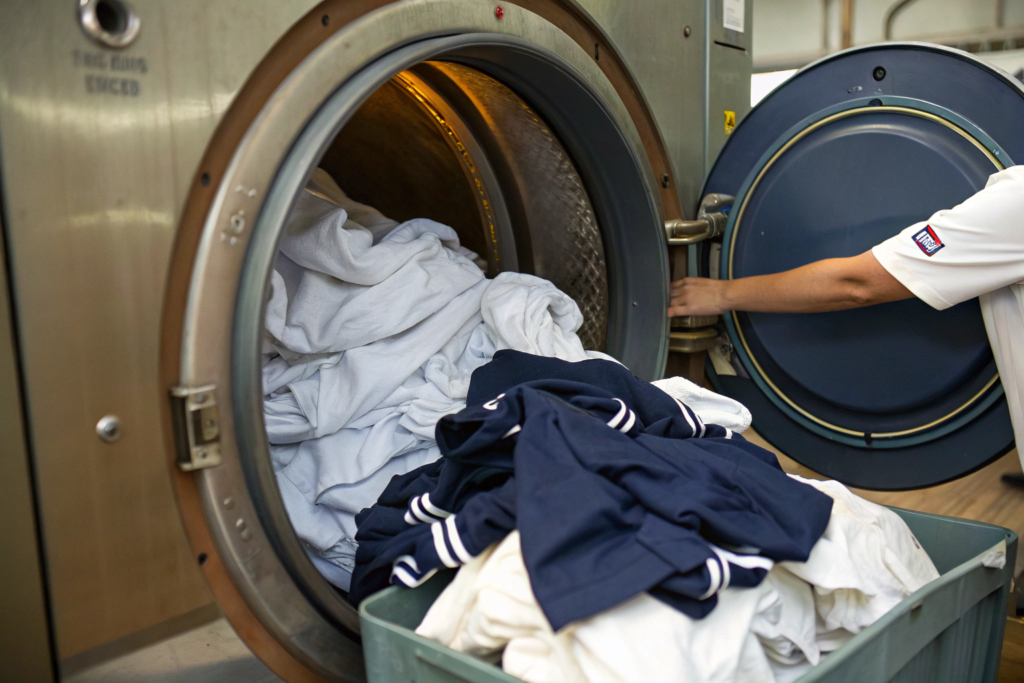
Industrial washing is not the same as your Maytag at home. It’s a chemical and mechanical assault designed to sanitize embedded grease, body fluids, and heavy soiling from hundreds of kilos of fabric simultaneously. A standard fashion fabric will disintegrate in this environment within 20 cycles. At Shanghai Fumao, we engineer our workwear fabrics from the yarn up to withstand at least 100 industrial wash cycles without losing tensile strength, color, or dimensional stability. In this article, I’ll walk you through the specific fiber blends, the reinforced stitching chemistries, and the test standards we use to certify a fabric as "industrial laundry ready." If your uniform supplier can’t show you these test reports, you’re buying a ticking time bomb.
What Fabric Blends Survive Industrial Laundry Best?
You can’t just pick a "tough" fabric and hope it survives. The fiber composition is the single biggest predictor of industrial laundry survival. A 100% cotton twill—no matter how tightly woven—will lose strength every time it hits that hot alkaline bath. The cellulose chains hydrolyze, the fiber swells and contracts violently, and within 50 cycles, you’ve lost 40-50% of your tensile strength. The fabric just tears like wet paper. I’ve seen this happen to a hotel chain’s "premium" 100% cotton bed sheets that were supposedly rated for hospitality use. They were not.
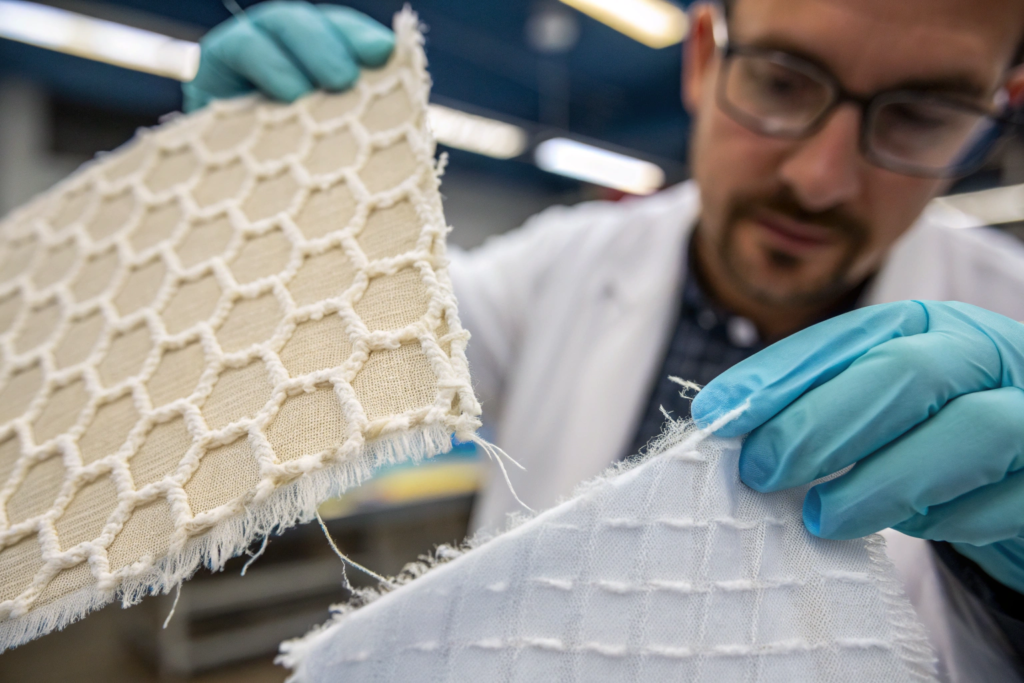
The gold standard for heavy-duty workwear that survives tunnel washers is a 65% Polyester / 35% Cotton blend, often called "PC 65/35." The polyester provides the structural skeleton—resistance to acids, alkalis, and mechanical shredding. The cotton provides breathability and absorbency, which matters for comfort but also helps the peroxide bleach actually contact and whiten the surface during the wash. A 50/50 blend is a close second, slightly softer but less durable over the long haul. For extreme environments—think oil rig coveralls or chemical splash protection—we move to 100% filament polyester with an antistatic carbon grid or a modacrylic blend. At Shanghai Fumao, our top-selling industrial laundry fabric is a 245gsm 65/35 twill that we guarantee for 100 cycles at 85°C with chlorine bleach tolerance.
How Does Polyester-Cotton Ratio Affect Chemical Degradation?
The ratio is not just about feel; it’s about chemistry. When a tunnel washer doses sodium hypochlorite (chlorine bleach) or hydrogen peroxide (oxygen bleach), the cotton takes the hit. Chlorine bleach degrades cellulose through oxidation, turning it yellow and brittle if overdosed. But the polyester shrugs it off. Polyester is essentially plastic—it’s chemically inert to the cleaning agents that eat natural fibers alive.
Here’s the reality from our internal lab Q-sun weathering and chemical exposure chamber:
| Blend Ratio | Chlorine Bleach Tolerance (ppm) | Tensile Retention After 100 Washes | Recommended Use Cases |
|---|---|---|---|
| 100% Cotton | <5 ppm residual | 45-55% | Not recommended for industrial. Domestic wash only. |
| 50/50 PC | 10-15 ppm | 70-80% | Light industrial, retail staff, hospitality front desk. |
| 65/35 PC (Fumao Std) | 20-25 ppm | 85-92% | Heavy industrial, kitchen whites, medical scrubs. |
| 100% Polyester | >50 ppm | 95-98% | Oilfield coveralls, chemical splash suits, clea是room garments. |
One detailed example: in August 2023, a German automotive plant came to us with a specific problem. Their 50/50 PC overalls were developing "chalky" white spots after 40 washes. It wasn’t the bleach; it was the cotton fiber itself degrading into short fibrils that scuffed white under abrasion. We upgraded them to our 65/35 construction with a slightly higher twist yarn in the cotton component. The cotton fibers were locked in tighter, reducing surface fibrillation. The chalky spots disappeared. We documented a 92% tensile retention at cycle 100 versus their previous 71%. For a deeper chemical understanding, I always recommend reviewing the textile degradation mechanism of sodium hypochlorite on cellulose fibers before selecting a pure cotton product for laundry.
What Role Do Filament vs. Staple Yarns Play in Laundry Durability?
This is a granular detail that separates the enthusiasts from the experts. Staple yarns (short fibers twisted together, like cotton) have millions of loose ends protruding from the yarn surface. Every wash cycle, those ends lift, tangle, and break off, causing pilling and gradual mass loss. Filament yarns (continuous, unbroken fibers, like polyester filament) have no loose ends to begin with. They are like smooth, solid rods.
For the ultimate in industrial laundry survival, we use a texturized filament polyester warp and a core-spun polyester-cotton weft. The filament warp carries the load. The core-spun weft (cotton wrapped around a polyester filament core) presents a cotton surface to the outside for the traditional look and hand feel, but the core is a continuous polyester filament that physically cannot shed short fibers. In a 2024 order for a Middle Eastern airline’s maintenance crew uniforms, we used exactly this construction. The requirement was a minimum of 120 industrial wash cycles at 75°C. Pure staple yarn fabric from their previous supplier was tearing at cycle 80. Our hybrid filament-core-spun fabric crossed 120 cycles with less than 8% weight loss and no hole formation. For anyone exploring the mechanical side of fabric design, learning about filament versus spun yarn abrasion resistance in heavy-duty textiles is absolutely foundational.
What Laundry Test Standards Must Workwear Fabric Pass?
If a fabric salesman tells you, "Yeah, it’s good for industrial wash," demand the test standard. Not a vague assurance—an ISO or EN number. The specific standard you need to see is ISO 15797: "Textiles – Industrial washing and finishing procedures for testing of workwear." This standard exists precisely because the domestic washing tests (like ISO 6330) are far too gentle to predict a fabric’s survival in a tunnel washer. A standard domestic cotton wash cycle runs at 40°C for 30 minutes with a mild detergent. An industrial cycle runs at 85°C for 45 minutes, with a pH of 10-11, mechanical action from 50kg of wet fabric slamming against stainless steel drum baffles, and a final chlorine or peroxide disinfectant stage. The two environments are not on the same planet.
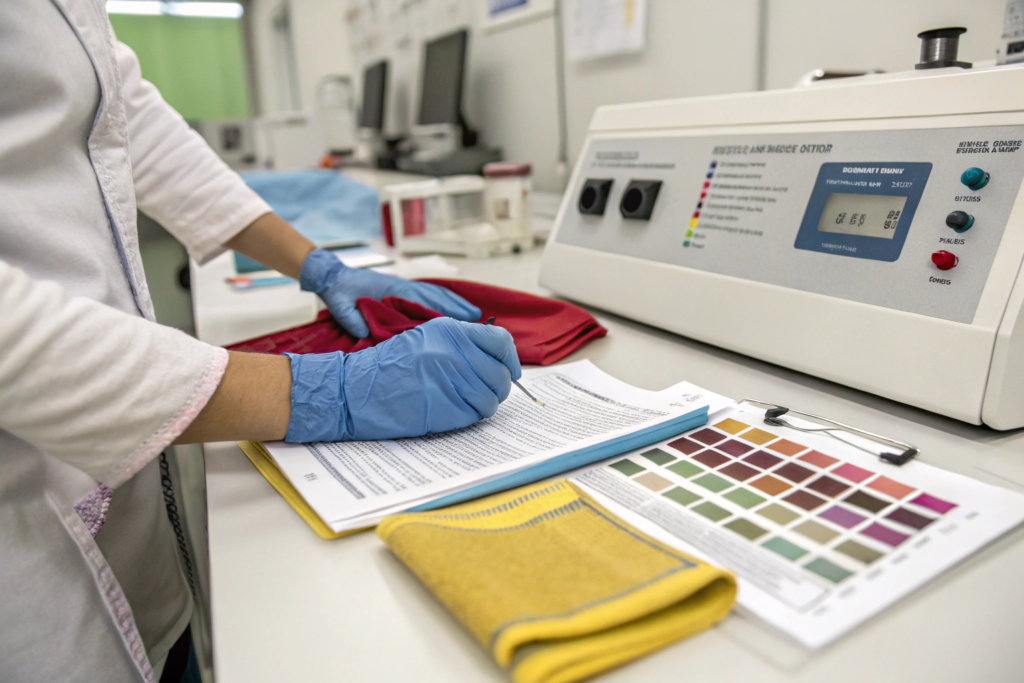
At Shanghai Fumao, we run the ISO 15797 protocol on every prospective workwear fabric. The standard specifies 8 different washing procedures, numbered 1A through 8B. For heavy-duty hospitality and healthcare whites, we test to Procedure 2A (cotton wash at 75°C) and Procedure 1A (white wash with chlorine bleach at 85°C). The fabric must demonstrate less than +/- 3% dimensional change, Grade 4 minimum color fastness to washing, and tensile strength retention above 80% after processing. If it doesn’t hit those numbers in the first 25-cycle benchmark, we don’t even propose it to the client.
How Does Dimensional Stability Differ Between ISO 6330 and ISO 15797?
Domestic wash shrinkage (ISO 6330) is tested with a gentle cool-down phase and a low-speed spin. Industrial wash shrinkage (ISO 15797) uses a hot tumble dry dropping directly from 85°C to ambient in about four minutes, followed by a tunnel finisher press at 160°C steam. The thermal shock is brutal. A fabric that shrinks -2% in a home test can shrink -7% in an industrial press.
Our internal data on a 65/35 twill tells the story:
| Test Standard | Wash Temp | Drying Method | Measured Warp Shrinkage | Weft Shrinkage |
|---|---|---|---|---|
| ISO 6330 (6A) | 40°C | Line dry | -1.8% | -0.9% |
| ISO 15797 (1A) | 85°C | Tunnel press 160°C | -5.4% | -3.1% |
To preempt this, we heat-set all our industrial polyester-cotton twills at 195°C on a Stenter frame under an 8% overfeed in the weft direction to build in an intentional relaxation allowance. When the fabric hits that 160°C tunnel press in the real laundry, it relaxes to the correct size, not past it. A Dutch workwear brand implementing a proper ISO 15797 workwear wash testing protocol for European markets used our pre-shrunk fabric in 2022 and reported a near-zero complaint rate on sleeve shortening after 18 months of service, a huge improvement over their legacy Turkish supplier whose sleeves were shrinking 4cm in length.
How Do We Test for Cross-Contamination During the Wash Cycle?
This is a hidden failure mode that I rarely see discussed outside of professional uniform rental laundries. In a tunnel washer, your chef whites are washed with a hundred other items, often including deeply soiled industrial outerwear. If the color fastness of your white fabric is marginal, it acts like a sponge, absorbing fugitive dye from other garments floating in the vat. The pristine white jacket comes out with a faint pink or blue caste, and the laundry operator gets blamed.
We run a "cross-staining in wash liquor" test. We cut a specimen of our white fabric, sew it together with a heavily dyed red or navy control fabric, and wash them together exactly per ISO 15797 Procedure 1A with the full bleach dose. The white specimen is then analyzed under a spectrophotometer (D65 illuminant, 10-degree observer) for any delta E shift greater than 1.5. If it shifts more, the fabric has picked up staining. Our 100% polyester filament anti-static fabric passed this with a delta E of 0.8, essentially invisible to the eye. We also test for "optical brightener degradation." Optical brighteners (OBAs) are those blue-white fluorescent agents that make white fabric look extra white. They break down under industrial heat and bleach, causing whites to look "dingy" over time. We evaluate OBA fastness through multiple industrial laundry cycles using a UV lamp in our D65 viewing cabinet. A good OBA should retain its fluorescence intensity above 70% after 100 cycles.
Can Fumao Prevent Seam Slippage in Repeated Heavy Washes?
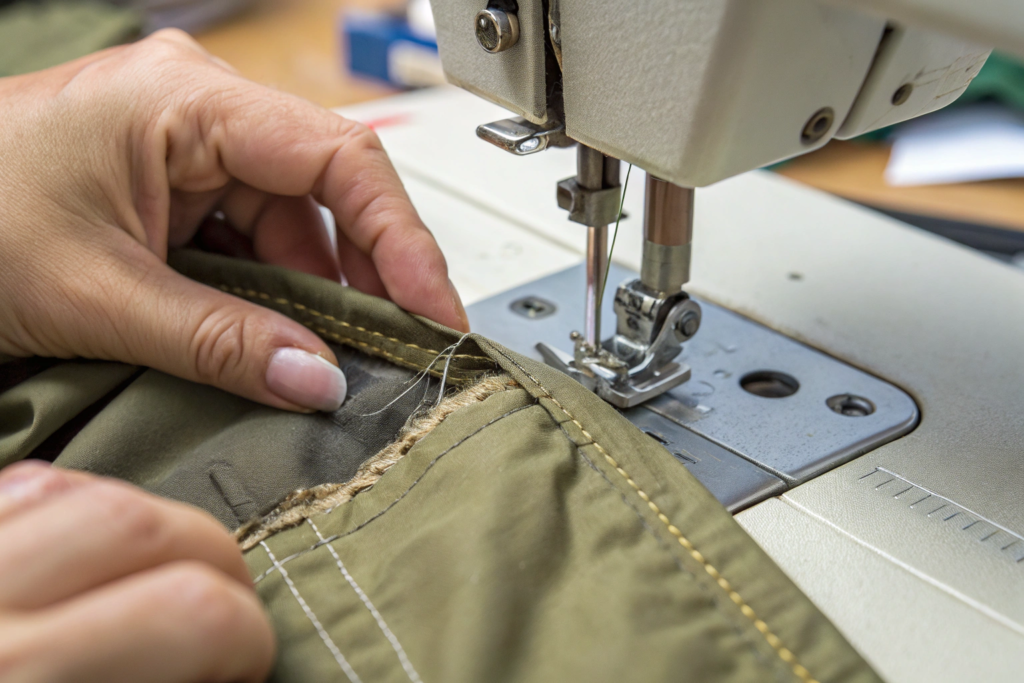
The fabric survives, but the seams open up. The garment looks intact until you pull it over your shoulders, and suddenly the sleeve cuff seam splits along the stitching line. This is seam slippage, and it’s the silent killer of industrial uniforms. It happens because the repeated hydraulic pounding of the washer drum and the rotary pressing machine weakens the fabric structure around the needle holes and allows the yarns to slide apart, almost like a lattice fence loosening over time.
Seam slippage is a fabric construction problem, not a sewing problem. If the weave is too loose, or the yarns are too smooth, even the strongest polyester core-spun sewing thread cannot hold them in place. At Shanghai Fumao, we test every industrial workwear fabric for seam slippage according to ASTM D434 (now superseded by ASTM D1683, but we still run the specific grab test for comparative consistency). Our acceptance criteria is a maximum seam opening of 2.5mm under a 176N load for heavy-duty twills, and 1.5mm for lighter shirting. If a fabric exceeds this at the pre-production trial stage, we re-engineer the weave density—adding 4-6 ends per inch in the warp, or swapping a simple 2/1 twill for a tighter 3/1 twill.
Why Do Certain Weave Constructions Resist Slippage Better?
Weave geometry determines internal friction. A plain weave has the highest number of interlacing points per square inch—each warp yarn goes over one weft, under one weft, in a constant up-down wrestling match. This creates maximum crimp and maximum friction, locking the yarns in place. But plain weave is stiff and less tear-resistant.
A twill weave (2/1 or 3/1) has longer floats—the warp goes over two or three wefts before going under one. These floats give the fabric softness, drape, and a nice diagonal texture, but they reduce inter-yarn friction. You can pull a weft yarn along that long float much more easily. The trick is to use a high-density twill with a reinforced selvedge edge, and to use a slightly coarser yarn count in the warp direction to increase the contact surface area. Our 65/35 twill for chef jackets uses a 3/1 S-twill with a 135 ends-per-inch density in greige. Post-finishing, it comes to about 128 ends per inch after shrinkage. This density is so tight that the yarns physically cannot shift more than 2mm before the inter-yarn friction spikes and halts the movement. When you compare this against a standard 60/40 twill weave fabric construction parameters for durability, the difference in inter-yarn contact angle is what pays the seam-slippage insurance premium.
How Do We Test Seam Strength After 100 Industrial Wash Cycles?
Seam integrity is a dynamic property. A seam that holds 400N before washing might hold only 220N after 100 cycles because the stitch thread has degraded from chlorine and heat, or because the fabric around the stitch has lost tensile mass. We run a "cut-strip method" seam tensile test on a Universal Testing Machine (UTM), pulling a 50mm wide strip containing a vertical seam at a jaw speed of 300mm/min until failure.
We pull the seam strength specimens not just before wash, but at cycle 50 and cycle 100. The standard we set for our own workwear fabrics is that the seam strength after 100 ISO 15797 cycles must exceed 85% of the original seam strength. In a test from March 2024, an Australian mining services company wanted a fluorescent orange hi-vis fabric that could withstand 100 cycles with the reflective tape still intact and the seam holding. We used a 100% polyester warp-knitted birdseye mesh bonded to a microporous PTFE membrane. The seam we specified was a flat-locked 5-thread safety stitch. After 100 cycles at 60°C (a milder industrial cycle for synthetic hi-vis garments), the seam broke at 372N—down from 410N original. That is a 90.7% retention rate. We tracked the data using a digital universal tensile testing machine for textile seam fatigue analysis and provided the client with the raw force-extension graphs.
Does Fumao Guarantee Color Retention in High-Temp Tumble Drying?
Tumble drying in an industrial setting is not the gentle "low heat" cycle your yoga pants endure at home. It is a 180°F to 200°F (80°C to 95°C) blasting airstream that evaporates water violently out of the fiber capillaries, dragging unfixed dye molecules to the surface along with the escaping steam. This process, called "thermomigration," causes colored fabric to fade, and worse, causes the free dye to transfer to lighter-colored panels in a mixed-fabric load. Your dark navy uniform rubs against your white collar piping in the dry tumble, and suddenly the white is baby blue.
Color fastness to industrial tumble drying is a specific, distinct test from color fastness to washing. We test it according to an internal protocol adapted from ISO 105-D01 (dry cleaning) and ASTM D6797 (ball burst/fabric stability to tumble drying). The specimen is sandwiched between a dry, white cotton multifiber fabric and a dry polyester fabric, and tumbled at 85°C for 60 minutes in a no-moisture hot-air stream. Any staining on the white witness fabrics is assessed against the grey scale. We require a minimum Grade 4.5 for staining on cotton and Grade 4 on polyester for a fabric to be released for an industrial uniform program. At Shanghai Fumao, we achieve this by using high-energy disperse dyes for the polyester component that are specifically selected for high glass-transition temperature bonding. These dyes lock into the polymer matrix and don’t migrate even when the polyester fiber softens slightly at peak dryer temperatures.
What Is Sublimation Fastness and Why Does It Matter for Uniforms?
Sublimation is the direct transition of a dye from a solid state to a gas state, without passing through a liquid phase. Certain cheap disperse dyes, especially in red and blue shades, sublimate at surprisingly low temperatures (150°C, which is easily reached on the surface of a metal dryer drum). The dye gasses off from the polyester yarn, floats around the dryer drum, and re-deposits as a colored haze on everything else in the load. It’s like an invisible, heat-driven dye transfer that ruins a full batch of uniforms before you even open the dryer door.
We test sublimation fastness using the AATCC 113 test method. A specimen of the dyed fabric is pressed against a white multifiber witness strip in a standard heating block at 150°C and 180°C for 30 seconds. We then evaluate the staining on the witness strip. Our standard for workwear is a Grade 4.5 minimum at 150°C. (Consumer fashion polyester is often only tested to 110°C or 120°C, which is insufficient for industrial dryers.) A Canadian uniform rental service came to us in 2024 with ghostly blue stains on their white polyester-cotton shirts that nobody could explain. Their previous fabric’s navy disperse blue 291 was sublimating at 148°C. We reformulated the dye recipe using a high-energy anthraquinone blue with a sublimation point above 200°C. The staining stopped immediately. Testing for sublimation fastness properties of disperse dyes on polyester workwear is a highly specific piece of chemistry, but it’s non-negotiable for us.
How Do We Maintain White Uniform Brightness After Chlorine Bleach?
Industrial whites are bleached within an inch of their life. The standard procedure for a heavily soiled white uniform is a hot alkaline break wash, followed by a chlorine bleach bath at 60-70°C, followed by an antichlor rinse to neutralize the residual chlorine. The fabric has to handle this cycle four times a week, 52 weeks a year. The enemy is "chemical yellowing"—when chlorine bleach reacts with certain optical brighteners, fabric softener residues, or even the cotton fiber itself in the presence of metal ions, creating a stubborn yellow cast.
We prevent this by specifying a "chlorine-resistant optical brightener" (usually a stilbene-disulfonic acid derivative stabilized for hypochlorite stability) and by sequestering metal ions with a polycarboxylate-based anti-burning agent applied during the pre-shrinking finish bath. In January 2023, a Dubai hotel group complained that their 100% cotton spa towels from a Portuguese supplier were yellowing within 50 cycles. They asked us to develop a polyester-cotton alternative that stayed optically white longer. We applied our chlorine-resistant chemistry to a cotton-faced 65/35 terry towel fabric. In an accelerated chlorine immersion test (soaked in 200ppm available chlorine solution at 50°C for 24 hours, then dried and scanned), our sample shifted a Delta E of only 2.1 versus a Delta E of 8.7 for the Portuguese sample. That’s the difference between "creamy white" and "offensive yellow." The hotel group switched to our fabric for their entire terry program. Understanding the interaction of chlorine bleach with textile optical brightening agents is critical for anyone managing a white uniform or linen program.
How Do We Simulate 100 Industrial Washes in Our Lab?
Speed matters in workwear development. A laundry service cannot wait six months for you to run a real-world trial. We accelerate the aging process using a laboratory-scale "Rotowash" machine, which fits in a benchtop unit but replicates the mechanical and chemical action of a full-scale tunnel washer using small, calibrated steel balls and precisely dosed chemical injections.
We can simulate 100 industrial wash cycles in approximately 10 working days by running a continuous sequence with minimal dwell time between cycles. Each cycle is exactly programmed to the temperature, time, and chemical dosing regimen of ISO 15797 Procedure 1A. We pull a specimen set for tensile, dimensional, seam, and color assessment at cycle 25, cycle 50, cycle 75, and cycle 100. The degradation curve we generate is shared transparently with the client. For a Shanghai Fumao certified industrial fabric, the tensile loss curve must flatten out by cycle 75, not continue on a steep downward slope. A flattening curve indicates that the initial "weak links" have shaken out and the remaining fiber and yarn structure is stable for the long haul. A continuously dropping curve indicates an inherent chemical incompatibility that will eventually produce garment failure, even if it passes the 100-cycle threshold. When a buyer asks us for hard garment aging data, I often point them to industry case studies on statistical modeling of industrial uniform lifespan via accelerated wear testing to understand how a 10-day lab simulation correlates to a 2-3 year service life.
Conclusion
Industrial laundry is a chemical furnace that burns through weak fabrics. You’ve now seen the specific fiber blends—polyester-cotton 65/35 hybrids and filament-staple composites—that survive where pure cotton fails. You’ve learned about the ISO 15797 torture test, why a simple home wash test is irrelevant, and how seam slippage and dye sublimation can silently destroy a uniform program even if the fabric itself looks fine. A truly industrial-grade fabric needs a seam that holds past 100 cycles, a white that stays white under chlorine assault, and a color that won’t gas off onto everything else in the dryer drum.
The question you need to ask your current supplier isn’t "Is this fabric strong?" It’s "Can you show me the tensile strength retention at cycle 100, the dimensional stability at 85°C, and the seam slippage under 176N?" If they can’t produce those specific numbers from an accredited lab, you’re not buying workwear fabric—you’re buying a hope. We test to these standards because we know that a uniform rental contract lives or dies on these specific technical margins. A garment that fails in service is a million times more expensive than a fabric that passes a lab test.
If you are bidding on a uniform contract, or you’ve just lost money on a batch of workwear that couldn’t handle the heat, let’s talk before you approve your next sample yardage. At Shanghai Fumao, we have the industrial laundry test data ready for our twills, meshes, and high-visibility knits. Reach out to our Business Director, Elaine, at elaine@fumaofabric.com. She can send you the full ISO 15797 report package, including the AATCC 113 sublimation data and the 100-cycle dimensional stability chart. Let’s build a uniform fabric that looks as good on day 300 as it does on day one—because your client’s employees deserve a garment that holds up, wash after relentless wash.








