
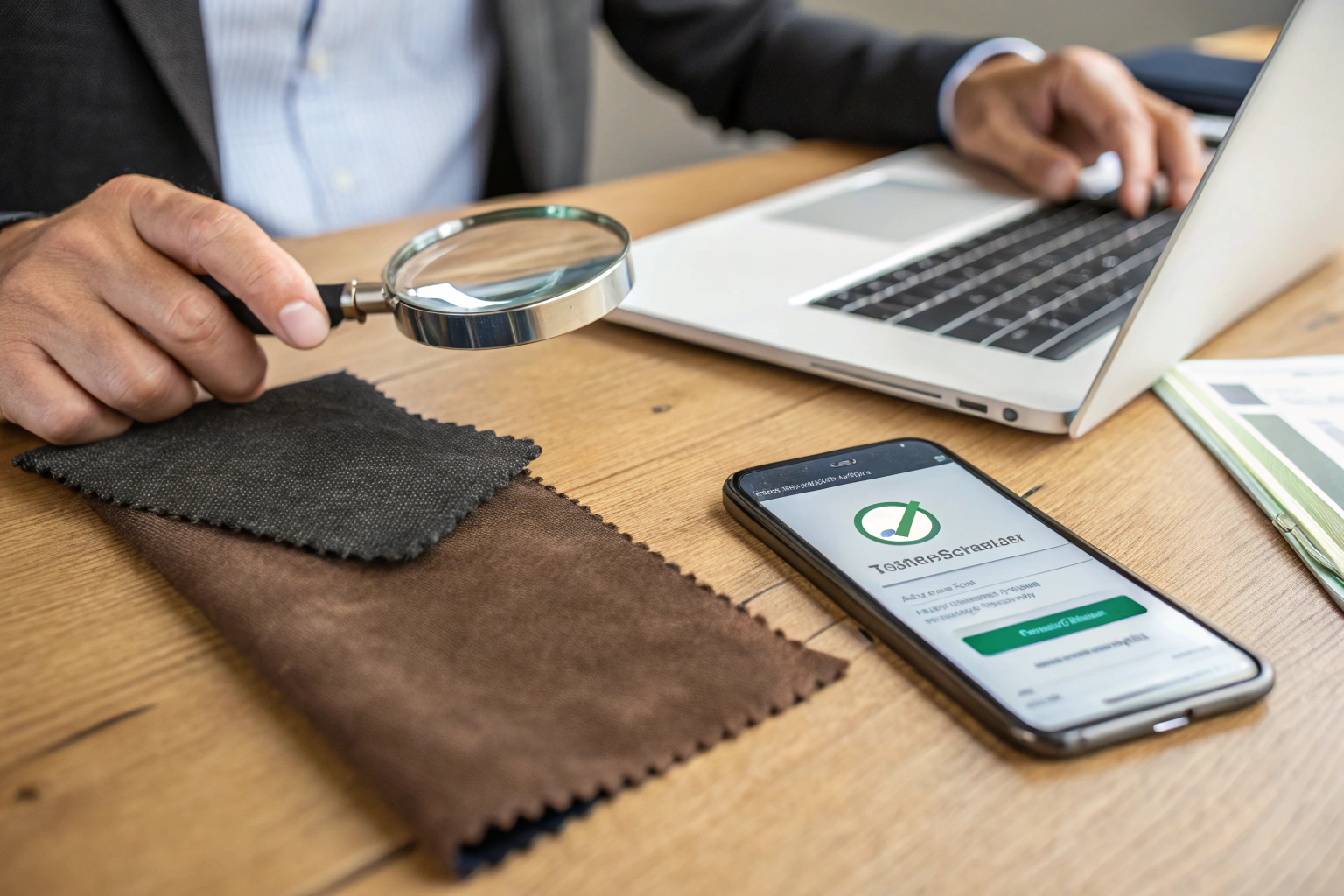
You receive a swatch from a new supplier. It feels soft, the color is perfect, and there’s a little OEKO-TEX hangtag pinned to the corner. You smile, drop it into your sourcing folder, and mentally check the "eco-friendly fabric" box. Two months later, your container arrives. You get a random REACH screening done at a European lab. The test comes back hot—restricted phthalates detected at 0.15%, triple the legal limit. You call the supplier. They say, "But we gave you the certificate!" What they gave you was a photocopied PDF of someone else’s certification number. Yours wasn’t genuine, and now your shipment is flagged for destruction.
A sewn-in label means nothing. A PDF attachment in an email means nothing. A genuine OEKO-TEX Standard 100 certification is a live digital record tied to a specific manufacturer, a specific product class, and a specific validity date. At Shanghai Fumao, we don’t hand out "trust me" swatches. Every certified swatch comes with a traceable number you can punch into a public database right there in the meeting. In this article, I’ll teach you the exact steps to verify a swatch on the spot, how to spot counterfeits, and why a verification QR code on the back of the label is now becoming the industry standard. Don’t let a fake tag trash your brand.
How Can I Spot a Fake OEKO-TEX Label on a Swatch?
I’ve seen counterfeit OEKO-TEX labels in Guangzhou fabric markets. They sell them by the roll—generic hangtags with a fake logo and a random string of digits that look convincing to a busy merchandiser. The counterfeiters bet that nobody will actually type the number into the verification portal. They are usually right. The single most common mistake a buyer makes is accepting a label that says "OEKO-TEX" without a registration number, or with a number that ends in something suspicious like "000001."
The genuine OEKO-TEX label has required visual elements. First, the logo itself—the green "Standard 100" branding with the specific leaf motif. Second, the issuing institute’s name (for China, this is often TESTEX or Hohenstein). Third, the certification number format. For a Shanghai Fumao swatch, our number starts with a specific prefix assigned to our legal entity, followed by a unique series. The format is usually something like "23.0.XXXXX" or "SH015 XXXXXX." If the number is just a random 8-digit string without the institute prefix, it is likely fabricated. The label must also state the product class. If a swatch of terry cloth for baby towels doesn’t say "Class I," the label itself is a misrepresentation, even if the number is real.

What Does the QR Code on a Modern OEKO-TEX Label Actually Do?
Paper certificates are dead. The new generation of OEKO-TEX labels includes a scannable QR code on the reverse side or printed directly on the care label. This isn’t a marketing gimmick; it’s a cryptographic shortcut to the official verification portal. When you scan a legitimate QR code from a Shanghai Fumao swatch, it takes you directly to a page on the Oeko-Tex Label Check site.
That page will display the exact manufacturer name (which must match the legal name of the entity that issued the invoice), the product scope ("Knitted fabrics for baby clothing, Class I"), the certification validity date, and the issuing body. You can cross-reference this instantly. In one case in early 2024, a garment factory in Vietnam called us about a sub-supplier claiming to use "Fumao Oeko-Tex certified base fabrics." The sub-supplier’s QR code led to a valid certificate—but for a completely different company in a different province. The supplier had copied the QR code image from a legitimate certificate and printed it on their own hangtag. The mismatch between the QR destination company name and the invoice company name was the smoking gun. When you scan a QR code, don’t just look for a green checkmark; actually read the company name and certificate scope. Smart counterfeiters are betting you’ll stop looking after you see the word "valid."
Here’s a step-by-step verification checklist I make my own QC team use:
- Scan the QR code or manually type the number at the official Oeko-Tex label check verification portal for fabric buyers.
- Check the legal entity name. Does it exactly match the name on the supplier’s invoice and business license?
- Verify the product class. Is it Class I, II, III, or IV? Does it match your product’s end-use?
- Check the expiry date. Is the certificate still valid on the day you are inspecting the swatch? (Certificates expire annually and must be renewed.)
Why Do Some Swatches Have a "Certificate Expired" Notice?
This is an honest mistake that looks dishonest. An OEKO-TEX certificate is valid for 12 months from the date of issue. A factory might pass the audit and testing in January 2024, print 50,000 hangtags, and then fail to renew in January 2025. The hangtags are still physically on the fabric, but the certificate is dead. Legally, if you ship a product with an expired certificate number, you cannot make the OEKO-TEX claim.
I saw a scenario in October 2023 where a UK high-street brand manually sampled a vintage stock fabric from another mill at a trade show. The swatch had a label, but the certificate had expired eighteen months prior. The mill said, "The fabric is the same fabric, we just haven’t renewed yet." But that’s not how the standard works. The renewal isn’t just paying a fee; it involves re-testing the current production for potential new contamination risks. If the mill hasn’t renewed, they haven’t proven their current water supply, dyestuffs, or machine lubricants are still compliant. Always check the meaning of the Oeko-Tex certificate expiration date and renewal process. If the date is past, the swatch is not certified.
Can a Swatch Label Prove Fabric Is Oeko-Tex Compliant?
A label proves intent. A test report proves fact. I can sew an OEKO-TEX label onto a piece of polyester that was dyed with a bath of APEO-laden surfactants, and the swatch itself won’t scream in protest. The label is only as honest as the person who stitched it on. That’s why, when I want to prove a swatch’s compliance to a skeptical customer, I don’t point at the label—I point at the batch-specific test report that corresponds to that swatch’s production lot number.
At Shanghai Fumao, every OEKO-TEX certified fabric roll we ship comes with a "Certificate of Compliance" (CoC) that links the roll number, the batch dye lot number, and the OEKO-TEX certification number. This CoC is signed by our lab director and stamped with our CNAS lab seal. If you are holding a swatch and the supplier can’t produce a CoC that traces the dye chemicals back to the feedstock, you are holding no more than a nice piece of marketing. An auditor from ZDHC once told me, "A label without a lot-traceable report is a postcard, not a passport."

How Do I Cross-Reference a Swatch with a Batch Test Report?
You look at the selvedge of the swatch. A proper textile mill prints the production lot number, roll number, and running meter marks along the selvedge using a digital inkjet or thermal transfer printer. This isn’t just for inventory; it’s for forensic traceability. If a selvedge print says "Lot: KQ-MJ-240803-22," the batch test report for OEKO-TEX should reference either that exact lot number or a clearly documented combination of lots that went into that specific dye bath.
In February 2024, a Swiss outerwear brand sat in our Keqiao showroom and asked to see the toxicology file for a water-resistant ripstop swatch they were holding. The swatch selvedge said "Lot: FU-SW-240157A." We pulled up our internal ERP system (which we call the "Fabric DNA Log") and showed them the entry: a PDF attachment of the SGS test results for extractable heavy metals specifically for "Lot FU-SW-240157A," with a timestamp that predated the swatch cutting. The buyer matched the lot number on the swatch to the lot number on the PDF and the OEKO-TEX appendix. Three-way match. That’s compliance. If the report only references a generic "Fabric Code: Nylon 66" without a batch date, it’s not a match. A thorough understanding of textile lot number traceability in supply chain auditing is what separates a spot-check from a systemic guarantee.
Can a Swatch Be "Pre-Certified" or "Pending Certification"?
Short answer: No. In the eyes of the OEKO-TEX association and EU customs, "pending" means uncertified. There is no grace period. A supplier might tell you, "We have applied, the audit is next month, we can deliver with the label after that." That’s fine for a future order date, but if they ship fabric today with a label that corresponds to an application in progress, they are committing fraud.
I’ve had small Turkish importers ask me, "Can we just use the same certificate number from a different factory we own? It’s the same parent company." No. The certification is tied to the legal entity and the physical production site address. In 2021, a Vietnamese mill in our supply chain moved their dyeing facility 30 kilometers down the road. Even though the equipment and staff were the same, they had to undergo a completely new audit because the water treatment facility and the physical location had changed. They could not use the old certificate for fabric dyed at the new plant. If a supplier tells you a certificate is "transferable" across factories, they are incorrect. You can verify this directly by searching for the official Oeko-Tex Standard 100 certification scope requirements for subcontractors. The scope is site-specific.
Has the Fumao Swatch Been Tested for Heavy Metals?
Heavy metals in fabric are invisible, odorless, and tasteless. You can hold a swatch to your cheek, smell it, even boil it in water and look at the color of the liquid—and you will not detect lead, cadmium, or hexavalent chromium. These elements are introduced through cheap metal-complex dyes (used for bright reds, oranges, and deep navy blues), through contaminated water, or through low-grade polyester catalysts containing antimony. A swatch can feel luxurious and still be chemically dangerous.
OEKO-TEX Standard 100 sets limit values for extractable heavy metals, which simulate the metals that could leach out of the fabric onto human skin through sweat. For lead, the limit is 90 mg/kg for Class I (baby items) and 90 mg/kg for Class II (skin contact). For cadmium, it’s 50 mg/kg for Class I and 100 mg/kg for Class II. But note: these are extractable heavy metals, not total heavy metal content. The extraction uses a simulated acidic sweat solution (pH 5.5) at body temperature. This is a better predictor of bioavailable exposure risk. If a mill claims they have a "non-detectable total lead" report, that’s good, but the OEKO-TEX test answers the specific question: "Does the lead come out onto the skin?" and that’s the number that matters.

What Does Atomic Absorption Spectroscopy Reveal About a Swatch?
When we need to investigate a suspicious swatch or verify a new dye supplier, we use our in-house atomic absorption spectrophotometer (AAS). The process is destructive—we burn a small known mass of the fabric in a furnace at 500°C to ash it, dissolve the ash in nitric acid, and aspirate it into the flame of the AAS. The machine measures the characteristic absorption wavelength for cadmium (228.8 nm) or lead (283.3 nm). The reading spits out a concentration in mg/kg against a calibrated standard curve.
In March 2023, a potential Indian indigo supplier sent us a beautiful sateen swatch. The hand feel was exceptional. But our AAS preliminary screen showed a cadmium peak that should not have been there—it read 87 mg/kg, over the Class II limit. We traced it to a contaminated zinc oxide powder they were using as a mordant to fix the natural indigo. The supplier’s own third-party report had "missed" cadmium because they didn’t run a heavy metal panel; they only tested for banned amines. We rejected the supplier. The lesson? A basic understanding of AAS testing methods for heavy metals in textile products is not just for chemists; it’s a sourcing survival skill. You can ask your supplier: "Do you screen dyes for cadmium via ICP-MS or AAS?" If they look confused, you have your answer.
How Do We Ensure Even the Trims on Your Swatch Pass Metal Tests?
The fabric selvedge passes. The main zipper passes. But the tiny metal press snap button—often a cheap alloy sourced from a third-party trim vendor—can fail spectacularly. OEKO-TEX certification covers the entire garment unit as tested, including non-textile parts, if they are attached and submitted during testing. A trim piece with high nickel content can cause an allergic reaction, even if the cotton fabric it’s attached to is perfectly clean.
Because we sell fabrics and not finished garments, our responsibility lands on the integrated components—the metallic yarn in a lurex jacquard, the flocking adhesive in a velvet, the heat-transfer print foil. For lurex, we don’t just accept the standard "polyester metallized film" spec. We buy only OEKO-TEX certified metallic yarns from a limited roster of Japanese and European suppliers whose AAS reports we audit annually. In one instance, the black nickel coating on a high-end "aged silver" look yarn kept releasing nickel above the 0.5 µg/cm²/week migration limit. Our testing caught it before bulk knitting. We switched to a titanium-based alternative that cost 8% more but had zero detectable nickel. When you hold a Shanghai Fumao lurex swatch, touch it—the lack of that weird metallic smell is often a sign of clean chemistry. (Yes, nickel sometimes has a faint tell-tale tang, but don’t rely on that; rely on the report.) For more information on metal migration limits in apparel trims, I always point clients toward EU REACH Annex XVII entry 27 guidelines for nickel release testing.
Why Is the Oeko-Tex Class I Label Harder to Get for Knits?
Class I is the "mouthing" standard. Babies don’t just wear fabric—they chew on it, drool on it, and sleep with their faces pressed into it for twelve hours. The chemical limits for Class I are brutally strict because a baby’s immune system and skin barrier are incomplete. Saliva is a different extraction solvent than sweat. Saliva contains amylase enzymes and has a different pH, which can pull different chemicals out of a fiber.
For knitted fabrics, Class I is even harder to achieve than for woven fabrics because of the construction process. The high-speed circular knitting machines that produce fine jersey for baby sleepwear require a constant layer of lubricating oil on the needles and sinkers. If you use a standard mineral oil, you introduce polycyclic aromatic hydrocarbons (PAHs) and other petroleum residues that are restricted under Class I. At Shanghai Fumao, we use a GOTS-approved, readily biodegradable knitting oil for all our infant-grade fabrics. This oil is four times more expensive than standard white mineral oil, but it scours out completely during the pre-treatment wash at a lower temperature. Standard oil requires harsh surfactants and high heat to remove, which can rough up the delicate cotton fiber and reduce the softness. A comprehensive specification for Oeko-Tex Class I infant product chemical limits reads like a pharmacy manual, and we treat it that way.

Why Does Saliva Resistance Testing Matter for Baby Knits?
The standard test for heavy metals and phthalates uses acidic sweat simulant. But OEKO-TEX and some stricter EU requirements also consider a saliva simulant test. Baby knitwear—think drool bibs, teething rings covered in fabric, the edges of a cotton blanket that gets chewed—needs to be safe under oral extraction conditions. The Simulated Saliva Fluid (SSF) used in test protocols has a higher pH (around 6.8) and contains mucin and enzymes.
In a test we ran in 2024 with a UK nursery brand, a competitor’s bamboo muslin swaddle failed the SSF extraction for formaldehyde. It passed the standard sweat extraction beautifully, posting a "not detectable" result. But the different enzyme chemistry of the artificial saliva pulled out 18 mg/kg of formaldehyde that had been trapped in the cross-linking resin used to give the muslin its "crinkle" texture. Formaldehyde-releasing resins are often hidden in wrinkle-free finishes, and a Class I certification must specifically catch them under the appropriate simulant. I always tell buyers of baby fabric: don’t just ask "Is it OEKO-TEX?" Ask "Has this specific lot been tested against the saliva extraction protocol in EN 71-3 toy safety standards?" It’s the closest proxy we have for mouthing safety before the full ISO 10993 biocompatibility panel that medical textiles require.
How Do We Minimize Chemical Inputs for Class I Knits?
You can’t fix a toxic swatch by washing it. The Class I standard is earned at the fiber selection and machine lubrication stage, not the post-production finish line. We begin with a restricted input policy. Our "red list" for Class I knitting includes any dye suspected of cleaving into carcinogenic amines (which is standard for OEKO-TEX anyway), any organotin catalyst (sometimes used in silicone softeners), and any formaldehyde-based anti-pilling resin. We use a formaldehyde-free, polyurethane-free cross-linker if the baby knit requires dimensional stability without shrinkage.
Our knitting workshop follows a "dry-handle" protocol for Class I greige. The greige fabric is handled with clean cotton gloves only, never bare hands, because the natural oils and skin cells from palms can create a poor surface for dye uptake and also introduce biological contamination. Before the fabric enters the dyeing kier, we perform a cold pad batch scouring with a specific enzymatic desizing agent that operates at 30°C. No high-alkaline boil-off. The lower temperature consumes less energy and preserves the natural waxiness of the organic cotton, giving the final swatch that incredibly soft, fatty hand feel without the addition of a silicone softener. (That’s our little trick: the softness is the absence of harsh removal chemistry, not the addition of a coating.) I recommend any brand developing infant playwear review the OEKO-TEX Standard 100 Annex 6 Class I restricted substances list for the most recently added chemical entries, which are updated annually.
Conclusion
A genuine OEKO-TEX swatch is a piece of a documented, verifiable chain. It carries a label that you have scanned, a lot number that you have cross-referenced, and a chemical fingerprint that has been checked by spectrophotometry. A fake swatch carries a photocopied hope. You now know how to check the QR code against the issuing body’s portal, how to read a lot traceability report, and why a baby’s mouth needs a completely different chemical safety protocol than an adult’s armpit.
The swatch is the smallest, cheapest part of your order. But it carries the entire weight of your regulatory risk. If that small piece of fabric is legitimate, the bulk container has a good chance of being legitimate. If the swatch label is blurry, the number unverifiable, or the batch report missing, you are building your collection on a foundation of sand. Don’t let a piece of printed ribbon on a sample card fool you—the real certification lives in a public database, not on a showroom table.
I want every buyer to feel empowered to check this themselves. Pull out your phone, scan the QR code on our label, and verify it while you sit in our meeting room or unbox our sample parcel at your desk. If you’re currently evaluating a new supplier and want a benchmark swatch that you can trust as ground truth, reach out to our Business Director, Elaine, at elaine@fumaofabric.com. She can courier you our OEKO-TEX Class I baby rib knit swatch card, complete with a live QR code and a copy of the corresponding batch test report. Once you see what genuine traceability looks like, you will never mistake a fake label again.








