
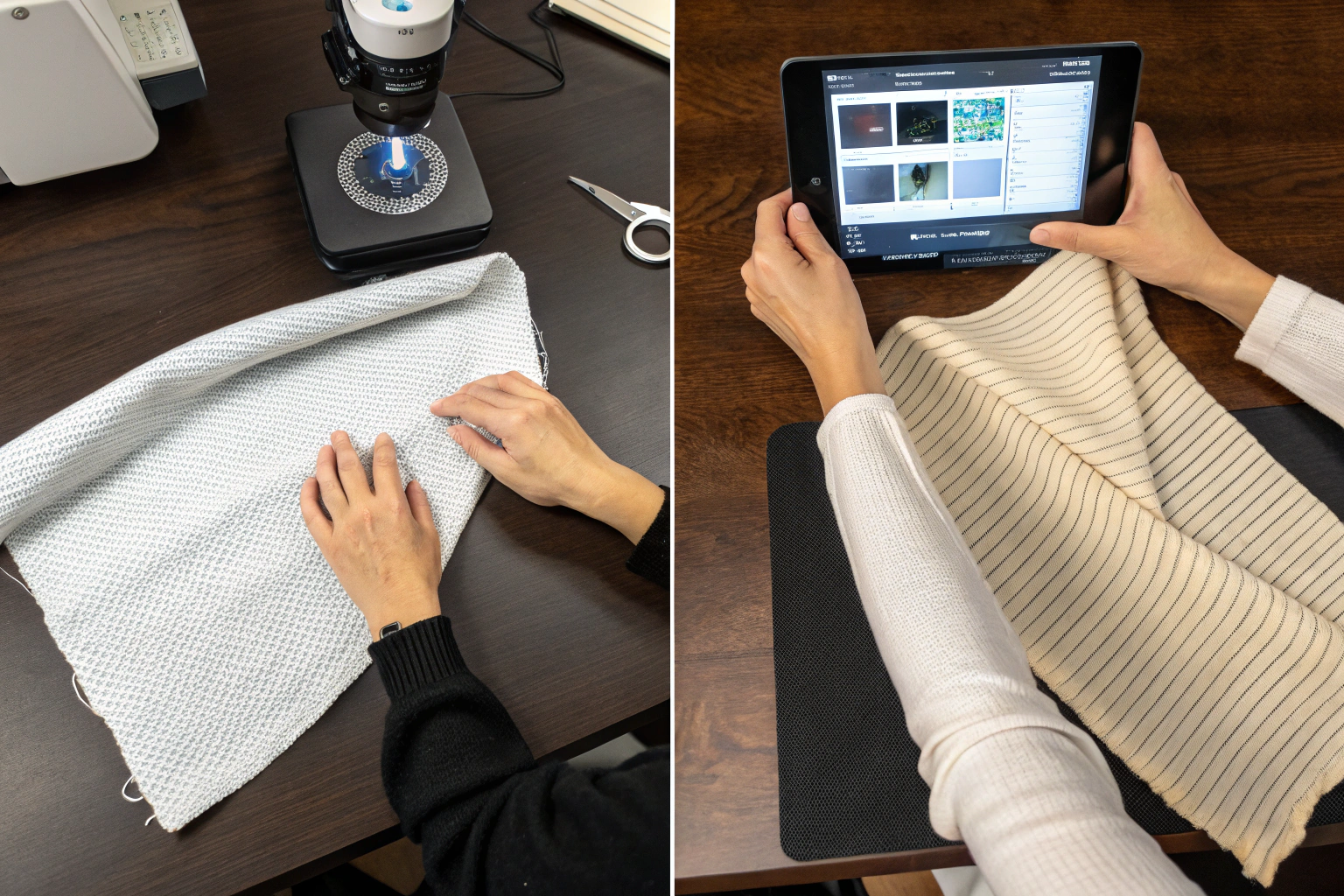
A buyer calls me and says, “I need fabric for a structured blazer and a soft tee. Same quality please.” That is like asking a chef for a great steak and a perfect ice cream sundae, but specifying “use the same technique for both.” Knits and wovens are fundamentally different animals, built on different machines, for different physics, and they fail in completely different ways. A "quality" knit that doesn’t bag out at the elbows is engineered completely differently from a "quality" woven that holds a sharp crease through a ten-hour travel day.
At Shanghai Fumao, we don’t grade knit quality and woven quality on the same scale because they don’t serve the same body. A high-quality jersey knit must fight the forces of stretch recovery, spirality, and pilling. A high-quality woven must fight the forces of seam slippage, warp tension, and tearing. You need to know how to inspect them separately, and you need to know which defects are genuinely fatal and which are just textile personality. I’m going to walk you right into our QC inspection room and show you exactly how we judge a knit against a woven, and why confusing the two leads to expensive returns. Let’s separate the stretch from the structure.
Why Do Knits and Wovens Need Different Quality Metrics?
The fundamental reason a knit and a woven can’t share a quality playbook is hidden in their geometry. A woven fabric is a grid—warp yarns running vertical, weft yarns running horizontal, interlacing at right angles. A knit fabric is a chain mail of interlooping loops—pulled through previous loops, building a structure that can stretch in all directions. Because the structure is different, the failure modes are different. You don’t measure a knit’s quality by its tear strength along a straight line, and you don’t measure a woven’s quality by its loop recovery after being stretched 50% of its length. You would be measuring the wrong physics.
I learned this lesson in a very stressful way back in 2017 with a Spanish brand that produced both tailored trousers and jersey polo shirts. They applied their woven trouser inspection standard to the polo shirts—looking for "stray weft threads" and "warp lines." The jersey polo had a slight horizontal barre effect (a faint periodic stripe caused by subtle differences in yarn tension between knitting feeds). It was invisible to 99% of consumers, but their inspector flagged it as a defect because in a woven twill, a horizontal line usually means a tension fault that will cause seam slippage. In a knit, that barre is a visual artifact only—it doesn’t weaken the loop structure. We had to re-educate the inspection team that a knit’s barre is cosmetic, while a woven’s barre is often structural. The entire 5,000-piece order was incorrectly rejected, costing three weeks in re-negotiation.

How Does Structural Geometry Dictate the Testing Method?
A woven resists force by tensioning its grid. Pull a woven shirting apart warp-ways, and you are fighting the tensile strength of the yarns themselves. That’s why ASTM D5034 (breaking strength) makes sense for wovens—you clamp a strip and yank it in a straight line. A knit doesn’t break that way. A knit redistributes force around the loops. If you pull a knit in one direction, the loops in the perpendicular direction contract and tighten, absorbing the energy. A straight tensile test on a knit often just pulls the curl out, not the yarn strength, giving you a misleadingly high elongation number.
For knits, the relevant strength test is the burst test (ASTM D3786 or D6797). A ball-shaped probe pushes through the fabric until it pops, simulating an elbow going through a sleeve or a knee pressing into a legging. The fabric stretches in every direction at once, just like it would on a body. The burst strength in kilopascals (kPa) is a genuine quality metric for knits—a fine 120gsm single jersey should pop above 250 kPa. Below 180 kPa, and you have a fabric that will ladder into a hole the first time it snags on a shopping cart. For a great breakdown of this, the textile burst strength standards for circular knitted fabrics used in activewear explains how impact mechanics differ drastically from pull mechanics.
Can the Same Fabric Weight Mean Different Quality in Knits vs. Wovens?
Absolutely. GSMs (grams per square meter) are a deceptive metric when you cross from knit to woven. A 180gsm woven poplin shirting is a lightweight, semi-sheer, crisp fabric suitable for a summer dress shirt. A 180gsm cotton jersey knit is a substantial, heavyweight t-shirt material, almost winter-weight. The woven feels thin and rigid; the knit feels thick and bulky.
This happens because the knit’s looped structure traps air and creates loft. The fiber mass might be similar, but the volume is completely different. So, when a buyer specifies "I need a 200gsm fabric, show me options," I immediately ask, "Knit or woven?" because the same GSM delivers an entirely different opacity and drape category. In 2022, a Canadian startup ordered "200gsm bamboo fabric" for pajamas, assuming a woven twill. We shipped a 200gsm bamboo jersey knit because they hadn’t specified construction. The knit was too heavy and stretchy for their piping details, and they couldn’t sew the crisp lapel collar. The error wasn’t quality; it was construction-type confusion. Specifying knitted versus woven fabric density measurement and how GSM affects garment drape upfront avoids this category error.
How Do I Inspect a Knit for Recovery and Spirality?
Knit spirality is the devil that nobody warns you about until your t-shirt side seams twist around to the front after the first wash. Spirality happens because the single jersey knit structure is inherently unbalanced—the loop legs pull diagonally because of the twist direction of the yarn. When the fabric is washed and tumbled, the loops relax, and the whole piece of fabric torques. You can’t fix spirality once the fabric is knitted and dyed; you can only set it during finishing, or prevent it at the knitting stage by alternating S-twist and Z-twist yarns in every other feed.
When I inspect a new knit development from our circular knitting workshop, I don’t just look at the surface for holes. I cut a 60cm x 60cm square, mark the grainline with a permanent fabric marker, wash and tumble dry it three times per AATCC 135, and then measure the deviation off the straight grain. A spirality angle of more than 5% is a fail for a garment with side seams. If a knit shows a 10cm distortion over a 100cm garment length, the side seam will visibly twist, and the consumer perceives it as cheapness, even if the fiber is 100% Supima. Our 2023 development for an Australian sleepwear label initially showed 8% spirality on a slub modal jersey. We fixed it by increasing the compacting machine pressure to 2.8 bar during finishing, which locked the loop geometry by controlled compressive shrinkage. The final bulk shipped with a 2.4% spirality, well within the 3% benchmark the label required.

What Is an Acceptable Stretch Recovery Percentage for Quality Knits?
Stretch is borrowed time; recovery is quality. Any knit can stretch—just yank it. A good knit stretches and comes back silently to its original dimension. A poor knit stretches and stays saggy, with bagged-out elbows and a droopy neckline. Recovery is measured as the percentage of original dimension regained after a specific stretch and relaxation cycle.
For a cotton-modal jersey slated for a premium polo shirt, I set the recovery spec at 95% minimum after 30% extension, held for 30 minutes, and relaxed for 30 minutes. We test this on an Instron tensile tester with a cyclic loading protocol. The machine stretches the specimen to 30% strain, holds it, releases to zero, waits 60 seconds, and then re-measures the specimen. The difference between the original 100mm gauge length and the final length tells the recovery percentage. A fabric that comes back to 101mm has a recovery of 97% (only 1% permanent growth). That’s an excellent knit. A fabric that comes back to 105mm has a recovery of 90% and will bag visibly at the elbows. For a demanding European fast-fashion account in Q1 2024, we added a proprietary cross-linking finish (formaldehyde-free, of course) to a viscose jersey that raised recovery from 89% to 96% without changing the drape. More details on these testing protocols can be found in this elastic recovery rate testing procedure for knitted jersey fabrics used in fitted garments.
How Can I Spot Spirality Before Cutting Into Bulk?
Don’t wait for the wash report; you can sniff out potential spirality on the inspection table. Take a single jersey swatch and place it flat on the cutting table. Look at the wale lines (the vertical columns of loops). Are they perfectly perpendicular to the cut edge, or do they already lean slightly to the left or right? A visible lean on the greige table means the yarn twist torque hasn’t been balanced by the knitting tension or finishing compaction, and the first wash will amplify the lean into a full twist.
Another cross-check is the "T-shirt test." Cut a simple, unshaped rectangular body panel from the fabric. Don’t finish the edges. Wash it in hot water once and dry it on high heat. Then lay it on the table and measure the distance from the center bottom point to the center neckline against a straight line. If it veers left or right by more than 3% of the total length, the spiral is active. A buyer from a US wholesale brand learned this from us in mid-2023 after a container of 20,000 scoop-neck tees spiraled badly and had to be sold off-price. Now, they require a textile spirality test report via AATCC 179 for every single jersey knit lot before shipment. That protocol specifically addresses the wet processing relaxation that triggers the twist.
Why Does Woven Fabric Seam Slippage Matter More Than You Think?
Seam slippage is the silent killer of a beautiful woven shantung or a structured cotton sateen. The fabric feels strong, the tensile test is good, but when you sit down in those trousers, the butt seam opens up, not because the thread broke, but because the yarns simply slid apart like curtain rods sliding through their rings. The seam didn’t tear; it gaped. The fabric didn’t actually fail; its internal friction failed. This is a uniquely woven failure mode. Knits don’t have seam slippage because their loops are mechanically interlocked and can’t be pushed apart without breaking.
We test seam slippage on every woven fabric intended for close-fitting trousers, skirts, or upholstery using ASTM D1683 (the grab-and-pull method on a sewn seam) or the simpler fixed-seam method. A standard 6mm stitch length seam is subjected to increasing load, and we measure the opening between the two fabric edges. For a standard 150gsm viscose challis dress weight, a seam opening of 2mm at a 100N load is acceptable. Beyond 3mm, the seam becomes a sheer panel. For a 250gsm workwear cotton twill, we expect less than 1.5mm opening at 175N. In early 2024, a Russian uniform supplier rejected a batch of our 65/35 twill because the back rise seam was opening up during wear. Their test report showed a 3.5mm opening at 175N. We re-inspected our retained sample and found the slippage was due to the sewing needle being oversized—a 90/14 needle instead of a 70/10—which had punched out fiber mass and pre-loosened the weave around the stitch holes. The fabric was fine; the sewing was the culprit.

How Do Weave Density and Yarn Crimp Lock Seams Together?
Think of a woven fabric as a wicker basket. A loose, low-density plain weave is like a woven basket with wide gaps—you can shift one strand easily against its neighbor. A high-density twill is like a tightly woven rattan basket with 100 strands per inch—the friction between the strands is massive, and you physically cannot push them sideways more than a fraction of a millimeter.
The key parameter is the "cover factor"—the percentage of the fabric surface actually occupied by yarns, not air. A cover factor above 85% typically eliminates seam slippage in all but the harshest stress conditions. We increase cover factor not by using thicker yarns (which makes the fabric heavy and stiff) but by squeezing more ends per inch into the warp and more picks per inch into the weft during weaving. Our heavy-duty upholstery woven for a UK cinema chain in 2023 used a warp density of 68 ends per inch in a 2/1 twill using a 16/1 open-end cotton warp and a 12/1 cotton weft with 48 picks per inch. The calculated cover factor was 92%, and the seam slippage under 250N was 0.8mm—barely visible. If the weave had been a standard 3/1 twill at 55 ends per inch, the cover factor would drop to around 78%, and the seam would have opened like a zipper within six months of popcorn-buttered patrons sliding across them. Understanding the cover factor calculation for woven fabric weave density and its relation to seam integrity is a game-changer for anyone specifying furniture or tight-fit suiting textiles.
How Do I Call Out Seam Slippage on a Woven Spec Sheet?
You can’t just write "no seam slippage please." That’s like telling a pilot "don’t crash." The test standard, the load, and the acceptance limit must be in the spec. I recommend this exact line for a standard tailored woven: "Seam slippage resistance: ASTM D1683, procedure D, seam opening ≤ 2.5mm at 200N load, assessed on standard 301 lockstitch with 6mm stitch length."
Specifying the stitch length is critical because a longer stitch length (fewer stitches per inch) concentrates the load on fewer needle holes, increasing the per-hole stress and the slippage. If you change the stitch length in production from 6mm to 8mm, the seam slippage value will shift by as much as 1mm. Always lock down the sewing parameters on the spec, not just the fabric construction. A comprehensive standard test procedure for woven fabric seam slippage under ASTM D1683 will provide the exact jaw separation speed and clamping pressure, which matter if you’re comparing lab reports from two different facilities.
Can You Feel the Difference Between a Good Knit and a Good Woven?
Walk into a fabric showroom and close your eyes. Have someone hand you a swatch. A good knit will feel alive. It will compress and rebound like a sponge, not a rubber band. It will have a cool, fluid weight that pools in your palm. A good woven will feel architecturally solid. You can feel the grid. When you fold it, it creases. When you crush it in your fist, it resists and then holds the crumple. These are not mystical feelings; they are your brain interpreting the mechanical behavior of the fiber architecture through your skin.
I train our junior merchandisers with a blindfold test. I hand them a 140gsm cotton-lycra jersey and a 140gsm poplin woven. I ask them to identify which is which without looking. The knit always twists and curls at the edges, feels spongy under a pinch, and stretches significantly when pulled. The woven lies flat, feels crisp and papery between the fingers, and resists stretching except on the bias. The difference is night and day when you remove your eyes from the equation. This test also reveals quality. A poor-quality knit feels "dead"—it stretches out and stays stretched, or it feels gritty from excessive leveling agents in the dye bath. A poor-quality woven feels "boardy" with too much starch, or it feels "limp" with too much mercerization that’s degraded the fiber tensile strength. You can literally feel the over-processing.

What Does "Recovery Snap" Feel Like in a Quality Knit?
Take a knit swatch between your thumbs and forefingers, stretch it 50% of its length, and hold for ten seconds. Release. A truly high-quality knit snaps back immediately like a stretched rubber band—you feel a definite, springy snap against your fingers as it recovers its original dimensions. The snap feeling is the elastomeric content (spandex or elastane) plus the inherent crimp recovery of the base fiber (like wool or polyester) working in tandem.
A mediocre knit slides back slowly, like a lazy river of fabric, taking a visible two or three seconds to return to approximately its initial shape. It may recover, but the delayed action means the fabric is fighting internal friction, not bouncing back. A cheap knit stays where you pulled it, showing a ghost of your fingers in the stretched zone. For a Brazilian athleisure client in 2024, we developed a double-knit ponte roma that had to pass the "finger snap test" explicitly. We added a 4% spandex core-spun into every feed, which gave the fabric a 97% instant recovery snap. The client’s design director said the snap was "addictive." That’s when you know the knit is right.
How Does a Quality Woven "Fold and Crease" vs. a Knit?
Take the swatch and fold it sharply between your nails, like you are making a paper airplane crease. Run your thumbnail along the fold. A quality woven—especially a cotton or linen woven with a high twist—will hold that crease. It might not be permanent, but the crease line will remain visible for several seconds, and the fabric will lie flat along the fold line. This is because the warp and weft yarns have been plastically deformed along the fold, physically shifting shape slightly.
A knit will never do this. A knit fabric folded under the same thumbnail pressure will immediately puff back up as soon as you release the pressure. The loop structure has shape memory, and you can’t crease a spring. This is why shirts hold a collar press, and t-shirts don’t. If a woven doesn’t take a crease—if it immediately bounces back like a knit—it’s likely heavily overloaded with elastane or it’s a very high-twist synthetic weave that mimics knit recovery. Both are functional, but they are different "feels." I recall a Hong Kong buyer in our showroom folding a swatch of our Japanese-cotton broadcloth and smiling when the crease stayed put: "Finally, a shirting that remembers I ironed it." That sensation of the crease biting and holding is a hallmark of a well-finished, high-quality woven. For a deeper comparison of how fabric structure influences this tactile property, you might read about how weave structure influences fabric drape coefficient and crease recovery angle in cotton suiting.
Conclusion
Knits and wovens are different species that breathe differently, break differently, and beautify a garment differently. A knit’s quality lives in its loop geometry, its recovery snap, and its spirality discipline. A woven’s quality lives in its grid density, its seam-slippage resistance, and its crease memory. Judging them on the same scorecard is a category error that causes good fabric to be rejected for the wrong reasons, and bad fabric to pass because it was tested against the wrong physics.
You now know that a 200gsm knit and a 200gsm woven are not even in the same weight class for garment behavior. You know that an ASTM burst test exists for knits and a seam-slippage ASTM test exists for wovens, and that confusing the two is costly. You can pick up a swatch in a showroom, close your eyes, and feel the difference between a snap-back recovery and a crisp crease hold. That tactile literacy turns you from a price-shopper into a specification partner.
If you’re developing a collection that mixes tailored wovens and stretch jersey knits, and you need a single supplier who understands both their technical languages with equal fluency, we should talk. At Shanghai Fumao, our lab tests knits for burst recovery and spirality with the same rigor that we test wovens for seam slippage and tear strength. We won’t let you apply a woven inspection checklist to a knit lot or vice versa. Reach out to our Business Director, Elaine, at elaine@fumaofabric.com. She can send you our separate Knit Quality Standard documentation and Woven Defect Tolerance guide. Let’s build your mixed collection on a foundation of correct inspection criteria so your knits stretch back and your wovens never gape at the seams.








