You placed your fabric order three months ago. You waited through the production run, the lab dips, the finishing, the packing. The container finally arrives at your cut-and-sew facility in Dallas. You open the doors, and your stomach drops. A roll on the top tier has shifted, crushed the roll beneath it, and the outer layers of fabric are now smeared with hydraulic fluid from a forklift leak. Ten percent of your order is unusable. The freight forwarder blames the shipper. The insurance claim will take six months. Your production deadline is in three weeks. And the worst part? It was entirely preventable with the right packing specification.
Ocean freight, trucking, and air cargo treat fabric rolls like punching bags. They get stacked, strapped, vibrated, exposed to condensation, and occasionally dropped from a loading dock. A beautiful bolt of satin charmeuse fresh off the finishing line can arrive at its destination looking like a used rag if the packing fails. At Shanghai Fumao, we’ve spent twenty years fine-tuning the way we pack, palletize, and containerize fabric for global shipment. We’ve learned every failure mode—from moisture migration to telescoping rolls to forklift puncture—and we’ve designed our export packing protocols to neutralize them. In this article, I will walk you through exactly how we protect your fabric from the moment it leaves our Keqiao warehouse to the moment it hits your cutting table. If your current supplier is still shipping rolls with a single layer of poly bag and hope, this is going to change your entire quality-control conversation.
Why Do Fabric Rolls Get Damaged in Ocean Containers?
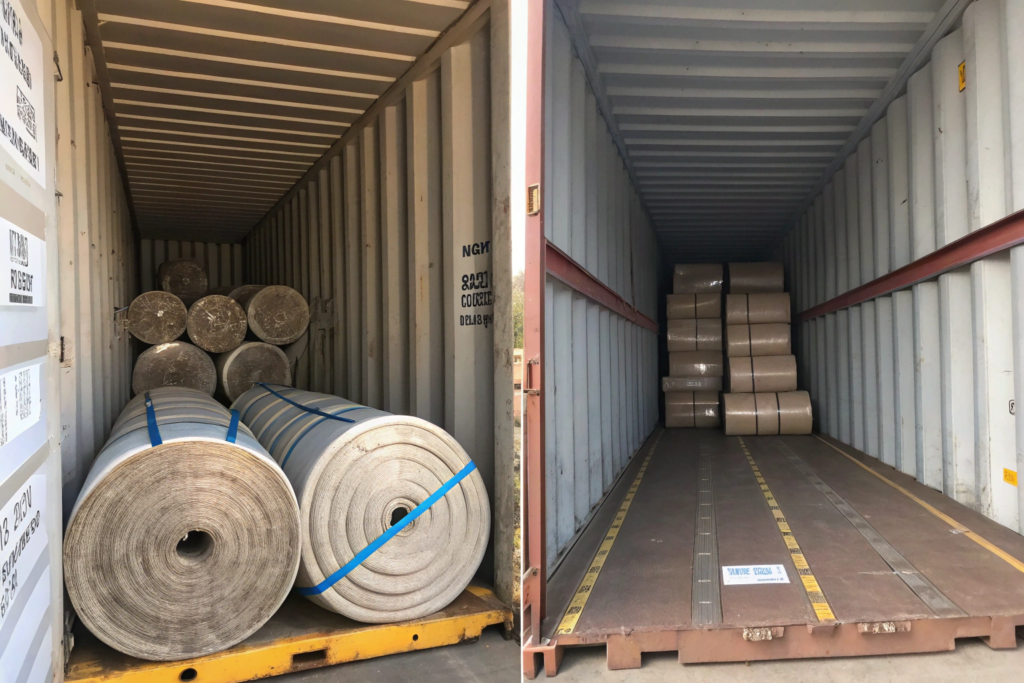
An ocean container is not a stable storage room. It’s a steel box that gets shaken by waves, heated by the equatorial sun to 60°C during the day, then cooled by a night on deck to 10°C. Inside that box, the air sweats. The humidity condenses on the cold steel walls and drips down onto your fabric. The container gets stacked ten high on the ship, so the bottom box takes the vibration and weight of nine fully loaded containers above it. The truck ride to the port hits potholes that generate momentary G-forces capable of shifting 150-kilo rolls if they aren’t blocked and braced. And the forklift driver at the destination warehouse might be on his sixteenth hour of a double shift and misjudge a fork insertion by two inches.
A fabric roll is vulnerable to four specific damage modes during ocean transit: moisture damage (from container sweat and rain ingress), compression damage (from over-stacking or shifting loads that crush the roll core), surface contamination (from dirty container floors, leaking adjacent cargo, or forklift grease), and telescoping (where the inner layers of a roll slide out axially, deforming the bolt into a cone shape). At Shanghai Fumao, our export packing checklist addresses each of these with a specific countermeasure. We don’t guess; we follow a protocol. A UK brand learned this with us in 2023 after their previous supplier delivered 300 rolls of viscose challis with black mold spots from container condensation. We shipped the replacement order with vacuum-sealed moisture barrier bags and desiccants, and the inspection at the Felixstowe warehouse showed zero moisture damage.
How Do Temperature Swings Create Moisture Damage Inside a Container?
The physics is called "container rain." Warm air holds more water vapor than cold air. When a container is loaded in hot, humid Keqiao at 35°C and 70% relative humidity, the air inside the sealed box is saturated with moisture. As the ship crosses the Pacific and the outside temperature drops at night, the container walls cool down. The air inside, still warm, hits the cold steel walls and drops its moisture load as liquid condensation. The water drips down the walls, pools on the floor, and soaks into the bottom rolls and any fabric touching the container sides.
We combat this with three layers of defense. First, every roll is individually sealed in a 0.08mm thick polyethylene bag with a heat-welded closure, not just a taped flap. Second, we place industrial-grade calcium chloride desiccant packs inside each bag before sealing—approximately 50 grams of desiccant per roll for a standard 25-kilo bolt. These absorb any residual moisture trapped inside the bag during packing. Third, we suspend container desiccant poles along the walls of the shipping container itself, typically 6 to 8 poles per 40-foot container. These poles absorb the ambient moisture in the container air before it can condense on the walls. One pole can absorb up to 2 liters of water over a 30-day voyage. A Dutch importer using our full moisture-protection protocol reported that their fabric dryness was "visibly different" compared to their other suppliers who only used pallet wrap. The relevant standard for this protection system is documented in container desiccant application guidelines for ocean freight moisture damage prevention in textile shipments which explains the gram-weight calculation based on voyage duration and climate zone.
What Is Roll Telescoping and How Do You Stop It?
Telescoping happens when the inner layers of a fabric roll slide sideways relative to the outer layers, creating a cone-shaped deformity. The bolt looks like an extended telescope, hence the name. This occurs when the roll is stacked vertically and the vibration from the truck or ship causes the layers to shift incrementally with each bump. The core of the roll essentially works itself out of the middle like a piston.
The root cause is insufficient winding tension and a weak core tube. If the fabric is wound loosely onto a thin, crushable cardboard tube, the vibration loosens the wind further and the tube ovalizes. The fabric layers lose friction with each other and slide. Our packing protocol requires that all fabric rolls be wound on heavy-duty, spiral-wound paper cores with a wall thickness of at least 8mm for rolls up to 30 kilos, and 12mm for rolls over 30 kilos. The winding tension itself must be firm enough that a finger pressed into the roll face encounters resistance, not a soft sponge. After winding, we insert plastic end-plugs into the core tubes to prevent the chucks of an unrolling machine from crushing the tube during downstream handling. For extra protection, we place a corrugated cardboard disc between each roll when stacking in tiers. This disc acts as a friction isolator—if one roll tries to telescope, the disc slides against the adjacent roll rather than allowing the internal layers to slide against each other. A textile roll winding tension and core strength specifications for preventing telescoping during export transport summarizes the engineering principles behind what seems like a simple packing job.
What Packing Materials Protect Fabric During Long-Haul Transit?
You can’t ship a $15-per-meter silk charmeuse in the same packing you’d use for a $0.80 industrial cotton greige. The packing material cost is a tiny fraction of the fabric value, but it’s the only thing standing between your order and a total-loss insurance claim. Skimping on packing materials is like buying a $50,000 car and insuring it with a $5 padlock. It’s a bad equation.
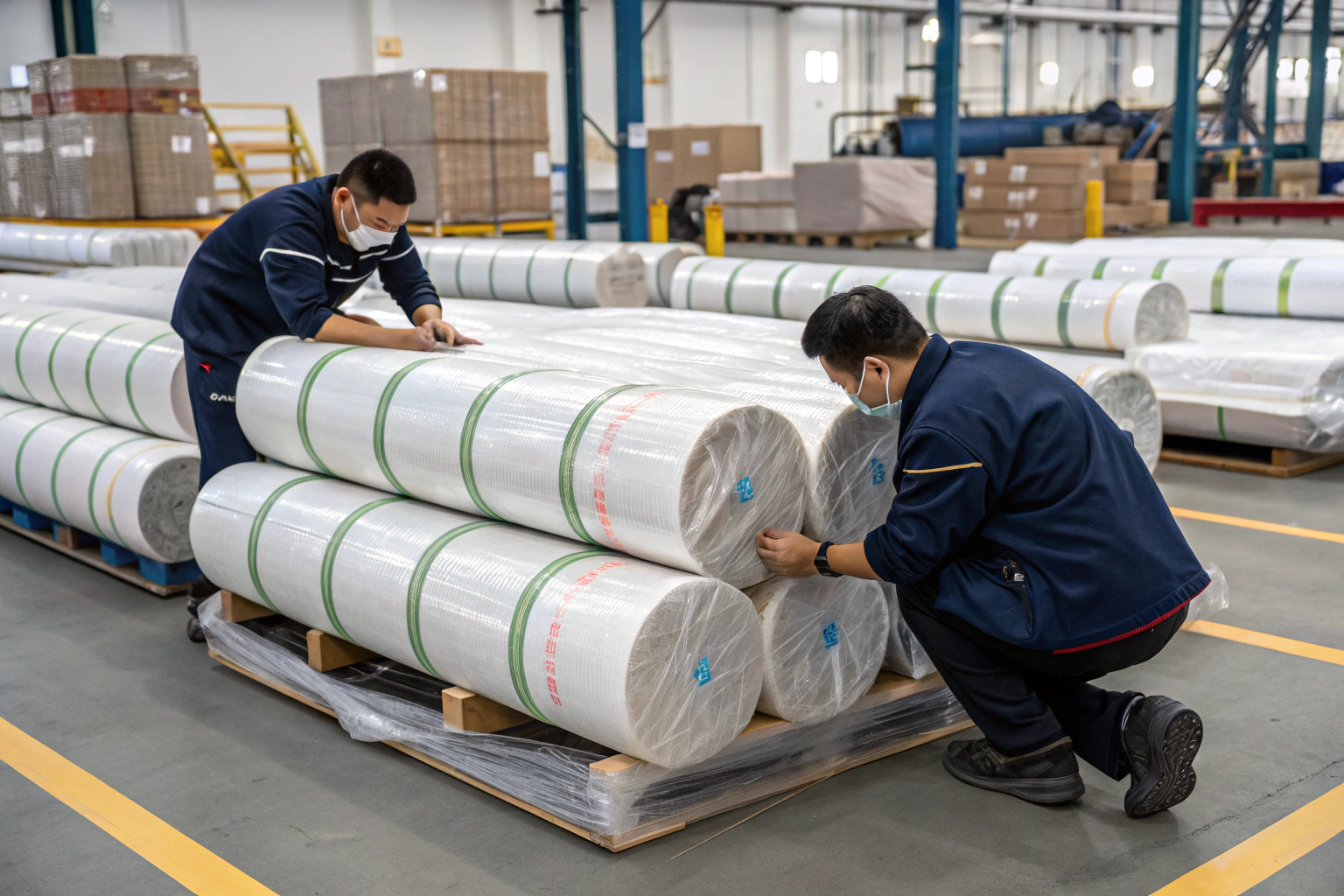
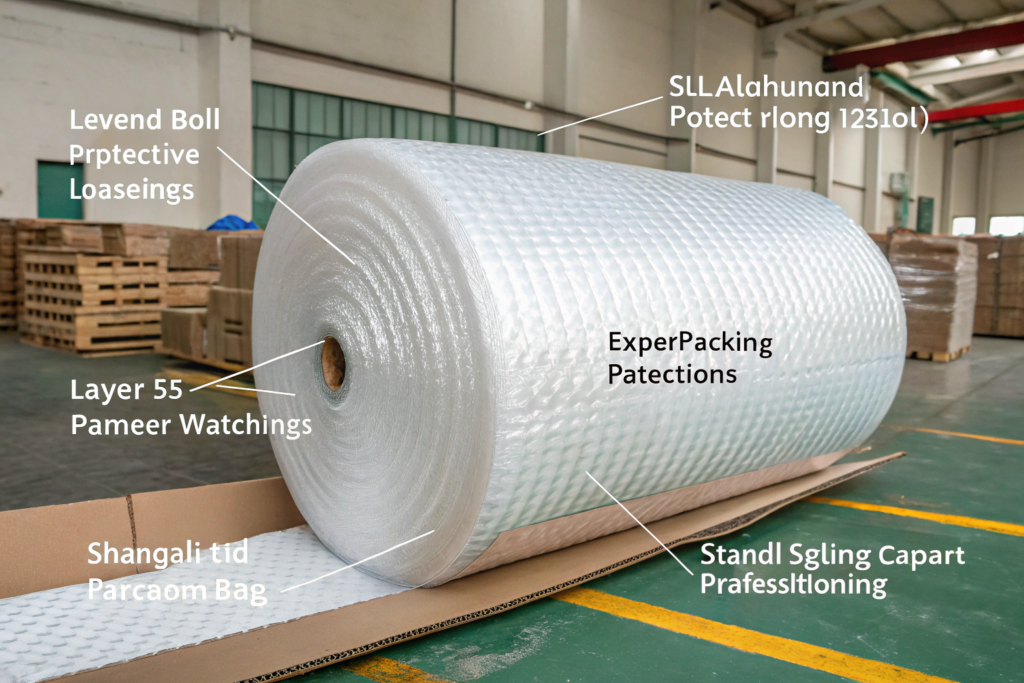
Our standard export packing spec at Shanghai Fumao layers five protective materials around every roll. Layer one: a clear polyethylene inner bag (0.05mm thickness) that keeps the fabric clean during the packing process and provides a smooth slip surface for the outer layers. Layer two: an aluminum-barrier laminated outer bag for any fabric sensitive to moisture or UV light, such as silk, viscose, or optical white polyester. The aluminum layer reflects radiant heat and blocks water vapor transmission far more effectively than clear PE alone. Layer three: heavy-duty corrugated cardboard end-caps that protect the roll edges from being crushed by strapping tension or adjacent cargo. Layer four: rigid plastic or laminated cardboard edge protectors running the full length of the roll, positioned under the strapping bands to distribute the strap tension across the roll circumference rather than cutting into the fabric at a point load. Layer five: PET (polyester) strapping bands tensioned to 60-70 kg of holding force, which is enough to lock the rolls in place on the pallet without crushing the core tubes. We use PET instead of steel strapping because PET maintains tension even if the cargo settles slightly, whereas steel can loosen.
Why Are Poly Bags Not Enough by Themselves?
A standard clear polyethylene bag stops dust and direct splashes of water. It does not stop water vapor. Polyethylene has a moisture vapor transmission rate (MVTR) of roughly 15 to 25 grams per square meter per 24 hours under tropical conditions. That means atmospheric humidity slowly migrates right through the bag wall over the 30-day voyage. If your fabric is a cellulosic fiber like viscose, linen, or cotton, it will absorb that migrating moisture and swell. The swelling releases internal tensions in the yarn, causing the fabric to crease permanently and potentially developing mildew if the moisture content exceeds 12%.
For moisture-sensitive fabrics, we use an aluminum-barrier laminate bag with an MVTR of less than 0.5 grams per square meter per 24 hours—effectively zero moisture migration. The aluminum layer is a metal vapor barrier, not a plastic film. It physically blocks water molecules from passing through. The cost difference between a PE bag and an aluminum-barrier bag for a standard roll is approximately $0.40 versus $1.20. On a $200 roll of silk charmeuse, that $0.80 upgrade is 0.4% of the fabric value, and it eliminates a failure mode that can render the entire roll worthless. A luxury sleepwear brand importing our 22-momme silk charmeuse in 2024 specified aluminum-barrier bags after a previous shipment absorbed moisture that created "watermark" stains visible under certain lighting angles. The aluminum-barrier solution eliminated the issue entirely. The technical specifications for these materials are well documented in the water vapor barrier performance comparison of aluminum laminate versus standard polyethylene packaging films resource.
What Are the Best Palletizing Practices for Heavy Fabric Shipments?
A pallet is not just a wooden platform; it’s a structural element of your packing system. A weak pallet collapses under the weight of stacked rolls, the bands loosen, and the cargo shifts into a chaotic pile. For a standard fabric shipment where each roll weighs 25 to 30 kilos, and you’re stacking 18 to 24 rolls per pallet (total weight 450 to 720 kilos), the pallet must be a heat-treated, ISPM 15 certified, four-way-entry hardwood pallet with a dynamic load rating of at least 1000 kilos.
We build the pallet stack in an interlocking pattern. The bottom tier has rolls placed side-by-side with alternating core directions (one roll core facing left, the next facing right) to create a flat, wide footprint. The second tier sits in the valleys between the rolls of the first tier, which prevents lateral rolling. The third tier mirrors the first tier’s orientation. This interlocking geometry mechanically locks the stack together even before any strapping is applied. We then place a heavy-duty corrugated slip sheet between the bottom tier and the pallet deck to prevent the roll surfaces from directly contacting any splinters or protruding nail heads in the wood. The entire stack is then wrapped in a minimum of five layers of machine-stretch film applied at 200% pre-stretch, which creates a compressive force that unitizes the load. Finally, PET bands run through the pallet fork tunnels and over the top tier, corner-protected with edge boards, to anchor the load to the pallet as a single handling unit. This system survives the "pallet tip test"—a 45-degree tilt—without any roll shifting. A detailed ISPM 15 compliant export pallet standards and load-securing techniques for roll-form textile cargo covers the international regulation side of the wood packaging material, which is critical for customs clearance.
How Does Fumao Label Rolls for Easy Customs Inspection?
You know what makes a customs officer angry? A fabric roll with no visible labeling, or worse, a label that’s illegible because it was hand-written in pencil on a piece of masking tape that got wet and smeared. An angry customs officer opens every roll, delays your shipment by two weeks, charges storage demurrage, and leaves your fabrics half-unrolled and contaminated from the inspection floor. Proper labeling is an export compliance requirement, not a warehouse suggestion.
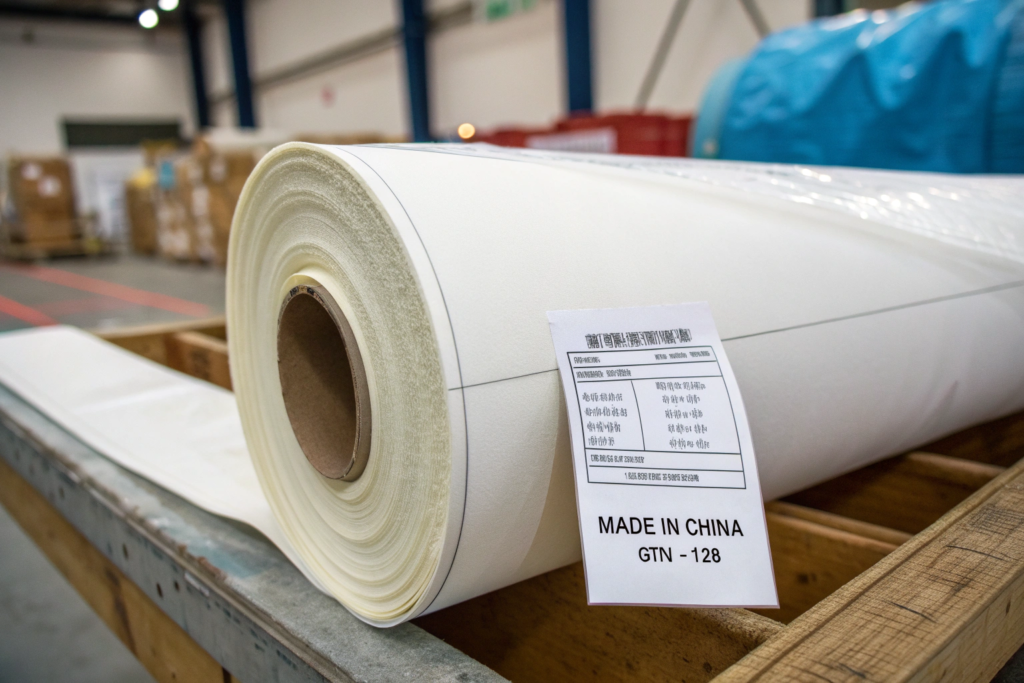
Every roll we ship carries a weatherproof, thermal-transfer-printed label affixed to the end of the poly bag. This label contains, at minimum, the following machine-readable and human-readable data: our company name and exporter registration number, the buyer’s purchase order number, the product code and color code, the roll number (sequential within the dye lot), the gross weight and net weight in kilos, the total meterage on the roll, the fabric width, the fiber composition percentage breakdown, the country of origin marking ("Made in China" in English and, if required, in the destination country’s language), and a unique GTIN-128 barcode that links to the digital test report for that specific roll. The label paper is a synthetic polypropylene stock that does not tear, smudge, or dissolve in water. The thermal transfer ribbon is a resin-grade ink that embeds into the label surface, so even if the print is exposed to oil or solvent during transit, the data remains readable. For EU-bound shipments, we include the EU REACH compliance statement and the OEKO-TEX certification number directly on the roll label, so the inspector can verify it without accessing a separate document.
Why Do Barcode Tracking Systems Prevent Shipment Errors?
A hand-counted and hand-written packing list is a human-error machine. Numbers get transposed. Rolls get missed. A buyer orders 50 rolls and receives 49, and there’s a three-week email chain about who miscounted. A barcode system eliminates this. Each roll gets scanned during packing, and the scan data populates the packing list automatically in our ERP system. The packing list is a digital output, not a manual transcript. The probability of a count error drops to near zero.
For our larger customers who have inbound warehouse barcode systems, we can send the packing list as an EDI 856 Advance Ship Notice (ASN) with the GTIN of every roll mapped to the purchase order line item. When the container arrives at the buyer’s distribution center, they scan our roll labels directly into their inventory management system without any manual data entry. This cut the receiving time for one US sportswear brand from 4 hours per container to 45 minutes, and eliminated a persistent "one roll short" discrepancy that turned out to be their receiver’s counting error, not our packing error. The GS1 GTIN-128 barcode standard for textile roll packaging and supply chain traceability applications explains the data structure that makes this plug-and-play logistics possible.
How Do I Ensure Important Labels Survive a Wet or Humid Journey?
Paper labels dissolve. Inkjet-printed labels run. Ballpoint pen on masking tape is a joke after one day at sea. We learned this lesson with a shipment to Brazil in 2018 that arrived with every outer-label illegible because the container sweating had turned the cardboard core labels into pulp. The customer had to unroll 200 bolts and measure each one to determine what they’d received. That was the day we switched to waterproof labeling.
The label stock we use is a three-layer composite: a printable polypropylene top layer, a permanent acrylic adhesive layer, and a silicone-coated release liner that peels off for application. This label can be submerged in water for 24 hours without the print degrading. The synthetic paper physically cannot absorb moisture, so it doesn’t wrinkle, tear, or grow mold. For extra insurance on ocean shipments to tropical destinations, we put each roll label on the end of the poly bag (so it’s under the outer shrink wrap), and we place a duplicate label inside the poly bag, stapled to the core tube end. If the outer label is somehow destroyed by abrasion against the container wall, the inner label survives pristine. I recommend to all our buyers that they specify "double-label with internal core duplicate" on their purchase order. It costs nothing extra and solves a known failure mode. The waterproof synthetic label material specifications for industrial export packaging identification provides the technical benchmarks you can ask your supplier to meet.
What Pre-Shipment Inspection Should My Fabric Pass Before Loading?
The container doors close, and your fabric is out of your control for four to six weeks. Whatever condition it’s in at the moment the bolt seal clicks shut is the condition it will arrive in. There is no mid-ocean inspection, no opportunity to fix a packing defect discovered halfway across the Pacific. The pre-shipment inspection is your last line of defense, and it has to be thorough, documented, and based on an objective standard.
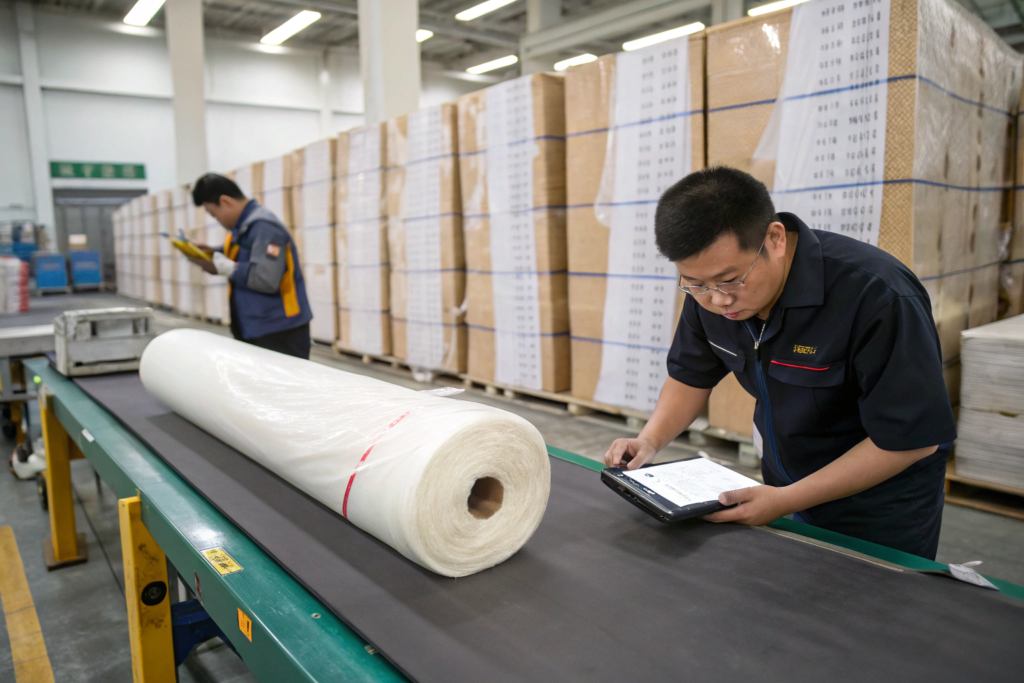
At Shanghai Fumao, we conduct a full pre-shipment inspection (PSI) on every export order, not just the ones a client specifically requests. The inspection follows an internal protocol based on the ANSI/ASQ Z1.4 standard for sampling by attributes, using a General Inspection Level II, with an Acceptable Quality Limit (AQL) of 2.5 for major defects and 4.0 for minor defects. The inspector pulls the sample rolls according to the lot size, unrolls a minimum of 10% of the meterage per selected roll, and checks for visual defects, measurement tolerances, shade continuity, and packing integrity. The roll packing is inspected simultaneously—the inspector verifies that the poly bag is sealed, the core plugs are in place, the strapping is tensioned, the label corresponds to the packing list, and the pallet construction matches the export spec. A digital report with photos is generated and uploaded to a shared cloud folder before the container is sealed. This report is the buyer’s proof that their goods were in perfect condition at the point of dispatch.
What Is an AQL Inspection and How Do I Request One?
AQL stands for Acceptable Quality Limit, and it’s the statistical backbone of professional textile inspection. It tells the inspector how many rolls to pull from the total lot, and how many defects are tolerable before the entire lot is placed on hold. The standard reference is ANSI/ASQ Z1.4 (which is the US adoption of ISO 2859-1). A typical textile PSI uses General Inspection Level II with an AQL of 2.5 for major defects—which means in a lot of 500 rolls, the inspector checks 50 rolls, and if more than 3 of those 50 have a major defect, the lot fails.
On your purchase order, simply write: "Pre-shipment inspection required per ANSI/ASQ Z1.4, Level II, AQL 2.5 major / 4.0 minor. Inspection report with photos to be emailed for approval before container loading." This line activates a professional inspection protocol and signals to the supplier that you understand quality control as a discipline, not just as an opinion. The ANSI ASQ Z1.4 sampling procedure for attribute inspection in textile and apparel product lots is your reference document if you want to understand exactly how the sample size table works and what the acceptance and rejection numbers mean at each lot size.
How Do We Verify the Packing Integrity in Our Own Warehouse?
The PSI report documents the fabric quality. A separate "Packing Integrity Audit" documents the structural security of the shipment. Before a container is loaded, our logistics supervisor walks the pallets and checks a physical checklist: Are the pallet stringers intact with no broken boards? Are the PET straps still at tension (checked with a manual tension gauge—anything below 50 kg is re-tensioned)? Is the stretch wrap intact with no tears or loose flaps? Are the desiccant poles firmly suspended and positioned away from the fabric to avoid contact staining? Are the container floor and walls dry and free of odor? Is the container seal number recorded and photographed, both on the door latch and on the shipping documents?
If any item on this checklist fails, the container loading stops until the issue is corrected. This audit is not performed by the person who packed the container. It’s performed by a separate logistics QA person, creating a two-person integrity check—the person who packs does not inspect their own work. This separation of duties catches human errors like a forgotten desiccant pole or a misaligned edge protector that the packer’s eyes have stopped seeing. The process seems bureaucratic, but it’s the kind of bureaucratic discipline that prevents a $40 shoe-cover staining incident from becoming a $4,000 claim for fabric damage. The methodology is grounded in the standard operating procedures for container loading supervision and pre-shipment packing integrity auditing for export textile cargo, which any international logistics provider should recognize.
Conclusion
Shipping fabric internationally is a stress test of your entire supplier relationship. The fabric can be flawless in the dye house, but if the packing fails, all that quality control work is erased. Moisture, vibration, compression, careless forklift blades—these are not theoretical risks. They happen every day in global logistics, and they only stop happening when the shipper designs the packing to defeat them specifically. We’ve covered how container rain forms and how aluminum-barrier bags stop it, why roll telescoping is a winding-tension problem solved at the core, why barcode labels eliminate receiving chaos, and how a cold-crack-rated film and a packing-integrity audit create a chain of evidence that protects your order from Keqiao to Kansas City.
Your packing specification is not an afterthought to scribble on the purchase order at the last minute. It’s an engineering document. It should specify the bag material, the core wall thickness, the strapping type and tension, the desiccant quantity, the label format, and the pallet configuration. If you leave these decisions to the supplier’s "standard packing," you’re gambling. Some suppliers pack well; most pack to a price. The ones who pack to a price are the ones whose containers show up with moldy, crushed, or telescoped rolls. And the insurance payout never covers the lost production time or the damaged customer relationship.
I want you to have a shipping experience where the container doors open and your fabric rolls come out in the same condition they left our warehouse. That outcome doesn’t happen by accident. It happens by packing protocol and pre-shipment audit. If you’re preparing an order and you want to review the exact packing spec we’ll apply to your specific fabric type and destination climate, reach out to our Business Director, Elaine, at elaine@fumaofabric.com. She can share our standard export packing guidelines document, and for air freight or special cargo, she can work with our logistics team to develop a custom packing plan. Let’s get your fabric across the ocean safely, so the only thing you’re inspecting at your dock is the quality of the cloth, not the quality of the packing.