You are standing in the bedding aisle of a department store. Or you are scrolling a DTC website for "luxury sheets." The marketing copy screams at you: "1000 THREAD COUNT! ONLY $79!" Your brain does the math. More threads equals more quality, right? You click buy. You wash them twice. They pill up like a cheap sweater. They feel like sandpaper. Or worse, they rip right down the middle when you make the bed with any kind of enthusiasm. You got played. You bought a number, not a fabric.
This is the single most successful con job in the history of home textiles. The Thread Count Myth. And it bleeds over into apparel too. I see it when buyers ask for "high thread count shirting" without specifying the yarn size. I see it when bag makers demand "heavy denim" without asking about the weave construction.
At Shanghai Fumao, we have been untangling this mess for two decades. We operate in Keqiao, where we spin, weave, and finish fabric for everyone from hotel chains to high-end fashion labels. And I can tell you with absolute certainty: Thread Count is a measurement of density, not a guarantee of quality. You can have a 600 Thread Count sheet that feels like a luxury hotel dream. You can have a 1200 Thread Count sheet that feels like a stiff, crackly tarp. The difference is not in the number. It is in the engineering behind the number.
This obsession with Thread Count has created a market where manufacturers cut corners in ways that actually increase the number on the label while decreasing the lifespan of the product. You are paying for a fake metric. Let me show you what actually matters in the weave room, and why at Shanghai Fumao we spend more time talking about staple length and ply than we do about thread count.
(And listen, I get it. We all want a simple number to make a decision. But fabric is like wine. You can’t judge it by the alcohol percentage alone. You gotta know the grape.)
What Is the Difference Between Thread Count and Fabric Density
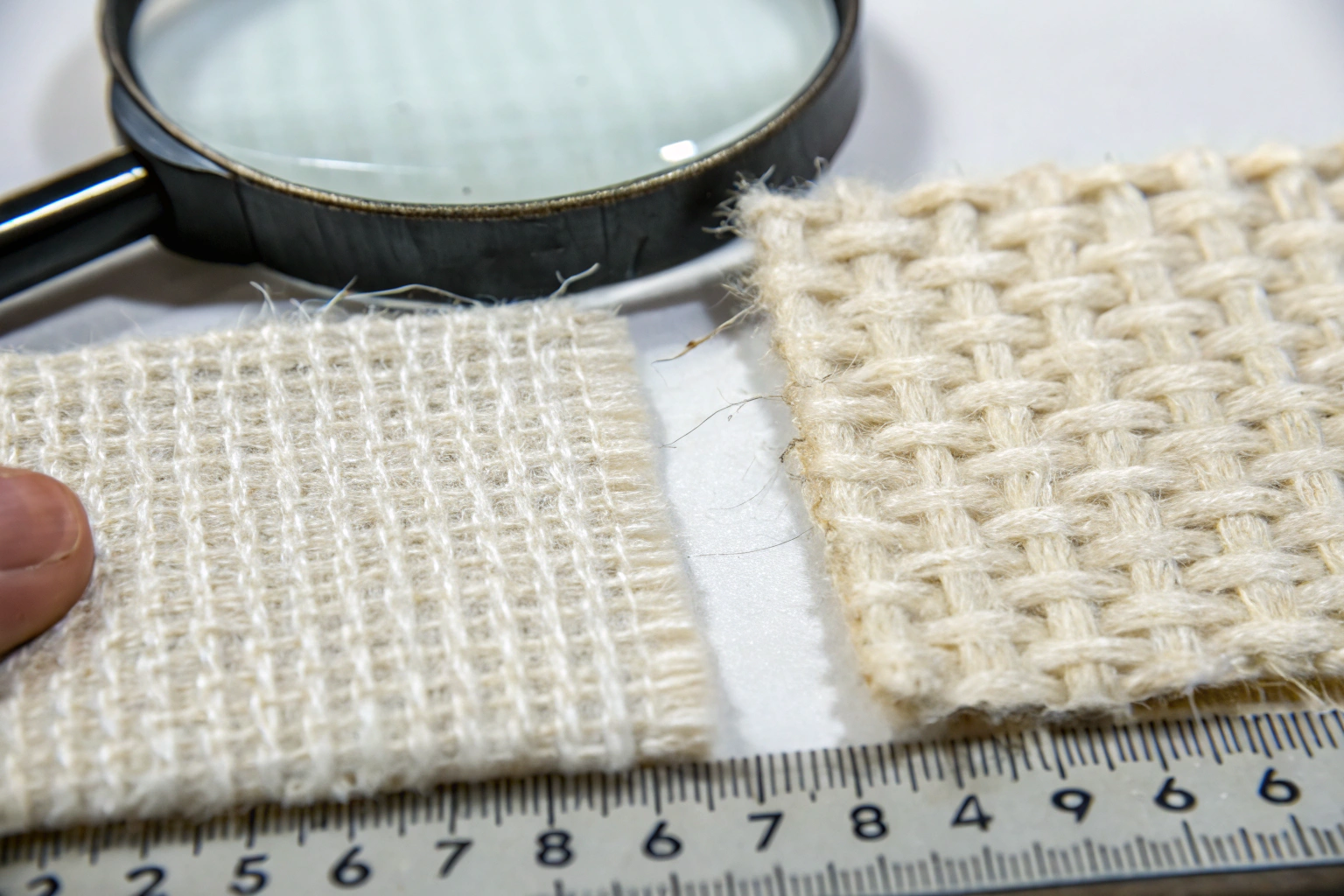
Let’s get the definitions straight because this is where 90% of the confusion starts. When you read "Thread Count" on a package, you are reading a sum. It is the number of warp (lengthwise) threads plus the number of weft (crosswise) threads in one square inch of fabric.
100 Warp + 80 Weft = 180 Thread Count.
That seems simple. The problem is that this number is mathematically limited by physics. You can only fit so many threads into an inch. If you use a standard, medium-thickness yarn (say, a 40s count yarn), the absolute maximum number of threads you can physically jam into that inch is around 380 to 400. You can’t fight the space.
So how do you see sheets labeled 1000 Thread Count? They are cheating the math. They are not using standard yarn. They are either:
- Using Microfibers (Polyester): These are so thin they are measured in Denier, not Cotton Count. You can pack 500 of them in an inch. The number goes up, but the fabric feels like plastic wrap because it doesn’t breathe.
- Counting Plies as Threads: This is the big one. They take a single thread that is made of three strands of yarn twisted together (a 3-ply yarn) and they count it as THREE threads instead of ONE. That is like counting the strands in a rope and saying you have a 12-strand rope instead of a 1-inch rope. It is mathematically fraudulent but legally common in some countries with weak labeling laws.
At Shanghai Fumao, we use Fabric Density as the primary spec. We look at Ends Per Inch (EPI) and Picks Per Inch (PPI) independently. We don’t care about the sum as much as we care about the balance.
How Do Multi-Ply Yarn Constructions Manipulate Thread Count Numbers
This is the sleight of hand that makes cheap sheets look premium. Let’s walk through a real example from our lab in Keqiao.
Scenario A: True Quality
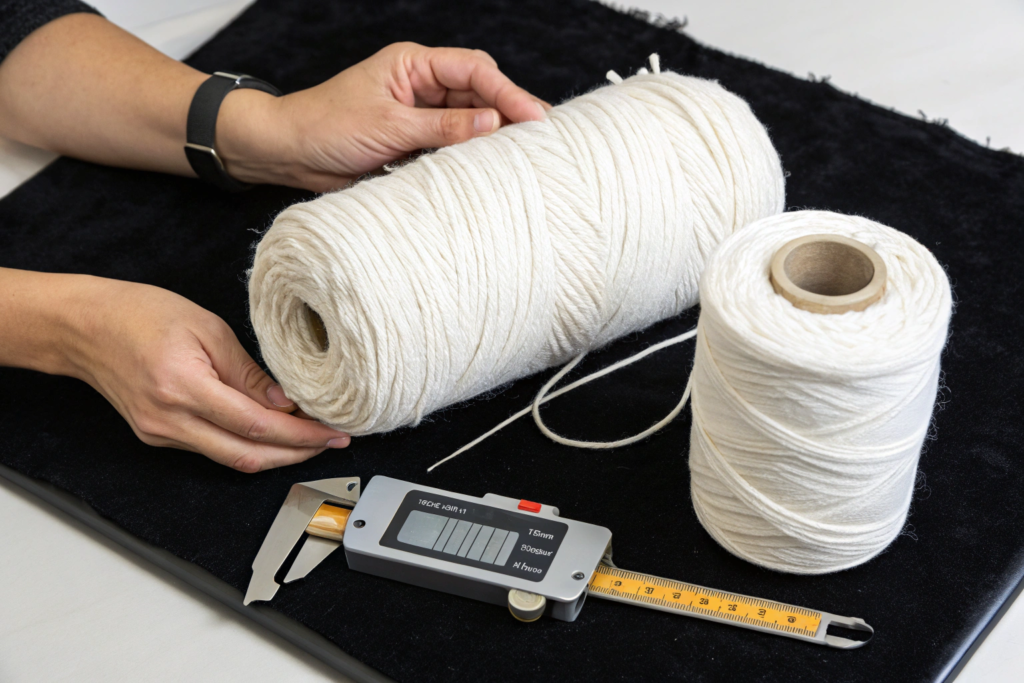
We use a 60/2 Yarn. This is industry shorthand for:
- 60: The thickness of a single strand. (Higher number = thinner fiber). 60 is a fine, luxury yarn.
- /2: Two of these fine strands are twisted together to make ONE thread.
We weave this at 110 Ends x 90 Picks.
True Thread Count = 200.
Handfeel: Incredibly soft, durable, lightweight, and breathable. This is a $200 sheet set.
Scenario B: The Fake Out
A factory uses a 20/4 Yarn.
- 20: This is a thick, cheap, coarse yarn. (Lower number = thicker, cheaper fiber).
- /4: Four of these thick strands are twisted together. It is basically rope.
They weave this at 80 Ends x 70 Picks.
True Thread Count (Standard Method) = 150.
But wait. They market it as: "80 Ends x 4 plies = 320. 70 Picks x 4 plies = 280. Total ‘Thread Count’ = 600!"
You just bought a 600 Thread Count sheet that is made of industrial twine. It will feel like burlap. It will never soften up. You will hate it. And the factory followed the "letter of the law" in their marketing copy.
At Shanghai Fumao, we have a strict rule. We report Single Yarn Equivalent Count. If a buyer from a hotel chain asks for a 300 TC percale, we know they mean 300 single-ply threads, not 75 four-ply ropes. This technical explanation from a textile standards organization clarifies how the ASTM thread count standard prevents multi-ply inflation in woven fabric labeling.
Does Higher Fabric Density Always Guarantee Better Durability in Wovens
No. And this is the second trap buyers fall into. "Okay, I’ll just buy the densest fabric I can find. More threads per inch equals stronger, right?"
Wrong. Over-engineering a weave makes it brittle.
Think of a fabric like a suspension bridge. The warp yarns are the steel cables. They need to stretch and flex slightly to absorb wind and traffic. If you make the bridge too rigid, it snaps in an earthquake. Same with fabric.
When you jam too many yarns into a square inch (high density), you create Crimp Interference. The yarns have no room to move. When you pull the fabric (tensile stress), the yarns cannot "give" or straighten out. They cut into each other like a wire cutter. This leads to Seam Slippage and Tear Drop Holes.
We see this all the time in Down-Proof Fabrics. You need a very tight weave so the goose feathers don’t leak out. But if you overdo the density, the fabric fails the ASTM D2261 Tear Strength Test. It rips like a piece of paper.
Here is a quick reference table we use internally for woven shirting:
| Fabric Type | Typical EPI x PPI | Yarn Size | Resulting Durability Feel |
|---|---|---|---|
| Cheap Poplin | 90 x 70 | 45/1 | Low Tear Strength, Wrinkles Badly |
| Premium Broadcloth | 110 x 80 | 80/2 | Excellent Balance (Soft, Strong) |
| Over-Engineered | 140 x 90 | 60/1 | Brittle (Prone to seam slippage) |
A men’s shirt brand came to us last year. They had spec’d a 140×90 broadcloth for a "luxury" dress shirt. The shirts were ripping at the elbow when the wearer bent their arm. Why? The fabric was so dense and rigid that the fibers couldn’t absorb the stretch. They were snapping. We moved them to a 120×80 using 80/2 yarn. The shirt had better drape, better breathability, and zero returns for tearing. We sacrificed 20 picks per inch of density and gained a massive amount of durability. You can read more about this specific failure mode in this analysis of why seam slippage occurs in high-density woven fabrics and how to prevent it.
How Yarn Staple Length Impacts Handfeel and Pilling
Alright, let’s move past the loom and talk about what goes into the yarn. You have your Thread Count number. You have your Density spec. But if the raw material is garbage, the finished fabric is garbage. It is that simple.
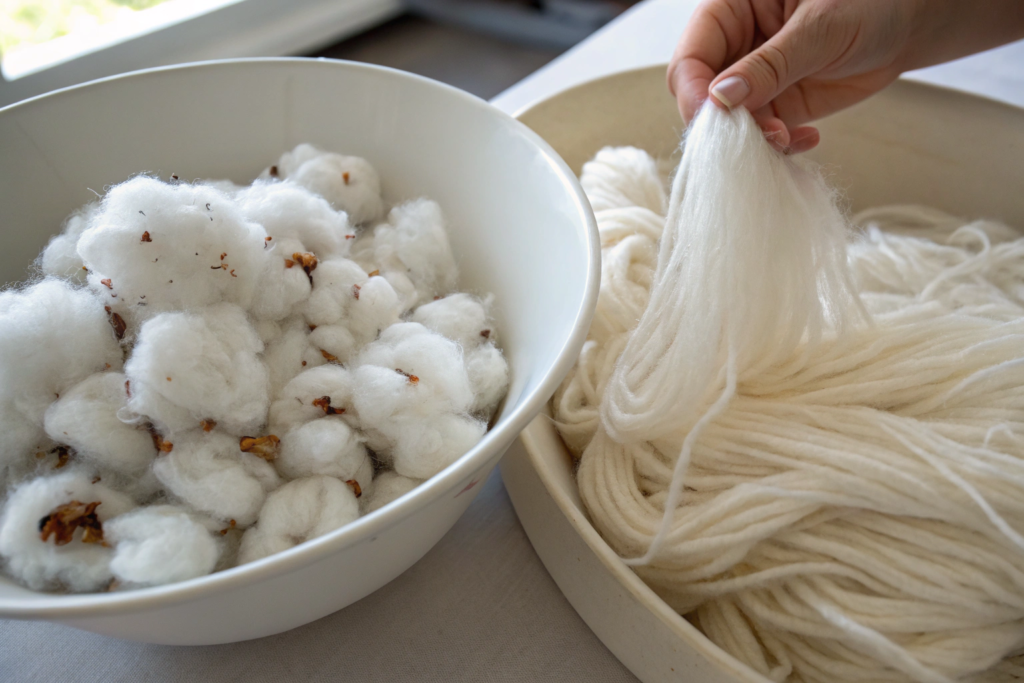
The most under-discussed metric in fabric quality is Staple Length. This is the average length of the individual cotton fibers (the little fuzzy hairs that make up the yarn).
Imagine you are braiding hair.
- Short Staple Cotton (Upland): This is like braiding hair that is cut in a choppy bob. You have lots of short pieces. You have to overlap them a lot to make the braid long. The ends stick out everywhere.
- Long Staple Cotton (Pima, Supima, Egyptian Giza): This is like braiding long, flowing mermaid hair. Fewer overlaps. Smoother surface. Fewer flyaways.
In textile terms, those "flyaways" are Pills. Those pills are the tiny fuzzballs that form on your sheets and t-shirts. They happen because short fibers work their way out of the yarn, tangle together, and form a ball on the surface.
At Shanghai Fumao, when a client asks for a "hotel quality" sheet, we don’t start with Thread Count. We start with "Supima or Giza 86?" The staple length is the foundation.
Why Does Long-Staple Cotton Reduce Pilling in High-Use Bedding
Because the ends are locked away. A yarn is just a long bundle of fibers twisted together. The strength of that yarn comes from Fiber Friction. Long fibers have more surface area touching other long fibers. The twist holds them tight.
Short fibers have less contact area. The twist can’t grip them as well. When you wash the sheet (agitation + water + heat), those short fibers wiggle free. They migrate to the surface. They rub against other free fibers. They form a Pill.
We did a side-by-side test in our lab.
- Sample A: 400 Thread Count Sateen made from Upland Cotton (Staple: 1.0 inch).
- Sample B: 400 Thread Count Sateen made from Supima Cotton (Staple: 1.4 inches).
We ran them through Martindale Abrasion (Pilling Test) for 5,000 cycles.
- Sample A: Showed significant surface fuzzing and visible pills. Grade 2.5 out of 5.
- Sample B: Showed only minor fuzzing. No pills. Grade 4.5 out of 5.
Same thread count. Same weave. Same dye. The only difference was the length of the cotton fiber. That 0.4 inches of extra length meant the difference between sheets that look worn out after 20 washes and sheets that look crisp after 100 washes. This is why Shanghai Fumao invests in sourcing long-staple fibers, even when cotton prices spike. We know our clients’ reputations depend on that post-wash appearance. There is a great resource on this topic explaining how staple length correlates directly with fabric pilling resistance and long-term aesthetic durability.
Can Compact Spinning Technology Improve Weak Yarn Strength Metrics
Yes, and this is where we get into the process innovation rather than just the raw material. You can have the best long-staple cotton in the world, but if you spin it on a rusty, 50-year-old ring frame, you are leaving performance on the table.
At our partner spinning mills, we use Compact Spinning Technology for our premium yarns.
Standard Ring Spinning: The fibers come out of the drafting rollers and go into the twist zone. There is a tiny "spinning triangle" where the fibers are loose. This is where short fibers escape and become Hairiness. That hairiness leads to pilling.
Compact Spinning: We add a suction zone right before the twist. A perforated drum condenses the fiber bundle. It makes it narrower. The spinning triangle disappears. The fibers are integrated right into the core of the yarn.
The result is a yarn that is:
- 15-20% Stronger than ring-spun of the same count.
- Significantly Less Hairy (Measured by Uster Hairiness Index).
- Smoother Surface.
This technology allows us to use a slightly finer yarn (say, an 80/1 instead of a 60/1) while increasing the fabric strength. It is how we achieve that "Buttery Soft Yet Bulletproof" handfeel that hotels love. They want thin, light, luxurious sheets that can survive being washed in industrial bleach 200 times a year. Compact spinning is the secret. This technical paper provides an overview of how compact spinning systems reduce yarn hairiness and improve tensile properties compared to conventional ring spinning.
When Does Weave Structure Matter More Than Thread Count
You have picked the right yarn. You have a good density. Now we need to talk about the Architecture. How you interlace those warp and weft yarns has a massive impact on how the fabric feels, breathes, and wears—often bigger than a 100-point swing in Thread Count.
This is where a 250 Thread Count fabric can feel softer than a 400 Thread Count fabric. It is all about Surface Float.
At Shanghai Fumao, we guide our clients through three primary weave structures for sheeting and shirting. Understanding these three will make you a smarter buyer than 95% of the people out there.
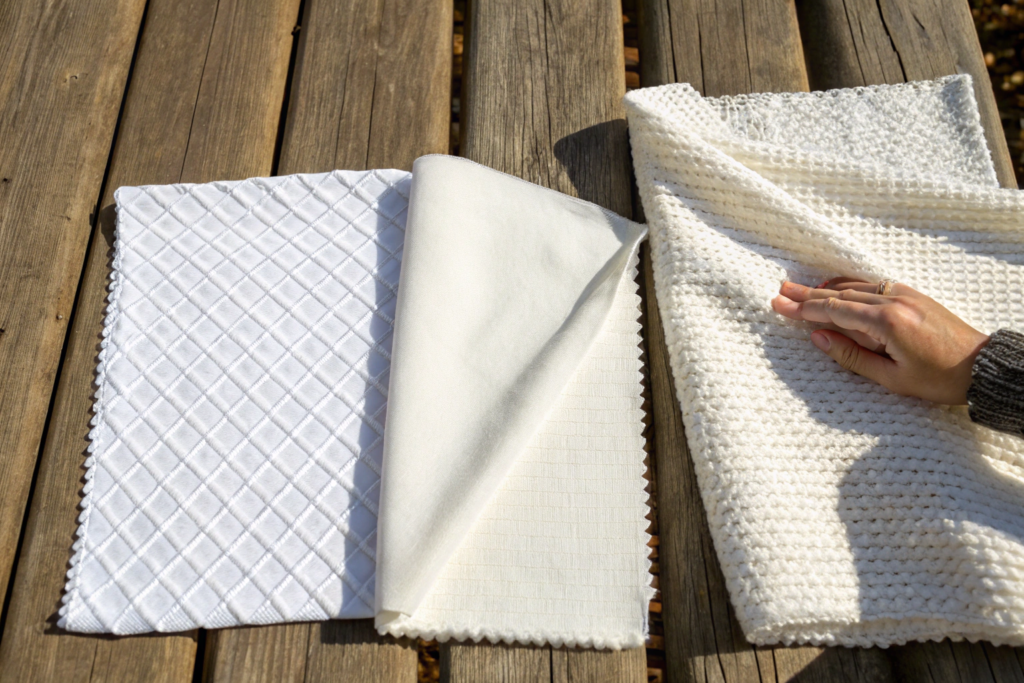
- Percale: Plain weave. One over, one under. It is a tight, grid-like basket weave. Result: Crisp, cool, matte finish. Durable. Breathable. Feels like a crisp hotel shirt.
- Sateen: Satin weave. Four over, one under. The weft yarn "floats" over multiple warp yarns. Result: Silky, smooth, shiny surface. Softer initial handfeel. Less breathable. Prone to snagging.
- Twill: Diagonal weave. Two or three over, one under. The pattern shifts one step each row. Result: Softer than Percale, stronger than Sateen. Distinct diagonal texture. Wrinkle resistant.
You cannot compare the Thread Count of a Percale sheet to a Sateen sheet. A 300 TC Percale is dense and tight. A 300 TC Sateen is actually quite loose because the yarns are skipping over 4 threads at a time. You need a minimum of 400-500 TC in Sateen just to match the coverage of a 250 TC Percale.
Why Does a 250 Thread Count Percale Feel Crisper Than 400 Thread Count Sateen
This is a question I get constantly from hotel procurement managers. "My guests complain the new sheets are too hot and sticky, but they are 400 Thread Count Egyptian Cotton!"
The answer is Airflow. Percale is a Plain Weave. There are more Interlacing Points. Each intersection creates a tiny micro-channel for air to move. It breathes. It feels cool against the skin.
Sateen is a Satin Weave. There are fewer interlacing points. The long "floats" of yarn lay flat on top of each other. They trap body heat. The fabric is dense and warm.
Here is the physical test we do in the booth at trade shows. We take a swatch of 250 TC Percale and a swatch of 400 TC Sateen. We put them flat on a cold granite countertop. We ask the buyer to put their palm on each one for 10 seconds.
- Percale: Feels instantly cool. Stays cool.
- Sateen: Feels room temperature initially. Quickly warms up to body temperature.
The Percale feels "crisper" because it has more structural integrity. It holds its shape. It doesn’t cling. The Sateen feels "softer" and "drapier" but also "heavier" and "warmer."
A luxury resort in the Maldives switched from a 400 TC Sateen to our Fumao 300 TC Percale (made with 80/2 Compact Yarn) two years ago. Their guest feedback scores on "Sleep Comfort" went up 18%. The reason? The resort is in a humid tropical climate. The Sateen was sticking to guests. The Percale allowed a breeze. The resort saved money on the fabric cost (lower nominal TC) and improved the guest experience. It was a win-win because they understood the weave. You can read more about this specific comparison in this guide on how to choose between percale and sateen sheets based on sleep temperature and personal comfort.
How Does Twill Weave Improve Tear Strength in Lower Thread Count Fabrics
Twill is the Workhorse of Wovens. You know it as Denim. You know it as Chino. You know it as Gabardine. It has a diagonal rib.
Why is a pair of 10oz Denim jeans (which is relatively light) so damn tough, while a 12oz Plain Weave canvas jacket might rip at the shoulder seam?
Twill Weave Mechanics.
Because the yarns float over 2 or 3 yarns before interlacing, they have more Freedom of Movement. When you stress a twill fabric, the yarns can slide and bunch together to absorb the force. They form a reinforced bundle at the point of stress. This is called Yarn Mobility.
In a Plain Weave, the yarns are locked in a tight grid. When you pull them, they can’t move. They just snap.
Here is the data from our lab on a 200 TC Cotton (40/1 yarn) :
- Plain Weave: Tear Strength (Elmendorf) = 1200g.
- Twill Weave (2/1): Tear Strength (Elmendorf) = 2100g.
Same yarn. Same density. Same thread count. The twill is 75% stronger simply because of how it is interlaced. This is why we recommend twill for Workwear, Children’s Wear, and Heavy-Duty Bags. You get massive durability without having to use thick, uncomfortable, heavy yarn.
(Editor’s note: I still wear a pair of chinos I made from Fumao twill 6 years ago. The color is faded, but the fabric has zero holes. That is twill magic.) For a deeper understanding of weave science, check out this article on the mechanical principles of twill weave and its superior tear resistance compared to plain weave structures.
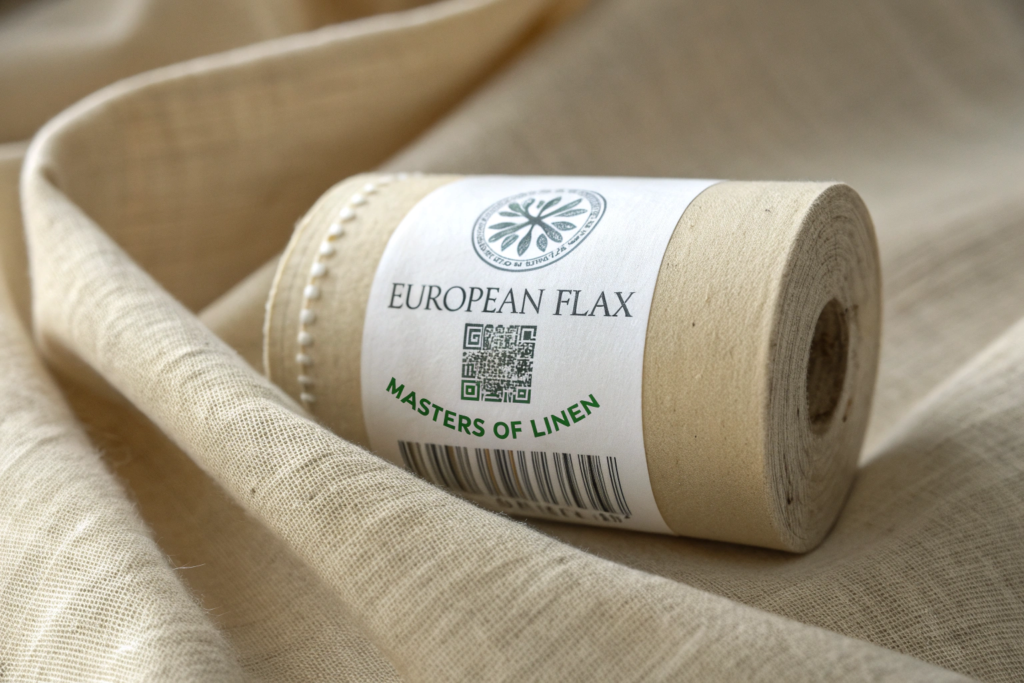
Why Fiber Origin and Certification Outweigh Label Numbers
We have covered the physics of the yarn and the geometry of the weave. Now let’s talk about the Provenance. In 2026, the number on the package is less important than the story and the certification behind the fiber. Consumers are savvy. They want to know: Where did this come from? Who made it? Is it going to give me a rash?
A 1000 Thread Count sheet made from Conventional Cotton grown with heavy pesticides and finished with formaldehyde-based softeners is a liability. It might feel smooth in the store, but after washing, it off-gasses chemicals and shrinks unevenly. A 300 Thread Count sheet made from GOTS Certified Organic Cotton is an asset. It is safe. It is traceable. It gets softer with every wash.
At Shanghai Fumao, we have seen the market shift dramatically in the last 5 years. Mid-tier and luxury brands no longer compete on "Who has the bigger number?" They compete on "Who has the cleaner story?" This is where we pivot the conversation from "How high is the TC?" to "What is the origin of the cellulose?"
Does GOTS Certification Guarantee Chemical Safety Beyond Just Organic Fibers
This is the most misunderstood aspect of Global Organic Textile Standard (GOTS) . People think: "Organic Cotton = No Pesticides on the Farm." That is only 10% of the story.
The real value of GOTS for a brand owner is Chemical Safety in Processing. Cotton farming is a small part of the journey. The dyeing, printing, and finishing stages are where the really nasty stuff gets applied. Formaldehyde (wrinkle-free finish). Heavy Metals (bright dyes). APEOs (softeners that are endocrine disruptors).
A GOTS certification prohibits all of that. It regulates every single chemical input that touches the fabric from the gin to the finished roll.
Here is why this matters for your MSRP and return rate. A customer buys a "100% Organic Cotton" sheet from a non-certified brand. It feels soft because it is loaded with Silicone Softener. They wash it twice. The silicone washes off. The sheet now feels like sandpaper. They return it. They leave a one-star review saying "This organic cotton is scratchy!"
If that same sheet was GOTS certified, the softener used would be a permitted bio-based softener that bonds differently. The sheet actually gets softer with washing because the fibers relax, not because a coating is washing off.
At Shanghai Fumao, we provide the Transaction Certificate (TC) with every GOTS shipment. This is your legal proof that the fabric was processed in a compliant facility. It is a shield against "greenwashing" accusations. It is also a shield against Skin Irritation Lawsuits. If you are making baby clothes or bedding, this is non-negotiable. There is an excellent summary of this in a guide to understanding GOTS chemical input criteria and how it protects against formaldehyde and heavy metal exposure.
How Does Supima Cotton’s Fiber Strength Compare to Standard Egyptian Varieties
This is a geeky comparison, but it matters for Longevity. Both Supima (American Pima) and Egyptian Giza (especially Giza 86/92) are Extra-Long Staple (ELS) cottons. They are both in the premium tier. But they are not identical.
We have processed both extensively at our Keqiao facility. Here is the practical, lab-verified difference we see in the weaving room:
| Fiber Type | Staple Length (Avg) | Fiber Strength (g/tex) | Uniformity | Best Use Case |
|---|---|---|---|---|
| Supima | 1.45 – 1.50 in | High (32-34) | Excellent | High-Speed Weaving, Heavy Use |
| Giza 86 | 1.40 – 1.45 in | Moderate (28-30) | Good | Luxury Handfeel, Silky Drape |
| Giza 45 | 1.40 – 1.45 in | Moderate (28-30) | Good | Premium Knits |
The Difference: Supima is Tougher. Giza is Softer.
Supima cotton has a slightly thicker cell wall. This gives it a higher fiber strength (g/tex) . This means when we run Supima yarn through high-speed air-jet looms, we have less end-breakage. The weaving efficiency is higher. The resulting fabric has fewer weak spots.
Giza cotton has a finer, more delicate fiber. It spins into a softer, more luxurious yarn. But it requires a gentler touch in weaving and finishing. It is more prone to damage if the loom tensions are off.
A hotel brand needs Supima. They need to wash it 300 times. They need tensile strength. A high-end fashion brand making a sheer voile blouse needs Giza. They need drape and luster.
At Shanghai Fumao, we don’t just say "Premium Cotton." We specify the origin because we know the performance characteristics are different. This is the level of detail that justifies a higher wholesale price. You can dig deeper into this comparison in this article on the comparative analysis of Supima versus Egyptian Giza cotton fiber properties for textile manufacturing.
Conclusion
So let’s bring it back to that shelf in the department store. You see the "1000 Thread Count" sticker. You now know to smile and put it back down. You have been armed with the knowledge that the number is just a small piece of a much larger puzzle.
We have walked through the yarn spinning room, where Staple Length and Compact Spinning determine whether a sheet will pill up like a sweater or stay smooth like glass. We have looked at the loom, where Weave Structure decides if you sleep hot and sticky or cool and crisp, regardless of the thread density. And we have traced the fiber back to the field, where Certification and Origin guarantee that the fabric against your skin is safe, ethical, and built to last.
At Shanghai Fumao, our job is to cut through the marketing noise. We don’t sell numbers. We sell performance data and tactile truth. The next time you are sourcing fabric—whether it is for a five-star hotel or a direct-to-consumer bedding brand—ask for the Tech Pack, not just the Thread Count. Ask about the yarn size (Ne 60/1 or 80/2?). Ask about the staple length (Upland or Supima?). Ask about the weave (Percale or Sateen?). Those are the questions that lead to a product that justifies its price tag and builds a loyal customer base.
The highest thread count in the world is worthless if the fabric feels like a plastic tarp and pills after two washes. The right combination of yarn, weave, and finish—that is where the real luxury lives.
If you are tired of guessing based on inflated marketing numbers and want to develop a fabric program based on engineering specs, let’s talk. Our Business Director, Elaine, can help you navigate our library of certified fabrics and find the perfect construction for your brand’s quality story. Reach out to her at elaine@fumaoclothing.com. Let’s weave something real.