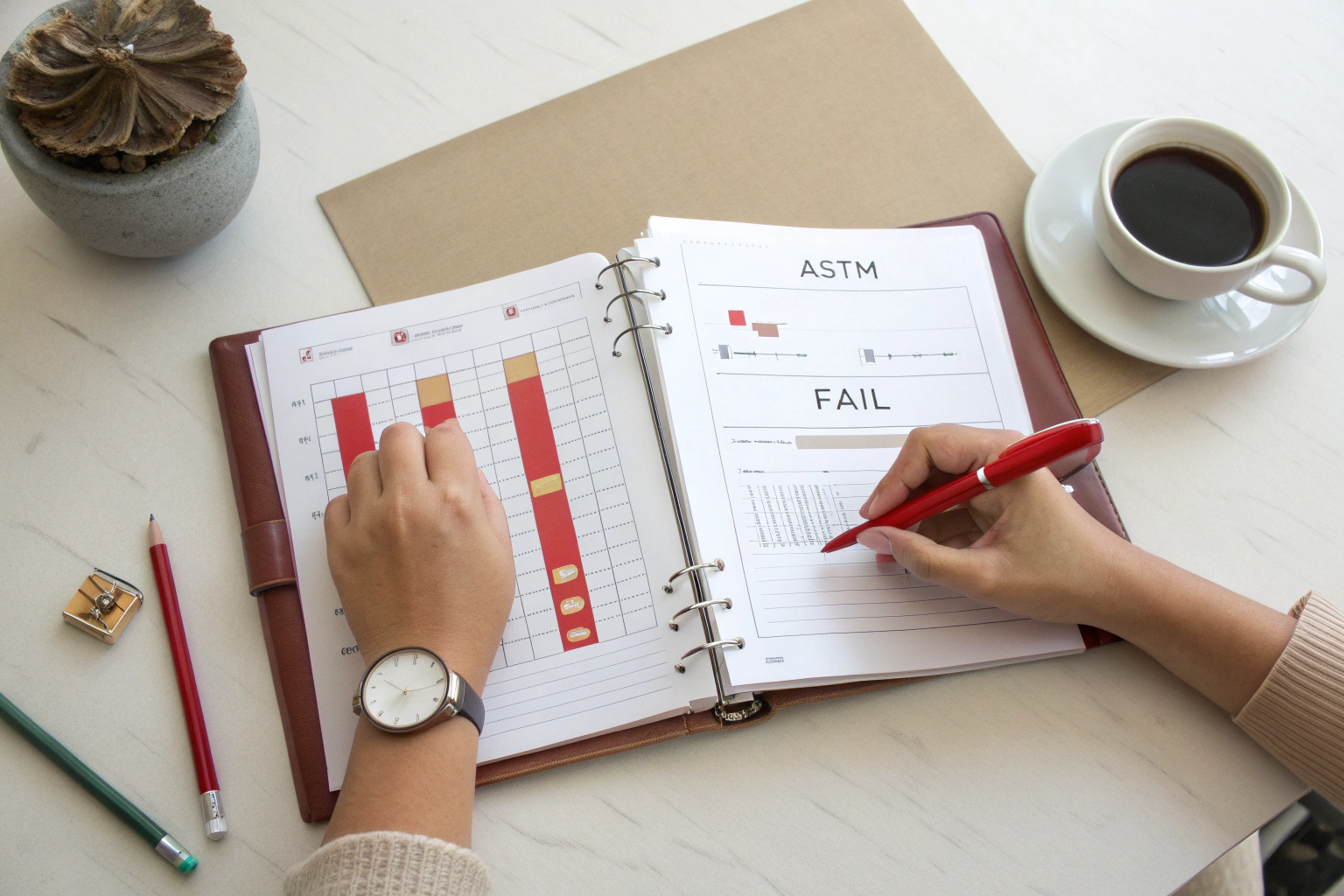
You get the email from your supplier. Subject line: "Fabric Quality Report – Lot 4521." You open the attachment. It is a 5-page PDF. It has logos from SGS or Intertek or the mill’s own lab. There are columns of numbers. Tensile Strength. Tear Strength. Crocking. Colorfastness. Pilling. There are bars and "Pass/Fail" stamps. You scroll through it. You see a lot of Green Checkmarks. You close the file. You think, "Looks good to me." You approve the shipment.
Six weeks later, the fabric arrives. You cut it. You sew it. You wash it. And the seams Slip. The black dye Bleeds onto the white trim. The fabric Pills after two wears. You go back to the report. You realize those "Green Checkmarks" were for Minimum Commercial Standards that are so low, a paper towel could pass. You didn’t read the report. You just looked at the colors.
This is the hidden skill that separates Professional Brands from Hobbyists. You cannot just trust the "Pass." You have to understand the Numbers. You have to know which tests Matter for your specific garment. A passing grade for a heavy duty work jacket is a Failing Grade for a luxury silk blouse. The report is not a Yes/No binary. It is a Performance Prediction.
At Shanghai Fumao, we provide CNAS-Accredited Lab Reports with every bulk shipment of our premium and performance fabrics. But we also spend hours on the phone teaching our clients how to read them. Because a client who understands the data is a client who never gets surprised by a quality issue. Let me teach you how to look at those pages like I do.
(And I will be honest: I still squint at the AATCC Gray Scale numbers sometimes. Color is tricky. Anyone who says they can read a crocking report in 2 seconds is lying to you.)
What Do ASTM and AATCC Abbreviations Mean on Fabric Reports
Let’s start with the alphabet soup. The first page of a legit report is usually a list of Test Methods. If your report does not list the specific test method used (just says "Shrinkage: Pass"), it is Useless. It is a marketing brochure, not a quality document.
You need to know the codes. Here are the Big Four that matter for 90% of apparel fabrics.
| Test Name | Common Codes | What It Measures | Real World Translation |
|---|---|---|---|
| Tensile Strength | ASTM D5034, ISO 13934-1 | Force to Break fabric (Pull) | Will the back panel rip when you stretch? |
| Tear Strength | ASTM D1424, ISO 13937-1 | Force to Propagate a tear (Rip) | If it snags on a nail, does it run like pantyhose? |
| Seam Slippage | ASTM D434, ISO 13936-1 | Yarn Sliding at seam | Will the seat seam open up when you sit? |
| Crocking | AATCC 8, ISO 105-X12 | Color Rubbing Off | Will the blue dye ruin your white leather car seats? |
ASTM stands for American Society for Testing and Materials. These are the standards used primarily for the US Market.
AATCC stands for American Association of Textile Chemists and Colorists. These focus on Color and Wet Processing.
ISO stands for International Organization for Standardization. These are used for the EU Market.
If you are selling in the US, demand ASTM/AATCC reports. If the report is only ISO or GB (Chinese National Standard) , you are taking a risk that the "Pass" level is different from what your customer expects.

Why Do ASTM D5034 Tensile Strength Values Differ From ISO 13934
This is a classic trap. You get a quote from a European mill with an ISO report showing Tensile Strength: 450N. You get a quote from Shanghai Fumao with an ASTM report showing Tensile Strength: 85 lbf. You think, "Wow, the European fabric is 5x stronger!"
Wrong. You are comparing Newtons to Pounds-Force. And the Test Specimen Size is different.
- ISO 13934-1: Uses a 50mm wide strip of fabric. The result is in Newtons (N) .
- ASTM D5034: Uses a 25mm wide strip of fabric (or 1 inch). The result is in Pounds-Force (lbf) or Kilograms-Force (kgf) .
The Quick Conversion: ASTM result (lbf) x 4.45 = ISO result (N) for a rough comparison of the number, but you also have to double the ASTM number to account for the width difference.
Example Fumao Cotton Twill:
- ASTM D5034 (Warp): 95 lbf.
- Equivalent ISO 13934-1 (Warp): (95 lbf x 2 (width)) x 4.45 = ~845 N.
See? The 450N European fabric is actually Half as Strong as the 85 lbf Fumao fabric. You must know the Test Method to compare numbers. Never compare ISO to ASTM without doing the math. This is a great reference chart for converting textile tensile strength units between ASTM D5034 and ISO 13934-1 test methods.
How Does the AATCC Gray Scale Quantify Staining and Color Change
This is the Subjective Test that drives people crazy. How do you put a number on "This red shirt turned my white undershirt pink"?
The AATCC Gray Scale is a physical set of cards. It has pairs of grey and white chips that show increasing levels of difference.
- Grade 5: No difference. Perfect.
- Grade 4: Slight difference. (Acceptable for most commercial apparel).
- Grade 3: Noticeable difference. (Borderline fail for premium brands).
- Grade 2: Significant difference. (Obvious failure. Looks bad).
- Grade 1: Severe difference. (Completely different color).
When the lab report says "Colorfastness to Laundering: Shade Change Grade 4-5, Staining Grade 4," here is what it means:
- Shade Change Grade 4-5: The fabric itself faded a tiny bit after washing. You can barely see it under special lighting.
- Staining Grade 4: The white multifiber test cloth sewn to the sample picked up a trace of color. You might see a faint tint on the white strip.
At Shanghai Fumao, our internal standard for Dark Colors (Navy, Black, Red) is Grade 4 minimum for both. If we get a Grade 3 on Staining, we Reject the Dye Lot. We do not ship it. Because a Grade 3 stain on a lab report means a customer’s white T-shirt will turn pink in the laundry. And that customer will never buy from your brand again.
Which Numbers Actually Predict Pilling and Wear Resistance
This is the section of the report where the rubber meets the road. Tensile Strength tells you how hard it is to rip the fabric in half with a sudden yank. That rarely happens in real life. What happens in real life is Friction. Thousands of tiny rubs against a desk, a car seat, a backpack strap, or just the fabric rubbing against itself.
The test that predicts this is Abrasion Resistance. And the specific test method matters.
- Martindale (ASTM D4966, ISO 12947): The global standard for apparel and upholstery. Rubs in a Figure-8 pattern. This is what we use at Fumao for Woven Shirts, Pants, and Suiting.
- Wyzenbeek (ASTM D4157): Rubs Back and Forth in a straight line. Used almost exclusively in the North American Upholstery market.
The report will show a number like "Martindale: 25,000 rubs (Grade 4)."
Here is the secret to reading this line: The "Grade" is more important than the "Rubs."
The test stops at a specific interval (e.g., every 5,000 rubs) and the lab technician compares the fabric to a Visual Standard.
- Grade 5: No change.
- Grade 4: Slight fuzzing.
- Grade 3: Moderate pilling / nap wear.
- Grade 2: Severe pilling / threadbare.
- Grade 1: Hole.
Our Fumao Standard: We guarantee our Workwear Twill will be Grade 4 at 30,000 rubs. That means it will look good for years. A cheap supplier might give you a report showing "Grade 2 at 15,000 rubs." They might even say "Pass" because there is no hole. But a Grade 2 surface looks Terrible. It is covered in pills. It looks old and cheap. Reject that fabric.

What Is the Minimum Acceptable Seam Slippage for Lightweight Apparel
This is the Silent Killer of blouses, dresses, and lightweight trousers. Seam Slippage is not the thread breaking. It is the Yarn Sliding within the fabric weave.
You sit down in your new $120 rayon pants. The seat seam holds (the thread didn’t break). But the fabric on either side of the seam Gapes Open. You can see the skin of the person wearing it. The pants are unwearable. That is seam slippage.
The test is ASTM D434 (or the newer ASTM D1683 ). The lab sews a standard seam, clamps the fabric, and pulls.
The Result is in mm (millimeters) or kgf (force).
The Fumao Cheat Sheet for Acceptable Seam Slippage:
- Heavy Upholstery / Denim: > 3.0 kgf or < 1.0mm opening at 6kg load.
- Standard Wovens (Pants/Shirts): > 2.0 kgf or < 1.5mm opening at 6kg load.
- Lightweight Blouses / Lining: > 1.5 kgf or < 2.0mm opening at 6kg load. (This is the tricky one. Many cheap linings fail here).
If you see a value like "0.8 kgf at 6mm opening," that fabric is Trash. It will gap at the armhole. It will gap at the back seam. You cannot fix it with better sewing. The weave is just too loose. I have seen a women’s brand lose an entire season of silk blouses to seam slippage because the fabric buyer didn’t check this number. This technical bulletin explains how to interpret ASTM D1683 seam slippage test results to prevent seam grin and gaping in woven garments.
How Does Elmendorf Tear Strength Differ From Grab Tensile Results
This is a physics lesson that saves money. You have two numbers on the report:
- Tensile Strength (Grab Test): 95 lbf.
- Tear Strength (Elmendorf): 4.5 lbf.
Wait. Why is the tear strength so much lower? Is the fabric weak?
No. They measure Different Failure Modes.
- Grab Test (Tensile): Pulls a Wide Area of yarns All at Once. It takes a lot of force to snap 100 yarns simultaneously.
- Elmendorf Tear Test: Starts with a Tiny Cut. Measures the force to tear One Yarn at a Time.
Think of it like opening a bag of chips.
- Grab Test: Trying to pull the bag apart from the top with both hands gripping the whole seal. (Hard).
- Elmendorf Test: Tearing the bag down the side from that little Notch. (Easy).
You want Both numbers to be good.
High Tensile + Low Tear = Brittle Fabric. It is strong until it gets a tiny cut or snag. Then it Rips Like Paper. This is common in over-engineered, high-density poplins.
High Tensile + High Tear = Tough Fabric. This is what we want for Outdoor Gear and Workwear. Our Fumao NYCO Ripstop has an Elmendorf Tear of 12 lbf. It stops a tear dead in its tracks.
When you compare two fabrics, do not just look at Tensile. Look at Elmendorf Tear. It is the better predictor of Real-World Snag Resistance.
Why Do Shrinkage Test Results Vary Between Woven and Knit
Shrinkage is the #1 complaint in apparel. "I washed it once and now it doesn’t fit!" The lab report has a line for Dimensional Stability. But you have to know How Much is Too Much for your specific fabric type.
The Universal Test Method: AATCC 135 (for Knits) / AATCC 150 (for Wovens)
The lab cuts a square of fabric. They measure it. They wash it (usually 3 times using a specific machine cycle). They dry it (Tumble Dry or Line Dry). They measure it again.
The Result: Length: -3.0% x Width: -2.5%.
The Trap: Many buyers see a negative number and panic. "My fabric shrinks 3%!"
The Reality: Some shrinkage is necessary. If you don’t pre-shrink the fabric during finishing, it will shrink after the customer buys it. You want the lab report to show Residual Shrinkage of < 3% for Knits and < 1.5% for Wovens. That means the fabric is Stable. It has done all the shrinking it is going to do.
If the report says Length: -8.0% , that fabric is Untreated Greige Goods. It will shrink dramatically when washed. Do not buy it for cut-and-sew unless you plan to wash the fabric yourself first.

How Do Tumble Dry Settings on AATCC 135 Affect Percentages
This is the detail that trips up Eco-Friendly and Low-Energy Brands. The standard AATCC 135 test uses a Tumble Dry setting. This is a harsh, hot, mechanical action.
If you are selling a "Line Dry Only" garment (like a delicate silk blend or a wool sweater), the standard AATCC 135 shrinkage number is Irrelevant. It will show high shrinkage (5-7%) because the test is abusing the fabric in a way the customer never will.
At Shanghai Fumao, when we test delicate fabrics, we also run a modified test: AATCC 135 with Line Dry. This gives the true, real-world shrinkage for the intended care method.
The 2026 Twist: Energy Efficiency Regulations.
New washing machines use Less Water and Lower Agitation. The shrinkage in a modern 2026 washer is actually Less than the 2015 washers used in many older lab reports. If you are getting a report from a lab using outdated equipment, the shrinkage number might look Worse than Reality. This is why we use updated equipment in our CNAS lab.
(Editor’s note: I have argued with a buyer who rejected a linen fabric because the lab report showed 4% shrinkage. Linen Shakes Out. It relaxes back to size with wear. The test doesn’t measure recovery, only shrinkage. You have to know the fiber character.)
Can Skewing Measurements Predict Garment Twist After Home Laundering
This is the Diagonal Death. You buy a cheap t-shirt. You wash it. The side seam Rotates. It twists around to the front of your stomach. The shirt is ruined.
This is Torque or Skewing. It happens almost exclusively in Single Jersey Knits (the most common t-shirt fabric). The yarn has a natural twist. If the fabric is not properly Heat Set and Compacted, that twist energy is still in the fabric. When you wash it in warm water, the yarns try to Untwist. The whole garment Spirals.
The Test: The lab measures the Skew Angle after 3 washes.
- Acceptable: < 5% Skew.
- Unacceptable: > 8% Skew. (Visible twisting).
If you are sourcing Jersey Knit for a premium t-shirt line, you must check the Skewing number. If the report doesn’t have it, ask for it. A cheap mill skips the compacting step. The fabric looks flat on the roll. It twists in the wash. Our Fumao Jersey goes through a Tube-Tex Compactor. We control skew to < 3% . That is why our t-shirts hang straight after 50 washes.
How to Spot Fake or Misleading Fabric Test Documentation
This is the sad reality of global sourcing in 2026. Fake Lab Reports are a cottage industry. You can buy a template on Taobao for $5 and Photoshop your company name into an SGS report.
You need to be a Document Detective. Here are the Red Flags that scream "This report is garbage."
- Missing Test Method: It says "Shrinkage: 2%" but doesn’t say how it was tested (AATCC 135? ISO 6330? Wash temp?). Fake.
- Missing Lab Accreditation Logo: A real report has the CNAS, A2LA, or ILAC-MRA logo with a specific Registration Number. You can look up that number online.
- Blurry Logos: Scammers screenshot the SGS logo and stretch it. Look for Pixelation.
- "Pass/Fail" Without Numeric Data: A real report shows the Raw Data. "Tensile Strength: 95.4 lbf." A fake report says "Tensile Strength: Pass." They don’t show the number because they didn’t do the test.
- Too Perfect: All numbers are round integers. Real lab data is messy. 2.1%, 94.7 lbf, Grade 3-4. If everything is a perfect "Grade 4.0," it is made up.

Why Should CNAS or A2LA Accreditation Logos Be Verified Online
Because anyone can copy and paste a logo. The Value of a report from Shanghai Fumao’s CNAS Lab is not the logo on the paper. It is the Live Database Entry.
The 2026 Verification Protocol:
- Look at the Certificate Number on the report (e.g., CNAS LXXXX).
- Go to the CNAS Website (or the specific lab’s online portal).
- Enter the Report ID Number (e.g., FUM-2025-10-284).
- Verify: Does the test data on the website Match the PDF you were sent?
We have had clients catch Switched Specs. A broker sent them a PDF of a good report for a different fabric lot. The client checked the ID number online and saw the online version was for Polyester Taffeta, but the PDF was edited to say Cotton Twill. The broker was trying to pass off a cheaper fabric.
At Shanghai Fumao, we Insist clients verify our reports online. We have nothing to hide. The QR Code on our hangtags links directly to the live CNAS report for that specific roll. This is Trust but Verify in action. You can read more about the importance of accreditation in this guide to understanding CNAS and A2LA textile lab accreditation and how to verify online test report authenticity.
What Is the Difference Between an Internal Mill Report and Third Party SGS
This is a question of Liability and Independence.
-
Internal Mill Report (Fumao CNAS Lab): We test our own fabric. It is fast. It is cheap. It is Accurate because our CNAS accreditation forces us to follow ISO 17025 standards (proficiency testing, equipment calibration). For Ongoing Production Monitoring, this is the gold standard. It allows us to catch issues in real-time.
-
Third Party Lab (SGS, Intertek, Bureau Veritas): You pay an independent company $300 to test the fabric. They have Zero Financial Interest in whether the fabric passes or fails. This is Essential for:
- First Article Inspection: Verifying a new supplier.
- Dispute Resolution: If there is a claim, the SGS report is the Legal Evidence.
- High-Liability Products: Children’s sleepwear (flammability), medical textiles.
The Fumao Policy:
We provide CNAS Internal Reports with every shipment at no extra charge. This covers 95% of quality assurance needs.
We Welcome and Facilitate Third Party SGS/Intertek testing. We will send samples to any lab the client chooses, on their account. A supplier who Refuses third-party testing is hiding something. Always insist on the right to independent verification.
Conclusion
Reading a fabric quality report is like reading a Medical Lab Result for your business. You cannot just look for the "Normal" range. You have to understand the Context. What is a healthy cholesterol level for a 25-year-old athlete is a red flag for a 60-year-old. A 15,000 rub Martindale score is fine for a decorative pillow; it is a Product Recall for a work jacket.
You now know to look past the Green Checkmarks and dig into the ASTM and AATCC Method Numbers. You know that Tear Strength predicts snagging, while Seam Slippage predicts embarrassing gaping. You know that Skewing numbers predict twisted t-shirts. And you know how to Verify the report itself to ensure you are not being scammed by a Photoshop expert.
At Shanghai Fumao, we provide this level of Granular Data because we want our clients to be Confident. We don’t want you to trust us blindly. We want you to trust the Data. We want you to be able to show your customer the lab report and say, "This is why this jacket costs $198. This is why it will last 5 years instead of 5 months."
Transparency is the ultimate marketing tool. And it starts with knowing how to read the page in front of you.
If you have a fabric quality report on your desk right now and you want a second set of eyes on the numbers, or if you want to see what a real, verifiable report looks like from our CNAS Lab, reach out to our Business Director, Elaine. She can walk you through the metrics that matter for your specific product category. Her email is elaine@fumaoclothing.com.
Let’s make sure the fabric on paper matches the fabric in the box.