You are walking the floor at Première Vision Paris or Texworld New York in 2026. The booth across the aisle has a beautiful Italian wool suiting. The price is right. The handfeel is luxurious. The sales rep is charming. You place a $50,000 order for your Fall collection. Twelve weeks later, the container arrives. You open it. The fabric is… wrong. It is a cheap polyester blend. The color is muddy. The drape is stiff. You check the selvedge. It has a "100% Wool" stamp on it, but your fingers know better. You have been scammed. And because you met them at a "reputable" trade show, you let your guard down.
This scenario happens less often than it did in 2010, but it still happens. The difference in 2026 is that the tools to catch this fraud are no longer locked in a laboratory two time zones away. They are in your pocket. The verification of fabric authenticity has moved from "Trust Me" to "Prove It Right Now." At Shanghai Fumao, we exhibit at these shows regularly, and we have had to adapt to a new reality: Buyers are no longer impressed by a nice booth and a firm handshake. They want Forensic-Level Verification at the Swatch Card Level.
The trade show floor in 2026 is a battleground of data vs. deception. You have brands claiming "GOTS Certified Organic Cotton." You have mills claiming "Japanese Selvedge Denim." You have traders claiming "EcoVero Viscose." How do you, as a buyer, separate the legitimate supply chain from the greenwashed marketing brochure? You do it with digital fingerprints, chemical tracers, and real-time lab access.
At Shanghai Fumao, we welcome this scrutiny. Why? Because we have the receipts. We have the lab. We have the blockchain ledger. The harder it is for fakes to survive, the easier it is for a legitimate operation like ours to prove our value. Let me walk you through exactly how the verification game has changed on the show floor in 2026, and how we use it to protect our clients’ brands.
(And yes, I am aware that some of this sounds like spy movie tech. The textile industry has more James Bond gadgets than you think.)
What Digital Fabric Passports Verify Organic Cotton at Texworld 2026
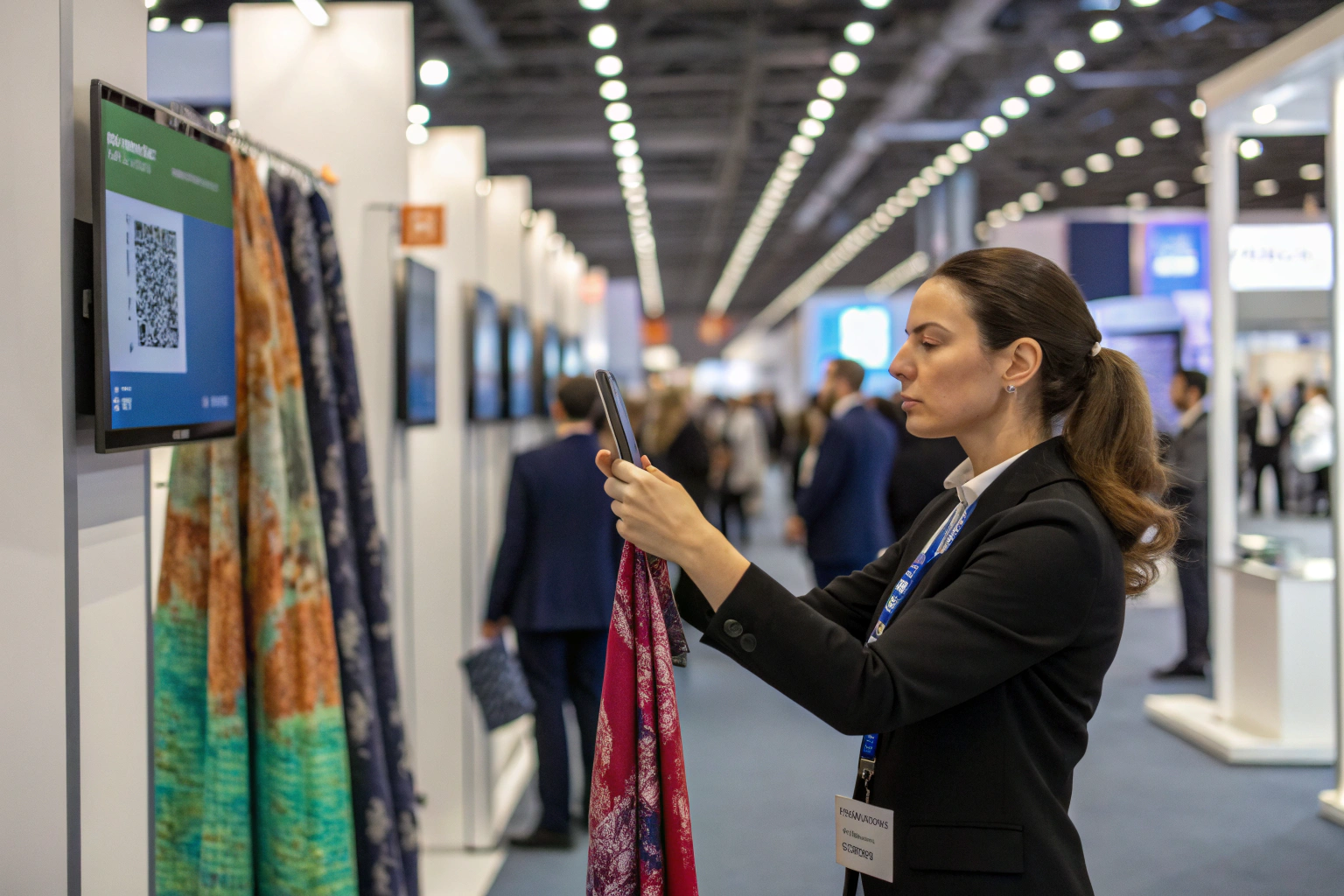
Let’s go back to that Texworld booth. You pick up a hangtag attached to a roll of organic cotton jersey. The hangtag has a QR Code on it. You pull out your phone. You scan it. Five years ago, that QR code would have taken you to a generic "About Us" page on the supplier’s website. In 2026, that is a Red Flag.
In 2026, that QR code takes you to a Digital Product Passport (DPP) . This is not a PDF. It is a live, cryptographically secured record of the fabric’s journey from the cotton boll to the show booth. At Shanghai Fumao, our DPP system (powered by a platform integrated with our CNAS Lab data) provides three layers of verification instantly:
- Geolocation of Origin: The passport shows the GPS coordinates of the gin where the cotton was processed. You can’t fake that easily.
- Transaction Certificate (TC) Chain: For GOTS goods, you can see the unique TC Number. You can click a link that takes you directly to the GOTS Public Database to verify that the certificate is active and belongs to us, not some shell company.
- Lab Report Hash: The spec sheet for shrinkage and colorfastness is hashed on a blockchain. If we tampered with the PDF report to make the numbers look better, the hash would break.
This is the standard in 2026. If a supplier at a major trade show cannot produce a verifiable DPP for their "premium" or "eco" fabrics, walk away. They are either technologically behind (which means their quality control is probably behind too) or they are hiding something.

How Do Blockchain QR Codes Prevent Fabric Swatch Substitution Scams?
This is a scam as old as trade shows themselves. The "Bait and Switch." You feel a gorgeous, heavy, 18oz selvedge denim at the booth. The swatch is perfect. You order 2,000 yards. What arrives is a 12oz denim that is stiffened with starch to feel heavy, but after one wash, it is limp as a dishrag.
In 2026, we stop this with Chip-Embedded Swatch Cards. It is not just a QR code printed on paper. We embed a Near-Field Communication (NFC) chip into the actual swatch header card. You tap your phone to the fabric swatch itself.
Here is the data you get before you leave the booth:
- Batch-Specific Weave Density: The exact Ends Per Inch (EPI) and Picks Per Inch (PPI) of the physical swatch in your hand.
- Yarn Composition Scan: A micrograph image of the yarn cross-section. You can visually confirm the core-spun structure we promised is actually there.
- Supplier Audit Trail: Links to the specific dye lot and inspection report for that exact swatch.
I had a conversation with a bag designer at a show in Munich last month. She had been burned twice by "heavy canvas" scams. I handed her our FUM-CAN-109 swatch. She tapped it with her iPhone. She saw the 68×68 construction and the 4.2 Twist Factor data pop up instantly. She looked up at me and said, "This is the first time I’ve actually believed a number at a trade show."
That is the power of 2026 verification. It removes the BS. For a deeper dive into this tech, check out this analysis of how NFC tags embedded in textile samples are revolutionizing trade show transparency and reducing sampling fraud.
Are Digital Product Passports Mandatory for EU Eco-Textile Exhibitors?
If you are selling into the European Union in 2026, the answer is trending toward Yes. The EU Strategy for Sustainable and Circular Textiles is pushing hard toward mandatory DPPs by 2027/2028. Trade shows like Première Vision are acting as early enforcement arms. They are quietly telling exhibitors: "If you claim sustainability, you better have the digital backbone to prove it."
At Shanghai Fumao, we got ahead of this curve two years ago. Our investment in ¥550M green manufacturing is useless if we can’t prove it on the show floor. We use the DPP to document:
- Water Usage per KG: We show the actual liters of water used in our partner dye house (compared to industry average).
- Chemical Compliance: We link directly to ZDHC Gateway reports showing our wastewater sludge is clean.
- Recycled Content Verification: We use a Mass Balance Approach verified by an external auditor.
A buyer from a major French fashion conglomerate walked into our booth last season. He didn’t ask for a price list. He asked, "Can I see your DPP for the recycled wool blend?" We showed him. He placed an order for 5,000 meters on the spot. His exact words: "This saves me three weeks of back-and-forth email compliance checks."
(Here is a reality check: If you are a small brand reading this, do not be intimidated by DPPs. It is our job as the supplier to provide it. You just need to know to ask for it. It is your shield against liability.) You can learn more about the regulatory landscape in this guide to understanding the EU Digital Product Passport requirements for textile importers in 2026.
Can Handfeel and Burn Tests Still Authenticate Premium Wools in 2026
Alright, let’s get analog for a minute. You have the fancy phone. You have the QR code. But what if the internet is spotty on the show floor? What if you are dealing with a vintage dealer who doesn’t do "digital"? Are the old-school skills dead?
Absolutely not. The Handfeel and the Burn Test are still your first and last line of defense. In fact, in 2026, these skills are more valuable than ever because the fakes have gotten really good at looking like the real thing on a screen. You can Photoshop a certificate. You cannot Photoshop the way cashmere melts into your palm or the way wool smells like burning hair.
At Shanghai Fumao, we train our booth staff not to just hand you a swatch and talk about price. We train them to walk you through a Sensory Verification process. We want you to feel the difference. We want you to burn a thread from the selvedge. (Yes, we have a small ceramic ashtray and a lighter in every booth. It is the most popular item on the table.)
Here is the 2026 reality: Sensory tests verify the substance. Digital tests verify the story. You need both.

Why Does the Acrid Smell of Burning Silk Still Matter at Premier Vision?
Because chemistry does not lie. You cannot fake the smell of burning protein fiber (Silk, Wool, Cashmere) versus cellulose fiber (Cotton, Linen, Rayon) versus synthetic fiber (Polyester, Nylon).
We had a situation in Paris in early 2025. A buyer was looking at a bolt labeled "100% Silk Charmeuse." The price was suspiciously low. The handfeel was almost right—a bit too slippery, maybe. I pulled a single thread from the selvedge (with permission, always ask!). I held a flame to it.
Here is the 2026 cheat sheet we use in the booth:
| Fiber Type | Burn Behavior (Flame) | Smell | Residue (Ash) | The "Fake" Tell |
|---|---|---|---|---|
| Silk / Wool | Burns slowly, curls away from flame. Self-extinguishes. | Burning Hair / Horn. (Acrid, sharp). | Crushable Black Bead. | Smells like plastic (Polyester blend). |
| Cotton / Linen | Burns quickly, steady flame. | Burning Paper / Leaves. | Fine, Grey Ash. | Beads up into a hard ball (Polyester blend). |
| Polyester | Shrinks, melts, drips. Burns with black smoke. | Sweet Chemical / Plastic. | Hard, Black Bead (cannot crush). | Smells like burning paper. |
The thread from that "100% Silk" bolt? It melted into a hard bead and smelled like a burning soda bottle. It was Polyester. The buyer avoided a €20,000 mistake because of a 5-second test that has worked for 200 years. This is why we still do it. For a more detailed guide, this resource explains how to perform a professional fabric burn test to identify unknown fibers in textile sourcing.
How Accurate Is Microscopic Fiber Analysis for Detecting Blended Wool Substitutes?
The burn test tells you if it is wool. It doesn’t tell you how much wool. A 70% Acrylic / 30% Wool blend will still smell like burning hair (a little bit) and leave a black bead. You might mistake it for pure wool if you aren’t careful.
In 2026, Pocket Microscopes are a thing. They cost $40 on Amazon and clip onto your smartphone camera. At the Shanghai Fumao booth, we have a Dino-Lite USB Microscope connected to a tablet. We don’t just tell you our cashmere is 100% pure. We show you the Scale Structure.
Here is the visual difference under 200x magnification:
- Real Wool/Cashmere: The fiber surface looks like snake scales or shingles on a roof. This is the cuticle. It is unique to animal hair.
- Acrylic/Viscose: The surface is smooth like a glass rod. No scales.
- Cotton/Linen: The fiber looks like a twisted ribbon or a bamboo stalk with nodes.
We use this to prove blend percentages. We take a cross-section image of the yarn. We count the number of round, smooth fibers (Acrylic) versus the scaly, irregular fibers (Wool). Our CNAS Lab does this with a Scanning Electron Microscope (SEM) for official reports, but the pocket scope gives you 80% of the verification power right there in the aisle.
This technology is so accessible now that I tell every design student who visits our booth: Buy a pocket microscope before you buy your next plane ticket to a sourcing show. You can read more about this in a technical review of using low-cost digital microscopy to verify natural fiber content claims in field sourcing scenarios.
How AI Spectral Scanners Identify Fumao EcoVero vs Generic Viscose
Now we get to the really cool 2026 stuff. You have two pieces of fabric. They are both soft. They are both drapey. They both look like Viscose (Rayon). One is labeled Lenzing™ EcoVero™. The other is labeled "Eco-Friendly Viscose." The EcoVero costs 30% more. How do you know the difference?
In the old days, you didn’t. You had to trust the invoice. You had to send a sample to a lab and wait three weeks for a DNA test (yes, they do DNA tests on wood pulp to see if it came from sustainable forests).
In 2026, we use a Handheld Near-Infrared (NIR) Spectral Scanner at the booth. This device (it looks like a chunky TV remote) shoots a beam of light at the fabric. The light penetrates the fibers and bounces back. Every polymer—whether it is Lenzing-certified Modal or Bamboo Viscose from a non-FSC forest—has a unique spectral signature. It is a fingerprint of molecular vibrations.
At Shanghai Fumao, we use this scanner to provide Instant Molecular Verification for our Regenerated Cellulose fibers.

What Is the Spectral Difference Between Lenzing Modal and Bamboo Rayon?
This is a massive issue in the sustainability space. Bamboo Rayon is often marketed as "green" because bamboo grows fast. But the process of turning bamboo into rayon is chemically identical to standard viscose and is often highly polluting if not done in a closed-loop system. Lenzing Modal and EcoVero are made from sustainably managed beechwood trees using a closed-loop process that recovers 99% of the chemicals.
When a buyer says, "I want the sustainable stuff, but that bamboo is cheaper," I pull out the scanner.
Here is the spectral difference we look for in the NIR data (wavelengths simplified for this post):
- Peak A (1450nm): This shows Water Content and Crystallinity. EcoVero has a tighter, more uniform peak because the fiber structure is more consistent. Generic bamboo rayon shows a broader, messier peak due to irregular polymer chain lengths.
- Peak B (1930nm): This correlates to Hemicellulose Content. Lenzing’s purification process removes more lignin and hemicellulose. The EcoVero signal is cleaner.
(Editor’s note: I am not a spectroscopist. I just know how to read the green checkmark on the screen. But the science is real. We have validated this against official Lenzing certificates.)
We scanned a swatch for a British lingerie brand at a recent show. Their previous supplier had sold them "EcoVero." The scanner flagged it as Standard Viscose. The spectral profile matched the "Generic Viscose" library entry in our database. The buyer was furious—not at us, but at her old supplier. She switched to Shanghai Fumao on the spot. This technology is becoming the standard for brands serious about their ESG (Environmental, Social, and Governance) reporting. For a deeper dive into the technology, see this article on how handheld NIR spectroscopy is being deployed to authenticate sustainable viscose fibers in the textile supply chain.
Can Chemical Tracers in Fibers Replace Traditional Certification Paperwork?
Yes, and this is where it gets very "Mission: Impossible." Chemical Tracers are invisible, edible (non-toxic) DNA markers or rare earth element tags that are mixed into the spinning dope of the fiber at the very beginning of production.
Lenzing does this with their Lenzing™ E-Branding Service. They embed a unique, scannable tracer in the fiber itself. It is physically part of the filament.
Here is how we use it at Fumao for our Tencel™ offerings:
- The Tracer: A specific fluorescent marker that glows under a certain UV wavelength.
- The Verification: We have a small UV Viewing Cabinet (like a black light box) in our booth. We put the fabric in. If it is genuine Tencel™ from Lenzing, it glows with a specific, faint blue signature. If it is generic lyocell from a knock-off mill, it stays dark.
- The Benefit: This cannot be faked. You cannot print this tracer onto a finished fabric. It has to be in the fiber. This provides Physical Brand Protection. It removes the need for a paper certificate that could be forged in Photoshop.
This is the future of trade show verification. The brand protection is literally woven into the cloth. This is especially critical for us as we supply to brands that require FSC (Forest Stewardship Council) chain of custody for their wood-based fibers. You can learn more about this innovative approach in this industry report on the adoption of fiber tracers to ensure supply chain integrity for man-made cellulosic fibers.
Why Live Factory Video Tours Build Trust for Asian Fabric Sourcing
In 2026, the trade show booth is no longer a 10×10 square of carpet. It is a Portal. The smartest buyers know that a booth is just a theater set. What matters is the factory 6,000 miles away. Is it real? Is it clean? Are the machines actually running, or is it a rented showroom for photos?
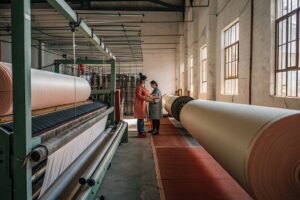
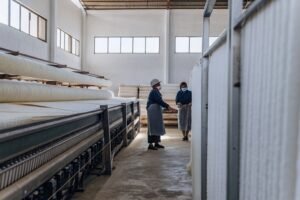
At Shanghai Fumao, we tackle this head-on with Live Factory Transparency. We have a policy: Any serious buyer can request a real-time, unedited video walkthrough of our facility in Keqiao directly from the show floor.
This is not a pre-recorded, polished corporate video with elevator music. This is a WhatsApp video call or a Zoom link handed to our Production Manager in China. We tell the buyer: "You tell me where to point the camera."
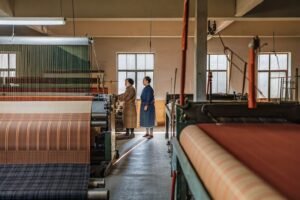
This is the ultimate verification of authenticity in 2026. Because you can fake a lab report. You cannot fake a 300-loom weaving shed running our specific FUM-CAN-109 greige fabric at 10:00 AM on a Tuesday.

How Do You Verify a Factory Hasn’t Outsourced Your Premium Fabric Order?
This is the nightmare scenario for a brand that pays a premium for "Japanese Quality Standards" from a Chinese mill. You place the order with the slick trading company at the show. They have a great booth. They promise the world. But when the order lands, they "job out" the weaving to a low-tier, dusty factory 500km away that uses cheaper yarn and older machines.
The Live Video Tour stops this cold. Here is what we show buyers in real-time during the call:
- The Warp Beam Ticket: We walk the camera over to the loom weaving their specific quality. We zoom in on the Warp Beam Ticket. This is the paper attached to the giant roll of yarn feeding the loom. It shows the Yarn Count (e.g., 40/2 NM) , the Blend (e.g., 70/30 NYCO) , and the Job Number.
- The Loom Speed: Our high-quality looms run at a specific RPM for dense fabrics. A cheap jobber runs the looms faster to get volume, which damages the yarn and reduces abrasion resistance. You can hear the difference. A good loom sounds like a steady "thrum-thrum-thrum." A rushed loom sounds like a panicked "clackety-clack-bang."
- The Inspection Table: We pan over to the fabric inspection area. You can see the Fumao QC team in their blue uniforms with digital tablets, checking rolls under the calibrated light box. You can ask them to zoom in on a specific roll number.
In May 2025, a buyer from a Canadian workwear brand was at a show in Las Vegas. He was skeptical of our Nylon/Cotton (NYCO) blend claims. It was 11:00 PM in Vegas, which meant it was 11:00 AM in Keqiao. We called the factory floor manager on WeChat. The buyer asked to see the core-spun yarn spinning frame. We showed him. He saw the Nylon filament being fed into the center of the cotton roving. He placed a $120,000 PO the next day. He told me, "I’ve been sourcing for 15 years. No one has ever just shown me the machine running."
This is the level of trust required in 2026. You can read more about this trend in a piece on how live virtual factory audits are replacing traditional social compliance certifications for mid-tier brands.
Are Remote Spectrophotometer Readings a Reliable Substitute for Physical Lab Dips?
This is a specific but critical question for color accuracy. At a trade show, you see a fabric color you love. You want to know if we can match it. Traditionally, you’d mail us a swatch, we’d do a lab dip, mail it back—a 2-3 week process.
In 2026, we use a Remote Color Verification Protocol.
- The Booth Spectro: We have a calibrated X-Rite spectrophotometer in the booth. We take a reading of the physical swatch you brought with you (or the Pantone chip you like).
- The Cloud Link: The spectral data (Lab* values) is uploaded to our cloud.
- The Factory Match: Our dyeing lab in Keqiao receives the data instantly. They pull a physical lab dip from our archive that matches those coordinates within a Delta E of < 0.8.
- The Video Verification: During the live factory tour, we walk the camera over to that exact lab dip hanging in the color cabinet. You see it on the screen under our D65 lighting.
Is it a 100% substitute for holding the physical dip in your hand? No. Lighting and camera sensors can distort the color slightly. But it is a 95% verification of capability. It proves we have the color in our library and that we can produce it. It proves the dye house exists and the swatch isn’t just a Photoshopped promise.
This is how we accelerate the development process while maintaining authenticity. We use the trade show interaction to collapse the timeline from "first meeting" to "color approval" from three weeks to 15 minutes.
Conclusion
The trade show floor in 2026 is no longer a place for blind faith. It is a proving ground. The days of the "trust me" handshake are over. They have been replaced by the Digital Product Passport, the NFC chip, the Pocket Microscope, and the Live Factory Portal.
For a brand owner, this is actually a golden age. The tools to protect your supply chain from fraud are more accessible and more powerful than ever before. You do not need to be a textile engineer with 30 years of experience to spot a fake. You need to know the right questions to ask and the right technology to demand. You need to partner with suppliers who welcome the scrutiny, not hide from it.
At Shanghai Fumao, we have invested in these verification systems not because we have to, but because it is the only way to separate ourselves from the ocean of mediocrity and outright deception in the textile trade. When you visit our booth—whether it is in Paris, New York, or Shanghai—we want you to scan, burn, zoom, and call. We want you to verify the fiber right down to the molecular level. Because when you know exactly what you are buying, you can justify the price tag to your customers with absolute confidence.
Verification is the new currency of textile sourcing. It is the foundation of brand integrity.
If you are planning your sourcing calendar for the next trade show season, or if you just want to see what a truly verified fabric supply chain looks like before you leave your office, reach out to our Business Director, Elaine. She can walk you through our Digital Product Passport portal and schedule a live virtual tour of our Keqiao facility. Her email is elaine@fumaoclothing.com.
Let’s build a collection that is authentic from the inside out.