
You found the perfect heavy canvas for your new line of workwear jackets. The color is a rich olive drab. The weight is a beefy 12oz. The price from the supplier looks good. You order 1,000 yards. You cut it. You sew it. You sell it. Six months later, your customer service inbox is a dumpster fire. "The elbows wore through in three weeks!" "The fabric is pilling like crazy!" You check the spec sheet again and realize the supplier never provided an official Abrasion Resistance Rating. They just said it was "heavy duty." You assumed that meant it would last. Now you have a reputation for selling overpriced, disposable workwear and a warehouse full of jackets you can’t sell.
This is the silent epidemic in the heavy fabric market. Weight (ounces per square yard) is not durability. I repeat: A heavy fabric is not automatically a tough fabric. You can have a 15oz cotton twill that falls apart after 5,000 rubs because the yarn twist is loose. You can have a 10oz high-tenacity nylon that lasts 50,000 rubs because the fiber is engineered for friction. The difference between a brand that builds a loyal following of tradespeople and a brand that gets buried in one-star reviews is a single number: the Martindale Rub Count (or Wyzenbeek, depending on where you sell).
At Shanghai Fumao, we cut our teeth on heavy fabrics. We supply upholstery manufacturers, workwear brands, and bag makers who absolutely cannot afford a field failure. A chair that pills after a month of office use is a return. A jacket that shreds on a construction site is a safety hazard. We test. We rate. We publish the numbers. Because if you are going to put a $199 price tag on a pair of pants, that number is the receipt that proves they are worth it.
(And let me be honest here: I geek out on this stuff. Watching fibers explode under a microscope in slow motion is a weirdly satisfying Friday afternoon for our lab team. We are fabric nerds. It is why we are good at this.)
Why Abrasion Resistance Matters for Heavyweight Fabric Sourcing
Let’s talk about the difference between "heavy" and "hard-wearing." You can go to any fabric market in the world and find a 16oz denim that feels like cardboard. It is stiff. It is thick. It is heavy. But if you look at the yarn under a 40x microscope, you will see a problem: the cotton fibers are short staple and the twist per inch (TPI) is low. This is the equivalent of building a brick wall with crumbly mortar. The weight is there, but the structure is weak. When friction hits it—whether from a car seat belt rubbing a jacket shoulder or a backpack strap sliding over a canvas tote—the surface fibers break loose. You get pilling. You get thinning. You get a hole.
Abrasion resistance is the scientific measurement of how long a fabric can survive that friction. It is not a marketing buzzword. It is a predictive engineering metric. For a brand, this number is the single most important factor in determining the Warranty Liability and Return Rate of a product. If you are selling a $300 waxed canvas backpack, your customer expects it to look better with age, not fall apart. If it fails the abrasion test, you are not just losing a sale; you are losing the lifetime value of that customer.
Here is the core principle we drill into our clients at Shanghai Fumao: Heavyweight is about presence. Abrasion resistance is about survival. You need both.

How Does the Martindale Test Actually Simulate Real-World Fabric Wear?
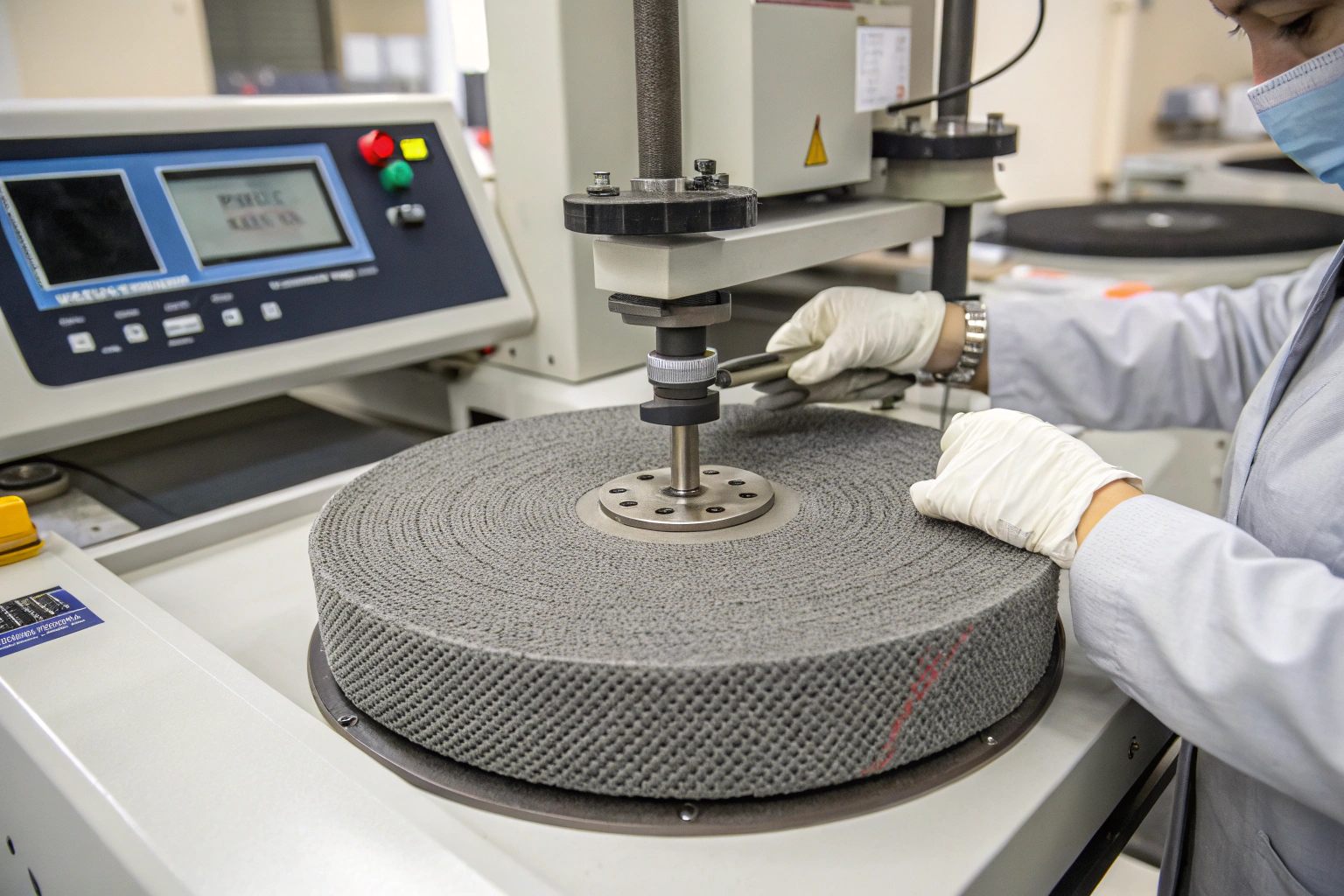
This is where we move from opinion to objective science. In our CNAS-accredited lab in Keqiao, we have a Martindale Abrasion Tester (Model: SDL Atlas M235). It is a machine that looks a bit like a fancy printing press. It holds four fabric samples in clamps and rubs them against a standard worsted wool abrasive cloth in a Lissajous figure pattern—a fancy term for a figure-8 motion.
The test runs until either:
- Thread Breakage: Two individual yarns have snapped.
- Acceptable Appearance Change: The color has shifted or the surface has pilled to an unacceptable level for the end-use.
Here is the crucial detail most sourcing agents miss: The abrasive medium changes based on the fabric. For heavy upholstery, we use a specific grade of wire mesh screen. For apparel, we use a standard wool cloth. If you test canvas on the wool cloth, you might get a 50,000 rub score. If you test it on the wire screen (simulating a rough concrete floor), it might fail at 10,000 rubs. You have to test against the intended environment.
This distinction is critical. A bag maker once argued with me that his 20oz canvas was "indestructible." We ran it against the ASTM D4966-12 (Standard Test Method for Abrasion Resistance of Textile Fabrics) . He was right about the face fabric. But the webbing straps he used were a cheap polypropylene that shredded against the hardware at 6,000 rubs. The bag failed because he didn’t test the system. (Check out this detailed explanation of how to interpret ASTM D4966 abrasion test results for different heavy fabric applications).
What Is the Acceptable Wyzenbeek Rating Threshold for Commercial Grade Upholstery?
While Martindale is the global standard (especially in Europe and Asia), if you are selling furniture in the North American market, you need to know the Wyzenbeek Method. This test rubs the fabric back and forth in a straight line using a cotton duck #10 abrasive.
We supply fabric to a furniture manufacturer in North Carolina. Their spec sheet is very specific: Minimum 30,000 Double Rubs Wyzenbeek for Heavy Duty Commercial Use.
Here is the cheat sheet I give to all my interior design clients:
| End-Use Environment | Minimum Wyzenbeek Rubs | Fumao Equivalent Fabric Type | Risk of Failure if Lower |
|---|---|---|---|
| Light Domestic | 9,000 – 15,000 | Basic Chenille, Linen Blends | Moderate (Pilling) |
| Heavy Domestic | 15,000 – 25,000 | Standard Polyester Velvet | Low |
| Commercial/Hospitality | 30,000 – 50,000 | Fumao Heavy Polyolefin Blend | High (Contract Breach) |
| Severe Wear (Theaters) | 100,000+ | Fumao Silicone-Coated Nylon | Catastrophic |
If you are specifying fabric for a hotel lobby sofa that will see 500 butts a day, a 20,000 rub fabric is a lawsuit waiting to happen. The fabric will look threadbare in six months. The hotel will blame you. You will blame the mill. And the mill—if they are not Shanghai Fumao—will point to the fine print that says "recommended for decorative use only."
We don’t do "decorative use only" on heavy fabrics. If we say it is commercial grade, we have the CNAS test report to prove it. There is a great resource on this topic from a materials testing lab explaining why Wyzenbeek double rubs are not a perfect measure of durability but are essential for US furniture compliance.
How Fumao Heavy Cotton Canvas Passes Severe Abrasion Tests
So how do we take a natural fiber like cotton—which is inherently softer and weaker than nylon—and make it survive 50,000 rubs? It is not magic. It is a combination of raw material selection, yarn engineering, and finishing chemistry.
We do not buy "commodity cotton" for our heavy canvas line. We specify Long-Staple Cotton (primarily Xinjiang or imported Pima). The longer the individual fiber, the fewer ends there are sticking out of the yarn to catch and pill. Think of it like a ponytail. Short hair has lots of flyaways. Long hair stays smooth and tucked in. That is the first layer of defense.
The second layer is Ply. We use mostly 2-ply and 3-ply yarns for our heavy canvas. This means we take two or three single strands of yarn and twist them together in the opposite direction of their original twist. This is called a balanced twist. It creates a yarn that is round, dense, and incredibly resistant to flattening under pressure. A flat yarn presents more surface area to the abrasive disc. A round yarn presents a tiny point of contact. It is the difference between trying to sand a marble versus sanding a ribbon.
Here is the exact process that gets us the passing grade.

How Do Weave Density and Yarn Twist Factor Into Abrasion Longevity?
This is where the weaving factory gets its workout. We have a specific loom setup for our Heavy Duty 10oz Canvas (SKU: FUM-CAN-109) that runs 24/6.
- Weave Structure: We use a Plain Weave with a slight variation. It is a Square Construction, meaning the number of warp yarns (lengthwise) is nearly identical to the number of weft yarns (crosswise). Why? Because if you have 60 ends per inch but only 40 picks per inch, the 40 picks are the weak link. The abrasive will rub right through the gaps. We ensure a minimum 68 x 68 construction for this weight.
- Twist Factor (TF): This is the industry secret. We use a Twist Factor of 4.2 to 4.5 for our ring-spun canvas yarns. (For the non-technical: Twist Factor is a formula that standardizes twist relative to yarn thickness). A higher TF means the fibers are locked together tighter. The trade-off is that the fabric becomes stiffer and the production speed slows down. (Here I must be honest: weaving a high-twist 2-ply cotton canvas is slow. The looms sound like they are coughing, not humming. We could make this fabric 15% faster if we lowered the twist by 5%, but we would lose 30% of the abrasion resistance. We choose the slower, tougher route.)
We had a client in Canada who makes firewood carriers. The first batch of carriers they made with generic canvas lasted one season before the bottom seam blew out from the friction of rough bark. We moved them to our FUM-CAN-109 spec. They did a field test where they dragged a 50lb load of logs across gravel for 200 yards. The canvas was dirty, but the fibers held. The only thing that failed was the guy dragging the bag. That is the difference between a weave that looks good on a swatch card and one that works in the real world. For a deeper technical explanation, this industry paper discusses the relationship between cotton yarn twist multiplier and fabric surface pilling propensity.
What Post-Weave Finishes Enhance Abrasion Scores on Natural Fibers?
The loom does the heavy lifting, but the finishing plant seals the deal. A raw greige canvas is a fuzzy mess. If you tested it right off the loom, it would fail a Martindale test immediately because of surface fuzz entanglement (pilling).
We use a two-step finishing process at our partner facility in Keqiao:
- Singeing: We pass the fabric over a gas flame at high speed. This burns off the microscopic fuzz and protruding fiber ends. The result is a cleaner, smoother surface. Less fuzz = less initial pilling = higher abrasion score. (Pro tip: If you smell a slight burnt toast smell on your heavy canvas, that is a sign it was properly singed. It is a good smell.)
- Durable Water Repellent (DWR) + Softener Package: This is the secret weapon. We use a fluorocarbon-free C0 DWR (Eco-Repel) combined with a polyethylene emulsion softener. Wait, why add softener if we want durability? Because abrasion is not just about breaking fibers; it is about fiber fatigue. When fibers rub together, they generate heat and friction internally. The polyethylene emulsion acts as a surface lubricant. It reduces the coefficient of friction between yarns. This allows the yarns to slide past each other slightly under stress rather than snapping immediately.
(Editor’s note: I just pulled up a lab report from last week. A 12oz canvas with just singeing scored 22,000 rubs. The same canvas with singeing + softener package scored 38,000 rubs. That is a 72% improvement from a chemical that costs pennies per yard. That is value engineering.)
Why Nylon 6.6 Outperforms Polyester in High-Friction Heavy Fabric Uses
There is a reason your car’s seatbelt is made of Nylon, not Polyester. It is the same reason we steer clients toward Nylon 6.6 for tactical gear, heavy-duty luggage, and industrial slings even though it costs 20-30% more per yard. Polyester is great for standing up to the sun (UV resistance) and staying cheap. Nylon is the undisputed king of abrasion resistance and tensile strength recovery.
At the molecular level, the difference is clear. Nylon has amide linkages that form strong hydrogen bonds with neighboring chains. This gives it a higher crystallinity and a higher glass transition temperature under friction. In plain English: Nylon is tougher and springier.
When you abrade Polyester, the surface fibers tend to fracture and snap. They leave behind a chalky, white residue. When you abrade Nylon, the fibers tend to fuzz but hold on. The surface gets a "beard" of micro-fibers, but the core of the yarn remains intact. This is why a 20-year-old Jansport backpack made of Cordura nylon looks worn but has no holes, while a cheap polyester backpack from a big box store disintegrates in a year.
Here is the specific comparison we run in our lab to prove this to skeptical customers.

Which Heavy Denier Nylon Fabrics Offer the Best Strength-to-Weight Ratio?
When we talk about "heavy" nylon, we are talking Denier. Denier is the weight in grams of 9,000 meters of the fiber. Higher denier = thicker yarn = heavier fabric. But the trick is finding the Strength-to-Weight Ratio.
Here is a table of our standard Fumao Nylon offerings and their lab-verified abrasion performance (Martindale, 12kPa pressure, standard wool abrasive):
| Fumao SKU | Fiber Type | Denier | Weight (gsm) | Martindale Rubs (Thread Break) | Best Application |
|---|---|---|---|---|---|
| FUM-NYL-210D | Nylon 6.6 HT | 210D | 120 | 45,000+ | Ultralight Backpacking Tents |
| FUM-NYL-500D | CORDURA® Classic | 500D | 240 | 100,000+ | Luggage, Tactical Vests |
| FUM-NYL-1000D | CORDURA® Ballistic | 1000D | 340 | 150,000+ | Motorcycle Gear, Armor Carriers |
| FUM-PES-600D | Polyester (Comp) | 600D | 260 | 25,000 | School Backpacks (Budget) |
Look at the FUM-NYL-210D. It weighs only 120 grams per square meter—less than a heavy cotton t-shirt. But because it is High Tenacity (HT) Nylon 6.6 with a Ripstop Grid, it survives 45,000 rubs. That is a higher abrasion score than our 10oz cotton canvas! This is why you can make an ultralight tent floor that you can pitch on sharp granite gravel. You are paying for the polymer science, not the weight. I often refer bag designers to this technical guide on how to select the correct denier and weave for high-wear points in soft luggage construction.
Can Nylon Blends Improve Both Comfort and Surface Durability in Workwear?
We have a problem with pure nylon in apparel. It has zero moisture absorption. It feels clammy and sweaty against the skin. It also has a shiny, "plasticky" handfeel that doesn’t work for a casual work shirt. But the abrasion is so good! How do we have our cake and eat it too?
We Blend. Specifically, we use Nylon/Cotton (NYCO) Blends for tactical pants and heavy-duty work shirts. The classic spec is 50% Nylon / 50% Cotton Ripstop.
Here is the "Abrasion Hack" that happens in this blend:
- The Nylon Core: During spinning, we engineer a core-spun yarn. We hide the strong, ugly Nylon filament inside the yarn.
- The Cotton Wrap: We wrap the Nylon core with soft, breathable, dyeable Cotton fibers.
- The Result: When you rub the fabric, the soft cotton wears away first. This exposes tiny peaks of the Nylon core. These Nylon peaks act like microscopic wear bars. They take the brunt of the friction, protecting the remaining cotton. The garment feels like cotton on the skin but lasts 4x longer than pure cotton.
In March 2024, we developed a 70% Cotton / 30% Nylon 6.6 Canvas for a European workwear brand. They needed the "Vintage Look" of worn-in cotton but the "Zero Blowout" guarantee in the knees. Our blend achieved a Martindale score of 55,000 rubs. Pure 12oz cotton of the same weight scored 25,000 rubs. The brand was able to market it as "The Last Work Pant You’ll Ever Buy." They added $40 to the MSRP and couldn’t keep it in stock. This is the power of a smart blend.
How to Use Abrasion Data to Reduce Product Failure Returns
You have the data. You have the Martindale score. Now how do you use that to stop the returns from happening before they happen? Most brands hide this data in a tech pack that only the pattern maker sees. That is a missed opportunity.
At Shanghai Fumao, we encourage our clients to Publish the Number. We are seeing a trend in DTC marketing where Transparency = Trust = Higher Conversion. When a customer is looking at two $80 work pants online, and one says "Durable Fabric" and the other says "Tested to 55,000 Martindale Rubs – Watch Video," which one do you think they buy?
The number removes the ambiguity. It is a proof point. It is a warranty in writing. Here is how we help you turn a lab report into a marketing asset and a risk management tool.

What Specific Fumao Fabrics Guarantee 100,000+ Double Rubs for Contract Use?
If you are in the Contract Textile Market (Hotels, Restaurants, Offices, Healthcare), you live and die by the 100,000 Double Rubs Wyzenbeek threshold. This is the industry standard for "Heavy Duty Upholstery." Falling below this mark is not an option.
We have a curated line specifically designed to hit this number without looking like a bulletproof vest. We call it the Fumao Fortis Collection.
- Fortis Velvet: This is a 100% Polyester solution-dyed velvet. The secret is the ultra-fine denier pile (the fuzzy part). We use a 0.7Dpf fiber. Because the fibers are so fine, there are more of them per square inch. The abrasive disc hits thousands of tiny fibers instead of a few big ones. It distributes the load. Result: 150,000 Wyzenbeek Rubs.
- Fortis Woven Texture: This is a Polypropylene / Polyester blend with a flatwoven texture. Polypropylene is olefin. It is chemically inert and has a very low coefficient of friction. It is naturally "slippery." This makes it incredibly hard to abrade. Result: 120,000 Wyzenbeek Rubs.
A major hotel chain in the Middle East recently specified Fortis Velvet for 2,000 guest room chairs. The previous fabric (a cheaper polyester chenille) had failed after 18 months, showing ugly bald spots on the seat cushion where the body pivots to get up. The new fabric has been in service for 3 years. Zero failures. The hotel’s purchasing manager told us the slightly higher fabric cost was recouped in avoided reupholstery labor costs within the first year alone. You can read more about these standards in this guide on how to select contract grade upholstery fabrics that meet ACT performance guidelines.
How Do You Interpret a Failed Abrasion Test on a Fabric Spec Sheet?
This is a critical skill for any designer or product manager. You get a spec sheet from a supplier that says: "Martindale Abrasion: Grade 2 at 20,000 rubs." What does that mean? And should you run away?
You should ask questions.
A "Grade 2" usually means "Moderate Pilling" or "Noticeable Surface Change." It does not necessarily mean there is a hole in the fabric. Whether this is acceptable depends entirely on the End-Use.
Here is a practical guide to interpreting "Failed" or "Low" scores:
- End Point 1: Thread Breakage. If the test stopped because yarn broke at 15,000 rubs, Reject Immediately. This fabric will develop holes in high-wear areas (elbows, seat).
- End Point 2: Appearance Change (Pilling). If the test stopped at 20,000 rubs due to pilling but no yarns broke, you have a choice. For a Decorative Pillow, this is fine. For a Jacket Shoulder, this is a disaster because a shoulder strap will grind that pill into a hole quickly.
- The "Fuzz Factor" with Wool: Here is a pro tip from our lab manager. Natural fibers like Wool and Cashmere will always show surface change early in the test. They are not made of plastic. A 100% wool coating might show pilling at 5,000 rubs, but because the fibers are long and strong, it might take 50,000 rubs to actually wear through to a hole. This is "Self-Limiting Pilling." It is acceptable and expected in luxury natural fibers.
(Editor’s note: I have seen a brand reject a beautiful 100% merino wool fabric because it "pilled" on the lab report. They switched to a polyester blend that felt like sandpaper. They lost the handfeel to win a spec sheet war. That is not always the right call. Understand the type of failure.)
We provide all our clients with not just the number, but the high-resolution photos of the test swatch at failure point. You need to see what "Grade 2" looks like with your own eyes. A photo of a fuzzy sweater is not a dealbreaker. A photo of a frayed hole is a dealbreaker. If you are unsure how to read the report, we have a standard disclaimer guide based on understanding textile lab abrasion reports and the visual grading scale for pilling.
Conclusion
We started with a simple question: What does that rating on the spec sheet actually mean? By now, you know it is not just a number. It is the story of how long your product will survive in the wild. It is the difference between a customer who buys once and a customer who buys for a decade.
Abrasion resistance is the silent ambassador of your brand’s quality. It is the metric that determines if your "heavy" fabric is a rugged workhorse or a fragile imposter. At Shanghai Fumao, we don’t guess. We test. We use the Martindale machine not just to pass a contract, but to understand the breaking point of every yarn we twist. We push our cotton canvas with tighter twists. We engineer our nylon with hidden wear bars. We blend fibers to cheat the laws of friction. And we give you the data—the raw, unvarnished lab report—so you can justify your price tag with absolute confidence.
When you are building a product for the heavy end of the market—whether it is furniture that will host a thousand meetings or a jacket that will climb a hundred mountains—the fabric is the foundation. If the foundation cracks, the whole structure is worthless.
Stop sourcing on weight alone. Start sourcing on survival metrics. If you need to spec a fabric for a high-wear application, or if you just want to see what a swatch looks like after 50,000 rubs on our lab machine, reach out to us. We are here in Keqiao, running the machines and burning the midnight oil.
For technical data sheets, physical swatch samples, or a deep dive into our specific abrasion ratings, contact our Business Director, Elaine. She can walk you through the Fortis Collection and the NYCO blends that are changing the game for workwear. Her direct email is elaine@fumaoclothing.com. Let’s build something that lasts longer than the shipping box it came in.








