
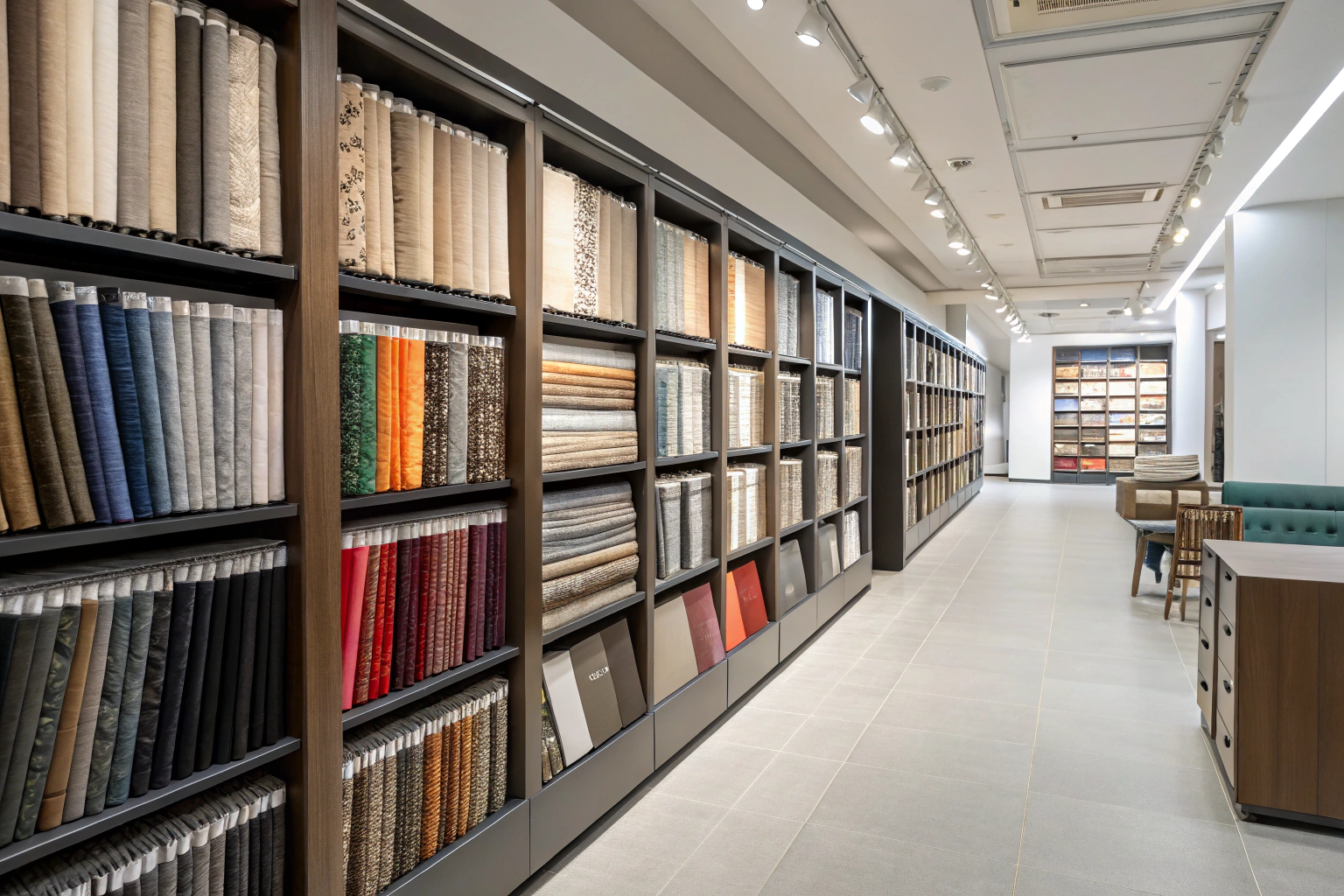
I have watched buyers walk into our Keqiao showroom, tired from a week of trade shows, eyes glazed over from seeing the same five floral prints and the same three satin bases in every booth. They sit down, and I bring out a binder. Not a digital catalog on an iPad—an actual leather binder with physical swatches stapled to spec sheets. Within ten minutes, they are leaning forward. Within twenty, they are canceling their afternoon supplier visits. What is in that binder is not just fabric. It is a curated archive of over 30,000 discontinued, limited-run, archive-dwelling, and technically exotic fabric styles that exist nowhere else in the active commercial market. I call this our Rare Style Library, and it is the single most underrated competitive advantage a fashion brand can access right now. It is not fast fashion. It is not trend chasing. It is a vault of textile DNA that allows a brand to create product that literally cannot be knocked off because the raw material does not exist on the open market.
The Rare Style Library at Shanghai Fumao is a physical and digital archive of fabric styles we have developed over twenty-plus years for clients across 100 countries. These are not deadstock leftovers. These are fully documented, production-ready fabric references—some were seasonal developments that never made it to bulk, some were exclusive custom projects where the exclusivity period has expired, some were speculative innovations from our R&D team that were ahead of their time. And here is the secret: because we own the weaving factory and control the dyeing and finishing supply chain within the Keqiao textile cluster, almost every single one of these 30,000+ styles can be resurrected and produced fresh for a new client. You are not buying old inventory. You are buying the rights to revive a proven, archived design and make it exclusively yours. This changes the entire sourcing conversation from "what do you have in stock?" to "what can you create that no competitor can copy?"
The reason I am writing about this now is that too many brands are playing a losing game of sameness. They source from the same open-market greige fabrics, dye them in the same trending Pantone colors, and wonder why their margins collapse in a race to the bottom. The Rare Style Library is an escape hatch from that trap. It is a way to build exclusivity into the very fibers of your product. Let me open the vault door and show you exactly what is inside, how we categorize and preserve these styles, and how specific brands have used this library to launch products that set them apart.
What Exactly Is the Fumao Rare Style Library and Why Does It Exist?
The Rare Style Library exists because I have a hoarding problem—a productive one. Over twenty years of textile development, we create thousands of strike-offs, lab dips, sample yardages, and first-run prototypes every single year. Many of these never become commercial products. Maybe the client went out of business. Maybe the brand pivoted their seasonal direction. Maybe the fabric was so innovative that the market was not ready for it. Most mills treat these as waste. They throw them in a corner, let them gather dust, and eventually recycle them into cushion stuffing or send them to landfill. I could never bring myself to do that. Every one of those swatches represented a moment of creative problem-solving between a designer and a textile engineer. I started keeping them, cataloging them, and storing them with full technical documentation. Over two decades, that collection grew into an archive of 30,000+ unique fabric references spanning every fiber category, weave structure, print technique, and finish type we have ever touched.
But this is not a museum. It is a production-ready resource. Every style in the Rare Style Library comes with a complete technical packet: the yarn specification, the weave construction data, the dye recipe number registered in our spectro database, the finishing route, and the original lab test results for shrinkage, colorfastness, and tensile strength. When a client selects a style from the library, we do not have to start from scratch. We pull the archived tech pack, source the yarns, load the dye recipe, and begin. This cuts development time from weeks to days. I had a situation in 2024 where a US streetwear brand was scrambling to launch a capsule collection. They had eight weeks from concept to delivery. I sat them down with the library binders on a Tuesday afternoon. They selected a discontinued Japanese-vibe ripstop nylon with a cire finish, a deadstock linen-silk jacquard, and a custom crinkle georgette from a cancelled 2021 order. We had lab dips approved by Friday, greige weaving started the following Monday, and the collection shipped on time. Without the library, that timeline would have been impossible. The library is not just about rare aesthetics; it is a time-compression machine.

Are These Styles Truly Exclusive or Just Old Stock Being Relabeled?
Let me be brutally clear because this is where I see competitors make false claims. Deadstock fabric is pre-produced inventory sitting on a shelf. It is what it is—fixed color, fixed quantity, first-come-first-served. Once it sells out, it is gone forever. The Rare Style Library is different. The swatches in the archive are reference samples, not sellable inventory. When you choose a style, we produce fresh fabric to your exact specification and quantity. You can adjust the color, modify the hand feel, change the width, or tweak the finish. The archive provides the starting point, but the final fabric is newly manufactured for you. This means the style is exclusive to your brand for the season or production run we agree upon. I do not resell the exact same style to two competing brands in the same market. If an LA streetwear brand selects a specific crinkle nylon from the library, I lock that reference for them for a defined period in their category and region. Exclusivity is a contractual commitment, not a marketing tagline.
I can prove this with numbers. About 40% of our library styles are what I call "orphan developments"—fabrics originally created for a specific client project that never went to bulk. The development was fully paid for by that original client, the exclusivity period in their contract has expired, and the intellectual property in the technical development reverts to us. Another 30% are "R&D speculative" styles that our internal 20-person innovation team develops proactively, testing new fiber blends, weave structures, or finishing techniques. These have never been commercially available. The remaining 30% are "archived commercial" styles—fabrics that were successful but deliberately retired from our active catalog to make room for new collections. They exist only in the archive vault. Every single style has a provenance trail. I can tell you exactly when it was developed, who commissioned it (if applicable), and what technical challenges were solved in its creation. This is not relabeling; it is textile archaeology with a commercial purpose.
How Does Fumao’s Vertical Factory Setup Enable a Library of 30,000+ Styles?
The library would be impossible without vertical integration. A trading company that sources from twenty different mills cannot maintain this kind of archive because they do not control the production assets. I own the weaving factory. I control the cooperative dyeing house relationship. I manage the coating and finishing lines. This means I can walk into my own weaving mill at midnight and tell my shift supervisor to pull a specific archived warp pattern from the dobby memory card library—yes, we keep the physical dobby chains and digital weave files for every archived style. Within hours, a loom can be re-configured to reproduce a fabric pattern we last wove in 2016. A trading company would need to find the original mill, negotiate a new minimum order, and hope the mill still has the technical capability. In most cases, the original mill has moved on, the technician who knew the recipe has retired, and the style is effectively lost. Our vertical setup makes the archive truly alive.
The dye house integration is equally critical. The Rare Style Library includes spectro color data—the exact Delta E values, reflectance curves, and dye recipe percentages for every colorway we ever developed. This data lives on our color-matching computers, not on fading paper records. When a client revives an archived style, we do not need to re-match the color from a physical swatch. We load the archived spectro recipe, mix the dyestuffs, and run a single confirmation lab dip. 95% of the time, the archived recipe hits the standard on the first try because our dye partners maintain meticulous calibration and chemical batch records. This integration between the physical archive and the digital color database is what makes the 30,000+ style count meaningful rather than just a vanity number. Every style is technically reproducible within a two-week sampling window. That is the operational miracle behind the library.
How Can Access to Discontinued and Archive Fabrics Create Brand Exclusivity?
Brand exclusivity is not a logo. It is not a marketing campaign. It is the physical impossibility of a competitor sourcing the same raw material as you. When Zara, H&M, or a fast-fashion upstart sees your best-selling jacket and tries to knock it off, their first step is to source the fabric. They take your garment to a fabric market, hand it to a supplier, and say, "Find me this." If your fabric came from an open-market commodity stock, they will find it in 48 hours. Your jacket will be copied, produced cheaper, and on a competing shelf before your reorder even arrives. But if your fabric originated from my Rare Style Library—a discontinued jacquard weave, a unique embroidered netting, a discontinued metallic coating—the knock-off artist hits a brick wall. The fabric literally does not exist on the open market. The weaving pattern is not in any active production catalog. The coating chemistry is proprietary to our formulation archives. The knock-off fails at step one. This is not theoretical. I have watched this play out in real time.
In 2022, a mid-tier German womenswear brand selected a heavily textured, irregular slub linen-viscose blend from our archive for a premium jacket. It was originally developed in 2019 for a Japanese designer who went out of business during the pandemic. The German brand launched the jacket at a €280 retail price point. Within six weeks, they saw a Polish fast-fashion chain attempt a copy. The copy looked ridiculous—the slub texture was wrong, the color was off by three shades, and the drape was stiff. Customers could instantly tell the difference. The German brand’s sell-through stayed at 92%, and the knock-off ended up on clearance racks at a loss. The brand owner called me and said, "The fabric was our moat." That phrase stuck with me. A rare fabric is a competitive moat. It is a barrier to entry built from threads and weaves, not from patents or lawyers. And it costs far less than a legal defense.

Why Do Fashion Brands Pay a Premium for Deadstock and Discontinued Weave Patterns?
I need to clear up terminology here because "deadstock" in the fashion industry usually means existing inventory of already-produced fabric. Brands pay a premium for that because it is immediately available, truly finite, and carries a sustainability story—they are saving fabric from landfill. But the Rare Style Library is "discontinued production capability," not deadstock inventory. Brands pay a premium for this because they are buying two things: exclusivity insurance and development acceleration. The exclusivity insurance is the guarantee that the fabric cannot be sourced by competitors because the technical data to produce it is locked in our vault. The development acceleration is the time saved. A brand that develops a custom fabric from a blank sheet of paper typically spends four to eight weeks in sampling, color matching, and testing before they can approve bulk. A brand that selects an archived style skips most of that. The weave is proven, the finishing route is documented, the lab test data exists. You pay a small premium per meter for that acceleration and exclusivity, but you save thousands of dollars in development costs and weeks of lead time.
The premium also covers the "small batch resurrection fee." To revive an archived style, we must interrupt our mass-production schedule, change over a loom for a small run, mix a custom dye bath for a small quantity, and dedicate a finishing line for a short batch. The unit cost of these small-run interruptions is higher than a continuous bulk run. I am transparent with clients about this cost structure. The archive premium is typically 10% to 20% above our standard custom development pricing, depending on the complexity of the weave and the quantity ordered. But compare that to the cost of developing an entirely original fabric from zero, which can involve ten to fifteen lab dips, multiple strike-offs, and weeks of back-and-forth. The archive route is often cheaper in total landed cost, even with the premium, because you eliminate the iterative sampling waste.
Is There a Risk Another Brand Has Used the Same Archive Style Before?
The honest answer is: sometimes, yes, but with important caveats. If a style in the library was a commercial success in its original run, it probably exists in the market as finished garments from that era. A particular jacquard from 2018 might be recognizable if someone finds a vintage piece on a resale platform. But textile trends cycle, and most fabrics that are 5 to 10 years old read as "fresh" and "unexpected" to a market that has been saturated with the current season’s open-market offerings. The context of the design matters enormously. The same base fabric, dyed in a different color, cut in a different silhouette, and paired with different trims, becomes a completely new product. I had a UK menswear brand select a 2017 archive wool-silk windowpane check. The original client had used it for a conservative business suit in navy. The UK brand used the exact same base fabric but dyed it in a dusty pink and sage green colorway and cut it as a relaxed, unlined overshirt. It looked like a completely different textile. Customers had no idea it shared DNA with a seven-year-old suit fabric.
My commitment is market-based exclusivity. If you are an Australian swimwear brand and you select an archived crinkle nylon, I will not sell that same reference to another Australian swimwear brand for the agreed exclusivity period. But a Korean handbag brand might use the same base, or a European scarf maker might use it. The application and geography are distinct enough that no consumer confusion occurs. I formalize this in the supply agreement with clear territory, category, and duration clauses. If you want absolute, global, across-all-categories exclusivity on an archive style, we can negotiate that, but the cost increases significantly because I am giving up all other potential revenue from that style for the contract period. Most brands find that category-and-territory protection is sufficient to build a moat. The fabric is rare enough that the overlap risk is already low; the contractual language just codifies it.
How Does Fumao Develop 1,000+ New Styles Annually and What Happens to Rejects?
One thousand new styles a year is not a marketing claim I throw around lightly; it is a manufacturing reality that strains our systems if we are not disciplined. Our R&D engine runs on a drumbeat. We have 20+ dedicated textile engineers, colorists, and weaving technologists whose entire job is to develop fabric that does not yet exist. They are not responding to purchase orders. They are not overseeing bulk production. They are pure forward-looking creation. The process starts with a quarterly "textile futures" meeting where we analyze trend forecasts from Première Vision, review technical innovations in fiber chemistry from our yarn suppliers, and most importantly, debrief the pain points our production team heard from clients in the previous quarter. A client struggling with a noisy rustling nylon becomes a brief: "Develop a silent-finish nylon with the same hand feel but zero acoustic footprint." That brief hits the R&D lab, and within 48 hours, there is a loomstate sample on the table. That speed is possible only because our R&D lab is physically inside our weaving factory, not in a remote design office.
The throughput rate is staggering. We track every R&D concept in a stage-gate system: Concept, First Loomstate Strike-off, Finish Refinement, Lab Test, and Archive. About 1,000 concepts clear the First Strike-off gate annually. Of those, maybe 400 are fully refined and lab-tested. And of those 400, perhaps 150 become active commercial styles that season. The remaining 250 join the Rare Style Library. They are not failures. They are ahead of the market, or they solve a problem that a client has not yet articulated to us, or they are simply too expensive to produce at scale until a specific order justifies the cost. But here is my rule: no R&D concept is ever discarded. Every strike-off that passes initial physical inspection gets a catalog number, a tech pack, and a place in the archive. If it does not make it to the commercial collection this season, it sits in the vault waiting for the right client to discover it.

What Percentage of Fumao’s R&D Output Goes Straight Into the Rare Style Archive?
The honest number is about 60% of our annual R&D output goes directly into the archive without ever appearing in our active seasonal collection. This is not a failure rate; it is a curation philosophy. Let me break down the math. Of the 1,000 concepts that reach first strike-off stage annually, roughly 250 are "client-commissioned custom developments" tied to a specific purchase order or a funded development agreement. Those are produced, shipped, and archived for potential future exclusivity release once the client’s contract period expires. Another 150 to 200 are "trend-reactive developments" that we fast-track because they align with a current market movement—these go into our active commercial collection for the season. The remaining 500 to 600 styles are the speculative R&D output. These are not rejected. They are "shelved." They are too innovative, too niche, or too expensive for the current market cycle. Some are pure experiments in fiber physics: "What happens if we weave a paper-yarn weft with a silk warp? Can we make a biodegradable metallic coating that actually survives a wash cycle?" These experiments often work technically but have no immediate commercial application. They sit in the archive, sometimes for five years, until external conditions change and a market suddenly demands exactly that solution.
I have an example that illustrates this perfectly. In 2019, our R&D team developed a copper-impregnated polyester yarn for antimicrobial performance, weaving it in a honeycomb structure for activewear. It passed all lab tests—99.9% bacterial reduction, good wash durability. But in 2019, the market did not care. Antimicrobial activewear was a niche wellness trend, not a mainstream demand. The style went into the archive. Fast forward to 2024, post-pandemic, and suddenly every activewear brand wants antimicrobial properties built into the yarn, not as a topical finish. A US fitness brand came to us asking for exactly this fabric. We pulled the 2019 archive reference, updated the base yarn to include recycled content for sustainability credentials, and had a bulk-ready sample in ten days. The five-year archive wait turned a speculative R&D cost into a first-mover advantage. This is why I protect the archive budget even when our commercial lines are running at full capacity. Today’s shelved experiment is tomorrow’s market-defining innovation.
How Does the CNAS Lab Validate New Styles Before They Enter the Library?
No fabric style enters the Rare Style Library without a full CNAS lab test report attached to its tech pack. This is my non-negotiable rule. The archive is not just a collection of pretty swatches; it is a database of production-ready technical specifications. Each new R&D style that passes the initial visual and hand-feel review goes immediately to our CNAS-accredited testing center for a standard battery of tests. We run dimensional stability to ISO 6330, color fastness to laundering, water, and perspiration under ISO 105, tensile and tear strength under ISO 13934 and 13937, and seam slippage resistance. For functional fabrics, we add the relevant performance tests—hydrostatic head for waterproof claims, moisture wicking rate for activewear, UV protection factor for outdoor fabrics. The test results are loaded into a digital record linked to the archive reference number. This means when a client selects a style from the library three years later, they do not need to wait for lab testing to confirm the fabric meets their standards. The data already exists. They can review the archived test report, compare it to their brand’s performance requirements, and make a decision instantly.
I recall a specific validation moment that proved the value of this system. In 2023, a Scandinavian childrenswear brand was sourcing fabric for a school uniform program. They had extremely strict requirements for formaldehyde content and flame resistance under the OEKO-TEX Class I standard. They selected three styles from our Rare Style Library for consideration. Within one business day, my team provided them the archived CNAS test reports for all three styles, showing the formaldehyde levels well below the 16mg/kg limit and the flame spread data under the EN 531 test method. Two of the three styles passed their internal toxicology review immediately. The third required a slight reformulation of the softener chemistry to meet the updated OEKO-TEX Annex 4 standards. Because we had the base technical data from the archive, the reformulation took three days instead of three weeks. The brand’s sourcing manager later told me our archival test data cut their vendor qualification cycle by 60%. That is the operational power of a validated archive.
How Can Small and Startup Brands Leverage the Rare Style Library for Low MOQs?
Small brands and startups are my favorite clients for the Rare Style Library. They are hungry, creative, and willing to take risks that big corporate brands avoid. But they face a brutal structural disadvantage: minimum order quantities. Most mills in China will not talk to a startup that needs 200 meters of a custom jacquard. The setup costs alone make the order unprofitable for the mill. The Rare Style Library changes that math. Because the weave development, dye recipe development, and lab testing are already done and amortized, the minimum viable batch size drops significantly. We are not starting from zero; we are restarting a proven process. For an archived style with existing dye recipes and a tested finishing route, I can often accept orders as low as 150 to 300 meters per color. That is a game-changer for a small brand launching a capsule collection. They can access a unique, high-complexity fabric at a quantity that makes commercial sense for their pre-order or small-batch production model.
I actively design our archive policies to be startup-friendly. There is no fee to browse the library. No subscription. No retainer. If you are a legitimate brand with a tax ID, a website, and a genuine intent to produce, you can schedule a library consultation with my team—either in person in Keqiao, or remotely via a curated digital lookbook. We select 30 to 50 archive styles we believe match your brand aesthetic and end-use requirements, and we send you high-resolution photos, technical data sheets, and pricing indications within 48 hours. You only start paying when you select a style and commit to a sample yardage or a bulk order. This low-barrier access model is deliberate. I want small, creative brands to succeed using fabrics that set them apart. When they succeed and grow, they remember that Shanghai Fumao gave them their first unique textile when no one else would take their order. That loyalty is worth more than a high-margin single order from a brand that will negotiate every cent and then switch suppliers next season.

Is There a Fee to Access Fumao’s Archive or Is It Free for Qualifying Clients?
No fee for browsing. No fee for consultation. No fee for initial style recommendations. I want to be unequivocal about this because I have heard rumors in the industry that some exclusive fabric archives charge an access fee or require an NDA before you can even see a swatch. My philosophy is the opposite. The value of the Rare Style Library is realized only when a style gets produced and shipped. Charging a gate fee just creates friction and discourages the very creative experimentation that makes the archive valuable. The only cost a qualifying client incurs before placing a bulk order is the sample yardage fee. If you want to see, touch, and test a physical sample of an archived style before committing to production, we charge a nominal sampling fee—typically $80 to $150 per style, which covers the cost of weaving a few meters of the fabric, running a lab dip in your chosen color, and couriering the sample to you. If you proceed to bulk, I credit that sampling fee against your order invoice. Essentially, the sampling is free if you follow through.
Qualifying as a client is straightforward. I need to verify that you are a real business, not a student working on a school project or a competitor trying to reverse-engineer our archive. A business license, a brand website, or a verifiable track record of commercial production is sufficient. For first-time entrepreneurs, I am more flexible than most mills—if you have a funded Kickstarter campaign, a well-structured business plan, or a mentorship relationship with a fashion incubator, I consider that qualifying. I have opened the archive to a solo founder working from her kitchen table in Portland. She had no track record, but she had a clear vision, a funded pre-order list, and a genuine understanding of her target customer. We found her a discontinued Japanese-vibe cotton dobby stripe from 2020. She launched a six-piece collection with it, sold out her pre-orders, and is now placing her third reorder. That is the kind of trajectory the library is designed to catalyze.
Can a Small Brand Reserve a Discontinued Style for a Season or Capsule Collection?
Yes, and I offer a streamlined exclusivity agreement specifically designed for small brands and startups. The standard large-brand exclusivity contract can be 15 pages of legal text covering territories, categories, distribution channels, and sub-license rights. For a small brand producing a single capsule collection, that level of complexity is unnecessary and intimidating. I have a simplified "Capsule Exclusivity Agreement" that is two pages long, written in plain English. It grants category-and-territory exclusivity for a six-month production window from the date of first sample approval. The brand commits to a minimum purchase quantity—typically 300 to 500 meters total across all colorways within that window—and I lock the style for them in their defined market. The financial commitment is modest enough to be manageable for a pre-order business model, and the exclusivity window is long enough to cover a full design-develop-market cycle.
There is no additional "exclusivity premium" on top of the standard archive pricing for this basic capsule protection. The exclusivity is built into the per-meter price we quote. The only circumstance where I charge an exclusivity premium is if the brand wants global, cross-category exclusivity, or if they want to lock the style for multiple years without a firm purchase commitment. That tying up of an asset without guaranteed revenue is what costs money. For a practical capsule, the standard agreement is sufficient. I had a startup from Austin, Texas, sign one of these Capsule Exclusivity Agreements in early 2025 for a discontinued bamboo-linen ikat jacquard. They produced a summer dress capsule, sold through 85% at full price, and are now negotiating a wider exclusivity for their spring 2026 collection based on the proven demand. They graduated from the startup agreement to a more comprehensive contract on their own timeline, with the sales data to justify the investment. That is how the system is supposed to work.
Conclusion
The Fumao Rare Style Library is a secret weapon because it solves the hardest problem in fashion: how to be different in a world of same. It is not a warehouse of deadstock; it is a vault of 30,000+ production-ready technical specifications, backed by twenty years of CNAS lab data, re-activatable on demand because we own the weaving factory and control the dyeing and finishing supply chain. I have shown you how the library exists because of our vertical integration, how brands use it to build competitive moats that fast-fashion knock-off artists cannot cross, how our 1,000-style annual R&D output feeds the archive with market-ahead innovations, and how small brands can access this resource with low minimums and no gate fees.
Every fashion brand that sources commodity open-market fabric is fighting the same margin-crushing battle. The Rare Style Library is a strategic alternative. It allows you to build product around materials that your competitors cannot source, at development speeds that are impossible for anyone without an archived tech-pack database, and with the quality assurance of pre-validated lab data. I have spent two decades building this resource, and it is the thing I am most proud of in my company. It represents thousands of creative conversations, technical problem-solving sessions, and "what if" experiments captured and preserved for future use.
If you are curious about what might be waiting for your brand in our vault, I invite you to start a conversation. Our Business Director, Elaine, manages library access for both enterprise clients and startup founders. Send her an email at elaine@fumaoclothing.com with a brief introduction to your brand, your target customer, and the type of fabric you are currently using or looking for. She will curate a digital lookbook of relevant archive styles and schedule a consultation to walk you through the technical data. Let us open the vault and find your brand’s next signature fabric.








