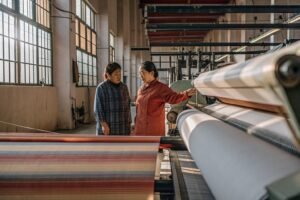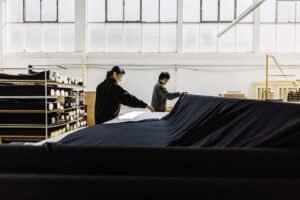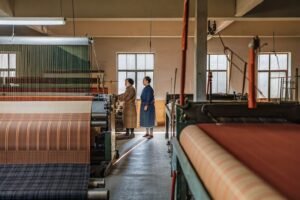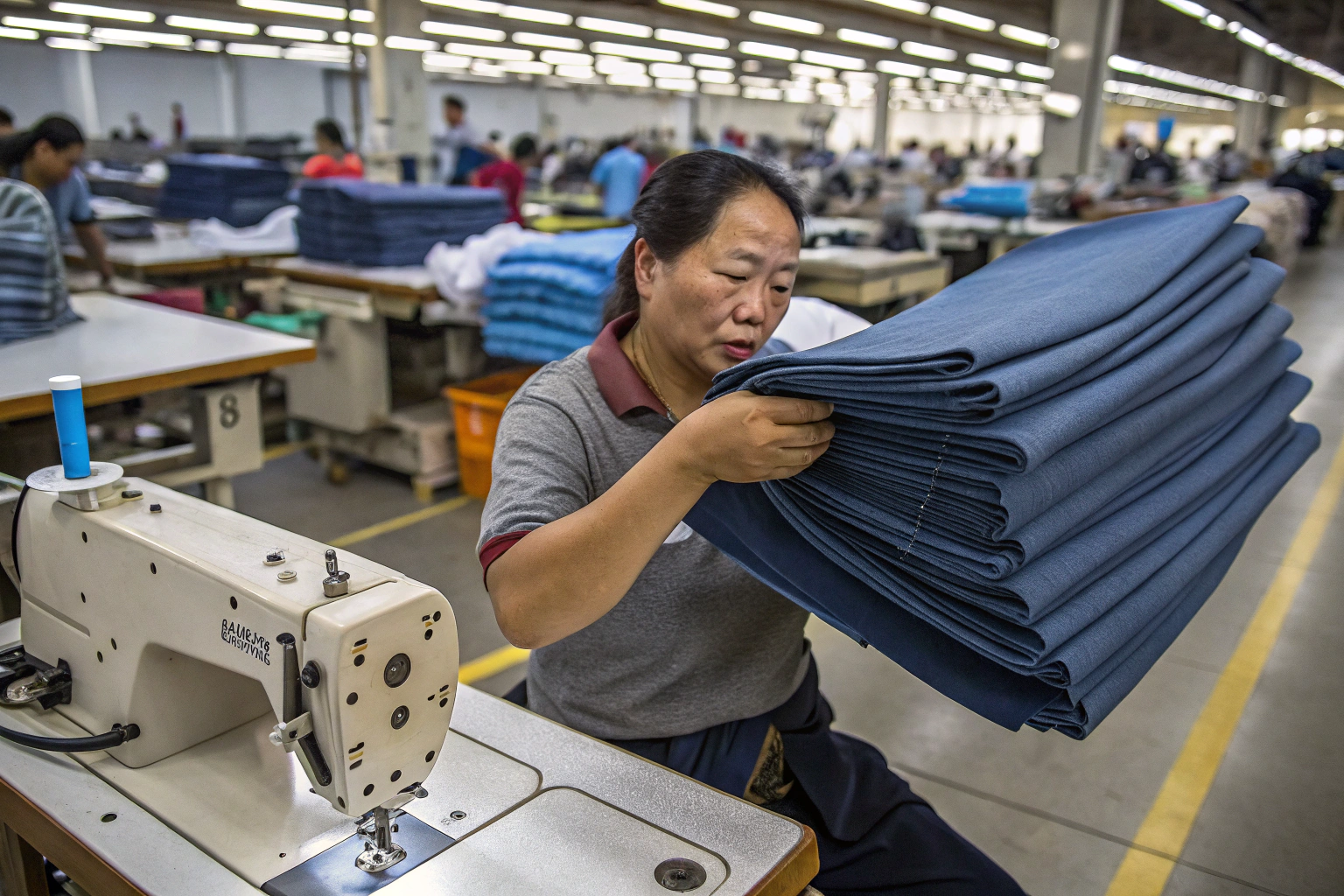
I have stood on a factory floor in Los Angeles and watched a sewer hold up a stack of cut panels, ready to run a seam, only to stop every five minutes because the needle was slicing through the yarns like a hot knife through butter. The fabric was not torn; it was punctured to death. That garment, a beautiful satin-finish blouse, was destined for the reject bin—not because of bad design, but because the fabric structure could not tolerate the mechanical violence of a sewing needle. Needle cutting, also called needle cutting damage, is the invisible killer in garment manufacturing. It is not a drape problem. It is not a color problem. It happens silently during sewing, and you only see the damage after the first wash when the tiny cut yarns relax and separate into a line of holes. By then, hundreds or thousands of units are already cut and sewn, and you are staring at a recall.
The right fabric does not eliminate the needle; it eliminates the fabric’s vulnerability to the needle. The secret lies in the relationship between yarn twist, weave density, and fiber elongation. A fabric with high elongation fibers, a balanced weave structure, and an appropriate finish can absorb the needle’s penetration by allowing the yarns to move aside temporarily rather than breaking under the impact. This is not a sewing machine adjustment problem; it is a textile engineering problem that starts on the loom. At Shanghai Fumao, we have spent years solving needle cutting for satins, chiffons, and tight-weave down-proof fabrics across lingerie, outdoor gear, and high-end wovens. We approach the issue not as a post-mortem inspection task, but as a pre-loom specification discipline. I tell my weaving master: build this fabric so it can survive a 75 needle at 4,000 stitches per minute. If it cannot, redesign the yarn.
What I want you to understand is that needle cutting is predictable and preventable, but you must stop blaming your sewing contractor and start auditing your fabric’s physical DNA. The fiber type, the size of the needle you intend to use, the density of the weave, and the coefficient of friction on the fabric surface all interact in a precise mechanical equation. When you understand that equation, you can specify a fabric that sews cleanly and lasts. Let me walk you through the exact mechanics of how needles break yarns, the fiber and weave choices that build natural immunity, the finishing tricks that lubricate the process, and the testing protocols we use at Shanghai Fumao to guarantee sewability before a single meter ships.
Why Does a Sewing Needle Cut Through Some Fabrics and Glide Through Others?
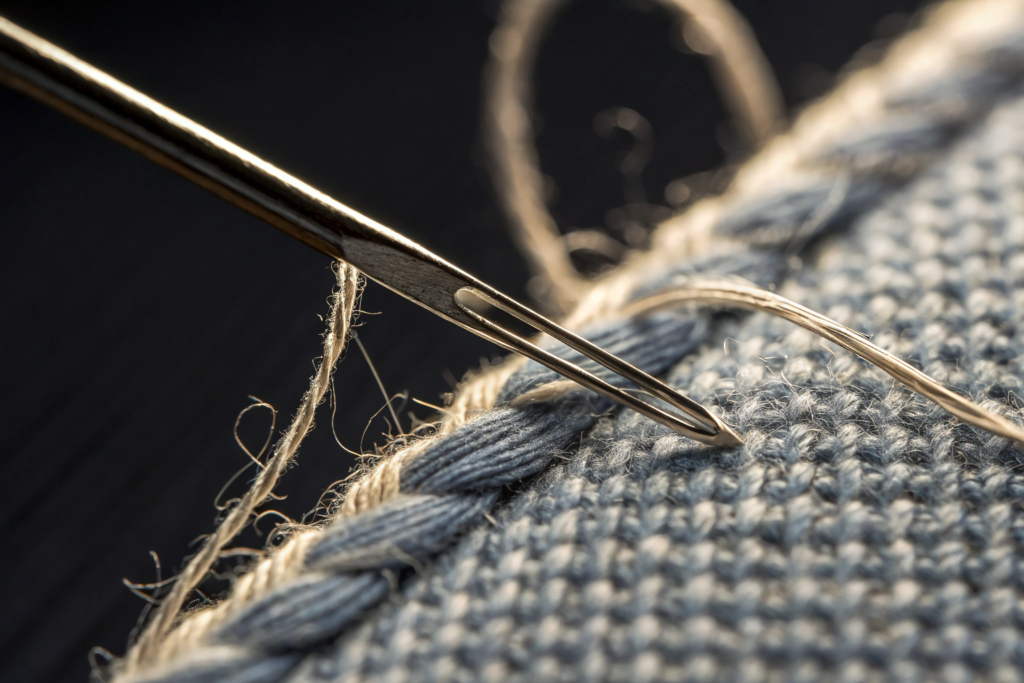
A sewing needle is not a sharp pin that slides between yarns; it is a blunt-force puncture tool that hits the yarns head-on. When a needle penetrates a woven fabric, it does not politely part the warp and weft like a curtain. The needle tip impacts the yarns with significant kinetic energy and must push them aside or break them. If the yarns are brittle, tightly twisted, and locked into a dense weave, they cannot move. They snap. This is needle cutting. Conversely, if the yarns have some stretch, if they can elongate or shift within the weave structure, they absorb the impact like a trampoline catching a falling person. They bounce back after the needle retracts. No broken fibers, no hole. The difference between these two scenarios is a combination of fiber type, yarn construction, and fabric finish. One of my early mentors in the industry showed me this with a strip of silk organza in one hand and a strip of polyester peachskin in the other. He pushed a needle through both. The organza made a crisp popping sound, and a distinct hole remained. The peachskin made a muffled thud, and the hole closed up instantly. The lesson stuck.
The problem gets amplified in production because the needle is moving at 3,000 to 5,000 stitches per minute. At that speed, the needle acts like a miniature punching machine. The fabric does not just experience a single static poke; it endures a relentless, high-velocity mechanical assault along the seam line. If the yarn tension in the weave is already high from the loom, the yarns have zero remaining stretch budget. They are pre-stressed. Adding the needle’s impact pushes them over the breaking point. This is why we control the weaving tension differently for fabrics destined for heavy topstitching. (I have had to loosen the warp tension on a batch of tightly woven cotton sateen by 10% just to give it the breathing room to survive a double-needle felled seam on denim-style jackets.) The dynamic of the sewing room must be anticipated in the weaving room.
How Does Fiber Elongation Percentage Determine Needle Cutting Risk?
Elongation is the fabric’s safety valve. It is the percentage a fiber can stretch before it snaps. Polyester and nylon have high elongation at break—typically 15% to 45% depending on the specific variant. Cotton has a low elongation at break—usually 3% to 7%. This single number explains why a 100% cotton poplin is vastly more vulnerable to needle cutting than a 100% polyester taffeta. When the needle hits a cotton yarn, the fiber can only stretch 7% before breaking. It has almost no give. The needle punctures it. When the needle hits a polyester filament, the fiber stretches, absorbs the energy, and contracts back. This mechanical logic is why I always recommend cotton-rich blends with at least 5% to 10% spandex or high-elongation polyester for any garment that requires heavy topstitching, like a 5-pocket jean or a structured blazer with edge stitching.
Let me give you a real data point from our CNAS lab. In 2023, we tested a 100% Tencel twill for a US sustainable fashion brand. Tencel has a dry elongation around 14%—decent, but not great. The fabric was for a utility jacket with extensive bar-tacking and multiple rows of 3mm topstitching. The first sewing trial in their LA sample room showed severe needle cutting along the topstitch lines. We pulled the fabric back to the lab. Our solution was multi-pronged: we switched the yarn spinning from ring-spun to air-jet spun, which created a slightly more compressible yarn core. We also added a 3% elastane filament in the weft to increase the stretch budget. The final fabric increased its effective elongation under sewing conditions from 14% to 18%, enough that the needle could displace the yarns without severing them. The next sewing trial passed with zero defects. The brand owner emailed me a photo of a clean topstitch seam with the subject line "Black Magic." It was not magic. It was fiber physics, elongation math, and a small dose of material science.
What Role Does Yarn Twist and Weave Density Play in Needle Damage Resistance?
Yarn twist is a double-edged sword. A high-twist yarn—think 30 to 35 twists per inch in a voile fabric—is compact, smooth, and strong. But it is also rigid and unyielding. A needle hitting a high-twist yarn encounters a dense, compacted bundle of fibers. The fibers cannot splay outward to absorb the puncture energy because they are wound together so tightly. The needle point simply shears through the bundle. A low-twist yarn, or an air-jet textured yarn with "give," has a looser structure. The fibers can spread apart under the needle pressure, creating a temporary path for the needle to slide through. I learned this in 2017 while developing a super-soft brushed flannel for a Canadian loungewear brand. The first iteration used a standard ring-spun cotton with 22 TPI (twists per inch). The needle cutting during the twin-needle hem operation was awful. We reduced the twist to 18 TPI and increased the yarn count to compensate for the strength loss. The looser twist allowed the fibers to splay, dramatically reducing punctures.
Weave density is the second half of the equation. A very dense, tight weave—like a down-proof fabric with a cover factor above 95%—leaves almost no interstitial space between yarns. The yarns are packed in tightly, and they cannot slide. When the needle enters, every yarn is a potential break point because no one can move out of the way. This is why down-proof and waterproof tight weaves are notorious for needle cutting. The fix is a lower cover factor during greige weaving, compensated by subsequent finishing processes like calendering to close the pores. Give the fabric breathing room at the loom level, then close the pores with heat and pressure later. It is a sequential engineering mindset. At Shanghai Fumao, our weaving spec for a down-proof 20D nylon includes a deliberate 5% to 8% porosity allowance before coating. That porosity is the fabric’s "crumple zone" for the needle. The final coated fabric is still fully down-proof, but the base weave preserved the mechanical space for needle insertion. Your sewing contractor will thank you, even if they never know the weave density spec was engineered for their needle.
Which Fiber Choices Naturally Resist Sewing Needle Damage?
Fiber choice is your first and most powerful defense against needle cutting, and I always tell my clients to think like a chemist before they think like a designer. Every fiber has a molecular backbone that defines its mechanical personality. Nylon 6,6 is tough and resilient; it has a high work of rupture, meaning it absorbs a lot of energy before breaking. This makes it naturally needle-friendly. Polyester is similar but slightly less tough in filament form, yet incredibly needle-friendly in staple-fiber form because staple fibers can slide against each other. Cotton is the problem child. Cotton fibers are short, stiff, and have low elasticity. They break under sudden dynamic loads like needle punches. Silk is an interesting exception—it has high elongation for a natural fiber, around 20%, but its fine filament structure makes it vulnerable to wedge-shaped punctures if the weave is too tight. Rayon and viscose are often the worst offenders because they have low wet strength and low dry elongation, making them brittle under mechanical stress.
I recall a specific project in 2022 with a Melbourne-based bridal designer who insisted on a 100% viscose satin for a bias-cut slip dress. The fabric was gorgeous but a nightmare to sew. The needle holes along the French seams were visible after the first steaming. We had to reformulate the fabric completely. I proposed a viscose-silk blend, 85/15, with the silk filament acting as a flexible internal skeleton that stretched and absorbed the needle impact. The silk increased the fabric’s elongation at break by 8 percentage points. That small shift solved the needle cutting entirely, and the drape was actually improved because the silk added a liquid flow to the hand feel that the pure viscose lacked. The designer later wrote me that her sewer said the fabric "sewed like a dream." That is the language I want to hear from the production floor. The right fiber choice turned a reject-prone material into a production-ready fabric.
Why Do Synthetic Filament Fabrics Cause Fewer Needle Holes Than Staple Cotton Fabrics?
The answer lies in the continuity of the fiber. A filament fiber is a single continuous strand that runs the entire length of the yarn, like a long steel cable. When a needle pokes a filament yarn, the individual filaments can slide along each other’s length, distributing the puncture force over a longer distance. They act like a telescoping antenna being pushed back into its housing—the force travels down the filament, not across it. A staple fiber yarn, like cotton, is made of thousands of short fibers, called staples, twisted together. These staples have free ends everywhere. When a needle hits a staple-fiber yarn, the short fibers are individually captured by the needle point and cut, or they are displaced and pulled out of the yarn structure entirely, creating a permanent hole. The yarn fails incrementally as each short fiber is severed. The continuous filament bends; the staple fiber breaks.
There is an additional factor called the "fiber migration" in spun yarns. In a ring-spun cotton yarn, the fibers twist in a helical path, migrating from the yarn surface to the core and back out. This creates a fuzzy, soft skin on the yarn. That surface fuzz is exactly what the needle point snags and breaks. A filament yarn is smooth and hard; there is no fuzz to grab. It is like the difference between trying to stab a smooth polished stone versus a ball of tangled hair. The smooth stone deflects the blade; the tangled hair catches it immediately. For a practical application, if you are making a crisp cotton shirting for formalwear and you are seeing needle damage at the collar and cuff seams, consider specifying a filament polyester core with a cotton wrap—a core-spun yarn. The polyester core provides the continuous filament backbone that resists cutting, and the cotton wrap provides the natural touch and sweat absorption. I keep samples of these core-spun fabrics in my office to show exactly this solution.
Can Natural Fibers Like Silk and Linen Be Engineered to Avoid Cutting?
Yes, but you must respect the raw material’s physical limitations. Silk is a natural filament, the only natural continuous filament. This gives it an inherent advantage over staple fibers like cotton or linen. However, raw silk filament is exceptionally fine, often as low as 1 denier per filament. A dozen filaments bundled into a yarn creates a structure that is strong in tension but delicate in puncture. To engineer silk for sewability, we use a higher number of filaments per yarn—called a higher denier per filament ratio—and we apply a gentle twist, around 2 to 4 TPI, called "organzine" silk. This twist binds the filaments together, making the yarn more cohesive and less prone to individual filament breakage under the needle. I once worked with a French couture atelier that complained their imported silk taffeta was needle-cutting on a vintage straight-stitch machine. We developed a custom 16-momme silk with a proprietary low-twist organzine construction. The slight twist gave the yarn the cohesion to roll under the needle point rather than splitting apart. The atelier reported the problem vanished immediately.
Linen is a harder challenge because flax fibers are naturally stiff, brittle, and have almost zero elasticity. Linen’s elongation at break is around 2% to 3%—worse than cotton. A needle hitting a linen yarn is like hitting a dry twig. It snaps. Pure linen garments are notorious for needle holes at stress points. The engineering solution for linen is almost always a blend. Adding 30% cotton softens the yarn and adds a bit of elongation. Adding 2% to 3% elastane transforms the mechanical behavior entirely, giving the fabric a "give" that allows the warp and weft to shift under needle pressure. I developed a 55% linen, 42% cotton, 3% elastane blend for a summer suiting fabric in 2023. The pure linen version failed the needle cutting test after 200 stitches on a multi-needle machine. The blend version ran 5,000 stitches without a single visible hole. The customer, a UK tailoring brand, initially resisted the elastane because they wanted a "100% natural fiber" story. I showed them the two swatches side by side under a 10x magnifier. The pure linen looked like Swiss cheese; the blend looked pristine. They chose blend integrity over fiber purity. That is a practical sourcing decision.
How Do Finishing Treatments and Fabric Lubricants Prevent Stitch Damage?
The loom hands you a greige fabric. That fabric is rough, stiff, and full of sizing agents from the weaving process. Sewing on greige fabric is a guarantee of needle cutting because the yarns are locked in place by the starch-based sizing. The needle has to overcome the friction of the sizing glue before it can even interact with the yarn. This is where finishing treatments and lubricants become the unsung heroes of sewability. A proper finishing sequence involves desizing to remove the starch, scouring to clean the fabric, and then applying a softener or lubricant that reduces the coefficient of friction between the yarns and the needle. The needle still penetrates, but it glides through with less resistance, generating less heat and less mechanical shock to the fibers. I often describe this to my younger technicians as the difference between pushing a fork through a dry loaf of bread versus a buttered loaf. The butter does not change the bread; it lubricates the interface.
At Shanghai Fumao, we have a range of finishing agents specifically formulated for needle cutting resistance. One of our most effective treatments is a micro-silicone emulsion softener. The silicone molecules bond to the fiber surface and create a permanent, low-friction coating that reduces the needle penetration force by 15% to 25%. We measure this in our lab with a needle penetration force tester—a machine that drives a needle through a clamped fabric sample at a controlled speed and measures the peak force in Newtons. The difference between an untreated and a siliconized fabric is immediately visible on the force curve. For a high-density nylon taffeta, the peak penetration force dropped from 3.8 Newtons to 2.9 Newtons after our silicone treatment. That 0.9 Newton reduction translates directly to fewer broken yarns on the production line. A buyer from a German technical outerwear brand visited our mill in 2024 and we ran this exact test live. He watched the needle force curve drop in real time and said, "That is the data I needed to see." The finishing chemistry is measurable, not mystical.
What Are the Best Anti-Friction Finishes for High-Density Weaves Like Satin?
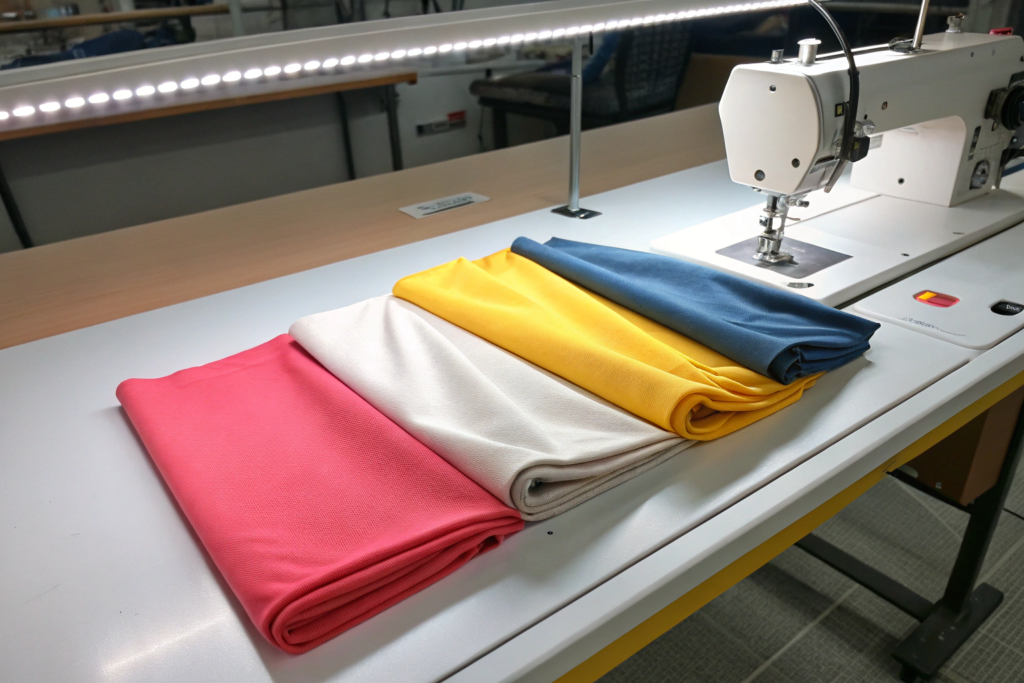
Satin weaves are the poster children for needle cutting problems. The long floats—those long sections of warp yarn that glide over multiple weft yarns before interlacing—create a beautifully smooth surface, but they also create a fatal mechanical weakness. A needle striking a float can easily split the yarn bundle because the yarn is unsupported and exposed for a long distance. For satins, I recommend a two-step finishing approach: a primary fatty-acid amide softener followed by a secondary macro-silicone topcoat. The fatty-acid amide gives a soft, waxy, internal lubrication that helps individual fibers within the yarn slide against each other. The macro-silicone provides a surface slickness that reduces the needle’s external friction. Together, they create a synergistic effect where the yarn bends flexibly and the needle slides past without grabbing.
I experimented with a heavy bridal satin—a 300 gsm polyester-viscose blend—for a 2025 spring collection. The initial greige fabric sewed like cardboard; the needle hole rate was 12 per 100 stitches. After a standard cationic softener, the rate dropped to 5. After adding a reactive amino-silicone as a top finish, the rate dropped below 1. The combination was the key. The cationic softener penetrated the yarn bundle and softened it from the inside out; the amino-silicone created an external shield that the needle could not grab. But I must warn you: silicone finishes can be too effective. If you apply too much silicone, the fabric becomes so slippery that it slides around on the cutting table and the sewing machine feed dogs cannot push it through properly. You trade needle cutting for seam puckering and mismatched panels. The art is in the dosage—typically 0.5% to 1.5% silicon on weight of fabric. We validate the exact ratio in our lab with a coefficient of friction meter, targeting a kinetic friction value between 0.25 and 0.35. Below 0.25, the fabric is too slippery to sew straight; above 0.35, the needle resistance rises, and cutting returns. It is a narrow window.
Can Fabric Calendering and Heat Setting Actually Worsen Needle Cutting?
Yes, and this is a trap that many fabric developers fall into. Calendering is the process of pressing fabric between heated steel rollers under huge pressure to create a smooth, glossy, compact surface. Heat setting stabilizes synthetic fabrics by heating them under controlled tension to lock in molecular orientation. Both processes make the fabric more uniform and "finished," but they can also fuse the yarns together at the crossover points. When yarns are fused, they lose their ability to slide independently. The fabric becomes a monolithic sheet rather than a flexible grid. A needle hitting a calendered or overly heat-set fabric does not just break one yarn; it breaks the entire fused network because the impact force propagates across the bonded junctions. Individual yarn mobility is what deflects a needle; fused yarns present a solid wall.
I had a painful experience with this in 2020. We developed a beautiful 100% recycled polyester microfiber for a high-end activewear brand. The fabric was down-proof, lightweight, and needed a crisp, papery hand feel. We heat-set it at 195°C for 45 seconds to stabilize the width and give it that crispness. It worked—the fabric looked and felt perfect. But when the brand sewed their first samples with a flatlock stitch, the needle cutting was catastrophic. Every seam looked like a perforated tear line. I went to the lab and pulled the heat-setting data. We had over-stabilized the fabric. The polyester fibers had partially melted at the crossover points during heat setting, creating micro-welds between the warp and weft yarns. The fabric had no internal mobility left. We reduced the heat-setting temperature to 180°C and decreased the dwell time to 30 seconds. The crispness was slightly lower, so we compensated with a light acrylic stiffener in the finishing bath. The needle cutting disappeared entirely. The lesson: heat setting stabilizes, but over-stabilizing welds, and welding is the enemy of sewability.
What Pre-Production Testing Guarantees Your Fabric Will Sew Clean?
You cannot guess your way to a clean-sewing fabric. You must test it, and you must test it under conditions that replicate the actual production sewing floor. Sending a swatch to the lab for a single-needle test on a relaxed, flat table tells you almost nothing. Real garment production uses multi-needle machines, overlock sergers, and topstitching machines running at high RPMs. The fabric is stretched, folded, and manipulated by operators who are incentivized by piece rate, not by gentleness. The test must mimic the production reality. At Shanghai Fumao, we run two layers of production protocol. First, we run our internal "sewability test" on every new custom development using a Juki industrial sewing machine set to 4,000 stitches per minute with a new needle—not a dull one from a month of production. If a fabric can survive a sharp needle at high speed, it can survive dull needles later. Second, we send a roll to our cooperative garment factory next door, and they sew a pilot run of actual garment panels, not just straight test seams. They do complex operations: a curved seam, a bar-tack, a buttonhole stitch. This pilot run exposes stress points that a simple straight stitch test misses.
I demand that my quality team document the needle type, needle size, thread type, and stitch density in the sewability test report. If you test with a 70/10 ballpoint needle and the production floor uses a 90/14 sharp needle, the test is invalid. The needle size and point type are part of the fabric specification, and the buyer must commit to them. I once had a dispute with a US denim brand. We shipped a custom cotton-twill stretch fabric that passed our sewability test with a 75/11 stretch needle. Their factory switched to an 80/12 universal needle to "speed up production." The needle cutting appeared immediately. They blamed the fabric. I sent them the test report with the needle specification clearly noted, and I also sent the retained sample from the same dye lot for them to test with the correct needle. The cutting disappeared. The needle choice must be a binding agreement, not an afterthought.
How Does a High-Speed Sewing Simulation Test Predict Needle Cutting Rate?
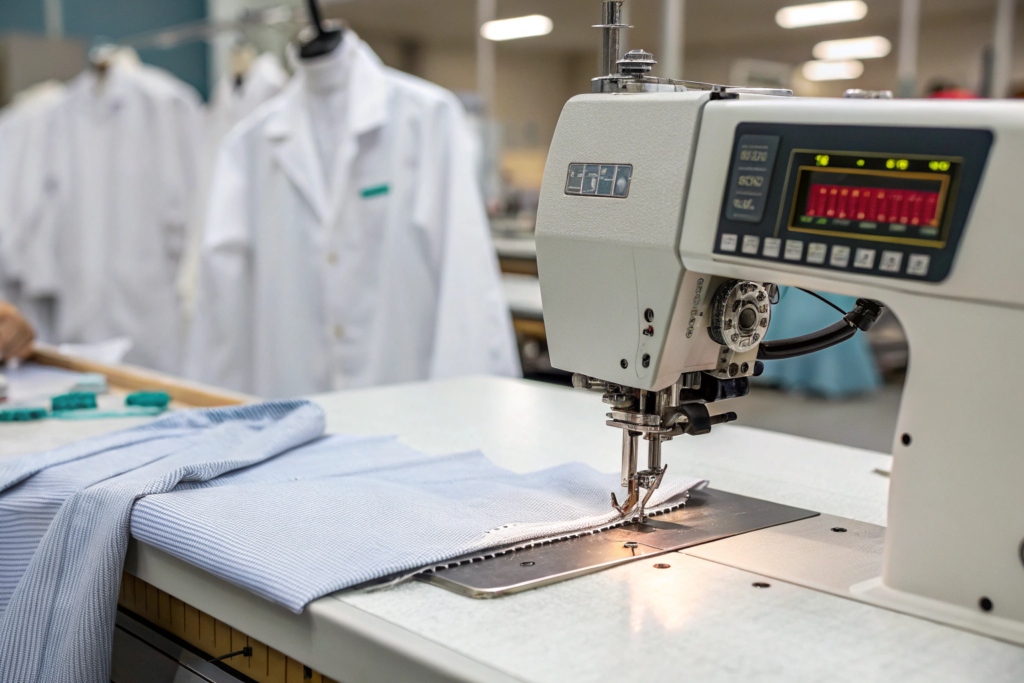
The machine we use is called a sewability tester, and it is not a standard sewing machine. It measures the needle penetration force and the needle temperature in real time as the machine runs. The device has a load cell under the needle plate that records the exact force profile of each stitch. A healthy force profile shows a smooth, low-resistance curve with a single peak. A problematic force profile shows multiple peaks and valleys, indicating the needle is snagging individual yarns, breaking them, and then hitting the next one. The machine also records the accumulated needle heat—a factor many buyers ignore. A needle at 5,000 stitches per minute can reach temperatures over 200°C on a synthetic fabric. That hot needle can melt polyester or nylon yarns on contact, creating hard, fused edges that rip open on the next stitch. Our sewability tester integrates a thermocouple into the needle bar to track this real-time temperature.
In 2024, we ran a high-speed simulation for a French performance brand developing a new polyamide-spandex activewear fabric. The sewability tester showed a needle temperature spike to 215°C after 500 stitches. At that temperature, the polyamide yarns were partially melting around the puncture, creating brittle, glassy edges. Subsequent stitches were then tearing through these brittle edges, mimicking needle cutting but actually being thermal damage. We solved it by adding a needle cooling lubricant—a small amount of silicone-based sewing machine oil applied directly to the needle during the test, simulating the lubrication system in a modern industrial machine. The temperature dropped to 170°C, below the polyamide softening point, and the damage vanished. This kind of failure mode analysis is invisible to the naked eye at production speed. Only a sewability tester catches it. If your fabric supplier does not own this equipment and cannot show you the force and temperature curves, you are ordering blind.
What Should You Ask a Fabric Supplier About Their Needle Damage Quality Control?
Ask them four short, precise questions. Question one: "What is the maximum recommended stitches per minute for this fabric?" A supplier who does not know the answer has never tested it. Question two: "What is the specific needle system, point type, and size you tested with?" The answer must be specific, such as "DBx1, SES (small ballpoint), size 70/10." If they say "just a normal needle," walk away. Question three: "Can you send me the needle penetration force curve and peak force in Newtons?" A genuine technical supplier will have this data from a sewability tester. Question four: "What is the needle damage grade after 5,000 stitches under your recommended conditions?" The fabric should be graded on a standard sewing damage scale—1 being no visible damage, 5 being severe and continuous puncturing. At Shanghai Fumao, we target a grade of 1 or 2 for all fashion fabrics, and 1 only for down-proof and tightly woven technical textiles. We ship nothing above grade 2 without explicit customer acknowledgment.
I also advise buyers to request two things in the pre-production package: a retained "sewability reference sample" and a photo of the test seam under 10x magnification. The retained sample is a physical piece of the exact lot tested that we keep on file, and the micrograph provides unmistakable evidence that the fabric is structurally intact after sewing. I had a startup outerwear brand from Canada visit our Keqiao office last year. They had been burned by a previous supplier who delivered fabric that needle-cut badly on their production run. I walked them through our lab, showed them the retained sewability sample from a recent order for another client, and let them inspect the test seam under the magnifier themselves. They signed the contract that afternoon. The transparency of the test data and the physical evidence built more trust than any sales pitch could. Your fabric’s sewability is a provable fact, not an opinion. Demand the proof.
Conclusion
Needle cutting is not a sewing problem; it is a fabric engineering problem that must be solved before a single meter hits the cutting table. The right fabric reduces needle cutting by combining high-elongation fibers with a forgiving yarn structure, a weave density that allows yarn mobility, and a finishing treatment that lubricates the needle’s path. We have walked through the precise mechanics of how a needle breaks a brittle yarn versus glides past an elastic one, the specific fiber choices that build sewability into the material’s DNA, the factory-floor finishing techniques that create a slippery, needle-friendly surface, and the laboratory testing protocols that prove the fabric will survive production before you commit to a bulk order.
I built Shanghai Fumao’s approach to sewability on two decades of sitting next to sewing operators and watching fabric tear under the needle. Every failed seam taught me something about yarn twist, or silicone dosage, or heat-setting temperature. I have encoded those lessons into our weaving specifications, our finishing recipes, and our quality control checkpoints. When you source fabric from us, you are not just buying meters; you are buying the accumulated knowledge of thousands of sewability tests and the engineering discipline to apply that knowledge to your specific fabric.
If you are tired of finding needle holes in your finished garments, or if you are developing a new fabric that must sew flawlessly on a high-speed production line, let us engineer the sewability from the yarn up. Contact our Business Director, Elaine, at elaine@fumaoclothing.com. Send her your fabric specification, your intended needle type, and your production stitch targets. She will work with our lab to provide you a sewability data package—force curves, needle temperatures, and a graded test seam photo—before you commit to the bulk order. Let us make sure your fabric sews as cleanly as it looks.