
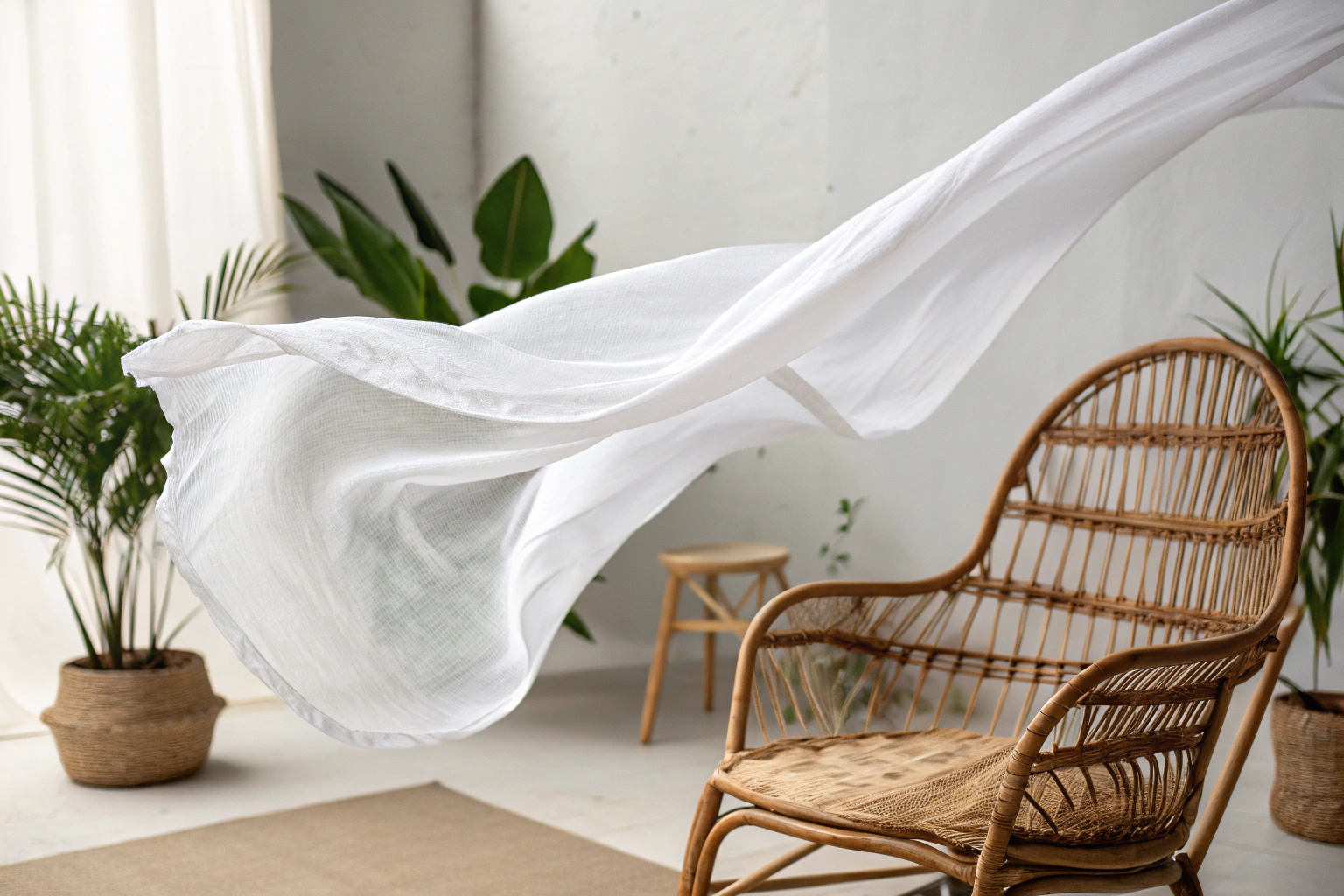
I’m going to say something that might get me in trouble with the fashion purists. The most beautiful summer dress in the world is worthless if wearing it feels like being wrapped in a Hefty garbage bag. I don’t care if the print is stunning or the cut is flattering. If the fabric doesn’t breathe, your customer will sweat. They will feel damp. They will feel sticky. And they will never, ever buy from you again. Summer 2026 isn’t just about looking cool. It’s about feeling cool. And with global temperatures breaking records every single year, the technical performance of your lightweight fabrics is no longer optional. It’s a survival mechanism for your brand.
At Shanghai Fumao, we’ve been fielding calls from European and US buyers since last September—and I mean way earlier than usual—all asking the same thing: "What’s the air permeability number on this linen blend?" They’re not asking about hand feel first anymore. They’re asking about airflow. The reason air permeability is crucial for Summer 2026 collections is simple math: rising temperatures + rising consumer expectations = zero tolerance for sweaty fabrics. If your fabric traps a boundary layer of hot, humid air next to the skin, you’ve failed the assignment.
Now, you might be thinking that this is just about picking "cotton" instead of "polyester." If only it were that easy. A tightly woven cotton poplin can suffocate you just as badly as a cheap poly satin. The devil is in the weave structure and the finishing. So, let’s pull back the curtain on what’s happening in our testing lab and our weaving mill right now as we prepare for the Summer 2026 season.
What Is a Good Air Permeability Rating for Summer Apparel
Let’s get technical, but not too technical. Air permeability is measured in units like mm/s or cfm (cubic feet per minute). It tells you how much air can pass through a given area of fabric under a specific pressure. Think of it like this: you put the fabric up to your mouth and try to blow through it. If it’s easy to blow through, the number is high. If you feel like you’re going to pass out trying to inflate a balloon, the number is low.
But what number is good for a summer shirt or dress? Here’s the range we use in our CNAS lab when developing for the Summer market:
- < 20 mm/s (or < 4 cfm): Suffocation Zone. This is dense denim, heavy canvas, or coated rainwear. Do not use for summer apparel unless you want a sweat lodge.
- 20 – 60 mm/s (4 – 12 cfm): Standard Woven Zone. This is your typical poplin or twill shirting. It’s acceptable for an office shirt in air conditioning, but not for a hot afternoon walk.
- 60 – 150 mm/s (12 – 30 cfm): The Fumao Summer Sweet Spot. This is where we engineer our high-twist cotton voiles, open-weave linens, and specialized polyester meshes. You get active cooling from airflow.
- 150+ mm/s (30+ cfm): Gossamer Zone. This is sheer curtain fabric or athletic mesh. Great for ventilation, but you sacrifice opacity and structure.
At Shanghai Fumao, we’re pushing all our Summer 2026 developments to hit a minimum of 80 mm/s for blouses and dresses. We want that breeze to cut right through.

How Do You Test Fabric Breathability in the Lab
We use a machine called the Air Permeability Tester (specifically the TEXTEST FX 3300 model in our lab). It’s a beautifully simple device. A vacuum pump sucks air through a precise area of fabric (usually 20 cm²). The machine measures the pressure drop across the fabric and calculates the velocity of the air passing through.
Here’s the catch: The result changes depending on where you test the fabric. We don’t just test one spot. We test 10 different spots across the width of the roll and take the average. Why? Because weaving is an organic process. The tension at the edges of the loom (selvedge) is higher than in the center. This means the fabric at the edge is often denser and less breathable than the center.
We report the Mean Value and the Coefficient of Variation (CV%) . If the CV% is too high (more than 5%), it means the fabric is inconsistent. That’s a red flag we fix before shipping. For a deeper look at the testing standards, check out this explanation of ASTM D737 standard test method for air permeability of textile fabrics.
What Is the Difference Between Air Permeability and Moisture Vapor Transmission
This is a crucial distinction that even some designers get wrong. They are cousins, but not twins.
- Air Permeability: How much WIND goes through the fabric. This cools you via convection. It carries hot, sweaty air away from your skin.
- Moisture Vapor Transmission Rate (MVTR): How much SWEAT VAPOR passes through the fabric molecularly. This cools you via evaporation.
Here’s the reality check: A fabric with high MVTR but low air permeability (like a very fine, tight microfiber) will still feel clammy in humid weather. The sweat turns to vapor and passes through, but you don’t get that satisfying whoosh of cool air. For Summer 2026, we are focused on high Air Permeability first, MVTR second. Because in high humidity, convection is king. For a great comparison of these two properties, read this guide on the difference between breathability and air permeability in performance textiles.
Which Fabric Weaves Offer the Highest Summer Airflow
If fiber is the ingredient, weave structure is the recipe. You can take the most breathable fiber in the world—say, linen—and if you weave it in a super tight satin construction, you’ve just built a wall. Conversely, you can take a standard polyester filament and knit it into a mesh that breathes like a screen door. For Summer 2026 woven collections (not knits), the structure is everything.
At Fumao, when a client asks for "something cool for summer," we immediately pivot the conversation away from standard poplin and toward these three specific weave structures:
- Plain Weave with Low Density: We simply use fewer yarns per inch. A 60×60 construction instead of 80×80. It’s the easiest way to open up the fabric.
- Basket Weave (Hopsack): Two or more yarns are treated as one and woven over/under in pairs. This creates large, visible gaps between yarn groups. It’s the classic look of a summer linen blazer.
- Leno Weave (Gauze): This is the king of airflow. The warp yarns actually twist around each other to lock the weft in place. Because the yarns are locked, they don’t need to be packed tightly. It’s incredibly stable and incredibly open.

Why Is Open-Weave Linen Better Than Tight-Weave Cotton
Let’s kill a myth right now. "Cotton breathes." Yes, but only if you let it. A 400-thread-count cotton sateen sheet is dense. It traps heat. A 100-thread-count cotton gauze is airy.
Linen’s natural advantage isn’t just the fiber’s wicking properties. It’s that the flax fibers are thick and stiff. When you weave linen, it naturally resists being packed tightly. You get a fabric with natural porosity even when you try to make it dense. With cotton, it’s very easy to compress the yarns and create a tight, smooth surface that blocks wind.
For Summer 2026, we’ve developed a Cotton/Linen Blend Basket Weave (55% Linen, 45% Cotton). We use the cotton to keep the cost reasonable and reduce wrinkling, and the linen to keep the weave structure open and slubby. The air permeability tests at 110 mm/s . It’s a dream to wear. If you want to explore this further, check out this comparison of thermal comfort properties between plain weave and basket weave linen fabrics.
Does Yarn Twist Affect How Much Air Passes Through
This is a deep-cut textile nerd detail, but it’s one of my favorites. High-twist yarns are rounder and harder. Low-twist yarns are flatter and softer. If you weave with high-twist yarns (like a Voile), the yarns are round. They touch each other at a single tangent point. This leaves tiny triangular air gaps between the warp and weft.
If you weave with low-twist yarns (like a flannel), the yarns squish flat. They fill in all those little gaps. The fabric becomes a solid sheet.
This is why a Cotton Voile feels so much cooler than a Cotton Lawn of the exact same weight. The Voile yarns are twisted within an inch of their life, creating a round profile and a crisp, open hand. We specify high-twist yarns for almost all of our Summer 2026 shirting developments. For more on yarn physics, this explanation of how yarn twist factor influences fabric porosity and air permeability is worth a read.
How Does Fabric Finish Change Breathability in Polyester
Most people think polyester is plastic, therefore it’s hot. That’s only true if you finish it wrong. At Shanghai Fumao, we spend a lot of time in our coating and finishing factory turning "plastic" into "clouds." The secret is in the heat setting and the wicking finish.
When polyester comes off the loom, it’s in a state of tension. The yarns are tight and the weave is compressed. If we just roll it up and ship it, it will feel like a stiff, non-breathable sheet. But we run it through a Stenter Frame. This machine grabs the edges of the fabric, stretches it out to the exact width we want, and bakes it at a precise temperature (usually around 190°C for poly).
This process does two things for airflow:
- Relaxes the Crimp: The yarns "relax" into their natural wavy shape, which opens up the weave structure slightly.
- Sets the Porosity: We can control how much we stretch it. If we stretch it wide, we open the pores. If we keep it narrow, we close them.

Can a Wicking Finish Actually Increase Airflow
Technically, no. A hydrophilic (water-loving) finish doesn’t make the holes bigger. But practically, yes, it changes the perception of airflow. Here’s why.
If sweat sits on the surface of the fabric, it blocks the microscopic pores. It creates a film of water that air can’t get through. A good wicking finish pulls that sweat inside the yarn and spreads it out over a huge surface area. This clears the surface pores and allows air to pass through again.
For our Summer 2026 recycled polyester sportswear line, we’re using a dual-action finish : A silicone softener to give it drape (and open the weave slightly via fiber lubrication) and a proprietary wicking agent to manage moisture. The combination takes a standard 75 GSM poly mesh from 180 mm/s air permeability to a measured 220 mm/s after finishing. That’s a 20% improvement just from the chemical recipe.
Does Brushed Polyester Kill Breathability for Summer
Yes. A thousand times, yes. Please, I’m begging you, do not use brushed polyester (like fleece or peach skin) for Summer 2026 unless you are designing for a very specific, chilly evening niche. Brushing is the process of taking a wire brush and raising the fibers on the surface to create fuzz.
That fuzz is essentially a layer of insulation. It traps dead air. That’s great for a winter blanket. It’s terrible for a summer blouse. The air permeability of a 100 GSM plain weave poly might be 80 mm/s. Brush one side of it, and it drops to 15 mm/s . You’ve just created a portable sauna.
We had a client from Australia last October who wanted a "soft hand" for a summer travel dress. They asked for a peach skin finish. We ran the test and showed them the data: Airflow dropped by 75%. We convinced them to use a sueded micro-modal instead, which is soft from the fiber itself and doesn’t require a destructive brushing process. They sold out of the dress in two weeks.
Why Are European Buyers Specifying Air Perm Standards Now
There’s been a shift in the past 18 months. It used to be that only the big athletic brands (Nike, Adidas, Lululemon) put strict Air Permeability numbers in their tech packs. Now? The contemporary fashion brands from Paris and Berlin are doing it too. I’m seeing specs on a chiffon blouse that I used to only see on a running singlet.
Why? Two reasons: Consumer Education and Liability. European consumers are savvy. They read labels. They read reviews. If a dress is described as "unwearable in summer," that review stays online forever and tanks the SEO. Second, with the EU’s push toward the Digital Product Passport and green claims, brands can’t just say "breathable." They need data to back it up.
At Shanghai Fumao, we welcome this change. It separates us from the mills that are just guessing. When a buyer asks for a specific mm/s value, we can either hit it or explain why that specific weave can’t hit it. It’s a conversation based on physics, not marketing fluff.

Is There an EU Regulation Coming for Breathability Claims
Not a specific regulation for breathability yet, like there is for flammability. But it falls under the umbrella of Regulation (EU) 2024/… on substantiating green claims. You can’t say "Cooling Fabric" unless you can prove it cools. And the easiest way to prove cooling in a woven textile is to show high Air Permeability and high Moisture Vapor Transmission.
I predict (and this is just me talking from the factory floor) that by Summer 2027, we will see specific thresholds in the EU Ecolabel criteria for apparel. "Air Permeability > X mm/s to qualify as Summer Weight." We are getting ahead of this curve. We’re building the database of test results now so that when the regulation hits, our clients are already compliant.
For those who want to stay ahead of the legal curve, keep an eye on this overview of the EU strategy for sustainable and circular textiles. It outlines the direction of travel for performance and transparency.
How Do You Test Air Permeability on Embroidered Summer Fabrics
This is a nightmare scenario for a lab tech, but a beautiful reality for a designer. Embroidery adds thread. Thread blocks airflow. But how much? You can’t just test the base fabric and assume the embroidery is negligible.
We use a specialized test method for these fabrics. We have a larger test head (usually 50 cm² instead of 20 cm²) so that we can capture a representative sample that includes both the embroidered area and the open ground fabric. We take 5 measurements: one on the solid embroidery motif, and four on the surrounding open areas. We then calculate a Weighted Average Air Permeability based on the percentage of the fabric surface covered by embroidery.
For a heavily embroidered summer dress (think Broderie Anglaise), the air permeability of the open areas needs to be extremely high (200+ mm/s) to compensate for the zero airflow over the embroidered motifs. We guide our clients on this balance. Too much embroidery, and the garment becomes a sweat trap in the specific spots where the embroidery sits. For a deep dive, check out this technical paper on the effect of embroidery stitches on the comfort properties of woven fabrics.
Conclusion
Air permeability is no longer a "nice to have" buried in the back of a technical data sheet. For Summer 2026, it’s the headline feature. As we face another year of record heat, the brands that survive and thrive will be the ones that take fabric porosity as seriously as they take color and silhouette. At Shanghai Fumao, we’re not just selling you meters of cloth. We’re selling you the promise that your customer won’t sweat through their outfit before they even get to the party.
We’ve shown you how we manipulate weave structures—from high-twist voiles to open basket weaves—to maximize airflow. We’ve explained how our finishing processes can either kill breathability (looking at you, brushing) or enhance it. And we’ve highlighted why European buyers are now demanding these numbers upfront, because the days of guessing are over. Whether it’s a cotton/linen blend for a relaxed blazer or a high-tech recycled poly for a travel dress, the science of staying cool is the same.
Don’t let Summer 2026 catch you with a warehouse full of beautiful, unwearable fabric. We have the lab equipment, the CNAS-accredited data, and the 20 years of hot-weather weaving experience to make sure your collection breathes easy.
If you’re working on a summer line and you want to see the air permeability reports before you commit to a fabric, let’s talk. We can send you swatches along with the data. Reach out to our Business Director, Elaine. She knows the mm/s numbers on our entire inventory by heart. Email her at: elaine@fumaoclothing.com. Let’s make sure your Summer 2026 collection is a breeze.








