
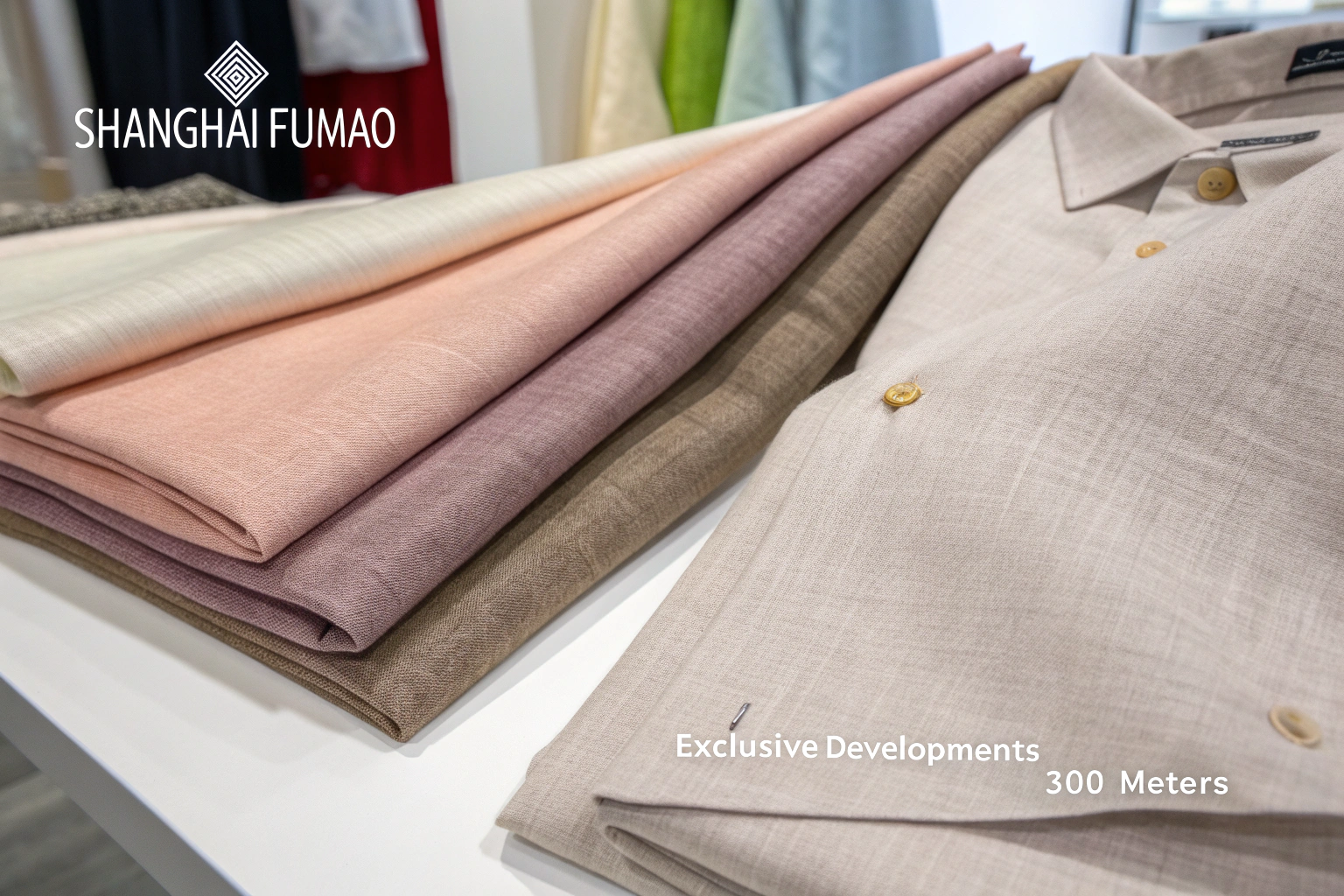
You designed a collection of linen blazers, wide-leg trousers, and bias-cut slip dresses for spring. The color palette is perfect. The pattern work is finished. Now you need fabric that moves like water and photographs like a painting. You order swatches from five mills. Four of them feel stiff, scratchy, or dead under studio lighting. The fifth swatch feels different. It has a fluid drape, a subtle luster, and a shade of bone white that looks expensive without trying. That is the moment a designer stops shopping on price and starts chasing a specific mill. I have seen this moment happen in our showroom in Keqiao, when a designer from a Paris-based label picks up a piece of our washed linen and just goes quiet for a second. They found the hand feel they have been imagining.
High-end womenswear brands choose Shanghai Fumao for linen because we engineer fabric for drape, tactile softness, and visual depth, not just for fiber content. We do not sell commodity linen. We sell garment-ready linen with a pre-washed, paper-touch, or peached finish that eliminates the stiff, boardy hand feel of standard flax fabric. Our minimum order quantity for exclusive developments starts at 300 meters, which lets boutique designers create custom colors and textures without committing to a container load. And our color matching uses a spectrophotometer with a Delta E tolerance below 1.5, ensuring the dusty rose you approved on the lab dip matches the bulk production exactly.
But the real answer is deeper than a spec sheet. It is about how we treat the fiber before it ever reaches the loom. Let me walk you through the finishing technologies, the color development process, and the sustainable story that makes our linen hang differently in a garment and sell faster at retail.
What Finishing Techniques Create A Luxury Linen Hand Feel
Standard linen is stiff. It wrinkles aggressively and holds the shape of the loom. That is fine for a rustic tablecloth, but it is unacceptable for a $600 blazer that needs to move with the body. The difference between commodity linen and luxury linen happens after the weaving, in the finishing department. We run multiple mechanical and enzymatic processes that physically break down the stiffness of the flax fiber without damaging its strength. The goal is a fabric that feels like a second skin, not a potato sack.

How Does Enzyme Washing Soften Flax Without Damage?
Think of enzyme washing as a controlled digestion. Flax fibers are bound together by pectin, a natural plant glue. This glue makes the fiber rigid. We use a specific class of enzymes called pectinases, which are proteins that break down pectin molecules. We dose the enzyme into a warm water bath, usually at 45°C to 55°C, and run the fabric through a jet dyeing machine for about 30 to 45 minutes. The enzyme eats the pectin on the surface of the fiber. It does not attack the cellulose core of the flax, so the tensile strength stays intact.
The result is a fabric that softens dramatically without the fuzzy, worn-out look that you get from stone washing or heavy mechanical beating. The fabric retains its clean surface but develops a fluid drape. A bias-cut slip dress made from enzyme-washed linen will glide over the body instead of standing stiffly away from it. This is a precision process. If the enzyme dose is too high or the dwell time is too long, the fabric loses too much weight and the seams will pull out under stress. We run a sample swatch through the enzyme bath first, test the tensile strength on the Instron machine, and only then process the bulk. You can learn more about the specific chemistry behind this by exploring how acid and neutral cellulase enzymes affect the softness and strength of linen textiles for apparel. It is a fascinating balance of biology and engineering.
What Is A Peached Finish And Why Do Designers Love It?
A peached finish gives linen a surface texture that feels like the skin of a ripe peach. It is a micro-sueded effect created by gently sanding the surface of the fabric with fine emery-covered rollers. The rollers knock off the very tips of the flax fibers, creating a microscopic fuzz that traps air. This trapped air gives the fabric a warm, soft hand feel that linen is not supposed to have, but designers absolutely adore it for autumn blazers and shift dresses.
The challenge with peaching linen is controlling the weight loss. Flax fibers are not as flexible as cotton. If you sand them too hard, you create a weak spot that will develop a hole after repeated wear. We run our peaching machines at a lower roller speed and with a finer grit than a standard cotton sander. We also process the fabric with the face side down and only peach the reverse side, which pushes the fuzz to the interior of the garment while leaving the face clean. This gives the wearer the softness against the skin without making the outside of the dress look fuzzy or faded. It is a subtle detail, but a designer who touches a peached linen blazer sleeve at a trade show immediately knows the difference. For more on this process, you can read about the mechanical peaching process for achieving a peach skin surface finish on woven linen fabrics. It is a technique that transforms the wearing experience of flax.
How Do We Match Complex Seasonal Color Palettes
Color is the first thing a consumer sees and the last thing a designer approves. For a high-end womenswear collection, the difference between a bestselling blazer and a markdown rack is often a half-shade of color. Our color development process starts with a spectrophotometer and ends with a human eye under a calibrated light box. We do not guess. We measure. And we archive every successful formula in a digital database that now holds over 5,000 recipes for linen blends.

What Is A Delta E Tolerance And Why Does It Matter?
Delta E is a measurement of color difference calculated by a spectrophotometer. The human eye can generally perceive a Delta E of about 2.0 to 2.5 as a visible shade difference. For high-end womenswear, that is not good enough. A pair of trousers cut from two different dye lots with a Delta E of 2.0 will show a visible mismatch at the side seam under boutique lighting. The customer will notice, and the garment gets returned.
We set our internal tolerance at a Delta E of 1.5 or lower for solid colors. For a neutral beige or a delicate pastel pink, we tighten that to 1.0. Achieving this requires a closed-loop dyeing system where the spectrophotometer reads the dye bath in real time and automatically doses additional colorant if the concentration drifts. It is a robotic system, not a guy with a bucket. Once we hit the target, we lock the formula into our database, tied to the specific substrate, the specific dye lot, and the specific water quality parameters of that day. When you re-order the same color six months later, we pull up the recipe, match the conditions, and hit the same shade. You do not have to re-approve lab dips for repeat colors. This speed and consistency is something high-end brands value because it lets them do mid-season replenishment without a two-month wait for color re-approval. Understanding how a spectrophotometer and CIELAB Delta E color tolerance system works in textile dyeing labs gives you insight into why some mills nail the color every time and others are always just a little off.
Can You Develop A Custom Linen Color From My Pantone Code?
Yes, and we do this for almost every womenswear client. You send us a Pantone TCX (Textile Cotton Extended) code, or a physical reference swatch like a piece of dried lavender or a vintage silk scarf. Our lab technician scans the reference with the spectrophotometer to get the spectral reflectance curve. The software then searches our database of existing dye formulas for the closest match. If a close match exists, we adjust it. If not, we start a new formula from scratch.
Developing a new color on linen is harder than on cotton because flax has a natural, slightly yellowish undertone and a lower dye affinity. A dye formula that works on cotton will look duller and warmer on linen. We adjust the base formula by adding optical brighteners or slightly shifting the dye mix toward cooler tones to compensate for the natural warmth of the flax. We then produce a lab dip on the actual production substrate—not on a cotton surrogate—and send it to you by courier. A typical lab dip takes 3 to 5 days. We offer three rounds of adjustment included in the development cost. Most designers approve the first or second round because we front-load the color matching in the lab before we even dip the first swatch. You can read about the process of developing a custom Pantone-matched lab dip for linen cotton blended womenswear fabrics to understand the full workflow from concept to approval.
Why Is Sustainable Linen A Priority For Premium Brands
The modern luxury consumer does not just want a beautiful dress. They want a story of provenance and a guarantee of ethical production. A linen garment already carries a narrative of natural fiber and biodegradability, but premium brands need to back that narrative with certifications and traceability. Greenwashing is a real threat to brand equity. If a customer scans your hangtag QR code and finds vague marketing language instead of a detailed fiber trail, you lose their trust.

Does Flax Cultivation Require Irrigation Like Cotton?
No, and this is one of the most powerful sustainability stories in the textile industry. Flax is a rain-fed crop. It grows in temperate climates like Northern France, Belgium, and the Heilongjiang province of China, where natural rainfall is sufficient for its growth cycle. Unlike cotton, which can require thousands of liters of irrigation water per kilogram of fiber, flax relies almost entirely on what falls from the sky.
This low water footprint is a major selling point for eco-conscious womenswear brands. We provide a Life Cycle Assessment summary with our certified linen that quantifies the water consumption per kilogram of finished fabric. We compare it to conventional cotton, and the difference is stark. A brand can put a hangtag on their garment that says, "This dress saved 500 liters of water compared to conventional cotton." That is a concrete, data-backed claim that resonates with customers who are tired of vague "eco-friendly" slogans. We trace our flax from specific growing regions, and we are building a system of digital farm passports that record the GPS coordinates, harvest date, and retting method for each fiber lot. This is where the industry is heading, and we are already running the pilot. To understand the full agricultural picture, you should explore the comparative water footprint and environmental impact of rain-fed flax cultivation versus irrigated cotton for sustainable fashion. The data is the antidote to greenwashing.
What Certifications Matter For Luxury Linen Exports?
OEKO-TEX Standard 100 is the minimum baseline. It certifies that the finished fabric is free from harmful levels of over 100 regulated substances. But for the premium market, GOTS (Global Organic Textile Standard) and the European Flax certification are becoming the differentiators.
GOTS certifies that the fiber was organically farmed and that every step of the processing chain—spinning, weaving, dyeing, finishing—meets strict environmental and social criteria. It is a holistic certification, not just a chemical test. European Flax certification, managed by the Alliance for European Flax-Linen & Hemp, guarantees that the fiber came from Western Europe, was retted in the field, and was processed without GMO or irrigation. It is a premium origin story. We carry both certifications on specific product lines. If your brand markets to the French or Scandinavian market, the European Flax label on the hangtag carries significant consumer recognition and trust. It justifies a higher retail price. For our Chinese-grown flax, we are developing an equivalent traceability standard that matches the transparency of the European system. You can read about the specific requirements and brand value of GOTS and European Flax certifications for premium linen apparel fabrics to understand which certification aligns best with your brand’s sustainability narrative.
How Does Our Quality Control Protect Your Brand Reputation
A defect on a roll of fabric is not just a defect. It is a returned garment, a one-star review, and a damaged relationship with a retail buyer. High-end womenswear operates on tight margins for error. A designer who finds a slub in the wrong place or a shade variation between the sleeve and the body panel will reject the entire delivery. Our quality control system is designed to catch problems before the fabric leaves our factory floor, not after it arrives at your cutting table.

What Is The 4-Point Fabric Inspection System?
The 4-point system is the global standard for grading fabric defects. An inspector visually examines every meter of fabric under a calibrated light panel. Defects are assigned penalty points based on their size. A defect smaller than 3 inches gets 1 point. A defect between 3 and 6 inches gets 2 points. Between 6 and 9 inches gets 3 points. Anything larger than 9 inches gets 4 points. Any continuous running defect gets 4 points per yard.
A roll passes inspection if the total penalty points per 100 square yards of fabric are below a specific threshold, usually 40 points for export-grade woven linen. We inspect 100% of our production, not a random sample. Every single roll that leaves our packing facility has been unrolled, examined under light, and graded. The inspection data is recorded digitally and linked to the roll’s QR code. If you find a defect later, you can scan the code and see the exact inspection report for that specific roll, including the inspector’s name and the time of inspection. This system is not cheap to operate, but it is far cheaper than processing a return from a disappointed boutique. You can learn the full methodology by reading about how the 4-point fabric inspection system works for grading woven linen textile defects. It is the language your QC team already speaks.
How Do You Prevent Shade Variation Within A Single Dye Lot?
Shade variation, where the fabric at the beginning of a roll is slightly darker or lighter than the fabric at the end, is a common defect in wide-width linen dyeing. It happens when the temperature or dye concentration drifts during the continuous dyeing process on a stenter frame. The fix is a combination of machine calibration and strategic cutting.
Our dye house runs a continuous monitoring system that samples the fabric color every 50 meters as it exits the stenter. The spectrophotometer compares the reading to the target and automatically adjusts the dye pump speed to correct any drift. This is a closed-loop feedback system that operates in real time, not a manual check at the end of the batch. After dyeing, we re-roll the fabric and perform a shade grouping step. A trained inspector compares the color at the head end, middle, and tail end of each roll under a light box. If there is a detectable shade drift, we split the roll into separate shade lots and label them accordingly. Your cutting room receives rolls that are grouped by shade consistency. You can cut with confidence, knowing that all the sleeves in a production bundle came from the same shade group. This attention to detail is tedious, but it is why our fabric ends up in boutiques that cannot tolerate a single mismatched trouser leg. Understanding how continuous dyeing shade drift is controlled and shade grouping is managed for bulk linen production gives you a window into the operational discipline required to hit luxury standards.
Conclusion
High-end womenswear brands do not choose us because we are the cheapest. They choose us because we solve the specific, maddening problems that kill a luxury linen collection. We enzyme-wash the flax until it drapes like silk without losing its strength. We peach the reverse side until it feels like a second skin against the body. We match the dusty rose Pantone code with a Delta E under 1.0 and lock the formula in a database so the re-order is identical to the first delivery. We provide the GOTS and European Flax certification that turns a fabric into a marketing story. And we inspect every meter under a 4-point system so your cutting table never receives a defect that becomes a customer return. That is the package. That is why a designer who visits our Keqiao showroom and touches our washed linen swatch goes quiet for a second before they start sketching.
If you are developing a spring collection and you need linen that moves, photographs, and sells like a premium fiber should, let us send you our latest womenswear swatch book. It includes our washed, peached, and paper-touch finishes in a curated palette of 24 seasonal colors. Contact Elaine and tell her your brand aesthetic and the types of garments you are designing. She will assemble a custom swatch set and include our GOTS and European Flax certification documents. Email elaine@fumaoclothing.com with the subject line "Womenswear Linen Swatch Request." Let us put a fabric in your hands that feels as beautiful as the dress you are about to make.








