

You are about to wire a $30,000 deposit to a supplier you have never met, in a city you have never visited, for fabric you have only touched as a small swatch. That feeling in your chest is not excitement. It is a calculated fear. What if the factory is just a trading office with a fancy website? What if the photos of the looms were stolen from another mill? I have heard these fears voiced by buyers a hundred times. In 2019, an Australian swimwear brand owner told me she booked a surprise inspection at a "factory" in another province and found an empty warehouse with a single cutting table and a rented sign. She lost $18,000. That story is why I never say no to a visit.
Yes, you can visit Shanghai Fumao’s cotton linen production lines in Keqiao, China. Our factory gates are open to qualified buyers and prospective clients. We actively encourage factory visits because we believe the fastest way to build trust is to let you walk the weaving floor, touch the greige fabric coming off the loom, and smell the dye house. We are a genuine manufacturer with physical assets—air-jet looms, a compacting line, a CNAS testing lab—and we want you to verify every single one of them with your own eyes before you commit a dollar.
A factory tour is not a sightseeing trip. It is a forensic audit of your supply chain. I want to prepare you for what you will see, how to interpret the machinery, and how to read the invisible signs of a well-run mill versus a disaster zone. Let us plan your visit from the airport to the inspection table.
How To Plan A Factory Visit To A Keqiao Textile Mill
Keqiao is easy to reach, but you need to know the logistics before you book the flight. We are located in Shaoxing, Zhejiang province, about two hours south of Shanghai by car or just over an hour by high-speed train. The nearest international airport is Hangzhou Xiaoshan International Airport (HGH), which is a 30-minute drive from our facility. You can also fly into Shanghai Pudong (PVG) and take the high-speed train directly to Shaoxing North station. I will arrange a car to pick you up from either station.
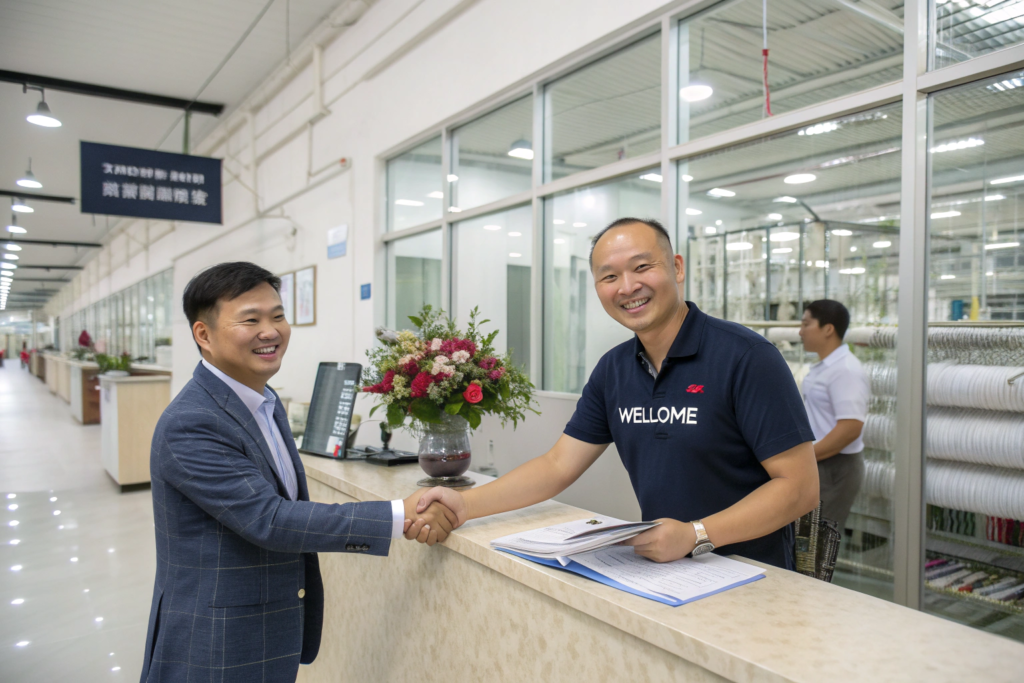
What Is The Best Season To Tour A Fabric Production Line?
Timing your visit is critical. If you arrive during Chinese New Year, you will see an empty factory. The entire country shuts down for two to three weeks, usually between late January and mid-February. Do not book your trip during this period. The machines are silent, the workers are home with their families, and there is nothing to audit.
The best seasons for a meaningful factory tour are March through May and September through November. During these months, production is running at full capacity. You will see the looms spinning at 700 RPM, the dyeing vats steaming, and the inspection tables piled high with finished rolls. The energy on the floor is tangible. However, you must give me advance notice of at least three weeks during peak season. My production schedule is tight, and I need to reserve time for a proper walkthrough, not a rushed five-minute stroll. I also recommend arriving on a Tuesday or Wednesday. Monday is often catch-up day from the weekend, and Friday afternoons can see early shift changes. Mid-week gives you the most representative view of our operations. If you are serious about the visit, you should consult a practical guide to planning a textile factory sourcing trip to Shaoxing Keqiao China for international buyers. It covers visa tips, local hotel recommendations, and cultural etiquette that makes the trip smoother.
Do I Need A Visa To Visit A Textile Factory In China?
Yes, most foreign nationals require a visa to enter mainland China. You will typically apply for an M visa, which is the business visa category. This visa requires an invitation letter from the company you are visiting. We provide this letter as a standard service for confirmed clients. The letter includes our company registration number, your passport details, the dates of your visit, and the address of our facility.
The visa process in the U.S. takes about one to two weeks through the Chinese embassy or consulate. You apply online via the COVA form, print the confirmation, and submit it with your passport and our invitation letter. Some consulates may also request a flight itinerary and hotel booking. I strongly recommend applying at least a month before your intended travel date to account for any administrative delays. The 10-year multiple-entry M visa is now standard for U.S. citizens, so the investment in getting the visa pays off for future trips. If you already hold a valid Chinese visa, confirm that it is still within its validity window and that the number of entries is not exhausted. A single misunderstanding about your visa status can cancel a trip that took months to schedule. It is also wise to check the latest US citizen business visa application requirements for visiting textile suppliers in China, because policies shift and you want the most current intel.
What Should I Look For On A Weaving Factory Floor
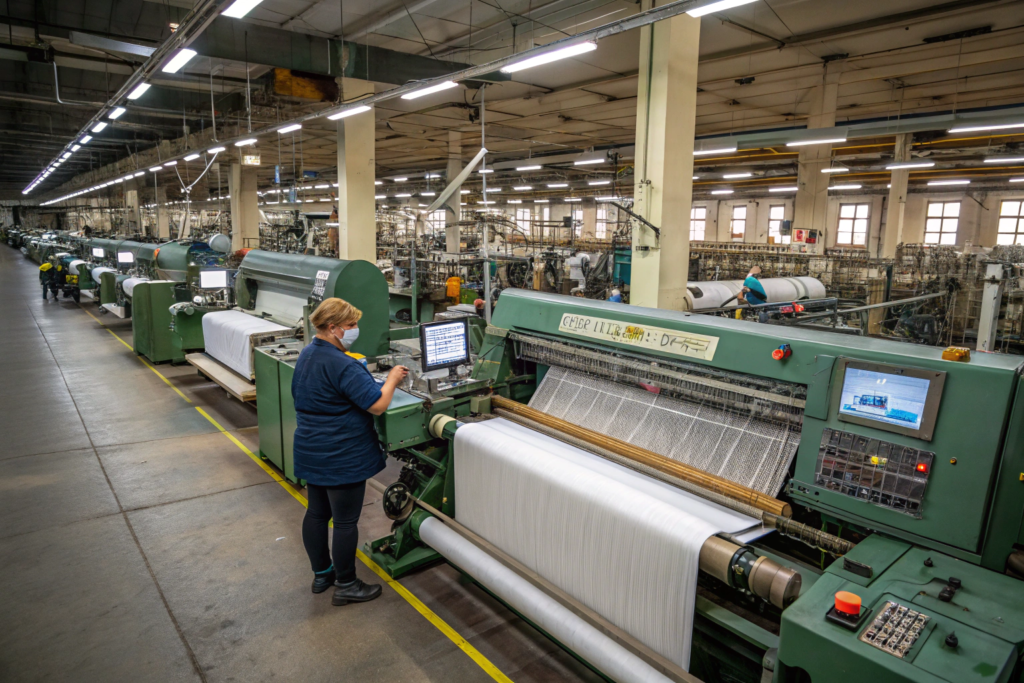
The weaving floor is the heart of the operation. When you walk through my workshop, I want you to look past the noise and the motion and focus on a few specific indicators that separate a world-class mill from a struggling one. Do not be distracted by a friendly guide handing you a cup of tea. Look at the machines. Look at the floor. Look at the digital displays. These things cannot be faked for a one-hour tour.
How Can I Tell If A Loom Is Running Efficiently?
The easiest metric to check is the loom speed displayed on the digital control panel. A modern air-jet loom weaving a standard 21s cotton-linen blend should run at a minimum of 600 to 700 RPM. If you see looms running at 400 RPM, the factory is slowing them down to compensate for cheap, inconsistent yarn that breaks constantly. They are sacrificing output to hide bad raw materials.
Second, watch the red stop lights. Every loom has an indicator lamp. A green light means the loom is running. A flashing red light means a warp yarn broke and the machine stopped. A solid red light means a weft insertion failure. In a well-run mill, less than 5% of the looms should be in a stopped state at any given moment. If you see a sea of flashing red lights, the weaving team cannot keep up with the repairs, or the yarn quality is terrible. Walk the entire aisle. Count the stops. This is data, not opinion. Also, look at the selvedge of the fabric coming off the loom. A clean, straight edge with evenly spaced leno threads indicates proper machine tension. A wavy, uneven, or frayed selvedge signals tension problems that will cause cutting waste in your garment factory later. For a deeper understanding, I recommend reading about how to assess air-jet loom efficiency and stop rates during a textile mill audit. It teaches you to read the machines like a production manager.
Why Does Factory Organization Affect Your Fabric Quality?
A messy factory produces messy fabric. This is an absolute law of textile manufacturing. When you walk through my facility, notice the floor. Is it clean and swept? Are there oil stains? Linen and cotton fibers create dust. If the factory does not have a central vacuum system and a disciplined cleaning schedule, that fiber dust settles on the machinery. It mixes with the lubricating oil on the loom harnesses and forms a sticky black grime. This grime eventually drops onto the fabric, creating a contamination spot that is almost impossible to remove in finishing.
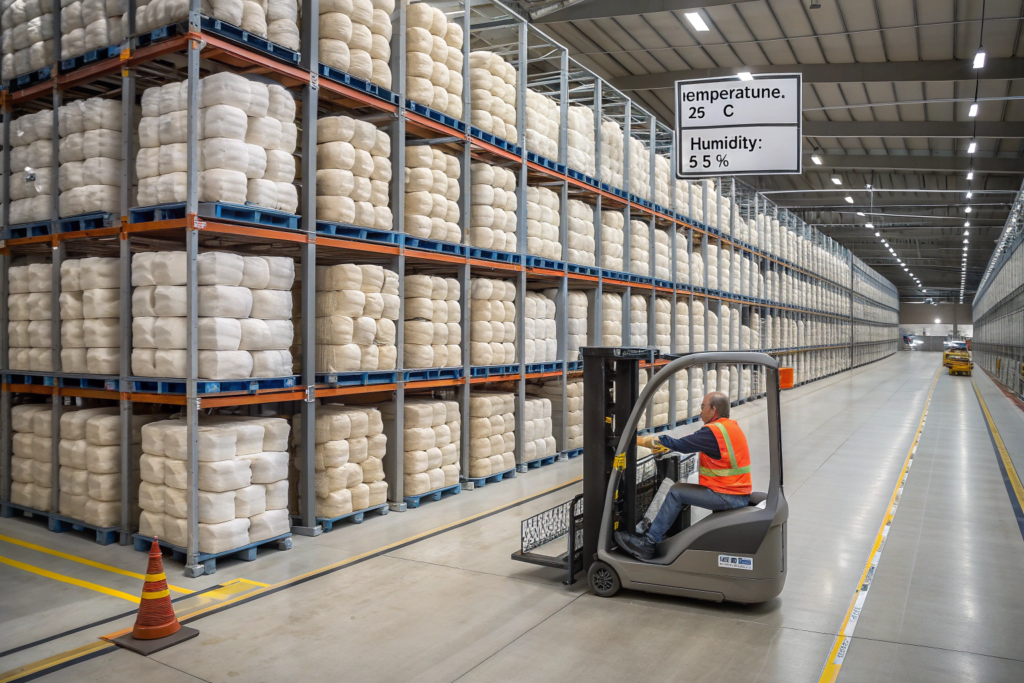
Look for the material handling system. In a disorganized mill, woven rolls of greige fabric are stacked directly on the floor. They collect dirt. Forklifts run over the edges. In our facility, every roll is sleeved in plastic and stored on a designated rack with a barcode label. The organization extends to the yarn inventory. Ask to see the yarn warehouse. The cones should be stored in a climate-controlled room, not a humid outdoor shed. Cotton and linen absorb moisture. If the yarn sits in a damp environment, the moisture swells the fiber, the weaving efficiency drops, and you get shade variation in the dye bath. Our yarn store is temperature and humidity controlled to 25°C and 55% relative humidity year-round. I pay extra for that control, but it eliminates the batch-to-batch color drift that plagues cheaper mills. You can learn more by exploring why factory organization and housekeeping in a textile mill directly correlate with export-grade fabric consistency. A clean factory is a predictable factory.
How Does The In-House Lab Verify Fabric Quality
After the weaving floor, the lab is the most important stop on your tour. This is where we prove that our words match our numbers. Our CNAS-accredited laboratory is not a showroom. It is a working testing facility that runs 50 to 80 tests per day on active production batches. When you step inside, you should see technicians actively operating equipment, not sitting on their phones. Ask to see the day’s test log. If it is blank or the ink looks fresh on every page, they cleaned up for your arrival. A real lab has a messy, ongoing history.
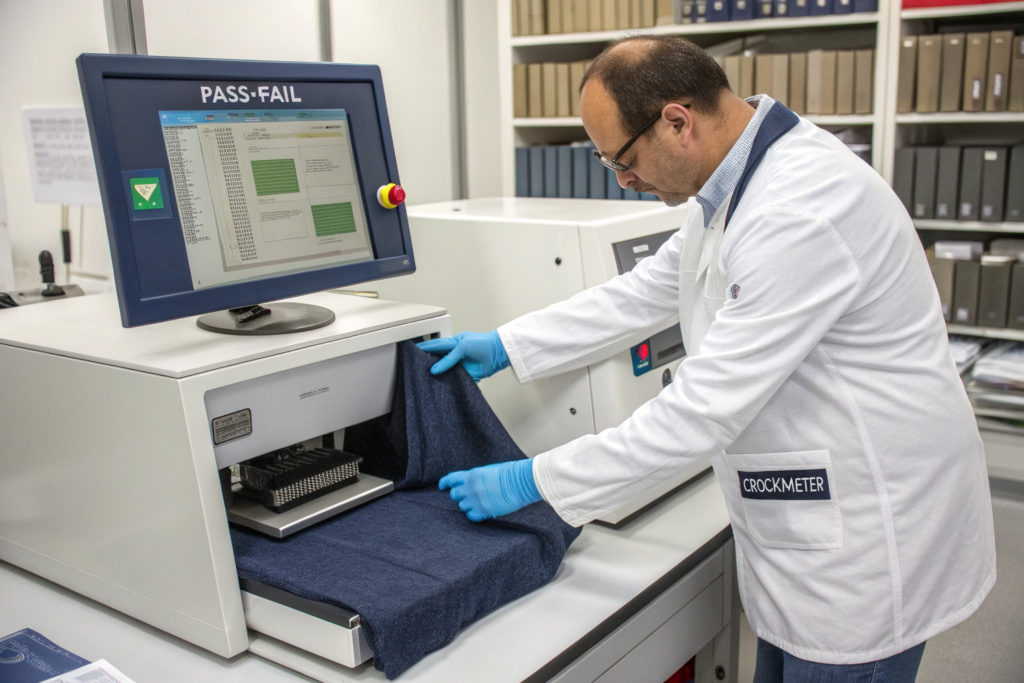
What Testing Machines Should A Good Lab Have?
You should see specific, recognizable machines. A universal tensile strength tester, often branded by Instron or a Chinese equivalent like Wance, pulls a strip of fabric until it breaks. This measures the force in Newtons required to tear your blazer. A Martindale abrasion tester rubs the fabric in a circular Lissajous pattern until it wears through, giving you the rub count for upholstery applications. A Crockmeter tests colorfastness to rubbing with a mechanical finger. A lightfastness tester, usually a Xenon arc lamp chamber, blasts the fabric with artificial sunlight for hours and measures the fade.
If a lab lacks a spectrophotometer for color matching, you are not in a quality-controlled facility. The spectrophotometer, typically an X-Rite or Datacolor device, reads the exact spectral reflectance of a dyed swatch and compares it to the standard. It outputs a Delta E value. A Delta E of less than 1.0 means the color is indistinguishable to the human eye. A Delta E of 2.0 is a visible shade difference. We reject any dye lot with a Delta E above 1.5 for solid colors. This is not subjective. This is physics measured by a machine. You cannot manage a bulk order of 10,000 yards without this equipment. For a complete checklist, you can review the essential fabric testing laboratory equipment list for verifying export quality woven cotton textiles. If you do not see these machines, the "QC report" you receive is a work of fiction.
Can I Bring My Own Fabric Sample For A Spot Test?
Yes, and I encourage you to do this. Bring a swatch from a competitor, or bring a reference standard from your previous production that you know performs well. During your lab tour, ask the technician to run a quick comparison test. A rub fastness test takes about ten minutes. A tensile test takes even less.
If I am confident in my lab’s capability, I will welcome this challenge. A supplier who refuses a live spot test on a visitor’s sample is hiding something. The machine does not lie. The Crockmeter does not care about our relationship. It just rubs the fabric and shows the stain on the white cloth. When you bring your own sample, you remove the possibility of a staged demonstration with a pre-selected "ringer" swatch. You control the variable. This is the single most powerful thing you can do during a factory visit. It transforms the tour from a passive viewing into an active verification. I have had buyers pull out a Ziploc bag with a competitor’s linen from their pocket and ask me to beat it on the tensile tester. Sometimes we win. Sometimes we learn what we need to improve. Either way, the data is real. That is how a partnership begins. Understanding how to conduct a live spot test on your own reference sample during a textile supplier factory visit gives you the confidence to walk into any mill and demand proof.
Why Should I Inspect The Raw Cotton And Linen Storage
The finished fabric is only as good as the raw fiber that entered the factory six weeks earlier. Most buyers never ask to see the yarn warehouse. They focus on the shiny looms and the finished goods showroom. But the yarn warehouse tells you the truth about a mill’s financial health and technical standards. If the raw material is disorganized, damp, and unlabeled, the finished fabric will be inconsistent. Guaranteed.
How Should Cotton Yarn Be Stored Before Weaving?
Cotton yarn is hydroscopic. It breathes with the air. If you store it in a warehouse with open windows and no climate control, the yarn absorbs moisture on a humid day and releases it on a dry day. This changes the yarn’s diameter and strength hour by hour. A cone of yarn that swelled overnight will weave differently at 8 AM than at 2 PM. You get warp streaks—visible lines running the length of the fabric where the yarn tension varied.
Proper storage requires a sealed environment with HVAC control. The temperature must be stable, ideally between 22°C and 26°C. The relative humidity must sit between 50% and 60%. This is the equilibrium moisture content zone for cellulose fibers. In this zone, the yarn is dimensionally stable. Our warehouse has a continuous monitoring system with sensors that log data every 15 minutes. If the humidity drifts outside the range, an alarm triggers, and the HVAC system adjusts automatically. I also insist on first-in, first-out (FIFO) inventory rotation. The older yarn lots are used before the newly delivered ones to prevent age-related yellowing. A disorganized warehouse mixes old and new lots, creating unpredictable dye uptake variation. Ask to see the lot number labels on the yarn shelves. Cross-reference a few lot numbers with the production schedule. If the system is real, the numbers should trace back to specific purchase orders. For a full picture, research the standard climate control requirements for storing cotton and linen yarn in textile manufacturing. A mill that skimps on this will never produce export-grade fabric consistently.
What Does The Raw Flax Quality Tell Me About The Linen?
Linen starts as a stalk of flax, not a fluffy boll like cotton. The retting process—where the woody stalk is rotted away to release the fiber—determines the color and strength of the linen. When you visit, ask to see a small bundle of raw flax fiber. It should be a pale, creamy blonde color. If it is gray, dark brown, or has black spots, the flax was over-retted in the field. Over-retted flax produces weak fiber with a dull, dead color that requires heavy bleaching to look presentable.
Feel the raw fiber. High-quality flax has a silky, cool touch and a natural sheen. Low-quality flax feels rough, straw-like, and brittle. Break a fiber bundle by hand. Good flax snaps with a clean, crisp sound and shows a fibrous, hairy break point. Over-retted flax tears like wet paper with almost no resistance. This raw material quality directly translates to the hand feel of your finished fabric. A heavy bleach can hide the color defect of over-retted flax, but it cannot restore the lost tensile strength. That linen blazer will rip at the elbow after one season. During your tour, hold the raw flax in your hands and then walk to the finished goods showroom and touch the final fabric. The connection between those two sensations should tell a consistent story of quality. You should also understand how to visually assess the retting quality of raw flax fiber before it enters the spinning process. It arms you with the knowledge to judge input quality at the source, not just output quality at the finished roll.
Conclusion
A factory visit to Shanghai Fumao is not a sales pitch. It is a physical verification of every claim I make on my website and in my emails. You will walk the weaving floor and count the red stop lights on the looms. You will step into the CNAS lab and ask the technician to test your own competitor’s swatch on the Crockmeter. You will inspect the raw yarn warehouse and check the humidity log on the sensor. You will hold a bundle of raw flax and judge its color and snap. And after a few hours, you will know with certainty whether we are the right partner for your cotton linen program. I want you to leave our facility with data, not just a handshake and a souvenir fabric card.
Book your trip. Plan for a Tuesday arrival in April or October. Send Elaine your passport details, and she will issue the business invitation letter for your M visa within 48 hours. She will also help you arrange a hotel near our facility and a driver to pick you up from Hangzhou airport or Shaoxing North station. Come with a Ziploc bag of your competitor’s best fabric and a list of questions. I will have the lab ready and the production schedule cleared. Email elaine@fumaoclothing.com with the subject line "Factory Visit Request" and your preferred travel dates. Let us turn a digital relationship into a physical partnership, one loom at a time.








