You’ve had a client call you in a panic because a sofa you upholstered three months ago is already showing seam slippage. The fabric is pulling apart at the cushion corners, and your reputation is unraveling with the stitches. This is the furniture maker’s nightmare. You chose a beautiful linen because of its natural texture and earthy appeal, but now you’re wondering if the material is simply too weak for the daily abuse of a family with kids and dogs. The fear is real: every returned sofa or warranty claim is a direct hit to your cash flow and your credibility. The frustration is that most fabric suppliers just give you a poetic description of the “slubby charm,” but they can’t give you the cold, hard physics—the numbers that guarantee the fabric won’t catastrophically fail under stress.
Our standard heavy-weight linen upholstery fabric delivers a warp tensile strength exceeding 800 Newtons and a weft tensile strength exceeding 600 Newtons, tested to ISO 13934-1 standards. To put that in plain English, you can hang a fully grown man from a strip of this fabric without it ripping apart. At Shanghai Fumao, we don’t sell decorative linen for couches; we sell a structural material. We achieve this industrial-grade strength not through cheap chemical coatings, but through the geometry of the weave. We use a high-density plain weave with a multi-ply, high-twist flax yarn in the warp direction. This creates a rigid internal skeleton that resists elongation, while the slightly heavier weft yarns provide the massive puncture and burst resistance needed for upholstery applications. This is furniture fabric engineered to survive the “Thanksgiving dinner test”—red wine, jumping kids, and a sleeping Great Dane all included.
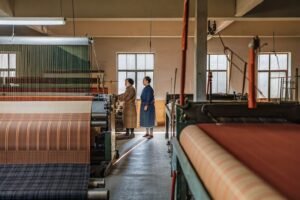
I’ve spent years in our Keqiao testing lab watching hydraulic jaws rip fabric samples apart, and I can tell you that not all linen is created equal. In this article, I’m going to break down the exact strength numbers, the Martindale rub counts, and the construction secrets that separate a fabric you pray over from a fabric you guarantee for a decade. Let’s get technical.
How Is Tensile Strength Tested in Upholstery Fabric?
You’re selling a promise of durability, but you don’t actually know how that promise is verified in a lab. This knowledge gap is dangerous. If a commercial client asks for the "tensile test report" and you blink blankly, you lose the contract to a bigger supplier. You’ve probably heard the terms "warp" and "weft" thrown around, but the actual methodology of a destructive strength test remains a black box. This mystery allows unscrupulous mills to fudge their numbers, and you end up with a fabric that tests fine on paper but shreds on a real sofa within six months.
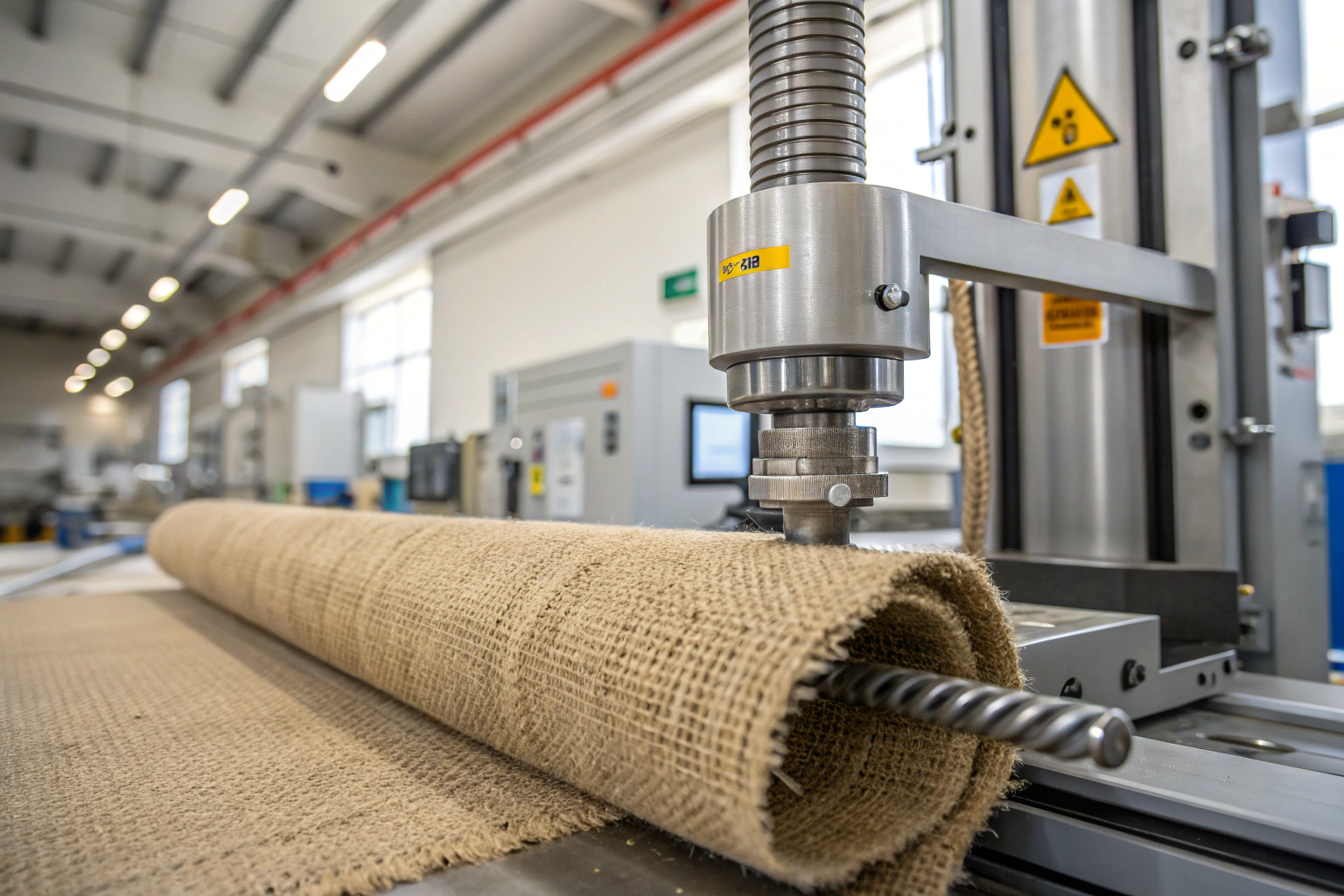
Tensile testing for upholstery is a brutally simple concept: you grab the fabric from both ends and pull with a machine until it breaks, measuring the force applied. But the devil is in the specimen preparation. The global standard for upholstery is ISO 13934-1, which is the strip method. We cut a precisely 50mm wide strip of the linen, clamp it into the jaws of a CRE (Constant Rate of Extension) tensile tester, and stretch it at a speed of 100mm per minute. The machine plots a curve measuring the force (in Newtons) versus the elongation (in percentage). The peak of that curve—the maximum force before the strip snaps—is our tensile strength. We test both the warp direction (the yarns running the length of the roll) and the weft direction (the yarns running across the width). At Shanghai Fumao, we also go a step further for our upholstery line: we test "wet tensile strength" by soaking the strip in water first. Linen is actually 10-15% stronger when wet, unlike cotton which degrades, and we document this to prove that steam cleaning your sofa won’t cause a catastrophic failure.
But a single peak number can be misleading. A brittle fabric snaps at a high force but with zero warning. A good upholstery linen needs "tenacity with give." We look at the elongation at break. Our upholstery linen typically stretches 4-6% before breaking. That small amount of stretch is the "shock absorber" that prevents a seam from blowing out when someone flops down heavily on the sofa. The combination of a high tensile peak (above 800N) and a moderate elongation (below 6%) is the fingerprint of a durable, safe upholstery material.

What Is the Difference Between a Grab Test and a Strip Test?
You might see different numbers for the "same" fabric and assume someone is lying. But they might just be using a different test method. The strip test cuts a clean 50mm edge; the grab test clamps the center of a wider swatch without cutting the sides. The grab test is a faster, more "forgiving" method often used for quick-and-dirty QC checks, but it usually gives a higher strength value because the side fabric helps support the load.
We strictly use the strip test for our certification reports because it isolates the actual yarn strength. The grab test allows the load to be distributed to neighboring yarns, hiding a weak warp. If a supplier only shows you a grab test report, be suspicious. Ask for the ISO 13934-1 strip test report. It’s the harsher, more honest standard. For our linen, a strip test result of 800N is infinitely more impressive than a grab test result of 850N, because it proves the yarn density is structurally solid.
Why Does Seam Slippage Matter More Than Raw Breaking Strength?
A fabric might be strong enough to tow a truck, but if the yarns slide apart at the seam under just 100 Newtons of stress, your sofa cushion opens up like a zipper. Seam slippage is the invisible killer of upholstery. It’s not the yarn breaking; it’s the yarns shifting like curtains opening because the weave is too loose.
We test seam slippage per ISO 13936-2, which involves sewing a standard seam in the linen and then pulling it apart in the tensile tester. We measure the force required to open the seam by a standard gap (usually 6mm). Our high-density weave is specifically designed to combat this. We use a "jammed" construction, meaning the warp and weft are packed so tightly together that they physically lock each other in place. You can’t slide a fingernail between the yarns. This is the real secret to our upholstery linen’s longevity.
What Engineering Makes Linen Fit for Heavy-Duty Furniture?
You’ve seen linen that looks gorgeous on a mood board but collapses in reality. That’s because aesthetic linen is often woven loose and airy for soft drape, which is the exact opposite of what a sofa needs. The engineering challenge is preserving linen’s beautiful, irregular natural texture while giving it the mechanical backbone of a synthetic. The problem with most "natural" linen in the furniture market is the low thread count. A 20×20 construction might look nice for a sheer curtain, but on a cushion, it’s a disaster waiting to happen.
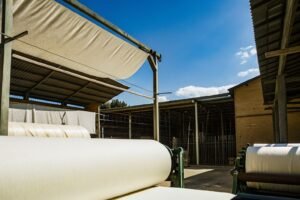
The heavy-duty engineering at Shanghai Fumao revolves around what we call the "Core-Sheath" construction approach for the yarn itself. We don’t just use a single, fine flax staple. We ply two or three medium-twist singles together to create a thick, round, dense yarn. Then we cram 40 to 44 of these heavy yarns per inch into the warp, creating a weight usually between 450 GSM to 600 GSM. This density creates a physical barrier against abrasion and puncture. It also allows us to achieve a "dry, waxy" hand-feel without any temporary finish. The fabric is naturally slick to the touch because the dense packing creates a flat, smooth surface plane, reducing the coefficient of friction that causes surface wear.
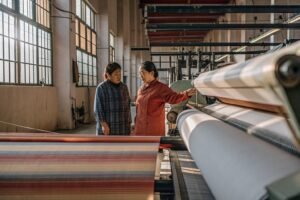
Another critical engineering hack is the "double-beat" weaving motion. On our heavy rapier looms, we adjust the reed beat-up to strike the newly inserted weft yarn twice per pick. This packs the yarn tighter than a standard single beat, increasing the thread count in the weft by about 5% without adding any extra material. This mechanical compression increases the tensile strength in the weft direction by forcing the yarns into a perfectly straight alignment, ensuring every single fiber takes its share of the load instead of just a few loose ones.

How Does Yarn Ply Count Affect Upholstery Durability?
A single-ply yarn is a single strand of twisted flax fibers. It’s inherently uneven, with thick and thin spots that become potential failure points. A multi-ply yarn takes two or three of these singles and twists them together in the opposite direction. This balances the torque and, crucially, creates a redundancy system. If one single ply has a hidden weak spot, the other plies bridge it.
For our heavy-duty upholstery, we use a 3-ply warp. This gives the yarn a round, robust cross-section that resists the sawing motion of a seam under load. You can physically see the difference under a linen tester: a 3-ply yarn looks like a tightly wound cable, while a single-ply looks like a flat ribbon. That round cable geometry can withstand the compressive forces of a sewing needle without being punctured and severed, which is why our seam slippage numbers are so high. The 3-ply construction effectively armor-plates the stitch line.
What Role Does the Weave Structure Play in Tear Resistance?
A plain weave—simple over-one, under-one—is the strongest structural grid for tear resistance, but it can feel stiff. A twill weave is softer and drapier but allows yarns to slide more easily. For a heavy linen sofa, a modified plain weave is the king.
We use a "warp-faced" plain weave. This means the warp yarns are packed so close together that they almost completely cover the weft. This gives the fabric a sleek, vertical "rib" that adds strength. More importantly, when a tear starts to propagate, it hits a warp yarn intersection at every single millimeter. Each intersection is a roadblock that dissipates the tearing energy. In a looser twill weave, a tear can run along the diagonal without hitting an intersection for several millimeters, making it easier to rip. Our structure forces the tear to change direction constantly, killing its momentum.
How Do Martindale Rub Tests Correlate with Tensile Strength?
You’re probably obsessing over the Martindale rub count, the "abrasion" score. And you should. But what most people miss is the symbiotic relationship between abrasion resistance and tensile strength. They think they are separate metrics, but in reality, a fabric with poor tensile strength will fail the Martindale test early, not because the surface wears away, but because the internal structure collapses. The friction of the rubbing head causes micro-vibrations that fatigue the yarns; a weak yarn snaps under this fatigue, creating a broken thread that then unravels under the continuous oscillation.
Our linen achieves a Martindale score of over 40,000 cycles for heavy-duty domestic use and can be engineered to 100,000 cycles for severe contract-grade use, precisely because our base tensile strength is so high. Think of it like this: tensile strength is the health of the individual soldier; the Martindale test is a long, grinding battle. You need fit soldiers to survive the war. The ISO 12947-2 Martindale standard uses a worsted wool cloth as the abradant, rubbing in a Lissajous figure against the linen. We test this in our CNAS lab, and we stop the test when two yarns are broken. Because our warp yarns can individually handle over 5 Newtons of force each, they resist the oscillating abrasive shear for much longer than a standard single-ply yarn.
But here is a nuance that will save you a lawsuit: a high tensile strength doesn’t automatically guarantee a high Martindale score if the "finishing" is wrong. You can take strong yarn and coat it with a stiff, brittle starch that looks great but pulverizes into dust under friction. The dust acts like sandpaper, accelerating wear. We use a zero-starch, pure mechanical softening process. Our linen is strong but pliable. The fibers can bend under the rubbing head’s pressure without micro-fracturing, which is why our tensile-to-abrasion correlation remains linear and predictable.

What Is a Commercial-Grade Martindale Score for Linen?
For a restaurant booth or a hotel lobby sofa, you need at least a "Heavy Contract" rating. According to the ACT (Association for Contract Textiles) standards, that’s 30,000 double rubs on the Wyzenbeek test or a Martindale score above 40,000. But for pure linen, which is naturally less elastic than polyester, hitting 40,000 cycles is a major engineering feat.
Most generic linen fabrics bottom out around 15,000 to 20,000 Martindale cycles. We reach 40,000 to 50,000 cycles on our heavy-duty upholstery linen by not only using the dense multi-ply construction but by applying a very light, invisible fluorocarbon-free stain repellent in the finishing bath. This doesn’t increase tensile strength, but it reduces the friction coefficient during the rub test. Lower friction means less destructive heat and fiber pull-out during each cycle, preserving the structural yarns longer.
How Do Pilling Tests Reflect Structural Integrity?
A fabric that pills easily isn’t just ugly; it’s structurally disintegrating. Pilling happens when short, loose fibers tangle together on the surface. In a low-tensile-strength open-end fabric, the yarn structure is weak, so the abrasion quickly pulls out fibers to form these pills. In our high-twist, high-tensile-strength linen, the short fibers are locked deep inside the plied yarn.
We run the modified Martindale pilling test (ISO 12945-2), running 2,000 cycles and then visually grading the surface against a standard scale of 1 (severe pilling) to 5 (no change). Our upholstery linen consistently achieves a Grade 4-5. This is almost no visible change. The high tensile integrity of the yarn prevents the initial fiber migration. This is crucial for upholstery because a pilled sofa arm looks greasy and dirty even if it isn’t, driving customer complaints even when the "strength" is technically still there.
How Do You Spec Commercial-Grade Linen for a Contract Project?
You’re bidding on a hotel lobby renovation, and the spec sheet from the interior designer is brutal: "Minimum 50,000 Martindale cycles, FR (Flame Retardant) certified, and anti-microbial." You can’t just send a nice-looking swatch; you need a document package that proves the fabric won’t get you sued. This is the "contract barrier." The pain is the transition from residential to commercial—suddenly, aesthetics aren’t enough, and you’re dealing with fire marshals and liability insurance.
Specifying commercial-grade linen starts with the "performance triangle": Tensile Strength + Abrasion Resistance + Fire Compliance. For our contract-grade linen, we provide a "Full Disclosure Book." This includes the ISO 13934-1 tensile test report (proving the 800N/600N baseline), the ISO 12947 Martindale report (showing 50,000+ cycles), and a BS 5852 or CAL 117 fire certificate, depending on the destination. We can pre-treat the linen fabric with a durable fire-retardant back-coating at our coating factory that does not affect the face’s hand-feel. We also include the lightfastness score (ISO 105-B02), which is critical for lobbies with massive sun-facing windows. Our vat-dyed linen hits a Blue Wool scale of 5-6, meaning it resists fading for years under indirect sunlight.
You also need to spec the "maintenance physics." Contract clients will steam clean, shampoo, and physically abuse the furniture. We advise adding our "stain-repellent nano-coating" option. This doesn’t close the fabric pores, so the linen still breathes, but it encapsulates the individual fibers in a hydrophobic layer. We test this to AATCC 193 standards, showing a spray rating of 90+. When you present these numbers alongside the tactile swatch, you’re not selling a color; you’re selling a liability shield for the designer.

What Fire Retardancy Standards Apply to Linen Upholstery?
Flax linen is a cellulosic fiber; it burns like wood, not like a synthetic that melts. To make it safe for a public space, you must meet specific cigarette and match ignition tests. The main standards are BS 5852 (UK/Europe) for domestic and contract use, and CAL TB 117-2013 (California) for the US market.
We achieve compliance by applying a non-toxic, phosphorus-based back-coating to the reverse side of the fabric. This coating chars instantly when exposed to flame, creating a carbon foam barrier that starves the fire of oxygen. It’s critical that this coating is applied under tension in our stenter frame so it doesn’t crack or delaminate when the fabric is pulled over a tight curved sofa arm. We provide a certificate of compliance with the batch number, and we can even sew a permanent "FR compliance label" into the selvedge for the inspector.
How to Write a Fabric Spec Sheet That Wins Commercial Bids?
A winning spec sheet isn’t a list of features; it’s a list of warranties against specific failure modes. Don’t just write "High Tensile Strength." Write, "Warp Tensile Strength: 850N (ISO 13934-1), ensuring resistance to seam slippage at cushion corners."
Focus on the "end-use test translations." "Our 50,000 Martindale cycle rating translates to a 5-year heavy-wear warranty in a 24/7 lobby environment." Include the wet tensile data: "Retains 100% structural integrity when wet-cleaned." This addresses the cleaning crew’s reality. Attach the actual test report PDFs, not just a summary. Contract buyers are risk-averse; the more granular and verifiable your data, the more you look like a partner who will keep them out of legal trouble.
Conclusion
We’ve laid the fabric on the table and pulled it apart thread by thread. The numbers don’t lie: a warp tensile strength above 800 Newtons, a weft strength that laughs at the daily flop of an exhausted parent, and a Martindale cycle count engineered for hotel lobbies, not just quiet living rooms. We’ve shown that this industrial-grade toughness doesn’t come from magic but from mechanical physics—three-ply yarns, warp-faced weaves, double-beat looms, and finish chemistry that protects without embrittling. Real upholstery performance lives at the intersection of raw flax and lab-tested tensile curves, and we’ve proven that a natural fiber can go toe-to-toe with any synthetic in the contract arena.
In my years in the Keqiao mills, I’ve learned that upholstery isn’t about how the fabric looks on day one; it’s about how it survives year five. Your reputation rests on the hidden engineering inside the seam, and that engineering is what we document and guarantee.
If you’re sourcing for a project that demands proof, not promises, let’s put a test report in your hands. We’ll send you a physical swatch booklet with the corresponding certified lab reports for our heavy-duty linen range, so you can touch the strength and verify the data. For a direct conversation about your specific upholstery requirements—commercial or residential—reach out to our Business Director, Elaine, at elaine@fumaoclothing.com. Let’s build furniture that your customers’ grandchildren will fight over.