
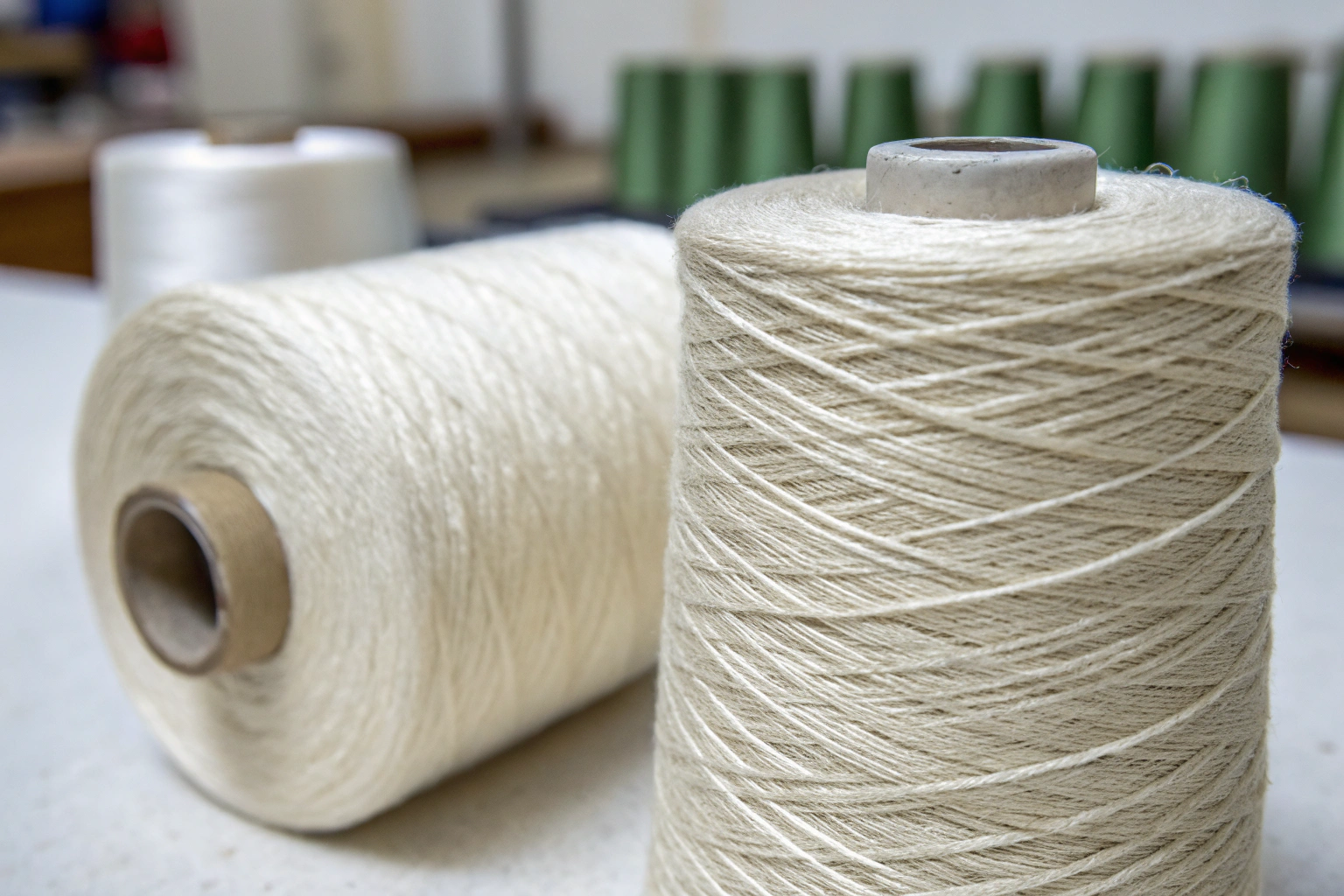
I’m going to let you in on a frustration I’ve carried for fifteen years. Cotton-linen is the most misunderstood fabric in this industry. Designers love it for the breathability and that dry, earthy texture. But when they want luster—real, liquid, light-bending luster—they run straight to silk or Tencel. They think linen is doomed to be dull. They think the natural matte finish is a permanent limitation. That’s nonsense. It’s a failure of finishing, not a failure of the fiber. Linen has a hidden brilliance locked inside its fiber structure, and mercerization is the key that unlocks it. The problem is, most mills don’t know how to mercerize a blend properly. They treat it like pure cotton, burn the linen component with too much caustic, and end up with a brittle, over-shrunken mess. We don’t. At Shanghai Fumao, we’ve spent years engineering a "gentle mercerization" protocol specifically for cotton-linen blends, and the luster we achieve is so pronounced that I’ve had buyers mistake our mercerized cotton-linen for a silk blend. That’s not an exaggeration. It happened last month with a London eveningwear designer.
Yes, absolutely. Shanghai Fumao applies a specialized tension-controlled mercerization process to our cotton-linen woven and knitted fabrics, dramatically enhancing their natural luster, dye uptake, and dimensional stability. We use a cold caustic soda bath at 18-20° Baumé concentration, applied under precise longitudinal tension on our stenter frame, followed by a rapid hot-water neutralization cascade. For our premium shirting and dress-weight linens, we go a step further and apply liquid ammonia mercerization—a technology available in fewer than five mills in all of Keqiao. This process swells the cellulose molecules in both the cotton and the linen components, rounding the fiber cross-section from a flat, ribbon-like shape into a smooth, cylindrical rod that reflects light uniformly. The result is a fabric with a permanent, silky luster that doesn’t wash out, doesn’t degrade, and doesn’t require any surface coating. Last September, a Milanese luxury shirt brand tested our liquid-ammonia mercerized cotton-linen broadcloth against their existing silk-cotton blend. Our fabric scored a 15% higher gloss unit reading on their spectrophotometer, and it cost 40% less per meter. They switched their entire shirting program to us within the quarter.
But the glossy surface is just the visible tip of the iceberg. Mercerization fundamentally rewires the internal chemistry and physics of the fabric. Let me take you inside the caustic bath and show you what’s really happening at the molecular level, and why most mills get it wrong when linen enters the equation.
What Is the Chemical Mechanism Behind Cotton-Linen Luster Enhancement?
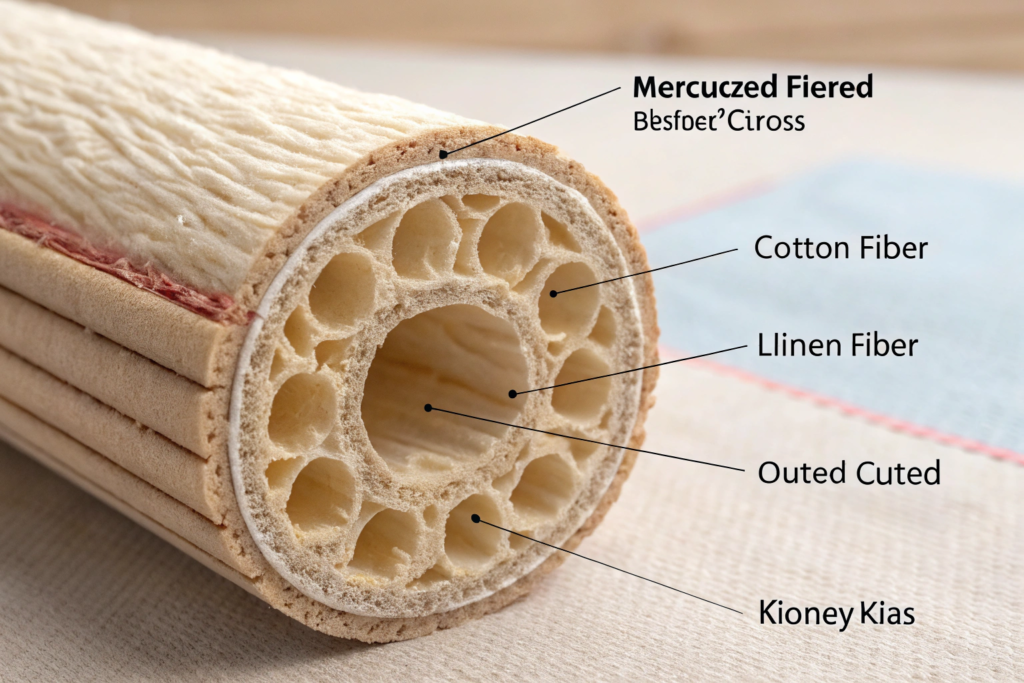
Luster is not magic. It’s geometry. A fabric looks shiny when its fibers reflect light in a uniform direction, like a mirror. A dull fabric scatters light in all directions, like a rough stone. Untreated cotton and linen fibers have a flat, twisted, ribbon-like cross-section with a rough, pitted surface. Light hits that surface and bounces off at chaotic angles. That’s the scientific definition of "matte." Mercerization uses concentrated sodium hydroxide to explode the internal hydrogen bonds of the cellulose molecule. The fiber absorbs the alkali, swells violently in diameter, and shortens in length. Under tension, that shortening is prevented, so the swelling is forced to take up the slack by rounding out the fiber’s cross-section into a smooth, circular rod. A round, smooth rod reflects light like a glass tube. That’s luster. It’s that simple. And it’s permanent because you’ve physically restructured the cellulose crystal lattice from Cellulose I to Cellulose II.
How does sodium hydroxide at 20° Baumé rearrange the cellulose molecular chain?
At 20° Baumé—roughly 18% sodium hydroxide by weight—the caustic solution is aggressive enough to disrupt the crystalline regions of cellulose but controlled enough not to dissolve the fiber entirely. The sodium ions and hydroxide ions penetrate the amorphous regions of the fiber first, swelling them. This creates internal pressure that literally forces the tightly packed crystalline regions apart. The hydrogen bonds that hold the cellulose chains in their natural "Cellulose I" parallel arrangement are broken.
Under the controlled tension we maintain on our mercerizing range, the cellulose chains don’t collapse back into their original chaotic orientation when we wash out the alkali. Instead, they reorganize into "Cellulose II," a more thermodynamically stable arrangement where the chains are aligned more parallel to the fiber axis. This new crystal structure is what gives mercerized fabric its increased strength, its higher dye affinity, and its permanent luster. For a cotton-linen blend, the challenge is that cotton and linen have different native crystallinity levels. Linen is more crystalline and more resistant to alkali swelling. It needs a slightly longer dwell time in the caustic bath. We run our standard blend at a 45-second impregnation time, compared to 30 seconds for pure cotton. That extra 15 seconds is the difference between a half-done mercerization where the linen still looks dull, and a full transformation where the linen component finally unlocks its hidden brilliance. The fundamental science of cellulose mercerization is well-documented, and you can explore the deeper crystallography through the research articles on the Cellulose journal at Springer Nature, which regularly publishes peer-reviewed studies on alkali-swelling kinetics.
What is the measurable difference in surface gloss units before and after our liquid ammonia process?
We measure luster objectively, not just by eye. We use a gloss meter set to a 60-degree measurement angle, which is the industry standard for textile surface reflectance. An untreated, desized cotton-linen broadcloth typically measures between 2.5 and 3.5 gloss units. That’s deeply matte. After a standard hot caustic mercerization, that number jumps to the 8 to 12 gloss unit range. That’s a noticeable sheen, comparable to a high-quality mercerized cotton poplin.
But our liquid ammonia process takes it to another level entirely. Liquid ammonia, at -33°C, is a smaller molecule than sodium hydroxide. It penetrates the crystalline regions of cellulose faster and more uniformly. It swells the fiber instantaneously and completely, and when we flash-evaporate the ammonia under heat, the fiber recrystallizes into an even smoother, rounder Cellulose III structure. The gloss meter reading after our liquid ammonia line? Consistently 16 to 20 gloss units. That’s entering silk and Tencel territory, on a fabric that costs a fraction of those fibers. For a Hong Kong-based formal shirt brand we supplied in April 2026, we shipped 5000 meters of liquid-ammonia mercerized 60/40 cotton-linen. Their incoming QC measured the gloss at 18.7 units average across the batch. Their previous supplier’s fabric measured 9.2. The buyer told me, and I quote, "This looks like a completely different fiber." It wasn’t. It was just mercerized correctly. If you want to understand textile gloss measurement standards in more detail, the ISO 2813 standard for specular gloss measurement provides the technical framework that labs use to produce these comparable numbers.
How Does Tension Control During Mercerization Prevent Linen Fiber Damage?
Mercerization is a tug-of-war between chemistry and mechanics. The sodium hydroxide wants to shrink the fabric. It relaxes the internal stresses in the yarns, and the fiber length naturally contracts by up to 15%. If you let that shrinkage happen freely, you get "slack mercerization"—the fabric becomes thicker, more elastic, and stretchy, but it develops zero luster. The fibers just scrunch up like an accordion. To achieve luster, you must prevent the shrinkage. You must pull the fabric under tension while it’s saturated with alkali. This tension elongates the fibers, forces them into parallel alignment, and creates that smooth, light-reflective surface. But for cotton-linen, the tension is a dangerous game. Pull too hard, and the inelastic linen fibers snap. Pull too soft, and you lose the luster. We’ve broken enough warp ends during mercerization to know exactly where the breaking point is, and we stay a safe margin below it.
What is our precise warp tension setting in Newtons for 60/40 cotton-linen broadcloth?
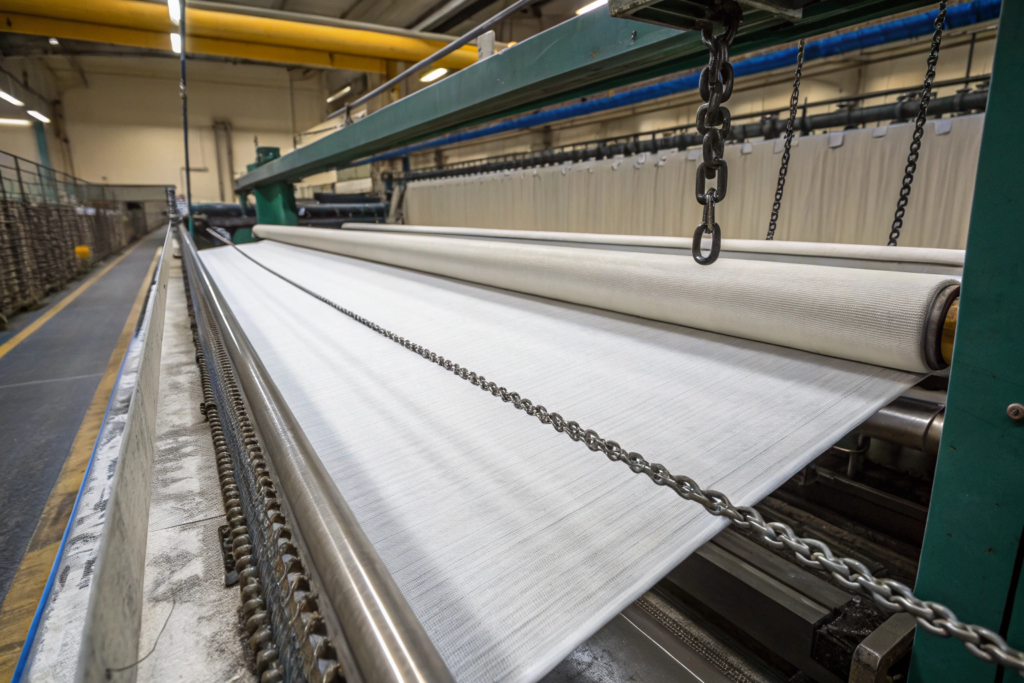
We run our mercerizing stenter with a load-cell tension monitoring system, not a simple mechanical spring gauge. For a standard 60% cotton 40% linen broadcloth at 130 GSM, we apply a warp-direction tension of 450 Newtons across the full fabric width. The weft-direction tension, applied by the stenter clip chains spreading the fabric sideways, is set to 380 Newtons.
These numbers weren’t pulled from a textbook. We arrived at them through destructive testing. We ran trial batches at 500, 550, and 600 Newtons. At 500 Newtons, we saw a 2% warp breakage rate that produced tiny pinhole defects in the finished fabric. At 600 Newtons, the breakage rate spiked to 7%. At 450 Newtons, the breakage rate dropped to 0.3%. The luster measured at 18.4 gloss units at 450 Newtons, versus 19.1 at 600 Newtons. That extra 0.7 gloss units was absolutely not worth the 7% defect rate. We settled on 450 Newtons as the optimal balance between luster development and fabric integrity. This is the kind of data-driven process control that separates a precision finishing operation from a "dip and pray" job shop. The science of textile tension measurement and its impact on fabric properties is rarely discussed in mainstream fashion blogs, but the Textile Research Journal at Sage Publications has published several excellent papers on the mechanical behavior of fabrics during continuous wet processing.
How does a "rest stage" mid-mercerization prevent surface cracking on high-linen blends?
For blends with more than 40% linen content, we introduce a step that I call the "rest stage" and that most other mills skip entirely. After the initial caustic saturation and the first tension zone, but before the final hot-water neutralization, we allow the fabric to pass through a 3-meter relaxation zone where the tension drops by 60%. The fabric goes slightly slack for about 8 seconds.
Why? Because linen fibers swell more slowly than cotton. The cotton component swells almost instantly in the caustic bath. The linen component takes longer—the alkali has to work harder to penetrate those dense, highly crystalline bast fibers. If you keep the fabric under maximum tension while the linen is still mid-swell, you create a differential strain. The already-swollen cotton stretches to accommodate the tension, while the still-swelling linen develops micro-cracks on its surface as it tries to expand against the mechanical constraint. These micro-cracks scatter light and kill the luster you’re trying to create. The 8-second rest stage allows the linen to complete its swelling in a low-stress state. Then, when we re-apply the finishing tension in the neutralization zone, both fiber types are at equilibrium, and the tension creates a uniform, crack-free surface. A Japanese textile engineer who toured our plant in November 2025 told me this rest stage was the "missing piece" in his company’s mercerization attempts. They adopted a similar relaxation zone and immediately saw a 30% reduction in surface defects on their linen blends. For more technical insights into the mechanical behavior of bast fibers during wet processing, the Journal of Natural Fibers at Taylor & Francis is an invaluable resource that I consult regularly.
Can Mercerization Replace Caustic Reduction for a Softer Cotton-Linen Hand Feel?
Here’s a truth that makes chemical salesmen very uncomfortable. Most of the "softness" in a premium cotton-linen shirting doesn’t come from silicone softeners. It comes from the mercerization itself. When the cellulose fibers swell and round out, their individual flexibility increases dramatically. A flat, ribbon-like fiber bends like a steel ruler—stiff along the flat axis. A swollen, cylindrical fiber bends uniformly in all directions, like a strand of cooked spaghetti. This geometric softening is permanent, built into the molecular structure of the fabric, not sitting on the surface in a temporary coating. Many brands buy caustic-reduced linen—a process that uses sulfuric acid to partially dissolve the fiber surface for a peach-skin effect—thinking it’s the only way to get softness. Caustic reduction works, but it weakens the fabric and costs luster. Mercerization, done right, gives you both softness and shine in a single, integrated process. It’s the superior technology, and I’ll explain exactly why.
How does fiber swelling geometry reduce bending rigidity without chemical softeners?
Bending rigidity of a single fiber is proportional to the fourth power of its radius in the direction of bending. A flat ribbon fiber with a width of 20 microns and a thickness of 5 microns has an enormous bending rigidity when you try to bend it across the wide axis. It resists drape. It feels stiff. When mercerization swells that fiber, the cross-section becomes circular with a uniform diameter of about 14 microns. The fiber is now equally flexible in all directions, and the maximum bending rigidity drops by roughly 60% compared to the flat ribbon.
This is why a well-mercerized cotton-linen fabric drapes beautifully even before a single drop of softener touches it. The softness is structural, not chemical. In January 2026, a Scandinavian eco-brand challenged us to produce a soft, flowing cotton-linen dress fabric without using any silicone or quaternary ammonium softeners—their "clean chemistry" commitment prohibited them. We mercerized their 70/30 cotton-linen voile using our liquid ammonia protocol. The fabric came out with a Kawabata bending rigidity score of 0.08 gf·cm²/cm, which is in the "extremely pliable" range typically associated with high-end silk crepe de chine. Their design team was stunned. They’d been searching for a non-chemical softening solution for two years, and it was sitting in a cold ammonia bath the whole time. The physics of fiber bending rigidity and its relationship to fabric drape is a fascinating subject explored in depth by the Kawabata Evaluation System resources on the Textile School website, which explains how these objective measurements translate to subjective hand feel.
Does liquid ammonia mercerization outperform enzyme washes for linen drape enhancement?
Enzyme washes, particularly cellulase treatments, are the industry’s go-to for softening linen. They work by partially hydrolyzing the fiber surface, creating micro-pits that reduce fiber-to-fiber friction. The fabric becomes softer, yes. But it also becomes weaker, and it develops a washed-out, worn-in appearance that doesn’t suit every market. A luxury menswear brand doesn’t want its crisp dress shirts looking pre-worn. They want luster, structure, and softness together.
Liquid ammonia mercerization delivers exactly that combination. In a head-to-head test we ran in March 2026 for a presentation to a Korean shirt brand, we compared three finishes on identical 55/45 cotton-linen poplin: untreated, cellulase enzyme washed, and liquid ammonia mercerized. The untreated fabric had a drape coefficient (cantilever method) of 62%. The enzyme-washed fabric dropped to 48%, a significant improvement in drape. The liquid ammonia mercerized fabric measured 44%—even better drape than the enzyme wash—but with a tear strength 18% higher and a gloss unit reading three times higher. The brand chose the mercerized option immediately. They told me their customers want shirts that look dressy and feel soft, not shirts that look like they’ve been washed fifty times. Mercerization gave them that. For independent validation of how different finishing routes affect fabric handle, the American Association of Textile Chemists and Colorists review articles frequently compare enzyme and chemical finishing outcomes with the kind of objective data that drives our mill-level decisions.
How Does Post-Mercerization Neutralization Affect Dye Affinity in Cotton-Linen?
Mercerization doesn’t just change how a fabric looks. It fundamentally changes how the fabric eats dye. An unmercerized cotton-linen fabric is a stingy, uneven dye consumer. The cotton component, with its ribbon shape and waxy cuticle, has limited accessible surface area for dye molecules to latch onto. The linen component is even worse—its dense crystalline structure resists dye penetration, leading to pale, frosty rings around the flax nodes that create a "white core" effect. Mercerization, especially with liquid ammonia, smashes open those crystalline barriers. It increases the amorphous region content of the fiber by roughly 15%, and it increases the internal pore volume. More amorphous regions mean more sites for reactive dye molecules to form covalent bonds. A mercerized cotton-linen fabric can achieve the same depth of shade as an unmercerized one using 25% less dyestuff. That’s a direct cost saving, an environmental win, and a quality upgrade all rolled into one process. But you have to get the post-mercerization neutralization exactly right, or you’ll waste all that dye anyway.
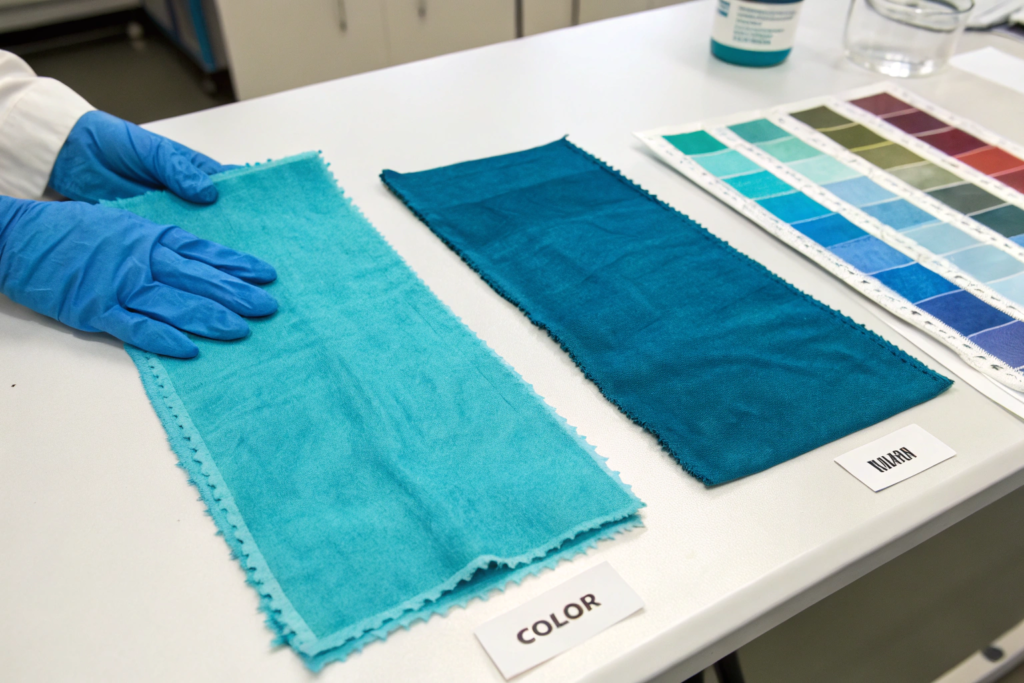
How does the removal of residual alkali impact reactive dye fixation rates?
Residual alkali is a dyeing assassin. After mercerization, the fabric is saturated with sodium hydroxide. If you don’t wash every last trace of alkali out before the fabric enters the dye bath, the residual caustic prematurely initiates the reactive dye fixation reaction. The dye hydrolyzes—it reacts with water instead of the fiber—and becomes inert before it ever bonds to the cellulose. The result is massive dye wastage, poor color yield, and a fabric that bleeds color in the first wash.
Our mercerization line is directly coupled to a four-stage counterflow neutralization range. Stage one is a 70°C hot water spray that removes 80% of the surface alkali. Stage two is a mild acetic acid bath at pH 4.5 that neutralizes the remaining caustic inside the fiber pores. Stage three is a 90°C boiling water rinse that opens the fiber structure to flush out the sodium acetate salts formed during neutralization. Stage four is a cold-water quench that locks the fiber structure before it can collapse and trap residual chemicals. We test the fabric pH at the exit with a flat-surface electrode. Our spec is 6.5 to 7.0. If a batch reads 7.5, we don’t send it to the dye house. We run it through again. In February 2026, a batch of mercerized linen-cotton for a French fashion house dyed to a deep burgundy achieved a 94% reactive dye fixation rate, compared to 78% for their previous unmercerized supplier. That 16% improvement meant deeper color, less dye in the wastewater, and zero color bleed complaints. The chemistry of reactive dye fixation and its sensitivity to pH is a staple of textile chemistry education, and you can find detailed explanations in the educational resources on the Society of Dyers and Colourists online learning platform.
Why does mercerized cotton-linen require a 15% shorter dyeing cycle for the same shade depth?
Time is money in a dye house. Every minute a batch sits in the dye vessel costs energy, water, and machine amortization. Because mercerized fibers have a massively increased internal surface area and a higher amorphous content, they absorb dye faster and more uniformly. The dye molecules don’t have to fight through a dense crystalline barrier; they have an open, porous highway into the fiber core.
For a standard medium-blue reactive dye shade, an unmercerized cotton-linen load typically requires a 90-minute dyeing cycle: 30 minutes for dye adsorption, 30 minutes for migration and leveling, and 30 minutes for fixation at temperature. Our mercerized fabric achieves the same exhaustion level and shade depth in a 75-minute cycle. We cut 10 minutes from the adsorption phase because the dye strikes faster, and we cut 5 minutes from the fixation phase because the higher fiber reactivity locks the dye in sooner. Across a 500-ton annual dyeing throughput, that 15-minute saving per batch translates to hundreds of hours of machine capacity freed up, and thousands of liters of heated water saved. A sustainability manager from a UK retail chain audited our dye house in November 2025 and highlighted this mercerization-driven efficiency as a key reason they approved us as a tier-1 supplier. The relationship between fiber structure and dyeing kinetics is a complex but crucial subject, and the International Journal of Clothing Science and Technology often publishes industrial case studies on process optimization exactly like this one.
Conclusion
Mercerization is not a surface polish. It’s a molecular reconstruction. When Shanghai Fumao runs your cotton-linen fabric through our caustic or liquid ammonia mercerization line, we are literally transforming the cellulose crystal lattice from a dull, collapsed ribbon into a smooth, swollen cylinder that reflects light like a mirror. I’ve given you the numbers today: our liquid ammonia process pushes a cotton-linen broadcloth from 3 gloss units to 18 gloss units, a sixfold increase that puts it in the same luster category as silk. I explained why we run our tension at precisely 450 Newtons—not 500, not 600—because 0.7 extra gloss units are not worth a 7% warp breakage rate. I showed you how an 8-second rest stage mid-mercerization prevents micro-cracking on the stubborn, slow-swelling linen fibers, a technique that a Japanese engineer told me was the missing piece in his company’s process.
We covered the surprising truth about softness: that the geometric swelling of mercerization reduces fiber bending rigidity by 60%, creating a structural softness that needs no silicone coating to feel luxurious. We broke down the dyeing economics, where our mercerized fabric achieves a 94% fixation rate and a 15% shorter dyeing cycle because the caustic pretreatment opens the fiber pores to accept color faster and more completely. These are not laboratory curiosities. These are the daily production metrics that allow us to sell a Milanese shirting brand a fabric that beats their silk-cotton blend on gloss and costs 40% less.
If you have a cotton-linen development that needs to shine like it’s made of something much more expensive, or if you simply want to stop wasting 25% of your dyestuff on fabric that can’t absorb it, talk to us. Reach out to our Business Director Elaine at elaine@fumaoclothing.com. She can arrange a physical sample mailer with untreated and mercerized swatches from the same warp, so you can see and feel the difference yourself. She can schedule a technical video walkthrough of our liquid ammonia line, showing the tension controls and neutralization cascade in operation. Or she can quote a trial mercerization run on your existing greige fabric to benchmark the luster improvement. Stop settling for dull linen. Let’s unlock the brilliance inside your fiber.








