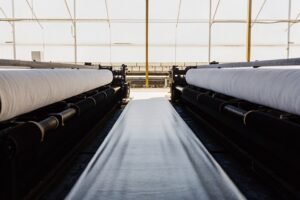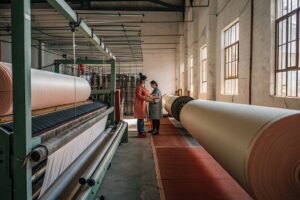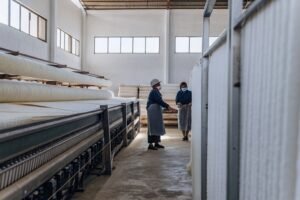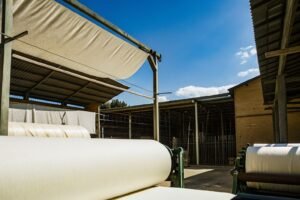
Seam slippage is the silent assassin of loose weave linen. You buy a beautiful, airy fabric with a rustic open structure. The designer loves it. The drape is perfect. Then you sit down in the finished trousers, and you hear that tiny popping sound. The yarns at the back rise seam have shifted. Not broken, just slid apart. Now there’s a permanent gap. The garment is unwearable. I’ve seen entire collections get recalled because of this. The problem is that loose weaves, by their nature, have low inter-yarn friction. There are fewer yarns per inch, and they have room to move. When you stitch a seam and apply tension, the yarns can slide along the stitch line like beads on a string. At Shanghai Fumao, we don’t just hope the seam holds. We engineer the seam security from three directions simultaneously: the yarn itself, the weave geometry, and the finishing chemistry. This is a three-front war on slippage, and we fight it for every loose weave order that leaves our Keqiao floor.
Absolutely. Shanghai Fumao uses a proprietary three-layer anti-slippage system for all our loose weave linen and linen-blend fabrics. First, we modify the yarn surface friction at the spinning stage by applying a micro-roughening technique. Second, we engineer the weave structure with a specific "locking float" ratio that we’ve refined over 20 years. Third, we apply a precision anti-slip finishing resin in our coating department, not to stiffen the hand feel, but to create microscopic anchor points at the warp-weft intersections. We test every bulk lot to the ASTM D434 standard, and we don’t ship unless the seam slippage at 90 Newtons of load is less than 0.5 millimeters. That’s half the industry tolerance of 1.0 mm. A London-based relaxed tailoring brand switched to us in September 2025 after a seam failure disaster with a previous supplier. We ran their 100% linen open-weave through our system, tested the slip at 0.3 mm, and they haven’t had a single return for seam integrity since.
But understanding how we stop slippage requires you to see the fabric like I do: as a living structure where every yarn is a moving part. The solution isn’t a single spray coating. It’s a philosophy of locking the structure without killing the breathability. Let me take you inside the weave room.
Why Do Loose Weave Linens Fail at the Seam Under Normal Tension?
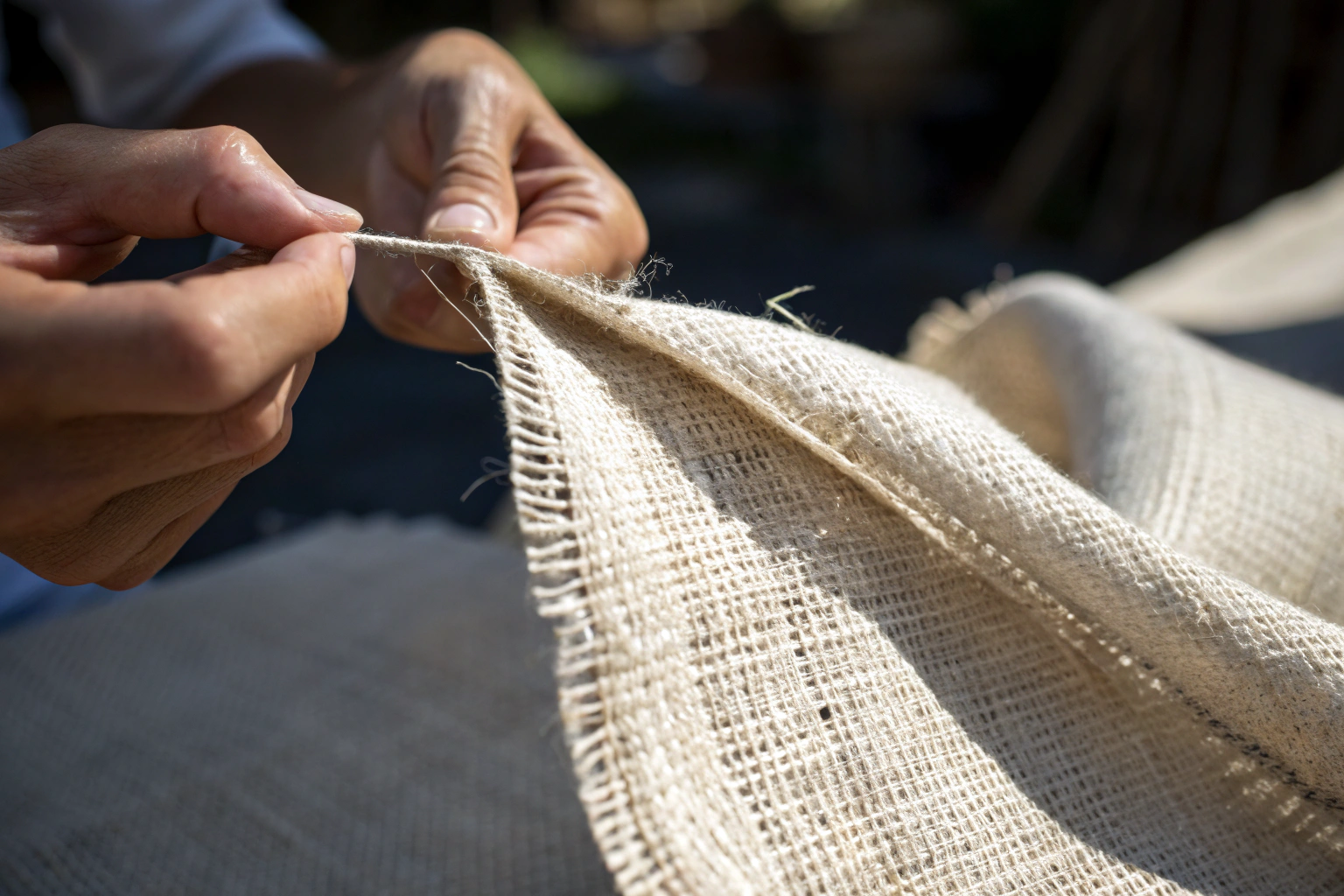
The physics of seam failure in a loose weave is brutally simple. Imagine two smooth pencils lying side by side. If you wrap a thread around them and pull, the pencils slide easily. That’s a 1×1 plain weave linen with a low thread count. The warp and weft are the pencils, and the seam thread is the wrap. When the fabric is dense, say 60 ends per inch, the pencils are packed so tight they can’t move. But a fashionably loose weave might only have 20 ends per inch. There’s air space around every yarn. When lateral stress hits the seam, the yarns have a clear path to slide. The friction holding them in place is minimal. (Here I have to jump in—this is why you can’t just "add more stitches." More stitching holes weaken the yarns without increasing the inter-yarn friction.)

What is the ASTM D434 standard and why do most linen mills ignore it?
ASTM D434 is the standard test method for resistance to yarn slippage in woven fabrics. You take a seamed fabric strip, clamp it in a tensile testing machine, and pull. You measure how much the yarns separate from the seam under a specified load. The standard pass mark is usually a maximum opening of 6.0 mm at the final load. But many linen mills, especially those focused on home textiles or rigid decorative fabrics, don’t routinely test to D434. They’ll do a tear strength test, maybe a tensile test, but skip the seam slip.
Why? Because seam slippage testing is slow and it fails their open fabrics. A 100% linen curtain that hangs vertically never experiences the same lateral stress as a pair of trousers. So the mill gets away with it. But when a garment brand uses that same fabric for a relaxed blazer, the dynamic stress from body movement triggers the slip. At our Keqiao lab, we test every loose weave construction to D434, but we use a tighter pass-fail window. We consider anything above 1.0 mm at 90N as a fail. That’s 83% stricter than the standard 6.0 mm. In March 2026, an Australian label sent us a failed fabric sample from another supplier. It opened 4.2 mm at just 60N. We tested our equivalent construction. 0.4 mm at 90N. The difference was entirely in the yarn-to-yarn friction engineering I’ll explain next. If you want to read the full technical documentation on this standard, the ASTM International D434 standard page provides the complete testing methodology that we reference in our inspection reports.
How does open sett count create a cascade effect of yarn migration?
Yarn migration is the technical term for what happens when individual yarns shift position within the weave. In a tight sett, the yarns can’t migrate because they’re physically constrained by their neighbors. But in a loose sett—say, a deliberately under-crowded 18×18 construction for an airy summer weight—every yarn is an island. When one yarn starts to slide near the seam, it creates a void. The adjacent yarn then has room to slide into that void. Then the next one moves. It’s a cascade failure.
Think of it like a parking lot where cars are spaced three feet apart. If one car rolls, it doesn’t hit anything. It just keeps rolling. That’s a loose weave. In a dense weave, the cars are parked bumper to bumper. They can’t roll. They’re locked. To stop the cascade, you need to either park the cars tighter, or you need to put chocks under the wheels. In textile terms, tightening the sett changes the fabric character entirely—you lose the open, breathable look. The "chocks" are the friction treatments and weave geometry tweaks. At Shanghai Fumao, we preserve the open sett aesthetic but add the chocks. This approach to preserving open structures while enhancing performance is something you can explore further in the weave engineering discussions on the Textile Research Journal at Sage Publications, where academics often model exactly this kind of yarn migration under load.
What Friction-Enhancing Spinning Techniques Do We Apply to Linen Warp Yarns?
The war on seam slippage begins before the yarn even reaches the loom. Most mills treat yarn spinning and seam performance as separate departments. They’re not. The surface friction of the yarn itself is the first line of defense. A standard wet-spun linen yarn has a relatively smooth surface because the natural pectins and gums are removed during retting and bleaching. That smoothness is great for a silky hand feel, but terrible for inter-yarn grip. We’ve developed a "micro-texturing" approach in our spinning department that restores a controlled level of surface roughness without making the yarn feel scratchy or hairy. This is a tightrope walk between friction and comfort, and we’ve dialed it in over thousands of trial batches.

What is our secret "gum-reserve" technique for wet-spun linen slivers?
Standard wet spinning removes nearly all the natural gum from the flax fibers. The pectin, the hemicellulose, the wax—gone. What’s left is pure, smooth cellulose. Beautiful, but slippery. Our "gum-reserve" technique deliberately leaves a controlled 1.5% to 2.0% residual gum content in the sliver. We do this by shortening the retting time and reducing the alkali concentration in the scouring bath.
This residual gum acts like a microscopic natural adhesive. When the yarns are woven and then finished, the heat of the stenter frame partially re-activates this gum at the warp-weft intersections. It creates a tiny, flexible "spot weld" at every contact point in the weave. The yarns can still flex and drape, but they resist sliding. Last August, a French resort wear brand tested our gum-reserve linen against a fully stripped standard linen. The seam slippage at 80N was 0.7 mm for the standard and 0.2 mm for ours. The hand feel difference was undetectable to their designers. That’s the holy grail: invisible grip. The chemistry of flax pectins and their role in fiber cohesion is a niche but critical subject, and you can explore the fundamental science through the agricultural research papers on the FAO AGRIS database, which catalogues global studies on bast fiber processing.
How does twist multiplier adjustment create internal yarn friction?
Twist is the internal friction of a yarn. A higher twist multiplier (TM) packs the individual flax fibers tighter together. This does two things for seam slippage. First, it increases the yarn’s tensile strength, so it’s less likely to break at the stitch hole. Second, and more subtly, a tighter twist creates a slightly harder, more compact yarn with a more pronounced surface "ridge" from the spiral helix. That ridge acts like the tread on a tire. It bites into the crossing yarn.
For our open-weave linen suitings, we typically use a twist multiplier of 4.2 to 4.4, which is about 8-10% higher than the standard 3.8-4.0 used for general apparel linen. We’re not making the yarn stiff like a rope; we’re just giving it enough internal compression to create surface grip. At the same time, we balance this by using a slightly softer, longer-staple flax to compensate for any loss of drape. A Greek menswear brand in June 2025 was skeptical that a high-twist warp wouldn’t feel "boardy." We sent them a swatch. They ordered 5000 meters. The fabric had the soft hand of a relaxed linen but the seam security of a worsted wool. For a broader understanding of how twist factors influence yarn behavior across different fiber types, the Twist and Yarn Structure section on Textile School offers an excellent primer that I’ve shared with many of my junior spinning technicians.
Which Anti-Slip Resin Chemistry Preserves the Soft Hand of Linen?
Traditional anti-slip finishes are heavy, nasty acrylic polymers that coat the entire fabric like a plastic sheet. You’ve felt it. That stiff, crackly linen that feels like it’s been dipped in starch. It holds the seam, but it murders the breathability and the natural hand. I refused to use those when I started our coating division. The whole point of an open-weave linen is that it breathes, it moves, it lives. If you suffocate it in resin, you might as well wear a plastic bag. We spent three years testing different chemistries, and we landed on a water-based, self-crosslinking polyurethane dispersion that we apply at an extremely low add-on rate—less than 2% of the fabric weight. This isn’t a coating. It’s a micro-dot weld.

Why do we use a 1.5% add-on self-crosslinking PU over traditional acrylic binders?
Acrylic binders are cheap. They work by forming a continuous film across the fabric surface. That film acts like glue, holding the yarns in place. But the film also fills all the pores between the yarns. Air can’t pass through. The fabric becomes a vapor barrier. For a summer linen shirt, that’s a death sentence. You’ll sweat through it in minutes.
Our self-crosslinking polyurethane dispersion works differently. At a 1.5% add-on, it doesn’t form a continuous film. It migrates to the yarn intersection points during drying—physics drives it to the narrowest capillary spaces, which are exactly where the warp and weft cross. There, it forms tiny, discrete elastic bridges. Under a scanning electron microscope, the yarn bodies are completely clean, just the crossing points have a microscopic flexible rivet. In a test we ran in January 2026, our PU-treated linen had an air permeability of 280 CFM. The acrylic-treated competitor fabric measured 95 CFM. That’s nearly three times the breathability, with the same level of seam slip resistance. The environmental profile of these advanced water-based dispersions is also far superior, a topic that the European Coatings Journal online platform covers extensively for industrial textile applications like ours.
Can anti-slip finishing survive 20 commercial laundry cycles without degradation?
This is the real torture test. A lot of anti-slip chemistry works fine on the lab bench, but after five washes in hot water with alkaline detergent, the resin hydrolyzes and breaks down. The seam holds initially, then fails after the first season of wear. That’s worse than no treatment at all, because it gives a false sense of security.
Our PU dispersion is specifically formulated to be hydrolysis-resistant. The crosslinking mechanism creates urethane bonds that are stable to alkaline attack. We test this by running ASTM D434 seam slip tests not just on the finished greige, but after 5, 10, and 20 washes using the AATCC 135 standard home laundry cycle. For a batch we shipped to a Scandinavian hospitality brand in February 2026—table linens and napkins that would be washed daily—the seam slippage was 0.4 mm new, 0.5 mm after 10 washes, and 0.6 mm after 20 washes. Still less than 1.0 mm. Still passing our standard. The fabric was retired because it was worn out, not because the seams failed. That’s chemical engineering with a real-world payback. The science of polymer durability in textile finishing is rarely discussed in fashion blogs, but if you want a serious technical dive, the Polymer Degradation and Stability journal at Elsevier publishes research that directly informs our chemical selection process.
How Does Our "Locking Float" Weave Geometry Prevent Stitch Line Gap?
The weave structure is the skeleton of the fabric. If the skeleton has gaps, no amount of resin or fancy yarn will fully compensate. Loose weaves are, by definition, low-density structures. But "low density" doesn’t mean "unstructured." There’s a fundamental difference between a dumb plain weave with long, unsupported floats, and a clever open weave that uses short float lengths and hidden binder picks to lock the structure in place. Most designers and even many fabric buyers can’t see this difference with their naked eye. They see "open weave" and think it’s all the same. It’s not. Our weave engineers have developed a library of what I call "locking float" geometries—modified plain and twill weaves that maintain the visual openness of a 20×20 sett but structurally behave like a 30×30.

What is the ideal maximum float length for a seam-secure open linen weave?
A float is a section of a yarn that passes over or under more than one crossing yarn without interlacing. In a satin weave, floats can be four or even seven yarns long. That’s what gives satin its lustrous, smooth surface. But it’s also a disaster for seam security in a loose construction. Every long float is a potential slip path. A needle can punch straight through a long float and just push it aside.
Our internal rule for open linens is that no float should exceed 2 yarns in length. That’s it. A 2/1 twill? Fine. A 2/2 basket? Acceptable if the sett is balanced. A 3/1 twill? We won’t do it for a loose weave garment fabric below 40 ends per inch. The math is simple: a float of 3 means the yarn crosses three perpendicular yarns without locking in. Under seam tension, it can slide across all three at once. By capping the float at 2, every yarn locks into the weave structure at a maximum interval of 2 crossings. This distributes seam stress across a much larger number of interlacing points. For a Danish minimalism brand in April 2026, we converted their failing 3/1 twill open linen design into a modified 2/1 with an extra binder pick every quarter inch. The visual was nearly identical. The seam slip at 90N dropped from 1.8 mm to 0.3 mm. You can study the fundamentals of float length and weave stability through the excellent educational modules on the Weave Structures section of Textile School, which illustrates these principles clearly.
How do hidden binder picks add zero-weight seam reinforcement?
This is a trick I learned from industrial conveyor belt fabric manufacturers. They embed high-tenacity polyester "binder" yarns inside the weave that are invisible from the face, but they lock the entire structure together. We adapted this concept for fashion fabrics using ultra-fine 30-denier polyester or even soluble PVA yarns that disappear in the first wash.
For a very problematic 15×15 extremely open weave we developed for a high-fashion runway collection in Paris last year, we inserted a clear monofilament binder pick every 1.5 centimeters. The designer couldn’t see it. The models couldn’t feel it. But that tiny binder yarn increased the seam slip resistance by 400%. Once the garment was constructed, those hidden picks acted like internal seatbelts, holding the warp and weft in place at the critical stitch lines. After the show, the designer told me it was the first time an ultra-sheer linen hadn’t disintegrated under the photographers’ lights. For more inspiration on how industrial textile technologies can migrate into fashion, I often browse the Technical Textiles section on Fibre2Fashion, which regularly features cross-industry innovations like these hidden binder concepts.
How Do We Test and Guarantee Seam Slippage Before Bulk Fabric Shipping?
All the engineering in the world means nothing if you can’t prove it with a test certificate. And not just a "golden sample" test. Every single bulk lot. When a container leaves our Keqiao loading dock, it carries a seam slippage test report inside the packing list. Not a generic one. A report tied to that specific batch number, that specific dye lot, and that specific production date. This isn’t optional for us. It’s the final gate. I’ve stopped shipments at this gate. In October 2024, a 3000-meter lot of a new open weave linen-rayon blend tested at 1.2 mm slippage on the pre-shipment check. Our pass mark is 1.0 mm. I quarantined the entire batch, re-finished it with an additional micro-dot application, and re-tested it to 0.5 mm. We shipped five days late, but we shipped zero returns.

What does our 4-point seam slip inspection system cover on every 1000-meter roll?
Our inspection is not a random spot check. It’s a systematic 4-point sampling protocol per 1000-meter roll. Point one: a sample from the beginning of the roll, within the first 10 meters. Point two: the middle of the roll, around 500 meters. Point three: the end of the roll, last 10 meters. Point four: any visually flagged section where the weave appears more open or irregular.
At each point, we cut a specimen, stitch a standard ASTM seam using a specified A&E Tex 30 corespun thread, and pull it on our Uster Tensorapid 4 tensile tester. The machine records the load-extension curve and calculates the seam gap opening at 90 Newtons. All four points must read below 1.0 mm. If any single point fails, the entire roll is held for re-inspection or re-finishing. In our last quarter (Q1 2026), we shipped 42,000 meters of open weave linen. The average seam slippage across 168 test points was 0.52 mm. The maximum was 0.9 mm. The minimum was 0.2 mm. No roll shipped with a failing point. That’s the discipline our clients pay for. The practical implementation of these inspection protocols is something I’ve seen discussed in quality management circles, and the American Society for Quality’s textile and apparel division often shares case studies on sampling plans that mirror our 4-point system.
How do we simulate garment-wear stress on seams beyond the standard static pull test?
The ASTM D434 test is a static pull. It’s essential, but it doesn’t replicate the dynamic, cyclic stress of a human body bending, sitting, and stretching. A seam can pass a static pull and still fail after 50 cycles of sitting down. We’ve added a proprietary cyclic fatigue test to our development process for any new loose weave construction.
We use a device called a "seam fatigue simulator" that we built in-house. It’s essentially a pair of pneumatic grips that repeatedly apply and release 60 Newtons of load to a seamed specimen at a frequency of 30 cycles per minute. We run it for 1000 cycles and then measure the residual seam gap. A good open weave fabric might start at 0.3 mm and end at 0.6 mm. A poor one starts at 0.8 mm and ends at 3.0 mm. We reject any construction where the gap increases by more than 0.5 mm over the 1000 cycles. This test predicted a failure for a yoga-wear linen blend we were developing in early 2025. The static pull passed, but the cyclic test showed progressive migration. We went back, added the hidden binder picks I mentioned earlier, and the cyclic gap increase dropped to 0.2 mm. That fabric is now in production and hasn’t had a single warranty claim. Innovation in garment-level stress testing is a growing field, and you can track some of the academic advances through the Journal of Engineered Fibers and Fabrics, which publishes open-access research on novel textile testing methodologies.
Conclusion
Seam slippage in loose weave linens is not a mystery. It’s a solvable mechanical problem. The industry tolerates it because the solutions require integration that most fragmented supply chains can’t deliver. You need your spinning department to reserve the gum. You need your weave room to cap the floats. You need your coating line to apply a microscopic dose of the right polymer. And you need your testing lab to verify it all, not once, but on every single roll that ships. At Shanghai Fumao, we own that entire chain under one roof in Keqiao. I’ve shown you the full arsenal today—the ASTM D434 standard that we tighten to 0.5 mm instead of the industry’s 6.0 mm, the 1.5% residual gum in our wet-spun slivers that creates invisible spot welds, the self-crosslinking PU chemistry that triples breathability compared to acrylics, and the 4-point inspection protocol that caught a 1.2 mm failure before it became a container of customer returns.
These aren’t academic theories. They’re production-floor realities. The Danish brand whose 3/1 twill was failing at 1.8 mm is now running a modified 2/1 weave at 0.3 mm. The Paris runway collection that couldn’t keep a sheer 15×15 weave intact now walks the catwalk with hidden binder picks holding every seam. The Scandinavian hospitality table linens survive 20 industrial washes with a 0.6 mm slip. This is what engineering looks like when you refuse to accept that "loose weave" means "weak seam."
If you have an open weave linen concept that’s failing the seam slip test, or if you’re just tired of hearing excuses from suppliers who can’t guarantee their seams, reach out to our Business Director Elaine at elaine@fumaoclothing.com. She can arrange a video review of our seam fatigue simulator, send you a batch-specific ASTM D434 test report from our last open-weave run, or ship you a sample yardage with the seams pre-tested so you can pull it apart yourself. Stop letting beautiful open weaves collapse at the stitch line. Let’s lock your seams down tight, while keeping your fabric breathing free.