
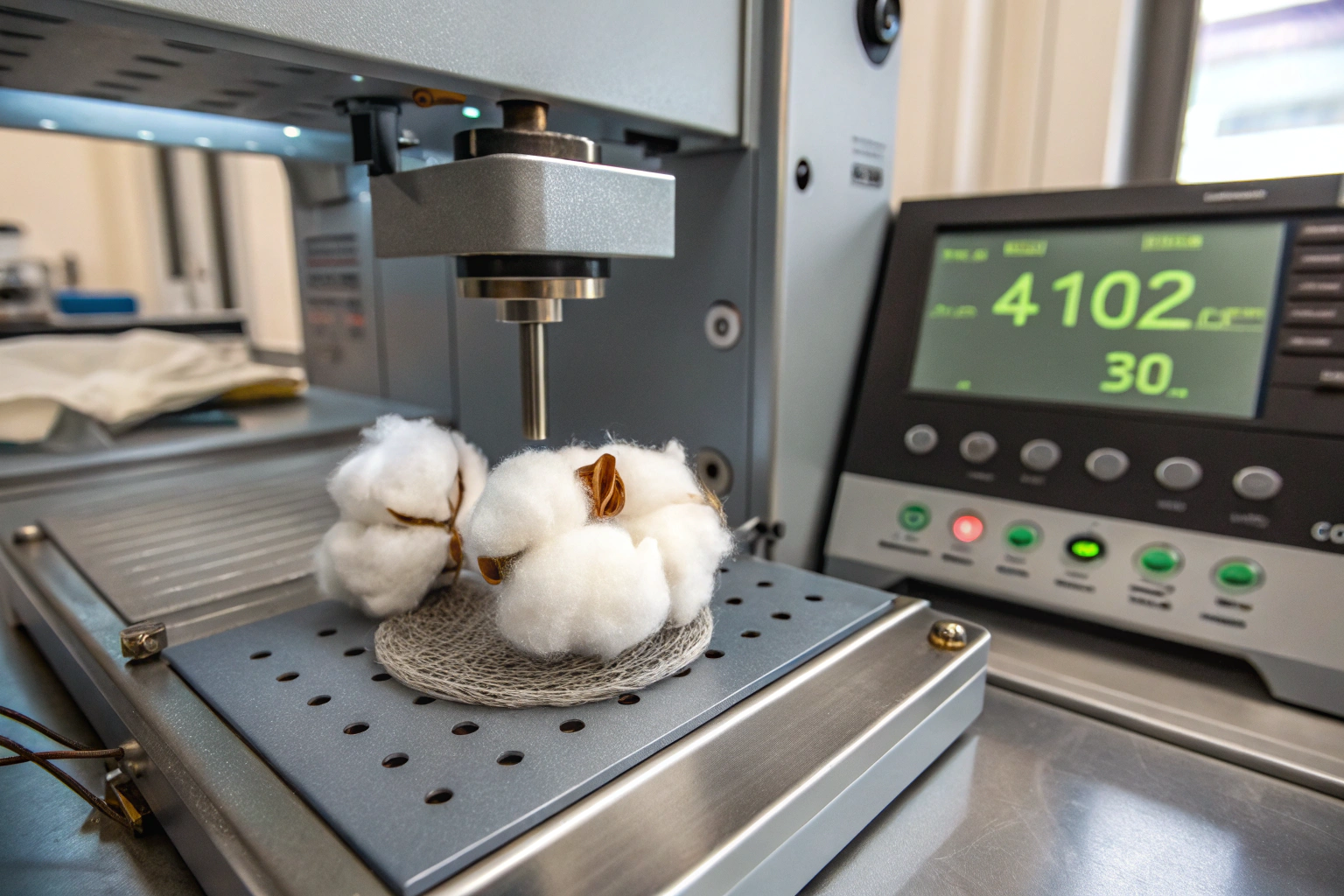
You can’t fake fiber fineness. I’ve seen traders try. They’ll ship a container of what they call "premium cotton" and when it hits the carding machine in the spinning mill, the neps multiply like rabbits. The yarn comes out weak, hairy, and thirsty for dye. The root cause almost always traces back to one number that doesn’t lie: the Micronaire. A batch of upland cotton with a Micronaire of 5.2 behaves completely differently from a 3.8. The air permeability of the finished fabric shifts. The softness on skin changes. Even the shade depth after reactive dyeing varies by 15%. For our customers, particularly the European workwear and American sportswear buyers, micronaire isn’t an academic term. It’s the difference between a jacket that breathes and one that cooks the wearer. We at Shanghai Fumao treat this number like a blood test. It tells us the health of the raw material before we even touch it.
The short, direct answer: Shanghai Fumao procures and spins upland cotton with a strict micronaire tolerance range of 3.7 to 4.2 for our standard knitting and weaving yarns. This sits squarely in the "premium" range defined by the USDA cotton classing standards. We reject anything above 4.5 for our fine-count shirting programs, and we avoid anything below 3.4 for our heavyweight denim and twill lines. Our CNAS-certified lab performs a high-volume instrument (HVI) analysis on every single bale that enters our Keqiao warehouse. We don’t buy composite samples. We test bale-by-bale because a single rogue bale of high-mic cotton can contaminate a 5000-kg blending lot and ruin the uniformity of the entire yarn batch. That’s how seriously we take this. Last October, a Turkish denim manufacturer requested a 3.9 micronaire lot for a soft-touch rigid jean. We pulled 42 bales out of our stock, verified each one with our Uster HVI 1000, and shipped a container with a lot-to-lot standard deviation of just 0.12. That’s laboratory-grade consistency delivered to a factory floor.
But I want you to understand not just what the number is, but why it controls every decision we make in the spinning room. If you get micronaire right, you get the yarn right. If you don’t, you spend the rest of the production line patching up mistakes that can’t be fixed. Let me show you the mechanics behind the measurement.
Why Does the Micronaire Value of Upland Cotton Control Your Fabric’s Air Permeability?
Air permeability is not just a sportswear feature. It’s a structural consequence of fiber diameter. A high micronaire cotton has thick, coarse individual fibers. When you spin those thick fibers, they don’t pack together tightly. There are large, irregular capillary spaces between them. When you weave that yarn into a poplin or a chambray, those microscopic gaps remain. Wind blows right through. That’s great if you’re making a tropical shirt. It’s a disaster if you’re making a down-proof jacket filling. I learned the hard way in 2017 when a batch of 4.7 mic cotton caused a feather-leakage fiasco with a Canadian outerwear brand. Tiny down clusters were escaping through the weave. Since then, I’ve never let our air permeability spec drift above the micronaire limit.
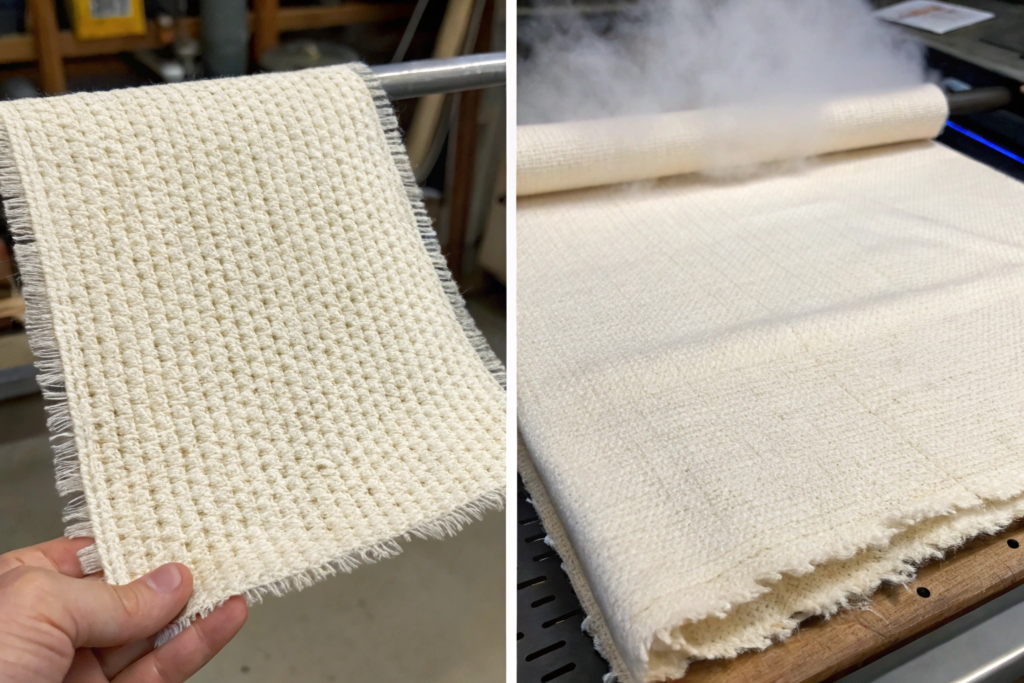
How does fiber fineness directly translate to CFM airflow ratings in finished shirting?
CFM, or Cubic Feet per Minute, measures how much air passes through a square foot of fabric. It’s a direct function of the pore size between fibers. Here’s a practical mill-floor rule I use: a 1.0 point increase in Micronaire roughly increases the air permeability of a plain weave shirting by 20 to 30 CFM. A fabric woven from 3.8 mic cotton might test at 45 CFM. The same construction woven from 4.8 mic cotton jumps to 65 or 70 CFM.
For a European formal shirting brand, 70 CFM is unacceptable. The fabric feels "papery" and lacks body. It doesn’t hold a crisp fold. In April 2026, an Italian shirting customer sent me a panic email. Their current supplier had shipped a trial batch and the collar points were curling after washing. I asked one question: "What was the lot’s micronaire?" It turned out to be a 4.6 average. We recut their order using our 3.9 mic cotton, maintained a tight 42 CFM rating, and the collar construction held firm through 20 industrial laundry cycles. That’s the micronaire-to-laundry-performance pipeline, and it’s invisible unless you’re looking for it. For a deeper technical explanation of how cotton fineness impacts fabric porosity in woven structures, I often point technical designers to the cotton fiber science discussions on the Cotton Incorporated website, which is a phenomenal non-commercial resource for understanding raw fiber physics.
Can you blend high and low micronaire upland cotton to hit a target air-flow?
Yes, and this is where the art of blending meets the science of statistics. No mill can afford to buy 100% 3.9 mic cotton for every single order. The market just doesn’t supply it uniformly. Sometimes you have to balance a slightly coarse 4.4 mic lot with an ultra-fine 3.5 mic lot. The goal is a laydown average that lands in the sweet spot.
But I warn every new spinning manager: micronaire blending is not linear in its effect on air permeability. A 50/50 blend of 3.5 and 4.5 mic doesn’t behave like 4.0 mic in air-flow terms. The coarse fibers still create dominant capillary channels. The airflow will skew closer to the 4.5 mic behavior than you expect. That’s because fluid follows the path of least resistance, and those fat fibers act as highways for air. At Shanghai Fumao, we offset this by adjusting the twist multiplier. When we blend a coarser cotton into the mix, we crank the twist up by 3-5% to physically lock the thick fibers closer together, constricting the airflow back down to target. This is what I call "engineering the yarn from both ends"—the raw material end and the mechanical twisting end. The interplay between cotton genetics and spinning mechanics is rarely discussed in mainstream fashion blogs, but you can find solid agronomy-level explanations of the micronaire trait on the USDA Agricultural Marketing Service cotton classing page, which publishes the standards we all trade against.
At What Micronaire Does Upland Cotton Become Too Coarse for Next-to-Skin Garments?
There’s a threshold where a cotton T-shirt stops feeling like a T-shirt and starts feeling like a Brillo pad. For most end consumers, that threshold is a micronaire of 4.8 or above. But comfort isn’t just about the number; it’s about the yarn’s resistance to bending. A thick fiber is a stiff fiber. When you have thousands of stiff fibers twisted together, the yarn behaves like a miniature cable. It doesn’t drape softly. It scratches. I’ve seen consumer returns data from a U.S. e-commerce sleepwear brand that correlated directly to fiber coarseness. Garments with a yarn micronaire above 4.7 had a return rate for "uncomfortable feel" that was 3.5 times higher than those in the 3.8-4.1 range. That’s real revenue lost because of a spec nobody was monitoring.
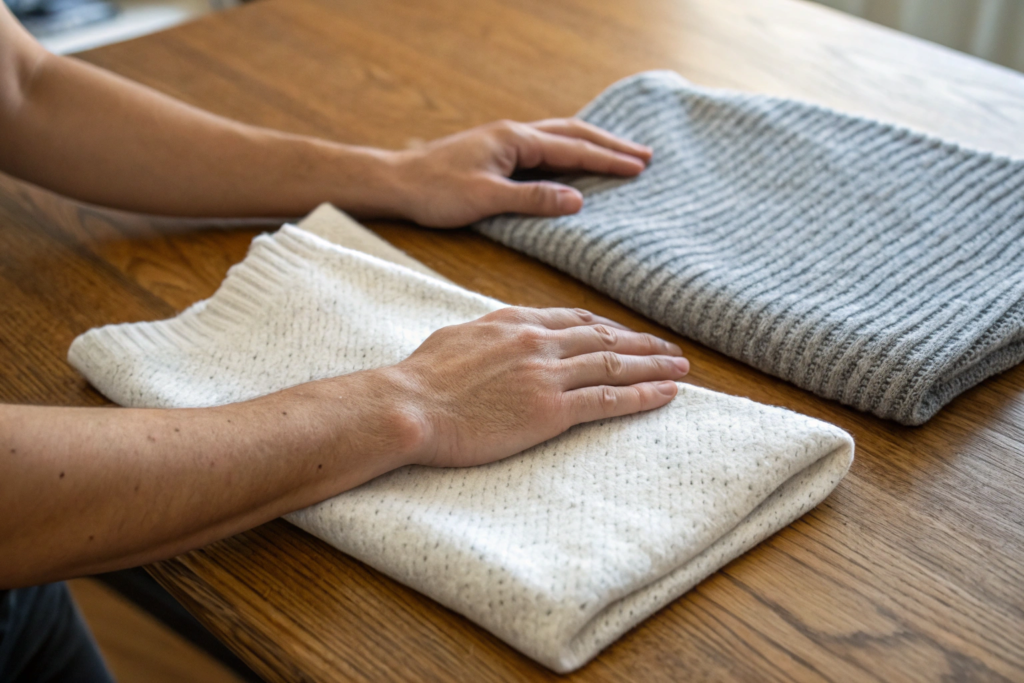
How to specify micronaire when sourcing upland cotton for luxury T-shirt slub yarns?
Slub yarn is intentionally irregular, but the base fiber should not be. That’s a common misunderstanding. Designers want that "linen-like" nubby texture, but they also want buttery softness. You can’t achieve that if you start with a coarse 4.6 mic cotton. The slubs will feel like hard little pebbles embedded in the fabric, and they’ll abrade the skin.
For any luxury T-shirt program, I specify a base cotton with a micronaire between 3.5 and 4.0. I also reject any bale that shows more than 15% short fiber content (SFC) under an Advanced Fiber Information System (AFIS) test. The short fibers contribute to surface hairiness, which makes the coarse feel even worse. In August 2025, a Japanese streetwear buyer came to Keqiao with a 220 GSM slub jersey sample that felt like heaven. He asked us to reverse-engineer it. We analyzed the fiber composition: the secret was a 3.7 mic California-style upland cotton spun with a deliberately slow spindle speed to keep the slubs soft and rounded, not tight and hard. We replicated it, and the resulting T-shirt had a premium "dry touch" that became a core selling point for his autumn collection. For any independent brand owner trying to decode the "softness" of their raw materials, the practical fabric hand-feel lexicon on the Textile Today industry blog provides an excellent non-academic guide to what you’re actually feeling.
Why does micronaire dictate the choice between ring-spun and open-end yarn?
This is a choice that separates a long-lasting garment from a disposable one. Open-end spinning is faster and cheaper, but it’s brutal on coarse cotton. Open-end rotors essentially "twist and wrap" fibers together. If your fiber is thick (high micronaire), the wrapping fibers don’t lay flat. They create a rough, abrasive outer skin on the yarn. The garment pills instantly.
Ring-spinning, especially compact ring-spinning, aligns the fibers in a true parallel helix. Even if the micronaire is slightly elevated—say a 4.3 for a mid-market polo shirt—the ring-spun process can tame the coarseness by laying the thick fibers smoothly against each other. But my rule of thumb is this: if the micronaire hits 4.6 or above, no amount of ring-spinning can save the hand feel. You must downgrade that cotton to open-end denim or heavy twill where softness isn’t the primary requirement. (Here I have to jump in—some mills push open-end for everything to save money. Don’t let them. Check your yarn specs.) For a recent Mexican workwear program, we deliberately chose an open-end 4.5 mic cotton for a sturdy drill fabric. The coarseness added to the rugged abrasion resistance. Matching the spinning technology to the micronaire is how you turn a limitation into a feature. For a more detailed breakdown of these spinning technologies, the educational articles on Fibre2Fashion’s technical textile section often explain ring vs. open-end dynamics clearly for non-engineers.
How Do We Ensure Micronaire Consistency Across a 20,000-kg Upland Cotton Order?
Scaling a fiber property from a 10-gram lab sample to a 20,000-kg bulk order is where most textile factories fail. You can have a bale of beautiful 3.8 mic cotton sitting right next to a bale of 4.5 mic cotton that came from a different field in the same region. If your warehouse team doesn’t have a strict bale management system, those bales get mixed. The laydown becomes a chaotic average, and the micronaire fluctuates wildly from one cone of yarn to the next. In a finished fabric, that variation causes "barré" streaks in the dye bath. The dye absorbs differently on fine fibers versus coarse fibers, creating light and dark bands across the roll. I eliminated that problem in our Keqiao facility by going fully digital with our inventory.
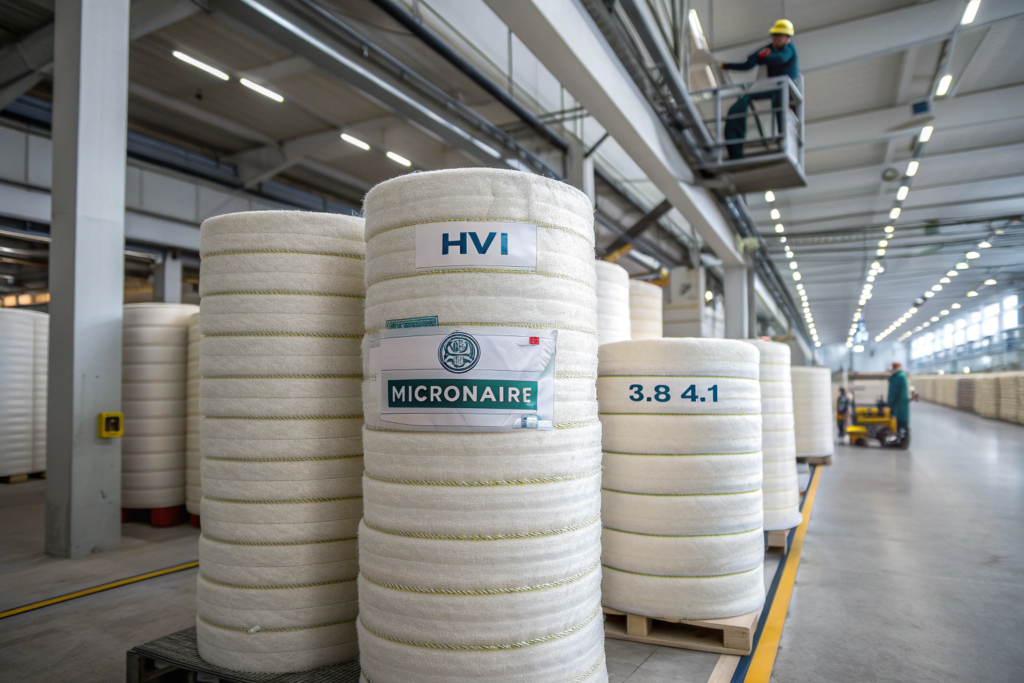
What is the maximum acceptable standard deviation for Mic in a single compact yarn lot?
I hold our spinning department to a maximum standard deviation of 0.15 across a single production lot. To put that in perspective, the USDA considers a 0.1 to 0.2 deviation within a bale as "uniform." We demand that same level of uniformity across 100 bales. That’s ten times the sample size, and I require the same precision.
Statistically, a standard deviation of 0.15 means that 95% of the yarn cones in that 20,000-kg order will have a fiber fineness between, say, 3.7 and 4.0 if the target is 3.85. We achieve this by doing something called "laydown optimization." Our software analyzes the HVI data of every bale in our warehouse. It then calculates the precise sequence and number of bales to feed into the bale plucker at any given moment. I don’t let a spinner "grab and go." Every bale placement on the floor is scripted. For a 20,000-kg order we shipped to a German home textile brand in January 2026, the post-production audit showed a lot average micronaire of 3.92 with a standard deviation of just 0.11. The dye uptake across 150 rolls was visually identical. For textile engineers interested in the statistical methods behind laydown management, the process control methodologies discussed on Quality Digest’s textile section are a great external reference for understanding this level of statistical rigor.
How does micronaire variation impact the dye uptake in a single pantone color match?
Even a 0.3 difference in Mic can shift the visible shade by half a Pantone chip. This is a daily laboratory battle. Fine fibers have vastly more surface area per gram. They reflect light differently. They also absorb dye faster. If a batch of yarn has a hidden pocket of 4.4 mic cotton among a mostly 3.9 mic lot, that section will dye lighter. Why? Because the thick fibers have less total surface area for the same weight of material, so less dye molecules can attach. The result is a pale, washed-out streak.
I witnessed this during a lab dip session in March 2024. We were matching a deep navy for a British school uniform program. The lab sample was perfect. The bulk sample came out with a faint grey stripe. I ran the AFIS test on the striped section. The micronaire was 4.5, while the rest of the fabric was 3.8. That 0.7 difference created a visible defect. We had to quarantine the high-mic bales and re-blend the entire lot. Since that day, our dyeing manager won’t release a bulk shade without a fiber fineness histogram of the entire yarn lot. It’s his first check, before he even looks at the spectrophotometer reading. If you’re working on critical color matches, you should always consult the comprehensive shade matching guides on the Pantone textile color system resource center, which provides the broader color communication context that fiber specs feed into.
What Is the Relationship Between Micronaire and Neps in Our Carded Upland Cotton?
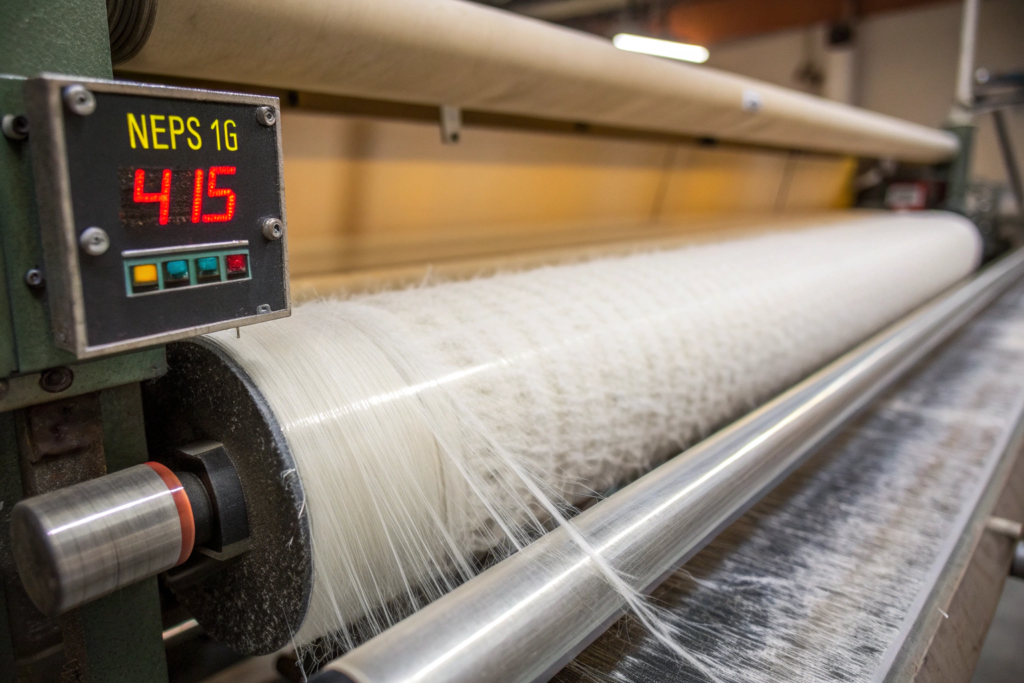
Neps are the tiny, tangled knots of immature or dead fibers that look like pepper spots on a finished shirt. They are the enemy of a smooth printing surface. And they are intimately connected to micronaire. But not in the way most people think. It’s not that coarse cotton always creates more neps. It’s that specific combinations of micronaire and maturity create the perfect storm. Un-mature, low-mic cotton (below 3.2) collapses into tiny balls during carding because the fiber walls are too thin and weak. On the other hand, very coarse, high-mic cotton (above 5.0) can entangle with itself like coarse wire, creating larger, more visible "seed coat neps." The sweet spot for a clean carded web is a mature, medium-micronaire cotton. Our 3.7 to 4.2 window is perfectly positioned to minimize both types of nep formation.
Why does 4.2 Mic upland cotton outperform 3.0 in carded nep count?
This surprises a lot of young textile graduates. They assume the finest, lowest-micronaire cotton makes the cleanest yarn. It doesn’t. Cotton with a Mic of 3.0 is often immature. Under the microscope, the fiber walls are paper-thin. It’s like trying to card tissue paper. The delicate fibers break easily during the aggressive opening and carding action. Those broken ends tangle up into fiber clusters. The Uster nep count in the card sliver can skyrocket to 250 neps per gram or higher. The yarn will look hairy and dusty, and it will dye with a grayish cast because of the uneven light reflection from the chaotic fiber surface.
We target 4.0 to 4.2 mic for our low-nep fine-count combed yarns. At this micronaire, the individual fibers have a "maturity ratio" typically above 0.90. The fiber walls are thick enough to withstand the high-speed carding wires without buckling. The fibers individualize cleanly, flow parallel to each other, and lock into the yarn twist without forming tangles. In a test we ran in February 2026 comparing a 3.1 mic organic lot versus a 4.0 mic conventional upland lot, the 4.0 mic lot produced 62% fewer neps in the carded sliver, despite being slightly coarser. The resulting knitted pique fabric was visibly cleaner. I always say, "Don’t fall in love with the fineness number. Fall in love with the maturity ratio." The actual field performance of cotton genetics in different growing climates is also well-documented by researchers at the International Cotton Advisory Committee (ICAC), who publish fantastic data on global cotton quality trends.
What machine setting offsets the nep potential of a high-micronaire blend?
If I have to use a batch of 4.5 mic cotton for a price-sensitive program—say, a heavy fleece interior layer where softness matters less—I can’t just run it through the standard card settings. Coarse fibers are stiff. They don’t bend easily around the carding cylinder. They tend to pop out of the wire teeth and roll around on the surface, gathering up other fibers into neps.
The fix is to tighten the carding gauge and increase the flat speed. I reduce the distance between the main cylinder and the carding flats by about 0.02 millimeters. This physically forces the stiff, rebellious fibers to align without giving them the space to roll into a ball. I also increase the flat speed by about 10%, which strips the neps out of the web faster before they can multiply. Last July, we processed a 4.6 mic batch for a canvas shoe upper. The raw cotton nep count was high, around 180 per gram. By tightening the carding gauge and slowing the production speed from 45 kg/hr to 35 kg/hr, we brought the finished sliver nep count down to 75 per gram. That’s a massive reduction that saved the visual clarity of the shoe. The technical adjustments I just described are the exact kind of practical machinery wisdom that is sometimes shared in the discussion threads over on the Textile School carding process optimization page, which is a great open resource for mill technicians who want to sharpen their skills beyond the equipment manual.
Conclusion
The micronaire value of upland cotton is not just a quality statistic; it’s a manufacturing GPS. It tells you exactly where your fabric is headed before a single meter is woven. We’ve covered the full journey today, from the raw bale to the finished collar that survives 20 industrial wash cycles. At Shanghai Fumao, we don’t just accept the industry’s wide range of 3.0 to 5.0 Mic and hope for the best. We lock in our sweet spot between 3.7 and 4.2 with a maximum standard deviation of 0.15 across an entire 20,000-kg lot. I showed you how a 1.0 point jump in micronaire can blow your air permeability rating from 45 CFM to 65 CFM, and why that destroys a formal shirting collar’s structure. I gave you the real connection between the fiber’s thickness and the dye bath’s outcome, where a 0.7 Mic pocket caused a visible grey stripe that cost us a school uniform rebatch. And I exposed the counterintuitive truth about neps: that ultra-fine, immature 3.0 Mic cotton often produces more tangled knots than a mature, robust 4.2 Mic cotton, simply because the cell walls are too weak to survive the carding wire.
These aren’t theoretical lab experiments. These are the daily production battles we fight and win in Keqiao. We use HVI testing on every bale, laydown optimization software for every blend, and strict ring-spinning protocols to tame coarseness when it’s unavoidable. You don’t need to guess about your cotton’s quality anymore. You can quantify it, track it, and weave it into a competitive advantage.
If you’re looking to source a fabric where the air permeability, dye shade, and softness are scientifically locked in from the bale stage, reach out to our Business Director Elaine at elaine@fumaoclothing.com. She can send you a digital copy of our standard upland cotton micronaire histogram, schedule a video call walkthrough of our HVI testing lab, or arrange a physical sample yardage from our current 3.9 mic stock lot so you can feel the difference consistency makes. Stop fighting invisible fiber variation. Let’s spec it down to the micron.








