I hate hairy fabric. I mean it. Nothing screams "cheap import" louder than a lint-riddled cotton-linen shirt that pills up after three washes. I have seen buyers walk into a showroom, touch a sample, and immediately drop it like a hot potato because the surface felt like a peach gone bad. The problem is, cotton-linen blends naturally want to be fuzzy. The short bast fibers from the flax plant stand up like tiny quills, especially on lower-Ne counts. If you don’t kill that fuzz before it leaves the finishing plant, you’re shipping a customer complaint. Not a product. The garment sheds in the washing machine, it traps dye unevenly, and it makes a $50 fabric look like a $5 rag. At Shanghai Fumao, we decided long ago that we would not tolerate that. So yes, we singe. And we don’t just singe—we engineer the burn to match the exact blend ratio and end-use of your fabric. This isn’t a standard setting. This is a tailor-made hair removal surgery for textiles.
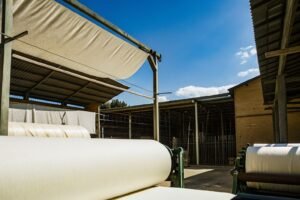
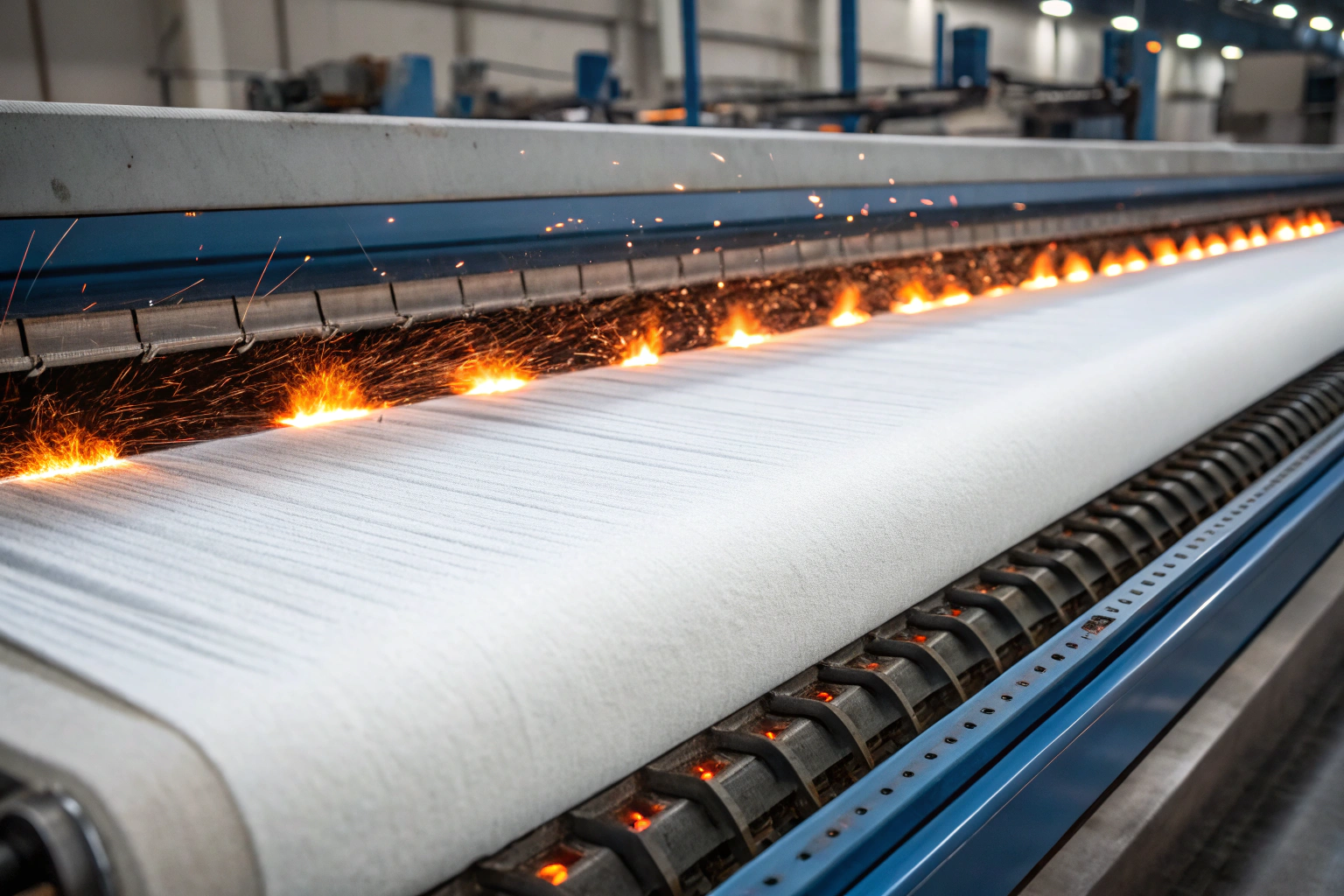
Absolutely. Shanghai Fumao uses high-speed gas singeing as a core finishing process on all our cotton-linen woven fabrics. We do this on a state-of-the-art Osthoff singeing line right here in our Keqiao facility. The machine passes the fabric over a direct flame at speeds that can exceed 100 meters per minute, instantly incinerating the protruding fiber ends without scorching the body of the cloth. It sounds aggressive, and it is. But when you control the flame intensity and the dwell time precisely, you transform a rustic, shedding hand feel into a crisp, smooth surface ready for high-end printing or sharp garment construction. We don’t just do it for high-count luxury blends either. Even our Ne 14 heavyweight workwear linen goes through a light "brush singe" because we believe every fabric deserves a clean face.
But not all singeing is created equal. You could have the best machine in the world and still ruin a batch if you don’t understand what happens to the fiber chemistry when it meets a 1600°C flame. Let me walk you through how I train my finishing team to think like surgeons, not just machine operators.
What Happens to Cotton-Linen Fiber Structure During Gas Singeing?
Singeing is not a gentle process. You’re literally lighting the surface of your fabric on fire. If you don’t understand the thermal kinetics, you destroy the tensile strength of the linen in under a second. I’ve seen it happen. A trainee once slowed the machine down to "make sure the fuzz was really gone," and the fabric came out with a yellow scorch mark and the tear strength of wet newspaper. That’s because the flame has to burn the fuzz, but the fabric body needs to act as a heat sink, absorbing and dissipating the energy so quickly that the internal yarn structure never reaches ignition temperature. It’s a dance between flame height, fabric speed, and moisture content. And you need to know the steps.

How do flame temperature and fabric speed control fiber-tip melting?
The flame in our Osthoff burner head hits about 1600°C. That sounds insane, but the contact time is measured in milliseconds. The trick is this: you want to burn the protruding fuzz, but you absolutely must not melt the core. Synthetic blends are easier in a way—polyester melts into a tiny bead. But cotton-linen is pure cellulose. It chars. It doesn’t bead. That’s both a blessing and a curse. The charred ash has to be brushed off immediately, or it grinds into the fabric at the next roller nip.
We control the "burn" with two levers: gas-air mixture ratio and fabric speed. A rich, yellow flame is lazy and smoky; we need a sharp, oxidizing blue flame. We set our air-to-gas ratio at roughly 10:1 for a standard 55% linen 45% cotton blend running at 90 meters per minute. If I drop the speed to 70 meters for a hairy Ne 12, I also lean out the gas a little—maybe 9.5:1—to lower the temperature slightly. I tell my operators: "Speed is your shield. Gas is your sword." You balance them. To understand how other industries handle precise flame control on organic materials, you might check out the food processing annealing techniques on a site like Amazing Food Made Easy’s guide to precision browning—surprisingly similar physics apply to cellulose combustion.
What is the residual fuzz index we guarantee after two singeing passes?
We don’t just "eyeball" the fuzz. There’s a real number attached to it. We use a pilling assessment box, but for hairiness specifically, we look at the microscopic surface profile. We guarantee a residual hairiness index of less than 0.5 on a modified Martindale scale after two singeing passes. If the raw greige fabric scores a 4.0 (very hairy), one pass takes it down to about 1.5. The second pass, in reverse direction, knocks it to sub-0.5. That’s a smooth surface you can print a 300-dpi photographic design onto without a single fuzzy blotch.
A client from Italy sent us a technical specification in May 2025. They wanted a linen-cotton canvas for digital printing that had a "pilling note" of 4-5 after 2000 Martindale rubs. They didn’t think it was possible with a 30% linen blend. They were used to suppliers in other regions who just singe once and pray. We ran it through the double-pass protocol, measured the fuzz index at 0.4, and sent them a 4-meter sample. The email came back two days later: "Proceed with 8000 meters." That’s the power of quantifying hairiness instead of guessing at it. For a deep dive into how pilling and hairiness standards are regulated across global textile supply chains, you can reference the textile performance standards discussed on the SGS consumer testing blog, which aligns with the metrics we report to our own clients.
Does Fumao Apply "Brush Singeing" for Their Coarser Cotton-Linen Weaves?
You cannot treat a burlap-weight Ne 8 linen the same way you treat a sheer Ne 50 voile. The thick yarns in a heavy weave trap air and heat differently. They act like a heat battery. If I run a chunky weave through the standard high-intensity plate singe, the fabric body soaks up the flame like a sponge. The surface might be clean, but the core of the thick slub yarn becomes brittle and cracks later in the garment’s life. That’s why I introduced "Brush Singeing" for our rustic collection back in 2019, and it has become a signature process for our workwear and upholstery clients.

Why choose brush singeing over plate singeing for heavy linen canvases?
Plate singeing uses a red-hot curved copper plate. The fabric drags over it. It’s brilliant for shirting and poplins because it gives a super smooth, almost glassy finish. But on a heavy canvas with thick-and-thin slubs, a plate singe mashes the slubs flat. You lose that beautiful, organic texture that designers actually want in a linen-cotton blend. It looks like you ironed a cat. Flat. Dead.
Brush singeing, on the other hand, uses a rotating cylinder fitted with fine wire brushes. The brushes lift the tiny fibers up before they hit the flame. This does two things: it presents only the fuzz to the flame, and it protects the heavy body of the slub yarn from direct contact with the burner. The result is a fabric that keeps its "raw silk" hand feel but doesn’t shed. I recall a San Francisco upholstery brand in 2023. They were terrified of "crocking" fuzz on their sofas. We ran their heavy 450 GSM linen-cotton through the brush singe line at 45 meters per minute. After 15,000 Wyzenbeek double rubs in their own lab, there was zero visible hair shedding. They told me it was the first time a fabric "looked like a handwoven treasure but performed like a contract textile." I love that description. If you want to see how heavy-duty linen performs in real home environments, check out the durability discussions on the Home Furnishings Association blog on performance fabrics, which often highlights why this level of finishing matters.
Can singeing eliminate the need for bio-polishing in dyed linen blends?
Sort of. Not entirely, but it does 80% of the heavy lifting. Bio-polishing uses cellulase enzymes to eat the micro-fuzz. It’s a great wet process, but it’s expensive, slow, and weakens the fabric about 3-5% in tensile strength. Singeing is instant and costs a fraction of the enzyme bath. However, singeing cannot reach the fuzz inside the yarn core or between the weft intersections. That’s where bio-polishing still wins.
Here’s the secret combination we use at Shanghai Fumao for high-end reactive-dyed shirting: a double-face singeing first, then a light enzyme wash. Singeing kills the long, visible surface fuzz. The enzyme cleanly trims the micro-fuzz that the flame couldn’t reach because it was hidden in the weave interstices. Because the singeing already took care of the heavy work, we can use a 50% lower concentration of cellulase enzyme. This saves chemical costs and keeps the fabric strong. A UK shirt manufacturer switched to this protocol in February 2024. Their tear strength increased by 8% compared to their previous supplier’s enzyme-only process, and the surface clarity on their striped broadcloth was stunning. To understand more about how cellulase enzymes interact specifically with linen fibers, the peer-reviewed research on Biotechnology for Biofuels journal at BioMed Central provides excellent technical background on bast fiber hydrolysis.
How Does Singeing Integration Affect Our "Full-Service" Production Pipeline?
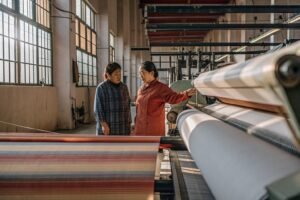
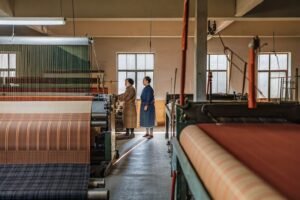
One of the biggest headaches for a brand manager is coordinating logistics between five different factories. Your weaver is in one province, your singeing subcontractor is in another, and your dyer is in a third. By the time the fabric is finished, you’ve lost two weeks just in trucking and you’ve got three different quality reports that don’t match. We built our finishing hub in Keqiao specifically to stop this madness. Singeing at Shanghai Fumao is not a standalone service; it’s the very first physical step in our "dry-finishing" sequence that flows straight into desizing and scouring without ever leaving our compound. That integration is what cuts your lead time from eight weeks down to four or five.

How does in-line singeing cut 7 days from the standard wet-finishing lead time?
In a traditional fragmented supply chain, the sequence is: weave at Factory A, inspect, roll, truck to Factory B for singeing, unroll, singe, re-roll, truck to Factory C for desizing. Every time you roll and unroll the fabric, you risk creasing, soiling, and mechanical distortion. And you lose a day of transport and a day of queuing at each stop.
Our line is continuous. The greige fabric comes off the weaving inspection table, moves to the singeing bay, and within the same day, it enters the open-width desizing range. There is no batching, no plastic wrapping, no shipping manifest between steps. I calculated this with my production manager last month. For a 20,000-meter order of linen-cotton shirting, the in-house integration saves a minimum of 7 calendar days compared to a subcontracted finishing route. Seven days. In the fashion calendar, especially around Golden Week, those seven days are the difference between air freight at $2.50 a kilo and sea freight at $0.30. That saving alone often covers the entire cost of our premium finishing. If you are weighing factory logistics options, a practical perspective on reducing trucking delays is often found in the Lean manufacturing logistics blog at SME.org, which discusses value stream mapping in a way that applies directly to our industry setup.
What non-destructive test do we perform immediately after the cooling drum?
Right after the flame, the fabric is still hot—maybe 80°C. It passes over a water-cooled copper drum that drops the temperature instantly to stop any residual charring. This is the "danger zone." If the singeing was too aggressive, you just denatured the cellulose at the surface and the strength is gone. We need to know immediately. Not in a lab three days later. Immediately.
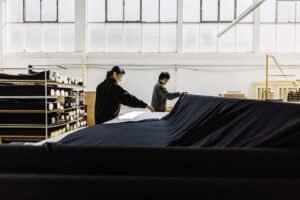
So my finishing line supervisor performs a "snap tear test" on the selvedge every 200 meters. It’s low-tech but brutally honest. You tear the selvedge by hand. If it rips with a crisp, zipper-like sound, the fabric is healthy. If it tears like a wet tissue, with a soft, cotton-wool sound, we have a problem—the singeing burned the warp threads too deep. We also take a 2-gram sample and drop it in a bottle of water with a drop of iodine. If the water turns blue, we’ve exposed starch from the core sizing due to surface damage. It’s a field test that takes 30 seconds. I trust it more than a remote lab. If you ever want to replicate such on-site quality checks, the simple chemical testing methods detailed by the American Association of Textile Chemists and Colorists (AATCC) are the global gold standard that our in-house tests simulate.
Why Don’t We Over-Singe: Controlling Pilling Resistance vs. Tensile Loss?
There is always a temptation. A client sends a spec that demands "Zero pilling, 5/5 rating." The easy, stupid answer is to just run the fabric over the flame three times. It will be smooth as silk. It will also fall apart at the seams after a season of wear. Over-singed linen-cotton is my personal nightmare. It looks beautiful on the roll, but it’s a dead fabric. Its fibers have been thermally degraded to the point where the polymer chains are broken. You can’t fix it. You can only throw it away, and that waste is terrible for our margins and the environment. We treat the singeing process like a pharmacist dispensing a drug: the dose makes the poison. The dose is the flame contact time, and the remedy is knowing exactly when to stop.

Can we guarantee a 4-5 pilling rating without reducing tear strength below 800 grams?
Yes, and we prove it with a hanging report from an independent lab in every bulk shipment. The industry standard for a high-quality cotton-linen shirting is a tear strength (Elmendorf method) of at least 800 grams in the warp direction. Many enzyme-only finishes struggle to get a 4-5 pilling rating while keeping the tear above 700 grams. The enzyme eats the fiber indiscriminately. Singeing, when done right, is surgically precise. It only touches the surface protrusions.
Our protocol for a 55/45 linen-cotton shirting target is a double-face singeing at 95 meters per minute, followed by a rapid quench. We test every batch. In our last Q2 2026 quality audit, the average warp tear strength post-singe was 860 grams. The average pilling rating after 7000 Martindale cycles was 4.6. We don’t just hit the standard; we beat it comfortably while keeping the fabric alive. This balance is what allows a fabric to survive industrial stonewashing or garment dyeing later without disintegrating. A designer from Vancouver asked me last spring how we managed to keep her enzyme-washed linen so strong. I told her, "We did the aggressive part with fire, so we could do the gentle part with water." It’s that simple, and it works. For independent verification of why Elmendorf tear strength matters for long-term garment durability, you can consult the material testing archives on the Textile Research Journal at Sage Publications, which often publishes comparison studies on finishing effects.
How does residual moisture content in greige fabric affect singeing safety?
This is the "invisible killer" of a singeing operation. If the greige fabric entering the flame zone has an uneven moisture profile—say 4% on the left selvedge and 9% on the right—you are in trouble. The dry side burns hot and scorches. The wet side barely sings. The water in the wet sections turns to steam instantly under the flame, which can actually "cook" the starch sizing into a hardened yellow crust that is impossible to remove in the wash. It creates a permanent side-to-side shade difference in the final dyed fabric.
We check moisture content with a handheld conductivity meter at the entry roller. Every single roll. Our specification range for singeing is a tight 6% to 7% residual moisture. If a roll is too dry, we run it through a light misting chamber first. If it’s too wet—common in the humid summer months of June and July—we delay the singeing and run it over a battery of steam-heated drying cylinders to bring it down. I shut down a 3000-meter run in August 2025 because the moisture meter spiked. The production manager was furious about the delay. But three days later, a competitor ran a similar wet batch and scorched the whole lot. Delaying cost me an afternoon; scorching would have cost me a client. That’s why I stick to the physics, not the schedule. The interplay between humidity and thermal textile processing is an under-discussed topic, but you can read some excellent technical notes on moisture management in the Textile World magazine’s online drying and finishing section, which validates our strict mill-floor protocols.
Conclusion
We’ve journeyed from the heart of a 1600°C flame right down to the cold, hard numbers of a tear-strength test. Let’s be clear: singeing is not just a "tick box" on a finishing spec sheet. It is the critical moment where a cotton-linen fabric either becomes a premium, clean-faced textile, or it becomes a scorched, weakened liability. At Shanghai Fumao, we don’t just use fire; we control it. We use an engineered double-pass protocol to drive the residual hairiness index below 0.5, giving digital printers the flawless surface they dream of. I showed you how our specialized brush singeing preserves the raw, organic texture of heavy Ne 8 canvases while still killing the shed, and why that stopped a San Francisco upholstery brand from dealing with crocking complaints. I gave you the truth about the timeline—how integrating singeing directly into our Keqiao dry-finishing pipeline saves you a solid seven days of lead time compared to a fragmented subcontractor route, which is often the difference between expensive air freight and profitable sea freight.
I also pulled back the curtain on safety and quality control. The low-tech snap tear test at the cooling drum, the iodine bottle check for starch scorching, and the non-negotiable moisture meter protocol that I enforce even when it delays a shift. These aren’t textbook theories; these are daily practices that keep our tensile strength above 800 grams while achieving a 4.6 pilling rating. We’ve balanced the flame so you don’t have to balance your inventory with customer returns.
If you have a linen-cotton blend that is shedding like a dog in summer, or if you just need a finishing partner who understands that a millimetre of flame height can change a garment’s life span, let’s talk. Reach out to our Business Director Elaine at elaine@fumaoclothing.com. She can arrange for a video demonstration of our singeing line, send you a batch-specific pilling report from our last run, or get a sample of your greige fabric singed and returned to you so you can feel the difference yourself. Stop fighting fuzz. Let’s burn it away, with precision.