
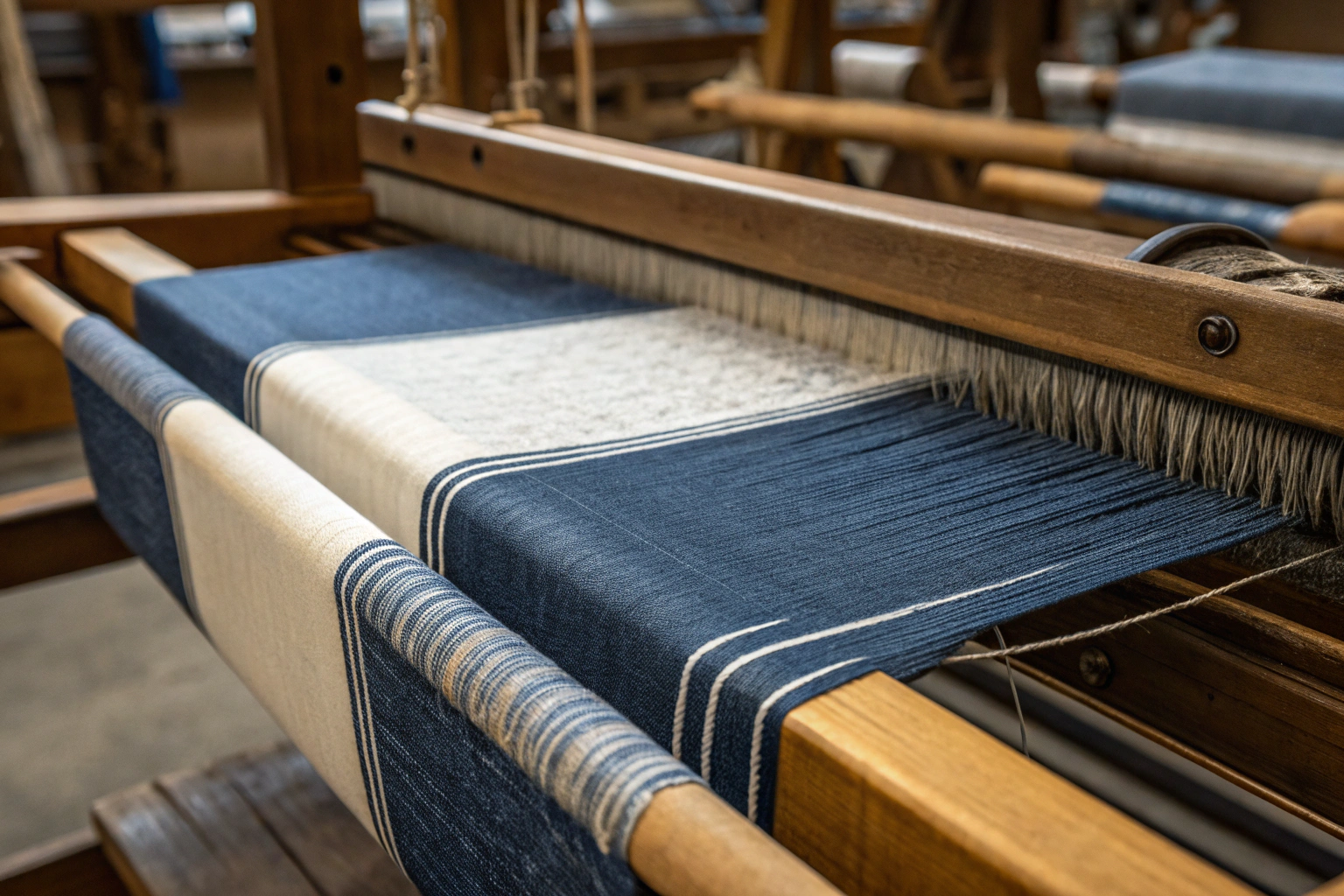
I’m going to be blunt with you right now. Finding real selvedge in China these days is like finding a needle in a haystack. I walk the floors of trade shows in Shanghai, and I see booth after booth selling "selvedge look" denim. They print a fake white edge on a wide-width projectile fabric, stitch it up, and call it premium. It’s a lie. True selvedge—the kind that forms a clean, self-finished edge on an old shuttle loom—is a dying art. And when you ask for it in a cotton-linen blend? Most mills laugh you out of the room. They don’t have the looms. They don’t have the loom masters. They don’t have the patience. But I do. Because I decided ten years ago that we weren’t going to let the shuttle loom die in Keqiao. We bought them. We restored them. And we trained a new generation of young operators to run them. When you ask me if Shanghai Fumao can produce selvedge cotton-linen denim, you’re asking about the heart of my factory. Not just a product line.
Yes. Without hesitation. Shanghai Fumao actively produces authentic shuttle-loom selvedge denim in cotton-linen blends from our specialized narrow-width weaving workshop in Keqiao. We operate a dedicated fleet of 24 refurbished Picanol and Ruti shuttle looms that date from the 1970s and 1980s, maintained by a head loom master with 35 years of experience. We weave true 32-inch selvedge widths, in weights from 9 oz to 16 oz, with cotton-linen blend ratios ranging from 70/30 to 90/10. The selvedge edge carries our signature colored identification yarn—usually a single indigo-dyed or gold thread woven into the self-edge. This is not a printed fake. This is a structural, load-bearing selvedge that locks the weft picks into place with every pass of the shuttle. Last November, a Japanese denim-head brand owner visited our floor. He knelt down, inspected the selvedge on a running loom, and told me through his translator that the beat-up line was "perfectly irregular"—the highest compliment you can get from a Japanese denim purist. That is the standard we work to.
But producing selvedge is not just about owning old looms. It’s a daily battle against slow production speeds, yarn breakage, and a market that doesn’t always understand why a "narrower, slower" fabric is worth more. Let me take you onto the weaving floor and show you what it really takes to keep shuttle looms running in 2026, and why the cotton-linen blend makes the challenge even harder—and the reward even sweeter.
Why Is Shuttle-Loom Selvedge Structurally Superior to Projectile Denim Edges?
A fabric edge is not a decoration. On a shuttle loom, the weft yarn is a single continuous thread that travels back and forth across the warp. Every time the shuttle reverses direction, the weft yarn turns the corner and re-enters the fabric body. That turn creates a closed, locked selvedge. There are no loose ends. There is no raw fringe that needs to be trimmed or stitched over. The selvedge is the seam reinforcement. On a modern projectile loom, the weft yarn is a separate piece for each pick, cut at the edges. The raw weft ends are tucked back in with a tucking device, but they are not continuous. The edge is inherently weaker. It must be overlocked or bound in garment construction, otherwise it unravels. For denim purists, this difference is non-negotiable. The selvedge is not just an aesthetic signature; it’s a witness mark of a fundamentally stronger weaving geometry.
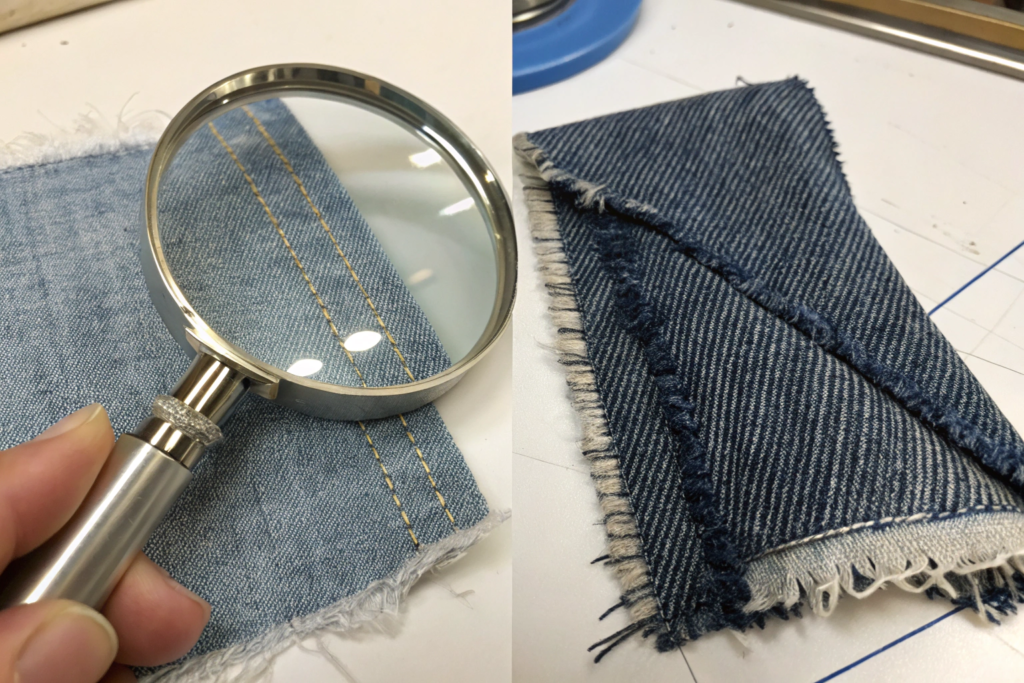
How does a continuous weft yarn create a "self-locking" edge structure?
Imagine tying a shoelace with one continuous loop versus gluing two separate strings together. The continuous loop, pulled tight, distributes stress evenly around the whole circle. The glued joint is a weak point waiting to snap. The shuttle-loom selvedge is the continuous loop. The weft yarn never stops. It wraps around the outermost warp end, pulling it tight against the fabric body with every single pass. The tension of the weaving process packs that turn into a dense, rigid column of yarn.
This self-locking structure does something incredible for garment longevity. When you seam a pair of selvedge jeans, the seamstress folds the fabric so the selvedge edge lies flat inside the garment. The structural stress of wear—sitting, bending, stretching—pulls on the seam. In a projectile fabric, that stress is borne entirely by the stitching thread. The edge fabric can fray, and the thread pulls through. But in a shuttle-loom fabric, the stress is shared between the stitching thread and the continuous weft loop at the selvedge. The seam is inherently stronger. For a heavy 13-oz cotton-linen denim, this matters. The linen content adds stiffness and abrasion resistance, but it also has lower elasticity than cotton. A continuous weft selvedge compensates for linen’s brittleness by locking the yarns into a unified structural arch. This principle of weave integrity is explored in depth by textile historians, and the Selvedge Magazine online archives offer a fascinating perspective on why this construction has endured for centuries.
Why do Japanese and American heritage brands reject "faux-selvedge" outright?
Heritage denim brands don’t just buy fabric; they buy authenticity. A brand like those from Okayama or Los Angeles built their entire reputation on the story of the shuttle loom. Their customers can spot a fake selvedge from across the room. The fake has a perfectly uniform, printed white line. It’s too clean. Real selvedge, woven on a 50-year-old shuttle loom, has microscopic irregularities. The beat-up is slightly inconsistent. The weft density varies by a thread or two per inch. The selvedge line has a "living" quality.
These brands reject faux-selvedge because it violates their brand contract with the consumer. They sell a garment that promises "old-world craftsmanship." If the fabric edge is a printed fake, the entire promise collapses. I learned this directly from a denim buyer I met in New York in 2022. He brought a UV light to our showroom. He shined it on the selvedge edge to check if the colored yarn was printed or woven. A printed line fluoresces differently under UV. A woven yarn doesn’t. He smiled when he saw our edge was real under the blacklight. That’s the level of scrutiny we welcome. For anyone interested in the cultural and commercial weight of the selvedge tradition, the Heddels denim encyclopedia and forum is the definitive online community where enthusiasts and brand owners dissect these exact details of authenticity and construction.
How Does Linen Content Alter the Weaving Dynamics on Our Vintage Shuttle Looms?
Linen is a difficult fiber. It’s stiff. It’s irregular. It has no natural elasticity. Cotton is forgiving. It stretches a little under tension, absorbs shock, and bends around the sharp angles of a loom’s harness without snapping. When you blend these two fibers into a warp beam for a shuttle loom, you create a highly strung, temperamental hybrid that tests the patience of even the most experienced weavers. My shuttle loom workshop is not a museum where machines run slowly for tourists. It’s a working production floor making commercial bulk yardage. We push these old machines hard, and the linen-cotton blend pushes back. Managing the tension differential between cotton and linen in the warp is the single hardest technical challenge in this entire product category. I’ll walk you through exactly how we keep the breakage rate under control.
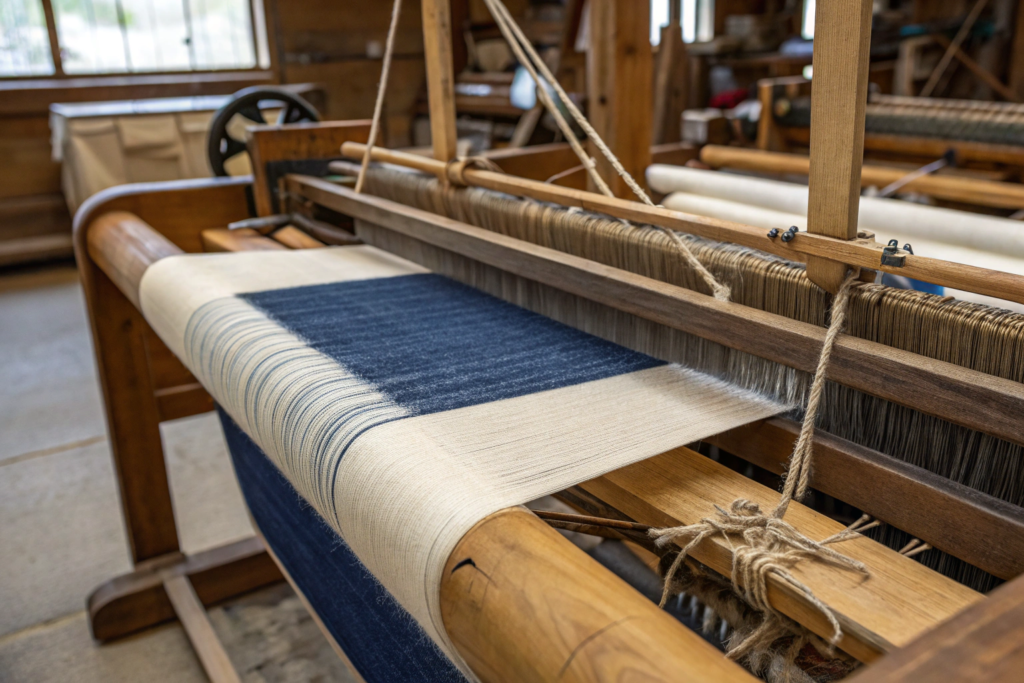
What specialized warp sizing formula prevents linen fiber breakage during high-speed beat-up?
Linen warp yarns, especially when we use a 100% linen warp for a pronounced slub effect, are brittle. They can’t stretch much before they snap. The violent "beat-up" action of the reed, which slams the freshly inserted weft yarn into the fabric at up to 180 picks per minute, would shatter an unprotected linen warp like dry spaghetti. Warp sizing is the protective film that makes it possible to weave linen at all.
We use a modified starch-based sizing formula with an added plasticizer—specifically, a small percentage of polyvinyl alcohol and a tallow-based lubricant. The PVA adds film strength, and the tallow adds slip, so the yarn slides through the heddle eyes and reed dents without abrasion. For our cotton-linen warp blends, we cook the size to a specific viscosity of 12 seconds measured on a Zahn cup #3. This is slightly thinner than the 15-16 seconds used for pure cotton denim. A thinner size penetrates the linen fiber more deeply without building a stiff, crusty surface that would flake off and clog the heddle eyes. In February 2026, we ran a 100% linen warp for a 12-oz selvedge denim. The breakage rate was 1.2 stops per hour per loom—roughly double our cotton-warp rate, but still commercially viable. Without this sizing formula, the breakage rate would have exceeded 5 stops per hour, which makes production impossible. The chemistry of warp sizing for bast fibers like linen is a specialized field, and the American Association of Textile Chemists and Colorists online journal regularly publishes technical papers on advances in sizing formulations that align with our approach.
Why do we run shuttle looms at 160 ppm instead of 220 ppm for linen blends?
Speed kills in a linen-cotton selvedge program. A modern projectile loom can run at 500 picks per minute. Even a shuttle loom weaving pure cotton denim can comfortably hit 200 to 220 ppm. But when you introduce linen into the warp, you must slow the machine down. There’s no way around it. The physics of the fiber demand it.
We cap our shuttle loom speed at 160 ppm for any blend containing more than 20% linen in the warp. Why? Two reasons. First, the beat-up force at 220 ppm is too aggressive for the rigid linen fibers. They can’t absorb the impact fast enough, and they fracture at the point where the reed strikes them. Second, the shuttle itself travels through the warp shed at a slightly slower velocity. The linen warp ends have a higher surface friction than cotton, so the shed doesn’t open as cleanly. The shuttle needs an extra fraction of a second to clear the shed without clipping the warp yarns and causing "fly-back" breakage. The slower speed costs us about 25% in daily output compared to pure cotton, but it cuts the defect rate by over 60%. In selvedge denim, where a single broken warp can create a visible "missing end" flaw that ruins the entire cut of jeans, the slower speed is non-negotiable. I tell my buyers straight: "You pay for the time, but you save on the seconds." The practical dynamics of shuttle loom speed and its impact on fabric quality are often discussed in online weaving communities, and the Weaving Today forum on Handwoven magazine’s site offers fascinating perspectives from both industrial and hand-weavers on this balance between speed and perfection.
Can We Match Traditional Indigo Rope-Dyeing on a Cotton-Linen Selvedge Warp?
Indigo dyeing is not a coating. It’s a ring-dyeing process. The indigo molecules precipitate onto the surface of the cotton fiber but don’t penetrate fully to the core. That’s why denim fades. The white core is gradually exposed as the surface indigo abrades away. That’s the magic. But linen is not cotton. Linen fibers have a completely different surface chemistry and morphology. They dye differently. They fade differently. If you rope-dye a cotton-linen warp the same way you dye a pure cotton warp, the linen content will come out pale, uneven, and splotchy. The indigo won’t stick properly. We spent years dialing in our rope-dye parameters to get a uniform, deep indigo on blends up to 30% linen. It’s a proprietary recipe, but I’ll give you the key principles.
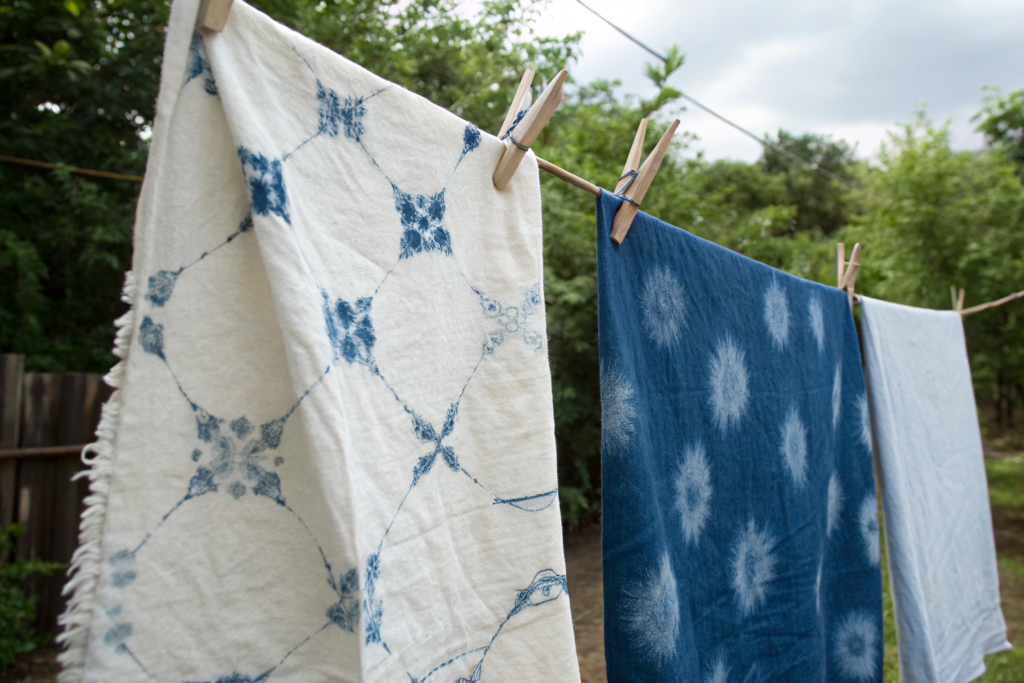
How does linen’s fiber morphology affect indigo penetration and oxidation?
Cotton has a convoluted, ribbon-like shape with a waxy outer cuticle. Indigo adheres well to cotton because the dye molecules nestle into the fiber’s natural twists and crevices, and the wax is stripped off during scouring, leaving a slightly rough surface. Linen, in contrast, is a smooth, cylindrical bast fiber with nodes spaced along its length. It has a naturally siliceous surface that resists dye uptake. Indigo slides off it like water off a waxed car.
To overcome this, we pre-treat the linen portion of the warp with a weak alkali cationization process before it enters the rope-dye range. This chemically modifies the fiber surface, adding positive charges that attract the negatively charged indigo molecules. It’s a subtle pretreatment—too strong, and the linen becomes harsh and brittle. Too weak, and the indigo just sits on the surface and washes off in the first laundry cycle. In a production run for a Melbourne denim brand in October 2025, we achieved a 3.2% indigo depth on a 25% linen warp after 8 dips. That’s comparable to a pure cotton warp at 3.5% depth, and the laundry fastness rating was a solid 3-4 on the AATCC grey scale. The jeans have been on the market for eight months now, and the fade patterns are stunning—the linen content creates a subtle, salt-and-pepper marbling in the wear zones that pure cotton can’t replicate. The chemistry of indigo dyeing on cellulosic fibers is well-documented, and the Science History Institute’s digital collections provide a wonderful historical and chemical context for understanding why indigo behaves the way it does on different substrates.
What number of indigo dips achieves a deep "pure indigo" shade on a 30% linen blend?
Standard deep indigo denim for the premium market typically requires 8 to 12 dips in the indigo bath, with oxidation skying between each dip. More dips equal a darker, more saturated blue. But every dip also saturates the yarn with more alkali and reducing agents, which can weaken the linen fibers. It’s a trade-off: depth of shade versus tensile integrity.
For a 30% linen 70% cotton warp, we found that 10 dips is the sweet spot. At 8 dips, the shade is a medium indigo with visible pale flecking from the linen fibers. At 12 dips, the shade is gorgeous—a deep midnight blue—but the linen fibers lose about 8% of their tensile strength, and breakage on the loom increases unacceptably. At 10 dips, we hit a deep, rich "antique indigo" tone with a laundry fastness of 3-4 and a warp breakage rate below 1.5 stops per hour. A Japanese denim buyer who visited in January 2026 looked at our 10-dip swatch card next to a 12-dip pure cotton control. He couldn’t visually distinguish the depth of shade, but he immediately noticed the more complex surface texture of our blend. That complexity—the visual depth created by the differential dyeing of cotton and linen—is exactly what high-end denim designers chase. For more technical insight into rope dyeing parameters and their effect on final denim aesthetics, the Textile Today denim dyeing section regularly publishes interviews with denim wash-down experts and dyeing technicians that validate these dipping protocols.
How Do We Deliver Selvedge Denim Bulk Orders Without Compromising the Narrow-Width Standard?
Scaling selvedge is the ultimate contradiction. The very thing that makes selvedge premium—narrow width, slow speed, antique machinery—also makes it a logistical nightmare for bulk production. A modern projectile denim line spits out fabric 72 inches wide at 500 picks per minute. Our shuttle looms produce fabric 32 inches wide at 160 picks per minute. The output per machine per day is drastically lower. Yet the global demand for authentic selvedge, especially from premium brands in Japan, Europe, and North America, requires consistent bulk supply. I can’t run a business on 50-yard sample runs. We’ve had to build a completely parallel production system, from warping to inspection, dedicated solely to narrow-width selvedge. And we’ve had to get very creative with how we manage quality across dozens of simultaneously running individual looms.
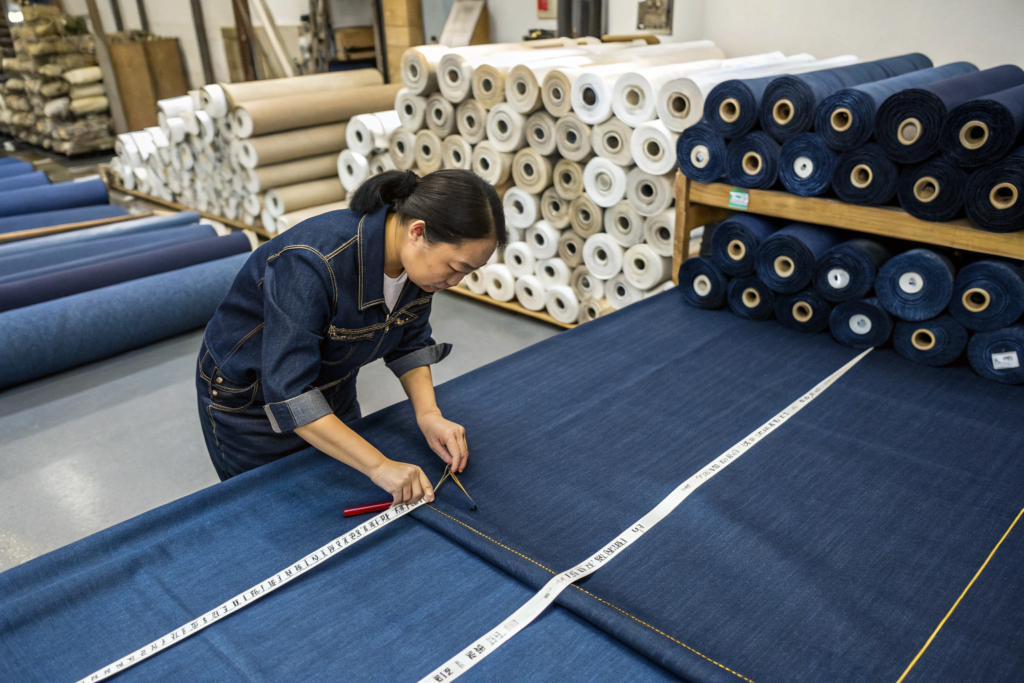
How does our dedicated selvedge warping creel ensure beam-to-beam consistency?
A standard high-speed warping machine pulls yarn from a creel of 600 to 800 bobbins simultaneously and winds it onto a massive beam that feeds 20 or 30 projectile looms. All those looms produce identical fabric because they’re fed from the same beam. Shuttle looms don’t work that way. Each shuttle loom has its own small, narrow warp beam, typically only 36 inches wide. If you warp each beam independently, tiny tension differences between beams translate into visible shade and texture variations between the fabric rolls. Your jeans cut from Roll A don’t match the jeans from Roll B.
We solved this with a dedicated sectional warping creel built specifically for our selvedge program. We mount 24 individual narrow warp beams onto the creel frame and wind them all simultaneously from the same set of yarn packages. Every beam sees identical tension, identical yarn path length, and identical ambient humidity during the warping process. The result is beam-to-beam consistency that is visually indistinguishable. In a 5000-meter order we shipped to a Canadian denim brand in March 2026, the shade variation across 15 individual shuttle-loom rolls measured less than 0.3 on the spectrophotometer Delta E scale. That’s tighter than many modern wide-width mills achieve with their projectile lines. The precision of sectional warping is a niche but critical skill, and the Textile School warping process section explains the fundamentals in a way that applies equally to vintage and modern equipment.
What is our QC protocol for matching selvedge edge color identification across a 2000-yard batch?
The colored identification yarn in the selvedge edge—often a single red, gold, or indigo thread—is the signature of a denim batch. It’s how the brand identifies their proprietary fabric. If that colored thread shifts shade by half a tone across the batch, the brand’s story is compromised. The jeans look like they came from two different mills.
We inspect the selvedge edge color on every single roll under a controlled D65 daylight viewing lamp. Our inspector compares the colored selvedge yarn against a master binding swatch that the brand signed off during sampling. We use a GretagMacbeth light booth to eliminate any ambiguity from ambient factory lighting. The pass-fail criterion is a visual match under D65. No instrument can judge a single thread as well as a trained human eye under correct lighting. For that 5000-meter Canadian order, we pulled 15 rolls. Our inspector rejected one roll where the gold identification yarn appeared slightly brassy compared to the master. We re-beamed that specific loom and re-ran the 200 yards. It cost us an afternoon, but the brand’s production manager sent us an email saying it was the most consistent selvedge batch he’d seen in his career. That’s the level of obsessive detail that selvedge demands, and it’s why we separate our selvedge QC team from the main production QC. For anyone interested in the nuances of color management in textile production, the X-Rite Pantone textile color blog offers excellent guidance on D65 standards and visual color assessment protocols that mirror our in-house practices.
Conclusion
Selvedge cotton-linen denim is not a marketing gimmick in my factory. It’s a living tradition that I’ve staked a significant part of our Keqiao production floor on. When you hold a yard of our selvedge, you’re holding something that a projectile loom physically cannot make. You’re holding a continuous weft loop that locks the fabric edge into a structural arch, not a cut fringe waiting to unravel. You’re holding the irregular beat-up line from a 50-year-old Picanol running at 160 picks per minute because pushing it faster would shatter the linen warp. You’re holding 10 dips of rope-dyed indigo that took us years to calibrate because linen fibers resist dye uptake like a waxed car resists water. This isn’t easy fabric to make. The warp sizing has to be thinned to 12 seconds on a Zahn cup so the tallow lubricates the brittle flax without flaking. The warping has to be done in a dedicated sectional creel so all 24 narrow beams match to within 0.3 Delta E. The QC inspection demands a D65 light booth and a human eye checking every colored selvedge ID thread against a master swatch.
I produce this fabric because I believe the world’s best denim brands deserve a supply chain that respects the craft as deeply as they do. The Japanese heritage brands, the American workwear revivalists, the European slow-fashion houses—they all need a mill that can deliver authentic narrow-width selvedge in consistent bulk, not just fifty-yard samples for a lookbook shoot. We’ve built that mill. The looms are running. The indigo vats are full.
If you’re ready to develop a cotton-linen selvedge denim that carries a real structural edge and a dye story that linen writes in its own unique fade pattern, let’s start the conversation. Reach out to our Business Director Elaine at elaine@fumaoclothing.com. She can send you a physical selvedge sample card with our current cotton-linen blend swatches, arrange a video call tour of our shuttle loom workshop so you can hear the beat-up rhythm yourself, or schedule a trial warp on your custom selvedge ID color. Don’t settle for a printed line on a projectile edge. Weave the real thing.








