
You’ve ordered what was supposed to be a premium cotton shirting, but when the fabric arrives, it looks like it has varicose veins. Thin streaks, thick bands, and an uneven surface that makes printing a nightmare. The garment looks cheap, the customer notices, and your brand’s promise of “luxury” evaporates. This is the silent killer of textile quality: yarn unevenness. The problem isn’t that the cotton is bad—it’s that the spinning process didn’t control the mass variation of the yarn. You can’t see it on a spec sheet that just says “100% cotton,” but you can absolutely see it on the finished garment. The frustration is that most suppliers don’t even measure this, let alone guarantee it.
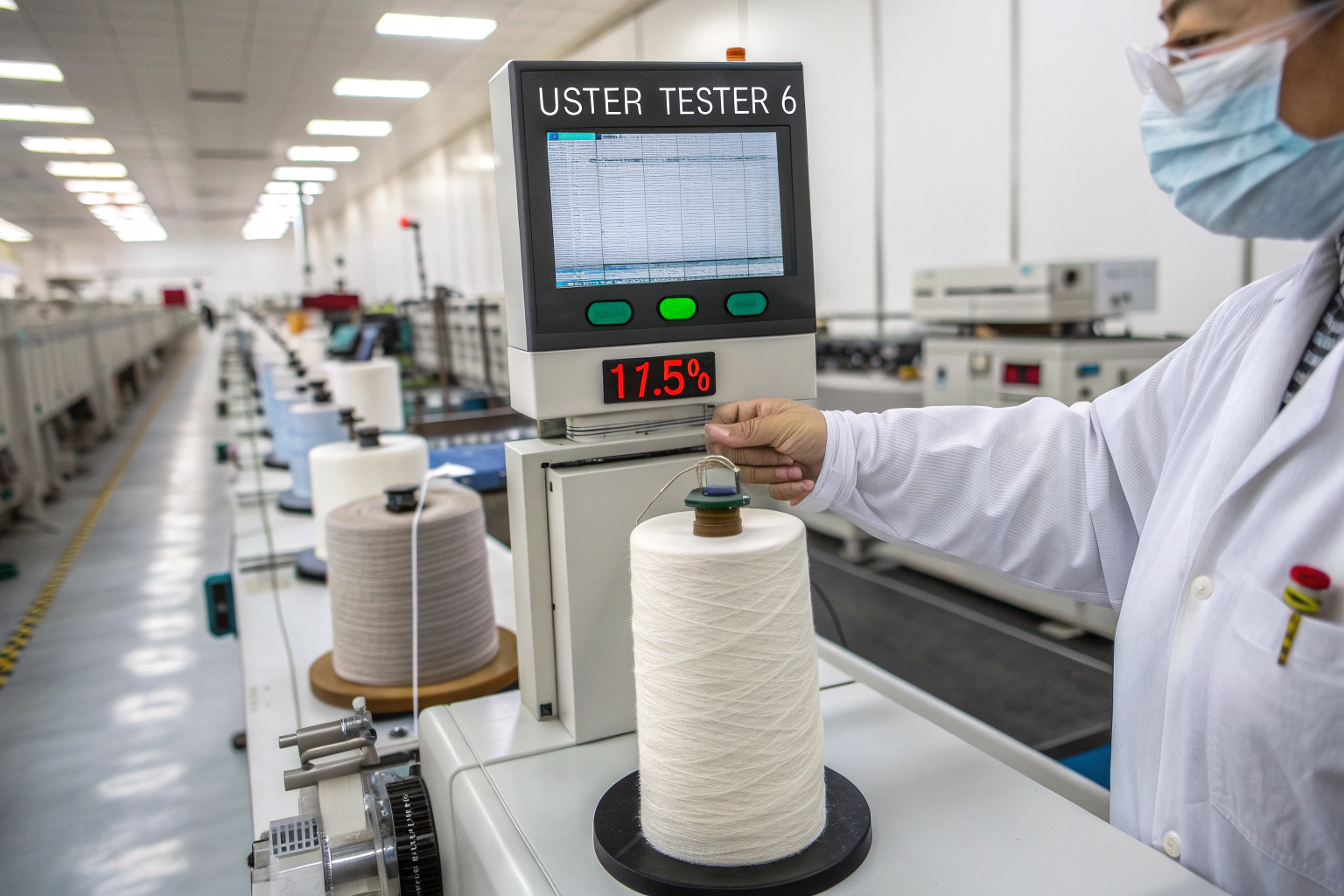
Our standard ring-spun cotton yarn for shirting and apparel consistently achieves a CV% (Coefficient of Variation of mass) between 11.5% and 13.5%, tested on an Uster Tester 6 at 400 meters per minute. For our premium compact-spun range, we push that down to below 11%. Let me translate that into fabric language. CV% measures how much the thickness of the yarn varies along its length. A CV% of 11.5 means the yarn is so consistent that the human eye cannot detect any variation in the finished woven or knitted fabric. At Shanghai Fumao, we don’t just aim for "good enough"—we set strict Uster Statistics percentile targets. Our standard yarn hits the 25% to 50% percentile of the global Uster benchmarks, meaning we’re in the top half of the world’s mills. Our compact yarn hits the top 5% to 25% bracket. This isn’t academic trivia; it’s the reason your fabric dyes uniformly, prints cleanly, and feels smooth against the skin. Every percentage point of CV% reduction translates directly to fewer customer complaints about a “rough” or “patchy” shirt.
I’ve spent too many hours standing next to a Uster machine watching a thin red line dance across a screen, and I can tell you that this single number predicts your return rate better than any subjective “hand-feel” approval. In this article, I’ll crack open the black box of yarn evenness testing and show you exactly how we measure it, why it matters for your specific product category, and how to read an evenness report without a PhD in textiles.
Why Does Yarn Evenness Matter for a Cotton Fabric’s Look?
You’ve seen the defect but couldn’t name it. A dyed cotton poplin that has faint, zebra-like stripes running across the width, or a knitted jersey with a cloudy, mottled appearance even though the dye bath was perfectly mixed. That’s poor yarn evenness written into the fabric. The problem starts at the spinning frame. When the yarn’s thickness fluctuates—thick spots, thin spots, and neps—those irregularities don’t disappear when you weave or knit them. They magnify. A thin spot absorbs less dye and reflects light differently, creating a pale streak. A thick spot absorbs more dye, creating a dark bar. This is called “barré” in the weaving room, and it’s an absolute margin-killer because the fabric can’t be sold as first quality.
At Shanghai Fumao, we treat CV% as the first domino in a chain of quality. A low CV% means the yarn is uniform, which means the fabric surface is flat and smooth, which means the dye takes up evenly, which means your garment looks expensive even if you’re using a standard reactive dye recipe. We’ve run split-batch comparisons in our factory: the same greige cotton fabric, knitted from a 13.5% CV yarn and an 18% CV yarn, dyed in the same black bath. The 18% CV fabric came out looking like a charcoal camouflage pattern; the 13.5% CV fabric was a deep, solid, commercial black. The difference wasn’t the dye—it was the yarn. This is why we reject any yarn lot that exceeds 14% CV for our shirting and dress-weight fabrics.
But this isn’t just about aesthetics. Evenness directly impacts the fabric’s “coverage factor.” A yarn with high CV% has thick spots that make the fabric feel rough and thin spots that are nearly see-through. In a light-colored garment, those thin spots are transparent, creating a visual “hole” that looks like a defect even though the stitch is intact. In our 20 years of experience, a CV% below 13.5 is the threshold where the fabric transitions from “okay for the mass market” to “acceptable for a premium brand.”

How Does Uneven Yarn Cause Fabric Barré?
Barré is the enemy of every quality manager, and it’s a direct child of high CV%. Imagine a horizontal stripe that appears in the finished fabric, often subtle but visible under certain lighting angles. It’s not a printing defect or a dyeing error—it’s a physical thickness variation in the weft yarns. When a thick weft yarn is inserted, it pushes the warp yarns apart slightly, creating a different surface tension and reflectivity compared to adjacent sections with thin weft yarns.
The dye bath is perfectly uniform, but the fabric surface is not. The thick sections trap more dye liquor, and the surface geometry scatters light differently, creating an optical illusion of a darker stripe. This is maddening because it’s intermittent—a CV% of 15 might only produce one bad pick in every hundred, but that’s enough to ruin a roll. Our Uster testing identifies these periodic faults before the yarn reaches the loom, allowing us to cut out the offending sections or reject the bobbin entirely.
Can You Feel Yarn Evenness in the Finished Garment?
Absolutely, and your customer can too, even if they don’t know why they dislike the shirt. A high CV% yarn creates a micro-texture of bumps and dips. Run your palm flat across a cheap cotton t-shirt and a premium one. The cheap one feels slightly granular, like fine sandpaper, because the thick spots in the yarn create pressure points against your skin. The premium one feels uniformly smooth because the yarn is consistently round.
This tactile difference is magnified by washing. A thick spot in the yarn has a different twist density than a thin spot. When the garment is laundered, the loosely twisted thick spots bloom and fuzz up, while the tightly twisted thin spots stay slick. The result is a “patchy” hand-feel that emerges after about five washes. Customers perceive this as “the fabric aged badly,” but it was actually born uneven. A CV% below 12 virtually eliminates this differential aging effect.
How Is Cotton Yarn Evenness Measured Accurately?
You’re picturing a lab technician squinting at yarn with a magnifying glass. That’s decades out of date. Modern evenness testing uses capacitance measurement at high speed. The yarn runs between two capacitor plates. Variations in the yarn’s mass cause variations in the electrical capacitance, and the tester converts these electrical signals into a continuous chart of mass vs. length. This is the principle behind the Uster Evenness Tester, the industry’s gold standard. It’s not a rough estimate; it’s measuring mass variations at millimeter resolution while the yarn flies through at 400 meters per minute.
At Shanghai Fumao, we test every spinning lot on an Uster Tester 6, which is the current generation machine with automatic bobbin changers and a touchscreen interface. We load 10 bobbins per lot and run at least 400 meters of yarn per bobbin to ensure a statistically valid sample. The machine generates a CV% number (the overall mass variation), but it also generates a spectrogram—a graph that shows the periodic wavelength of the variations. This spectrogram is the real detective. A spike at a specific wavelength tells us exactly which machine component is causing the problem: a worn drafting roller, an eccentric spindle, or a carding flat that’s out of adjustment. CV% tells you there’s a problem; the spectrogram tells you where the broken part is.
The Uster system also classifies “imperfections” per kilometer: thin places (-50% of mean thickness), thick places (+50% of mean thickness), and neps (+200% of mean thickness). A yarn might have an acceptable CV% of 13 but still fail because of an excessive number of neps. We set a strict limit of 50 neps per kilometer for our premium range, which is well below the industry average. This granular breakdown is what separates a mill that ships "okay" yarn from one that ships yarn that makes your fabric look flawless.

What Is an Uster Spectrogram and How Do You Read It?
A spectrogram looks like a mountain range drawn by an earthquake seismograph. The horizontal axis represents the wavelength of the variation (from 1 cm to 100 meters), and the vertical axis represents the amplitude (how big the mass variation is at that wavelength). A perfectly even yarn would produce a flat line. A real yarn produces gentle hills representing the natural randomness of the fibers.
A problem jumps out as a sharp “chimney”—a narrow, tall peak at a specific wavelength. If the peak appears at a wavelength equal to the circumference of the drafting roller, the roller is eccentric and needs replacing. If it appears at the wavelength of the bobbin diameter, the spindle is bent. Our technicians are trained to read these peaks like a mechanic listens to an engine knock. The machine also overlays a red “warning limit” and a blue “alarm limit” curve. If the measured variation crosses the blue line, the bobbin is immediately quarantined.
How Do IPI Values (Imperfections) Relate to CV%?
CV% is the macro measure of evenness; IPI (Imperfections per Kilometer) is the micro-measure of specific defects. You can have a decent CV% but disastrous IPI numbers, and the fabric will still look terrible because of scattered thick and thin spots. It’s like a road with an average smooth surface but scattered potholes.
The three IPI categories are: Thin places (-50%), Thick places (+50%), and Neps (+200%). For our ring-spun Ne 30/1 cotton, we target less than 5 thin places, less than 30 thick places, and less than 50 neps per kilometer. These numbers align with the Uster Statistics 25% percentile—meaning only 25% of mills worldwide achieve these levels. The IPI values are a direct predictor of fabric grade. A high nep count means your dyed fabric will have a speckled, dirty appearance. A high thick-place count means your printed fabric will show dark spots. We report all four numbers—CV%, Thin, Thick, Neps—on every yarn inspection certificate we ship with the order.
What CV% Is Acceptable for Different Cotton Fabric Types?
You wouldn’t use the same tire on a Ferrari and a tractor, and you shouldn’t use the same yarn evenness standard for a luxury dress shirt and a heavy-duty canvas tote bag. The acceptable CV% depends entirely on the end-use product category and the fabric structure. A knitted single jersey magnifies yarn unevenness because the loops are large and the surface is open. A densely woven twill hides minor variations because the tight weave structure physically constrains the yarn and blocks light transmission. Knowing these thresholds prevents you from paying for premium evenness when you don’t need it—or worse, not paying for it when you absolutely do.
At Shanghai Fumao, we’ve developed a simple product-grade matrix based on two decades of customer feedback and return data. For premium shirting and lightweight blouses (fabrics under 120 GSM), you want a CV% below 12.5. Any higher, and the thin spots become transparent. For standard knitwear and dress fabrics (120-200 GSM), a CV% between 12.5 and 14 is acceptable; the fabric weight provides coverage. For heavy bottom-weight fabrics, denim, and canvas (above 200 GSM), a CV% up to 15 is workable because the density hides the variation. For upholstery and industrial textiles, you can tolerate up to 16.5% CV without functional issues. We print these thresholds directly on our internal spec sheets, and our sales team actively advises customers against buying a higher grade than their product needs. That kind of honesty builds long-term partnerships.
There’s also the fiber blend factor. A 100% cotton yarn with a CV% of 14 will look worse than a cotton-linen blend with the same CV%, because the natural slubs in the linen create a deliberate texture that masks the cotton’s unevenness. A cotton-polyester blend is even more forgiving. We adjust our CV% targets downward when the fabric is 100% cotton and destined for a solid-color dyeing program, where every irregularity is exposed.

What CV% Is Best for High-End Cotton Shirting?
For a dress shirt that retails above $100, the fabric must be flawless under the harsh lighting of a fitting room. A customer trying on a white shirt in front of a mirror with overhead spotlights will see every imperfection. The CV% for this product category needs to be below 11.5, ideally below 11.
We use our compact-spun cotton for this market. Compact spinning eliminates the spinning triangle—the tiny zone where fibers splay out before twisting—which reduces hairiness and improves evenness. The result is a yarn with a CV% of 10.5 to 11.2. When woven into a broadcloth or poplin, the fabric has a silky, glass-like surface that reflects light uniformly. This is the “boardroom quality” that executives expect. We also run an additional “electronic clearing” step on these yarns, where an optical sensor on the winding machine cuts out any remaining thick or thin spots and splices the yarn back together with a compressed air knot. This adds cost but guarantees near-zero visible defects.
What Happens If You Use Low CV% Yarn for Printing?
Printing is the ultimate evenness stress test. A screen print or digital print sits on the fabric surface. If the surface is uneven, the print paste doesn’t transfer uniformly. A thin spot in the fabric creates a low-pressure zone under the squeegee, so the paste skips and leaves a faint white spot in the middle of a solid color block. A thick spot creates a high-pressure zone, squeezing too much paste through and creating a dark blob.
We’ve seen this destroy a launch. A swimwear client in 2023 used a cheap open-end cotton with a CV% of 17 for a digital floral print. The flowers looked blotchy and "sick," with inconsistent color saturation across the yardage. They switched to our 12.5% CV ring-spun base for the reorder, and the print was crisp and photorealistic. The cost of the fabric upgrade was $0.60 per meter; the cost of the failed first run was $8,000 in dead stock. Print clarity is directly proportional to yarn evenness, and we now require a minimum 13.5% CV for any fabric destined for our printing factories.
How Do You Verify a Yarn Evenness Test Report?
You’ve received a test report from a supplier claiming a CV% of 12.8, but the fabric looks uneven. Your gut says the report is fabricated or the sample wasn’t representative. This is a common industry scam: sending a "golden sample" yarn for testing while shipping bulk yarn spun on worn-out machinery. Verifying an evenness report requires you to understand the test conditions, not just the final number. A CV% is meaningless without the test speed, sample length, and instrument model. A CV% measured at 25 meters per minute on a 30-year-old machine is not comparable to one measured at 400 meters per minute on a current-generation Uster.
At Shanghai Fumao, we provide a "Full Disclosure" evenness certificate. It includes the Uster Tester model (Tester 6), the test speed (400 m/min), the total sample length tested (usually 4,000 meters across 10 bobbins), the yarn count (Ne 30/1), the CV% result, the IPI breakdown, and the Uster Statistics percentile ranking. This last piece—the percentile—is the objective benchmark. A CV% of 13.2 might be "50th percentile" (world average) or "75th percentile" (below average) depending on the yarn count. The Uster Statistics are updated every few years based on global mill data, and they provide a neutral yardstick. We also invite clients to send a random bobbin from their shipment to an independent third-party lab like SGS or Intertek for verification, and we’ll cover the testing fee if our reported CV% deviates by more than 0.5 percentage points.
The other verification method is the "cut-and-weigh" cross-check. A yarn evenness tester measures mass variation electrically, but you can verify it manually. Take 100 one-meter lengths of yarn, weigh each on a precision balance, and calculate the coefficient of variation of the weights. This is labor-intensive but foolproof. We’ve done this correlation exercise in our lab, and our Uster readings consistently match the manual method within 0.3 percentage points.

What Does a "USTERIZED" Certificate Actually Mean?
"USTERIZED" is not just a marketing sticker. It’s a licensed quality seal from Uster Technologies. A mill that displays the USTERIZED certificate has undergone an on-site audit by Uster engineers who verified that the lab equipment is calibrated, the testing procedures follow international standards, and the quality data is managed properly. The certificate is renewed annually and can be revoked.
When you see the USTERIZED logo on our reports, it means our CV% numbers are generated on validated instruments by trained operators using controlled procedures. It’s the closest thing the textile world has to an ISO 17025 accreditation for yarn testing. It also means we contribute our data to the global Uster Statistics database, so our percentile rankings are real, not cherry-picked.
How Can You Cross-Check Evenness Without a Lab?
If you don’t have access to a Uster machine, you can still do a crude but useful visual check. Wind 10 meters of yarn around a black cardboard sheet in parallel, adjacent wraps—like a guitar string winding. The black background and the parallel tensioned wraps make variations in thickness jump out to the naked eye. A yarn with 12% CV will look like a smooth, uniform band. A yarn with 18% CV will look wobbly and uneven, with visible thick and thin spots.
Another field test is the “differential dyeing” trick. Knit a small tube of the yarn, then dye it with a direct dye at 0.5% shade depth (a very pale pastel). Pale dyeing is much less forgiving than dark dyeing because it doesn’t saturate the fiber. Uneven yarn will show obvious barré in a pale blue or pale pink. This is a destructive but definitive test.
Conclusion
CV% is the quiet, invisible number that shouts through your finished fabric. We’ve traced its impact from the spinning frame to the fitting room, showing how a few percentage points of mass variation can mean the difference between a flawless black dress shirt and a streaky, returned disappointment. We’ve unpacked the Uster tester, the spectrogram, and the IPI values that provide the granular evidence of quality, and we’ve mapped out the exact CV% thresholds that each product category—from delicate shirting to rugged canvas—demands. The truth is that evenness isn’t an abstract metric; it’s the physical foundation of dye consistency, print clarity, tactile softness, and long-term durability.
In my years in the Keqiao testing labs, I’ve learned that the mills that obsess over these numbers are the mills that build brands that last. Every yarn bobbin we approve carries a test report that’s a promise: this fabric will look, feel, and perform as intended, wash after wash.
If you’re developing a collection where consistency is non-negotiable and you want to see the evenness data before you commit to a production run, let’s put the numbers on the table. We’ll send you a yarn evenness certificate along with a physical hand-feel sample of the exact batch we’re reserving for your order. For a detailed technical review of your fabric requirements and the CV% targets we recommend for your product category, reach out to our Business Director, Elaine, at elaine@fumaoclothing.com. She’ll connect you with our lab team to answer every question down to the last nep.








