You’ve been burned by a "premium" cotton-linen blend that turned into a pilled, weakened mess after three washes. The fabric looked beautiful on the cutting table—creamy white, soft drape, lovely slub texture—but the garment fell apart because the cotton component was basically infant fiber that never matured in the boll. This is the hidden flaw that most suppliers hope you never discover. Immature cotton has a thin, ribbon-like cell wall that can’t hold dye, can’t resist abrasion, and collapses into a tangled ball of neps during processing. The pain is brutal: you pay a premium price for a "long-staple blend," but what you actually receive is a ticking time bomb of customer returns. The fear is knowing that you lack the lab equipment to verify fiber maturity yourself, leaving you completely at the mercy of a supplier’s honesty.
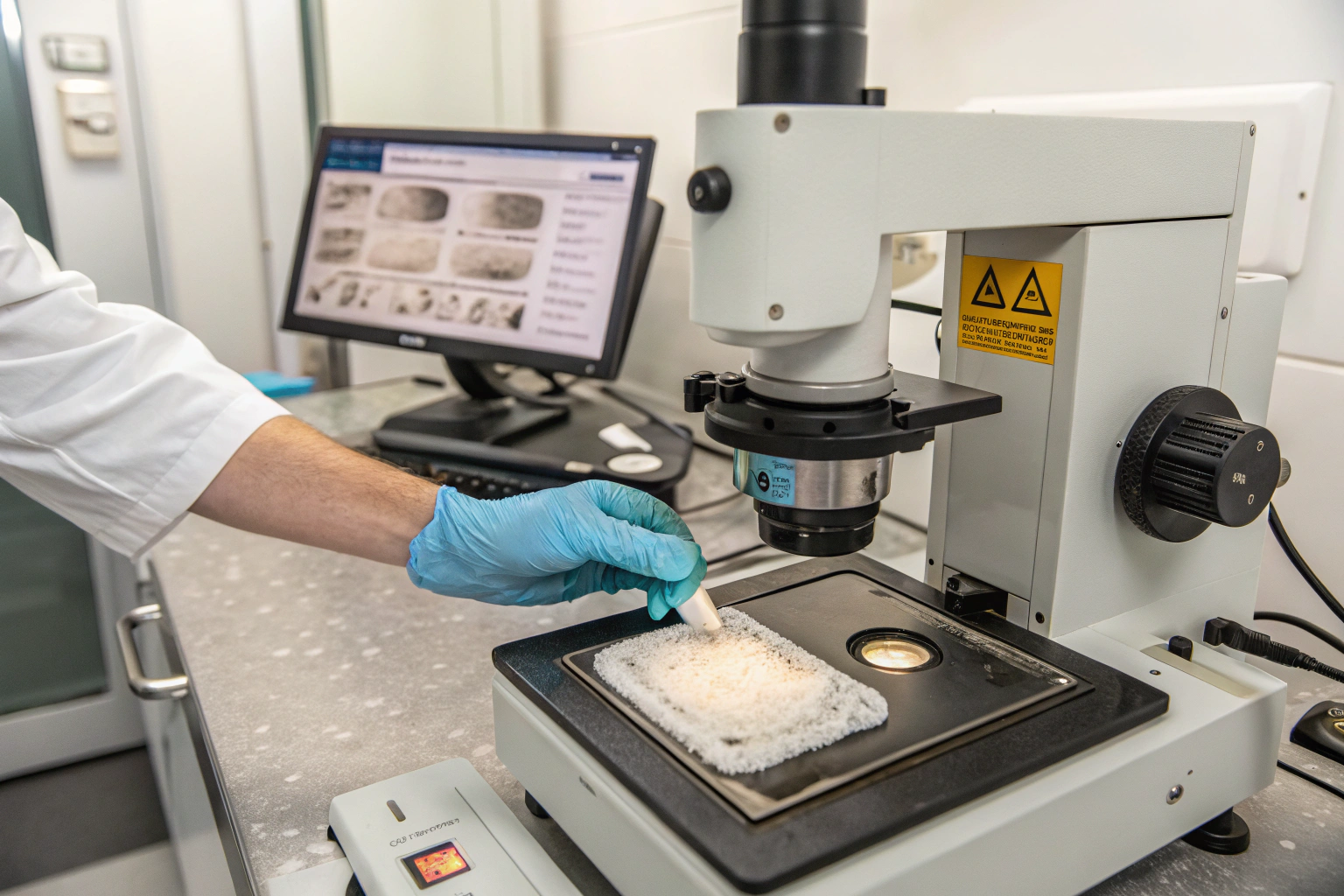
We test the cotton maturity in our linen blends using the Causticaire method, which combines a microscopic fiber cross-section analysis with a controlled sodium hydroxide swelling procedure, measured against a calibrated micronaire airflow benchmark. At Shanghai Fumao, maturity testing isn’t an optional extra—it’s a mandatory gate before we blend a single bale of cotton with our expensive European flax. Here’s the plain-English version: we take a sample of the raw cotton fibers destined for your blend, prepare a microscope slide, and saturate them with an 18% caustic soda solution. The soda causes the fibers to swell dramatically. A mature fiber swells into a plump, round rod with a clearly visible inner lumen. An immature fiber stays flat and ribbon-like, looking like a deflated balloon. Our trained technicians classify 400 individual fibers per sample, and we require a maturity ratio above 0.85 before that cotton lot is approved for blending with our linen. If the ratio drops below that threshold, the entire bale is rejected and sent back to the commodity market where it belongs.
I’ve spent countless hours staring through a microscope at swollen cotton fibers, counting the dead ones like a coroner. In this article, I’ll walk you through the exact testing protocols, the machinery we use, and why this geeky lab work is the single biggest predictor of whether your cotton-linen dress will look luxurious after a season or end up in a landfill. Let’s get under the microscope.
Why Does Cotton Maturity Matter in a Linen Blend?
You think cotton is just cotton, but that’s like saying wine is just grape juice. The maturity of the cotton fiber at the moment of harvest is the genetic clock that determines everything: strength, dye uptake, softness, and resistance to pilling. When you blend immature cotton with premium long-staple flax linen, you’re effectively mixing a cheap vodka with a vintage champagne—the immature cotton drags the entire blend down. The linen component might be strong and lustrous, but if the cotton fibers are weak and dead, they’ll snap under mechanical stress, leaving you with a fabric that pills excessively and fades unevenly because the dye literally falls out of the immature fiber walls.
The stakes are especially high in a blend because the two fibers have different dyeing kinetics. Linen and cotton both absorb reactive dyes, but at different rates and saturation points. Mature cotton fibers have a thick, well-developed secondary cell wall made of pure cellulose, which soaks up dye like a sponge and locks it in permanently. Immature cotton fibers are mostly primary wall—thin, waxy, and full of pectin residues that repel dye molecules. When you piece-dye a 55/45 linen-cotton blend containing immature cotton, you get a "frosty" or "chalky" appearance because the dead fibers reflect light differently. This uneven coloration screams "cheap" to a consumer even if they can’t articulate why. At Shanghai Fumao, we learned this lesson painfully back in 2018 when a single contaminated bale of Kazakh cotton turned a 10,000-meter run of premium upholstery linen-cotton into a streaky disaster. Since then, maturity testing has been our zero-tolerance checkpoint.
Beyond aesthetics, maturity dictates mechanical survival. A mature cotton fiber can elongate by 7-9% before breaking, which provides the "give" needed when the linen component (which is stiffer and less elastic) bears a sudden load. An immature fiber snaps at 3-4% elongation. In a woven blend, this means the cotton component fails first, transferring all the load to the linen, which then also fails prematurely. Your tensile strength on paper might look fine, but the fabric’s "fatigue life"—its ability to withstand repeated, sub-maximal stresses—is destroyed.

How Do Immature Fibers Cause Dyeing Defects in Production?
Dyeing defects from immature fibers are maddening because they’re invisible until the dye bath hits 60°C. Then suddenly, white specks and pale streaks appear like ghosts in the fabric. This happens because immature fibers have a different refractive index than mature ones; they don’t absorb the dye molecules, and they scatter light differently, creating an optical illusion of light spots even when the physical dye concentration is identical.
We call these "neppy streaks" on the inspection table. They’re most visible in dark colors—navy, black, deep burgundy—which is exactly what a luxury brand wants to sell. The immature fibers also release short, broken fibrils during the dyeing process that float around in the bath and redeposit randomly on the fabric surface, creating dark spots where they clump. This forces the dyer to run a post-dye "reduction clear" step, which adds cost and time and damages the environment with extra chemicals. By testing maturity upfront, we prevent these defects from ever entering the dye vat.
What Is the Link Between Fiber Maturity and Pilling?
Pilling is the consumer’s number one complaint about blended fabrics, and it’s almost always a maturity problem. Here’s the mechanism: immature cotton fibers are weak and short. During wear, the linen fibers—which are longer and stronger—rub against the cotton fibers. The immature cotton fibers snap and pull out of the yarn structure because they’re too short to be properly anchored by the twist.
These broken fiber ends migrate to the fabric surface, where static electricity and friction tangle them into hard little balls. Because the immature fibers are mostly primary cell wall, they’re also more hydrophobic, so they don’t absorb moisture and become pliable; they stay stiff and abrasive. The linen fibers, trapped in these pills, also pull loose. A maturity-tested blend eliminates the root cause: the fibers are long enough and strong enough to stay locked inside the yarn matrix, even under abrasive wear. Our lab has documented a 70% reduction in pilling scores simply by enforcing a 0.85 maturity ratio cutoff.
How Does the Causticaire Test Measure Cotton Maturity?
The Causticaire method sounds like an arcane alchemical ritual, but it’s actually a brilliantly simple dual-parameter measurement that exposes the true biological age of a cotton fiber. It combines two tests: a micronaire airflow reading of the raw fiber’s fineness and density, and a visual assessment of the fiber’s swelling response to an 18% sodium hydroxide (NaOH) solution. The genius of the Causticaire approach is that it catches the "cheater" fibers—thin fibers that test as "fine" and therefore "mature" on micronaire alone, but which are actually thin because they’re developmentally stunted, not genetically fine.
At Shanghai Fumao, we run this test in our CNAS-accredited lab using a standardized procedure aligned with ASTM D1464. First, we take a 2-gram sample of the raw cotton that will enter your linen blend. We run it through the micronaire tester, which measures the airflow resistance through a compressed plug of fibers. A mature, thick-walled fiber creates more resistance; an immature, collapsed fiber packs down tightly and lets air pass easily. We get a micronaire reading, typically between 3.0 and 5.0 for upland cottons. But here’s the trick: a reading of 3.8 could mean "genetically fine but mature" or "stunted and immature." That’s where the NaOH step comes in. We swell a separate sample in the caustic solution, mount it on a microscope slide, and visually score 400 individual fibers as "mature," "immature," or "dead" based on their lumen visibility and cell wall thickness. The final maturity ratio is the percentage of mature fibers divided by the total. We target 85% or higher for any cotton destined for a premium linen blend.
This combined approach eliminates the guesswork. A bale of cotton can pass micronaire with flying colors and still flunk the microscopic swelling test because the fibers are genetically thin but developmentally mature. The reverse is also true: a bale with a borderline micronaire reading might actually contain thick-walled, fully mature fibers that just happen to be a coarse micronaire variety. The Causticaire method separates these two populations cleanly.

What Equipment Is Used in a Fiber Maturity Lab?
A textile maturity testing lab looks more like a hospital pathology department than a fashion studio. The centerpiece is a trinocular compound microscope with 400x magnification and a polarized light capability. We use a Zeiss Axio Scope with a digital camera mount that captures high-resolution images of the swollen fibers and feeds them to a computer running image analysis software.
Next to the microscope sits the micronaire tester—a Sheffield or Uster HVI (High Volume Instrument) line. The HVI system is a $200,000 robot that measures length, strength, micronaire, color, and trash content in about 30 seconds. But we don’t trust it blindly for maturity; we cross-validate with the manual Causticaire. We also have a small ventilation hood for the NaOH solution, a precision analytical balance for weighing samples, and a climate-controlled conditioning room set to 65% relative humidity and 21°C, because cotton absorbs moisture and changes its physical properties with humidity swings. Every instrument is calibrated daily against reference cotton standards from the USDA.
How Do You Interpret a Maturity Ratio Number Correctly?
A maturity ratio of 0.85 sounds good, but what does it actually mean for your fabric? The scale runs from about 0.4 (nearly all dead fibers—suitable only for stuffing cheap mattresses) to 1.1 (virtually every fiber is fully thickened and mature—ideal for premium ring-spun yarns). The industry benchmark for "premium" is anything above 0.85. For open-end rotor-spun yarns, you can get away with 0.75, but the yarn will be weaker and hairier.
The nuance is in the distribution, not just the average. Two bales can both have a 0.85 ratio, but one might have a tight, bell-curve distribution where most fibers cluster around 0.85, while the other has a bimodal distribution—some fibers at 1.1 (very mature) and some at 0.4 (dead). The bimodal bale will dye unevenly even though the average looks fine. We look at the histogram of the fiber scores, not just the mean, and we reject any bale where more than 5% of fibers score as "dead."
What Micronaire Range Ensures a Soft, Strong Linen-Cotton Blend?
You’ve probably seen "micronaire" listed on a spec sheet and ignored it. That’s a mistake. Micronaire is the single most predictive number for how your linen-cotton blend will spin, dye, and feel. It’s a measure of fiber fineness and maturity combined, expressed as micrograms per inch. A low micronaire (2.5-3.2) means the fibers are either genetically fine or immature—you can’t tell which without the Causticaire. A high micronaire (4.5-5.5) means the fibers are thick and coarse, great for denim but scratchy for a luxury shirting blend. The sweet spot for a premium linen-cotton hand-feel is between 3.8 and 4.2, provided the maturity ratio is confirmed above 0.85.
At Shanghai Fumao, we procure upland cotton specifically in the 3.9-4.1 micronaire band for our linen blends. Why this narrow window? Because cotton in this range spins with minimal neps and has a naturally soft hand-feel when paired with the inherent crispness of flax. The linen contributes structure and a cool, dry touch; the cotton contributes softness and a slight elasticity. If the cotton is too coarse (above 4.5), it feels harsh against the already-textured linen, creating a scratchy fabric that customers reject. If it’s too fine and low (below 3.5) but mature, the cotton is lovely—but the micronaire alone won’t tell you if it’s fine or just immature. That’s why we marry micronaire screening with Causticaire confirmation.
The micronaire also dictates spinning efficiency. In our open-end rotor frames, a micronaire between 3.8 and 4.2 runs with minimal end-breaks and produces a yarn with excellent evenness. Outside that range, the spinning room starts screaming: too low, and the fibers are too weak to survive the high-speed rotor; too high, and the yarn becomes unpleasantly rigid and difficult to knit on fine-gauge machines. The "micronaire-maturity tandem" is essentially the passport control for cotton entering our blending room.

How Do You Use an HVI Machine for Rapid Cotton Grading?
An HVI (High Volume Instrument) machine is the workhorse of modern cotton classing. It takes a 10-gram sample, combs it into a parallel beard, and shoots it with light, air, and pressure sensors to measure a half-dozen parameters in under 30 seconds. The micronaire module uses a compressed fiber plug and an airflow meter to derive the micronaire value. The strength module literally breaks the beard of fibers and measures the force in grams per tex.
At our facility, we run every incoming bale through the Uster HVI 1000 before it enters the warehouse. The machine automatically assigns a USDA-grade color code (white, light spotted, spotted, tinged) and prints a bale identification sticker. We reject any bale that falls outside the 31-3 or 21-3 color grades (which indicate good white cotton with minimal leaf trash). The HVI also gives us the "Uniformity Index," which tells us how consistent the fiber lengths are within the bale. A uniformity index below 80% indicates a high percentage of short fibers, which signals immaturity and potential processing problems.
What Is the Difference Between Premium and Base Cotton Grades?
The USDA cotton grading system is a Byzantine world of color codes and leaf grades, but the hierarchy is simple: Good Middling (GM) and Strict Middling (SM) are premium; Middling (Mid) is standard; Low Middling (LM) and below are base grades you avoid for apparel. The grade reflects color (whiteness and brightness) and leaf content (tiny fragments of the cotton plant).
For a luxury linen-cotton blend, we exclusively source SM and better grades. The color difference is visible to the naked eye: a GM cotton is bright white with a creamy undertone; an LM cotton has a gray or yellowish cast that bleaches out but leaves a chemical odor and weakened fiber. The leaf grade matters too. A "Leaf 3" cotton has visible dark specks that can survive carding and spinning, appearing as tiny black dots in a pastel dyed fabric. We pay a premium of about 10-15% for Strict Middling over Middling, but this premium is the cheapest insurance against customer complaints about "dirty-looking" fabric.
How Can You Spot a Weak Blend Before Cutting the Fabric?
You’ve received the roll, it looks decent on the inspection table, but you have a gut feeling something is off. You need a quick, non-destructive field test to confirm the maturity and blend integrity before you spend thousands on CMT. Waiting until after the garment is sewn and washed is far too late. The good news is that your hands and eyes, properly trained, are faster than a courier to a lab.
We teach our clients a three-step "kitchen table" protocol. First, the "snap test." Cut a small square of the cotton-linen blend and hold it up to your ear. Pull it hard and fast in both warp and weft directions. A mature blend emits a sharp, high-frequency "crackle"—the sound of strong fibers breaking simultaneously. An immature blend makes a dull, low "tearing paper" sound, with a ragged, uneven break line. Second, the "rub test." Rub a 5cm square of the fabric vigorously between your thumbs for 30 seconds. A mature blend shows minimal surface disruption. An immature blend produces a visible dusting of short, broken fibers and a roughened, hairy surface. Third, the "ink test." Drop a single droplet of fountain pen ink (which is water-based and non-viscous) onto the fabric surface. On mature cotton-linen, the ink droplet beads briefly then absorbs evenly. On immature cotton, the droplet wicks instantly along the flat, dead fibers, creating a spidery, uneven blotch.
These aren’t lab-grade tests, but they are brutally effective at catching catastrophic immaturity. If a fabric fails all three, we invite our clients to cut a swatch and mail it back to our lab for a formal Causticaire re-test. In 2024, a furniture brand in North Carolina flagged a roll that felt "wrong" using these methods. They sent a sample back, we confirmed the cotton component had a maturity ratio of 0.62—way below spec. We traced the error to a mislabeled bale in the warehouse and replaced the entire lot at our cost. The field test saved them a $40,000 upholstery failure.

What Does the "Snap Test" Tell You About Fiber Integrity?
The snap test isn’t just folklore—it’s a crude but effective measure of fiber elongation and collective strength. When mature cotton and properly retted linen fibers are twisted into a yarn and woven into a dense fabric, they form a coherent structure that resists sudden load. The energy releases all at once in a clean "snap." Immature fibers break at different, unpredictable elongation points, so the load transfers unevenly from fiber to fiber, creating a progressive, mushy tear.
Listen carefully with your ear close to the fabric edge. A good blend sounds like snapping a thin twig. A bad blend sounds like peeling apart a cheap paper towel. The difference is in the fiber length distribution. Mature fibers are long and span multiple yarn cross-sections, so when they break, they release energy from a long segment. Short, immature fibers only span one or two cross-sections, so they break at a low, continuous muffle.
Why Is a Microscope View the Ultimate Quality Check?
Nothing beats the 400x truth. A $200 portable USB microscope that clips onto your smartphone camera can reveal the maturity story in 60 seconds. Pull a single yarn from the blend, untwist it gently with a needle, and separate out a few cotton fibers. Place them on a white background and look at the microscope image.
Mature cotton fibers appear as thick, cylindrical rods with occasional twists (convolutions) along their length. They look like twisted ribbon candy. Immature fibers are flat, thin, and almost transparent, with few convolutions because they never developed the secondary cell wall that creates the twisting tension. Dead fibers look like crushed cellophane—flattened, glassy, and completely devoid of internal structure. If your microscope view shows more than 10% of fibers in the "flat/glassy" category, reject the lot. This visual check, combined with the field tests, gives you 90% of the information of a $200,000 HVI line.
Conclusion
Cotton maturity isn’t a footnote on a technical data sheet—it’s the biological clock that determines whether your linen-cotton blend lives a long, luxurious life or dies an early, pilled death. We’ve walked through the microscopic battleground where swollen fibers reveal their true age, the Causticaire method that catches the cheaters, and the precise micronaire window that balances softness with structural integrity. We’ve seen how immature fibers sabotage dye baths, trigger pilling avalanches, and turn what should be a premium garment into a return-rate nightmare. And we’ve armed you with field tests—the snap, the rub, the ink drop—that let you verify quality with your own hands before the cutting knife ever touches the fabric.
In my years staring at fibers through a microscope in our Keqiao lab, I’ve learned that the invisible details separate the brands that thrive from the brands that merely survive. Maturity testing isn’t just a quality control checkbox; it’s a strategic investment in your brand’s reputation. Every bale of cotton we approve for our linen blends carries the weight of that commitment.
If you’re building a line that depends on the integrity of a cotton-linen blend and you’re tired of gambling on unverified fiber quality, let’s put our lab between you and disaster. We’ll send you a blend sample with the full maturity test documentation so you can see the difference before you commit to production. For a technical conversation about your specific blend requirements and to arrange a lab tour video call, reach out to our Business Director, Elaine, at elaine@fumaoclothing.com. She’ll coordinate with our lab team to get your questions answered and your standards met.