Let’s be honest. Every year, my clients, especially those sourcing from the U.S. or Europe, face the same frantic scramble. They get a fantastic new design idea, send it over, and then… radio silence for weeks? Or worse, they place an order and are met with unexpected delays that blow their entire marketing and sales calendar out of the water. The emails I get are full of frustration: “Why is everything taking so long?” “I was told 45 days, now it’s 60?” If this sounds familiar, you’re not alone. The pain is real.
The secret isn’t finding a “faster” factory—it’s understanding and planning with the natural rhythm of China’s manufacturing calendar. The core issue isn’t capability; it’s capacity. Just like farming has seasons, Chinese manufacturing has predictable peaks, valleys, and mandatory holidays. By syncing your production schedule with these cycles, you can transform delays into advantages, secure better pricing, and ensure your goods hit the shelves exactly when you need them. I’ll show you exactly how, based on my 20 years in the heart of Keqiao’s textile cluster.
I’ve seen too many brands miss opportunities simply because they fought against the tide. The smart ones learn to ride the wave. In this guide, I’ll break down the annual manufacturing calendar, give you actionable strategies for each period, and share real examples from my clients who turned this knowledge into their most reliable competitive edge. Stick with me, and you’ll never be blindsided by a production delay again.
What Are the Key Periods in China’s Manufacturing Calendar?
You need to think of the year not in months, but in production windows. There are three distinct seasons that dictate everything from lead times to factory availability and even negotiation power. Missing these windows is the number one cause of shipment delays for overseas brands.
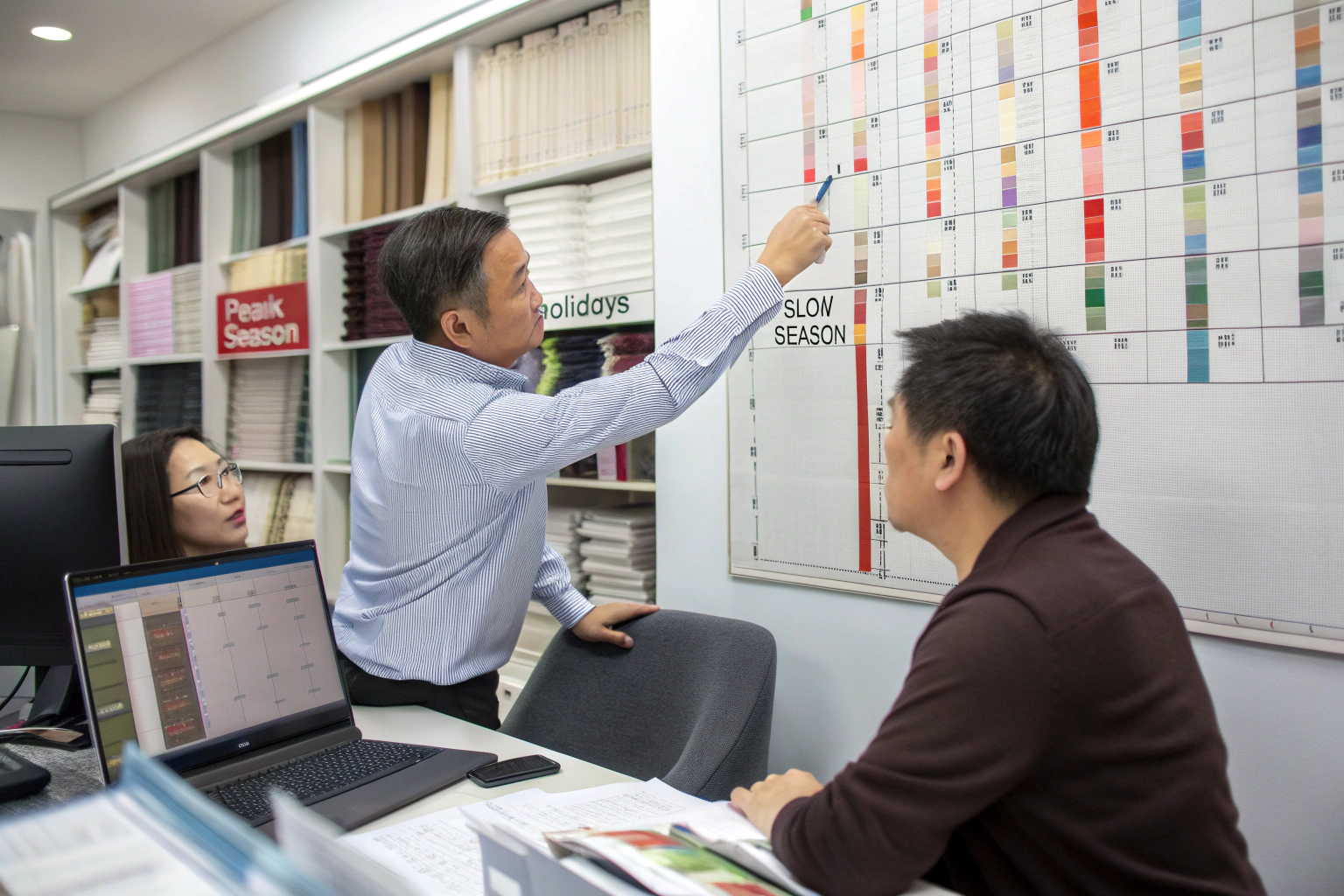
The annual cycle is defined by two massive holiday shutdowns, two intense production peaks, and two slower periods that offer strategic opportunities. It’s not random; it’s driven by national policy, weather, and global buying patterns. Getting this timeline wrong can cost you weeks. Getting it right can save you money and stress.

When Do Production Peaks Actually Cause Delays?
The first peak runs from March through May. After the Chinese New Year (CNY) restart, factories are at full capacity fulfilling backlogged orders and catching up on Q2 deliveries for Northern Hemisphere brands. The second peak is from August to October, as factories work furiously to produce goods for the Western holiday season (Black Friday, Christmas). During these peaks, every resource is stretched thin.
Raw material supplies get tight, dyeing vats are booked solid, and skilled workers are in high demand. A standard 45-day lead time can easily stretch to 60+ days. I advise clients to add a 1-2 week buffer automatically during peak seasons. For instance, in April 2023, a Swedish activewear brand ordered a high-performance moisture-wicking fabric. Because we anticipated the dye-house congestion, we secured our polyester yarns and booked dyeing slots before the order was finalized, saving them a 15-day delay. This kind of proactive planning is what sets a partner like Shanghai Fumao apart – we don’t just react, we forecast. If you’re navigating these peaks, understanding the nuances of managing textile dyeing lead times during global fashion cycles can be a game-changer, as discussed by industry planners on platforms like The Sustainable Fashion Forum.
How Do Major Holidays Shut Down Factories Completely?
Chinese New Year is the big one. It’s not a one-week holiday; it’s a 3-4 week national migration. Factories shut down, workers travel home, and the entire supply chain grinds to a halt for at least two weeks, often longer. The National Day Golden Week in early October is a fixed one-week shutdown. Planning must revolve around these dates.
The key is not just knowing when the holiday is, but understanding the “ramp-up and wind-down” period. Production slows significantly 1-2 weeks before CNY as workers leave. It takes another 1-2 weeks after reopening to return to full speed. A European fashion brand we work with now has a golden rule: all pre-production (fabrics, trims, tech packs) must be signed off 6 weeks before CNY. This allows our Shanghai Fumao production team to start cutting immediately when the factory reopens, securing the first slots in the line. They haven’t missed a season since implementing this. For a deep dive on navigating this specific challenge, I recommend this practical guide on strategies for supply chain continuity before and after Chinese New Year from a leading logistics consultancy’s blog.
How to Plan Orders Around Chinese New Year?
This is the ultimate test of a sourcing manager’s skill. Treat CNY as the absolute deadline for starting production, not the finish line. Success depends on backward planning from the factory reopening date.
My advice is to work in 4 phases: Finalization, Pre-Production, Production, and Shipment. Each phase has a non-negotiable deadline relative to the CNY closure. The most successful clients treat the 8-week period before CNY as their most critical project management window. It’s all about locking in everything upfront.
What’s the Ideal Pre-CNY Timeline for Fabric Development?
Initiate fabric development at least 10-12 weeks before the CNY closure. This covers sampling, testing, and approval. For custom fabrics, this timeline is sacred. In November 2022, a U.S. outdoor brand needed a new recycled nylon with a specific waterproof coating. We started lab dips on November 10th for a late-January CNY. By December 20th, they had approved the third strike-off and the CNAS-certified test reports from our lab. This left a full month for us to bulk-source the recycled yarn and schedule coating before the holiday, ensuring production kicked off in mid-February.
If you’re developing new materials, this pre-holiday period is also perfect for rigorous testing. Don’t just rely on standard tests. Ask for specific tests like multiple wash-cycle colorfastness or abrasion resistance. We once helped a German workwear client avoid a catastrophe by running an extra flammability resistance test for industrial safety fabrics on a prototype blend; it failed, and we had time to reformulate. Resources like the Textile Exchange’s materials database can help you specify the right certified base materials early in this process.
How to Secure Factory Capacity Before the Holiday Rush?
You must confirm and secure production capacity before the pre-CNY rush, typically 8 weeks out. This means having your Purchase Order (PO) and deposit ready. Factories allocate slots based on firm POs. A “maybe” or a late PO gets pushed to the back of the queue, which could mean a post-CNY start and a May delivery instead of April.
Here’s a real tactic: negotiate a “capacity hold” with a small commitment fee. We often do this for our long-term partners at Shanghai Fumao. In early December 2023, for a repeat client in Los Angeles, we reserved a 2-week slot on our jacquard looms for mid-February production based on their forecast. They confirmed the final order on January 5th, and because the slot was held, their goods shipped on March 20th, while their competitors were still waiting for machine time. It’s about treating factory time as a precious, bookable resource. Understanding how to negotiate production slots with Chinese manufacturers is a nuanced skill, and industry forums like Sourcing Journal often feature discussions on these tactical agreements.
Can Slow Seasons Really Give You a Timeline Advantage?
Absolutely. This is the hidden gem for savvy brands. The periods of June-July and November-December (post-October peak, pre-CNY) are traditionally slower. Factories are hungry for orders to keep lines running, and you have maximum leverage.
Lead times can be 20-30% shorter. You get more attention from production managers and QC teams. You can negotiate better pricing. Scheduling becomes flexible. I actively encourage clients to plan their less time-sensitive, basic replenishment orders or develop new lines for the following year during these windows.
Why Are June-July Ideal for Development and Sampling?
After the Spring peak subsides, factory R&D and sampling departments have more bandwidth. This is the perfect time to develop new fabrics or garments for next Spring/Summer. The pressure is off, and creativity flourishes.
In July 2023, a startup sustainable brand from Amsterdam used this window to develop a capsule collection using our BAMSILK (bamboo silk) and organic cotton blends. Our design team worked closely with them, producing 15 different sample iterations in under 3 weeks—a speed impossible during peak season. They finalized their designs by August and were first in line for September production, hitting shelves for early Spring 2024. This strategic move gave them a critical head start. If you’re exploring new sustainable materials, using this time to research the complete guide to sourcing and testing bamboo-derived fabrics from specialized material blogs can provide a solid foundation before you engage a supplier.
How to Leverage November-December for Better Pricing?
This window, after the holiday rush and before the CNY panic, is prime for negotiating. Factories want to fill their Q1 (post-CNY) production schedules early. This is when you can lock in favorable rates for the upcoming year.
Don’t just ask for a discount. Structure a forward-looking agreement. For example, a Moscow-based apparel distributor approached us in late November 2022. They committed to a 6-month forecast of their core polyester-spandex jersey volumes. In return, we guaranteed a 5% price hold and priority post-CNY production slots for Q1 2023. This gave them cost certainty and reliable timing while ensuring our looms had booked work. It was a classic win-win. Understanding long-term textile sourcing contract strategies with Asian mills is key to making these deals work, a topic sometimes covered in-depth by B2B trade platforms like Just-Style.
What Are the Best Communication Practices During These Cycles?
Communication isn’t just about language; it’s about timing, frequency, and data. During critical periods, your communication strategy must adapt. Assume nothing. Verify everything. Over-communicate.
Set a regular update cadence (e.g., weekly during development, bi-weekly during smooth production, daily during critical 2-week windows pre-shipment). Use multiple channels (email for records, WeChat/WhatsApp for quick updates, video calls for complex issues). Always share visual evidence—photos, videos, spreadsheets.

How to Use Digital Tools for Real-Time Tracking?
Gone are the days of waiting for a weekly PDF report. We integrate digital tracking for key clients. Every bulk order from Shanghai Fumao gets a unique QR code. Scanning it shows a dashboard with real-time status: “Yarn Received,” “Weaving in Progress,” “Awaiting Dyeing,” “QC Inspection Passed,” “Packed.”
In a recent case from March 2024, a UK client was anxious about their linen order for May delivery. Instead of back-and-forth emails, their production manager simply scanned the QR we provided. She saw the fabric was at the finishing stage and had passed colorfastness tests, which instantly alleviated her concern. This transparency builds immense trust. For brands looking to implement similar visibility, exploring digital supply chain traceability solutions for small and medium apparel brands is a worthwhile investment, as many tech providers discuss on their solution pages.
Why is Proactive Problem-Solving Communication Critical?
Don’t just report status; anticipate and solve. If your supplier sees a potential delay—a late trim shipment, a slight color deviation—they must tell you immediately with proposed solutions. Silence is the enemy.
Here’s how we operate: Last August, during the peak season, our QC head spotted a minor consistency issue in the weave of a large batch of twill for a French brand. Instead of hiding it or shipping it, we immediately video-called the client, showed them the flaw live on camera, and offered two solutions: 1) A slight discount for the minor imperfection, or 2) Weaving a replacement batch with a 10-day delay. They chose option 1 for part of the order, as the flaw was negligible for their end-use. The trust we built was worth more than the discount we gave. This approach is central to what we call co-creating value, not just selling fabric. Learning about effective cross-cultural problem-solving in manufacturing can prevent countless misunderstandings, a subject often tackled by international business coaches.
Conclusion
Mastering China’s manufacturing calendar isn’t a sourcing hack; it’s a fundamental business discipline. It turns the perceived weakness of long distances and complex supply chains into a structured, predictable advantage. By respecting the peaks, strategically navigating the holidays, and aggressively exploiting the slow seasons, you control your timeline, not the other way around. Remember, the goal is partnership with your supplier, not just purchase orders. When both sides understand and plan for these rhythms, success is inevitable.
Your designs deserve to be produced smoothly and land on time. If you’re tired of the guesswork and want a fabric partner who guides you through these cycles with proven systems and transparent communication, let’s talk. We at Shanghai Fumao have been helping global brands turn the complexity of Asian manufacturing into their most reliable advantage for over two decades. Reach out to our Business Director, Elaine, to discuss how we can schedule your next successful production run. She can provide tailored advice and a clear roadmap for your specific needs. You can contact her directly at: elaine@fumaoclothing.com.