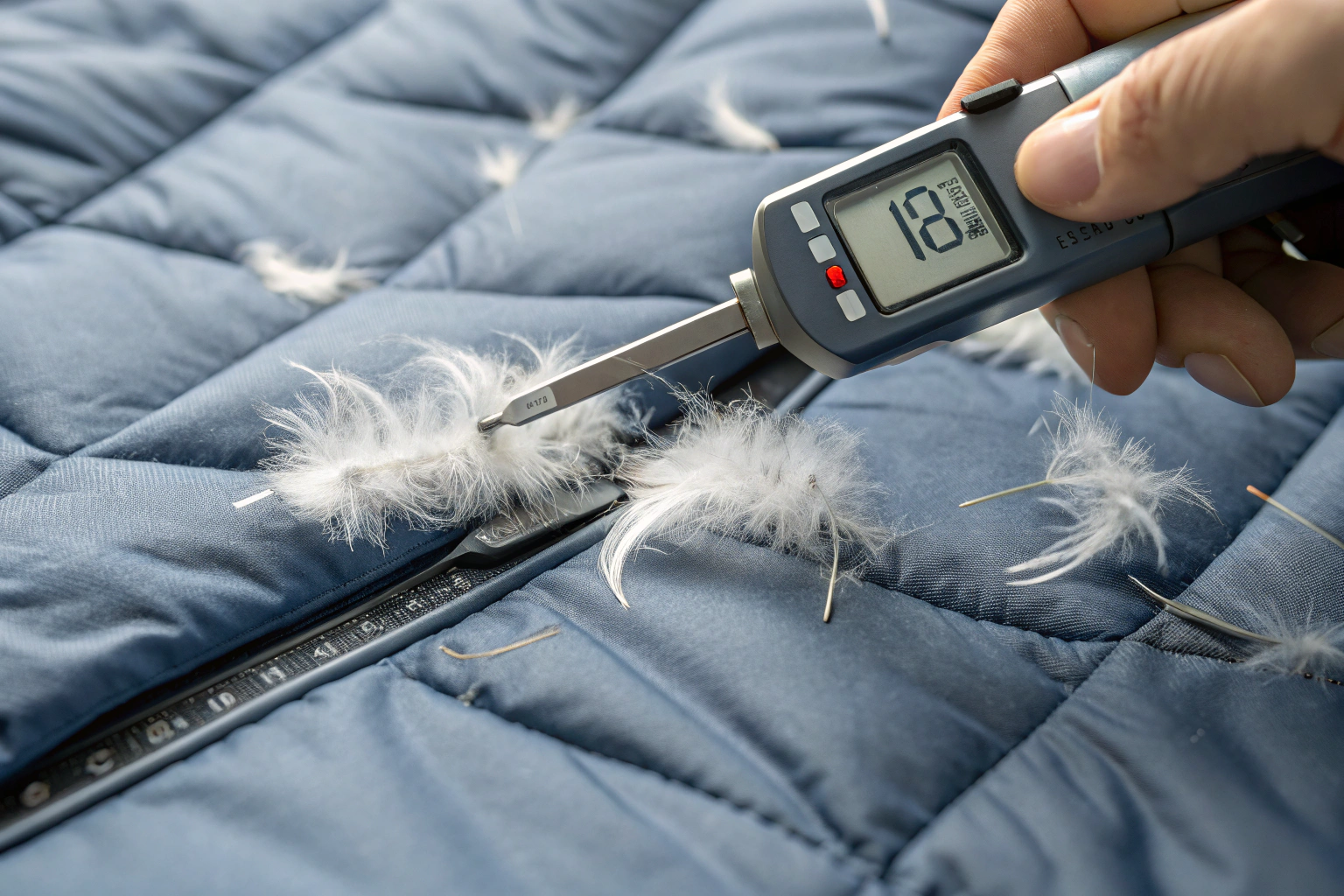
A cold-weather brand owner called me in a panic last November. Her premium $350 down parka was shedding feathers like a molting bird. Customers posted photos of white fluff covering their black sweaters after wearing the jacket for an hour. The down-proof fabric was lab-certified. The down fill itself was high-quality 800-fill goose down. The zippers were perfect. The failure point that destroyed her winter season? The sewing contractor used 8 stitches per inch on the quilting lines instead of the specified 12. Those four missing stitches per inch created microscopic exit tunnels that every down cluster found its way through.
Stitch density isn’t just a tailoring detail. It is the primary mechanical barrier that prevents the down insulation from escaping through the millions of needle holes punctured into an otherwise down-proof fabric. Every time a sewing needle penetrates the shell, it creates a permanent hole. If the stitches per inch (SPI) are too low, the gaps between threads are large enough for a down cluster to wriggle through. If the SPI is too high, you risk perforating the fabric into a weakened "tear-off" line. At Shanghai Fumao, when we supply down-proof wovens to outerwear brands, we always include a mandatory sewing specification sheet alongside the fabric—because the best fabric in the world won’t save a poorly stitched seam.
I’ve spent years analyzing down-leakage returns under a microscope, and the needle hole is almost always the culprit. Stick with me, and I’ll break down the exact SPI thresholds for different down fill powers, explain why the needle type and thread ticket size must match the stitch density, and show you how to write a sewing specification that your garment contractor cannot ignore.
How Down-Proof Fabrics Get "Perforated" by Needles During Quilting
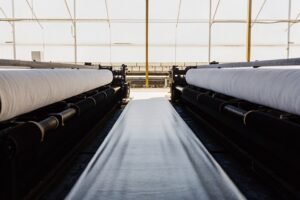
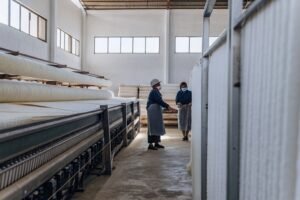
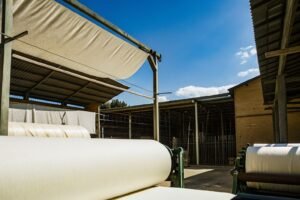
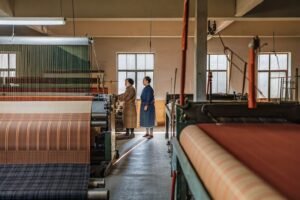
Down-proof fabric is a marvel of tight construction. We weave it with micro-denier nylon or polyester yarns, calendared under heat and pressure to flatten the fibers and close the interstitial spaces. It passes the "down-proof test"—a standardized tumble test where a bag of the fabric filled with down is agitated, and the number of escaping fibers is counted. The fabric, as a flat sheet, is virtually impenetrable to down.
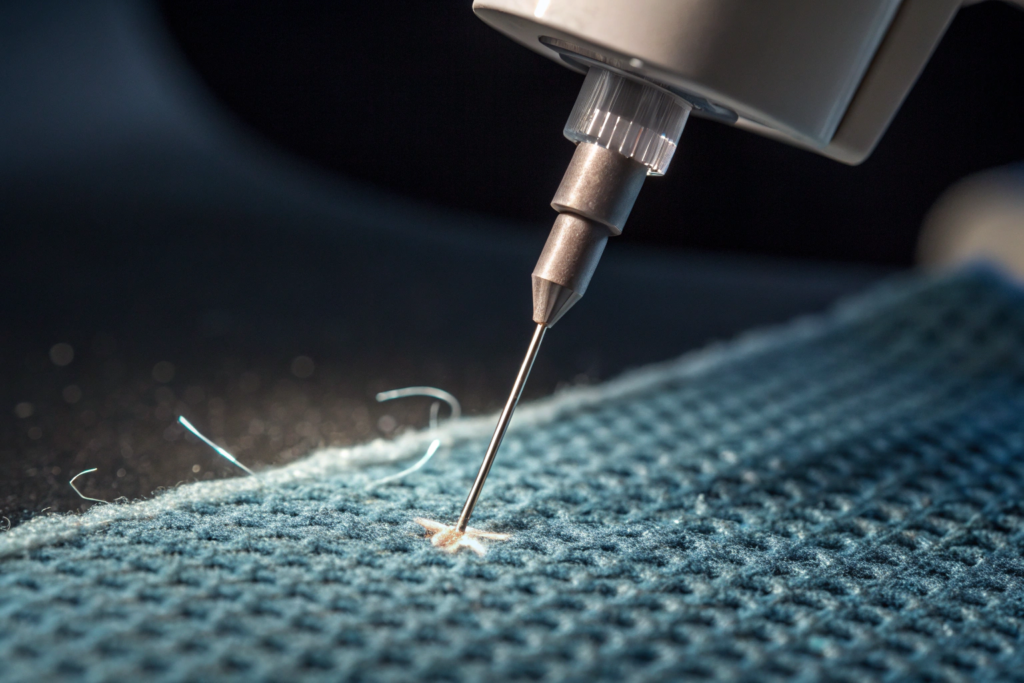
Then the sewing operator runs it through a lockstitch machine, puncturing it with a needle 12 times per inch along every quilt line. Each needle penetration cuts a permanent cylindrical hole through the calendared surface and the tight weave structure. If the needle is blunt, it tears a ragged, oversized hole instead of a clean one. If the stitches per inch are too few, the thread doesn’t fill the hole adequately, leaving a crescent-shaped gap around the thread. These holes are now the only exit path for the down. The fabric is still down-proof, but the sewn garment is not.
What Is the Minimum SPI to Prevent 800-Fill Down Migration Through Seams?
Higher fill power down is finer, more compressible, and more migratory. An 800-fill goose down cluster is smaller and more flexible than a 600-fill duck down cluster. It can squeeze through a tighter gap. This means your stitch density must increase as your fill power increases, not stay the same.
Here is the stitching specification chart I use for our down-proof shell fabric clients, based on twenty years of leakage analysis:
| Down Fill Power | Minimum Stitches Per Inch (SPI) | Recommended Needle Size | Thread Ticket |
|---|---|---|---|
| 500 – 600 Fill (Duck) | 10 – 12 SPI | #70 (Metric) | Tkt 40 |
| 700 – 800 Fill (Goose) | 12 – 14 SPI | #65 (Metric) | Tkt 50 |
| 850+ Fill (Ultra-High) | 14 – 16 SPI | #60 (Metric) | Tkt 60 |
(Here is a critical nuance: switching to a smaller needle alone doesn’t fix a low SPI problem. A large hole with a tight thread is still a leak path around the thread circumference. You must reduce hole size AND increase hole count to minimize the individual gap volume.)
I work with a technical outerwear brand in Vancouver that uses 850-fill goose down. They run 15 SPI with a #60 needle and a Tkt 60 microfilament thread. Their leakage rate is 0.2%. A competing brand using identical fabric but 10 SPI was pulling 3% leakage. The stitch density was the entire difference. You need to check how to specify SPI requirements based on down fill power for leakage-free quilted outerwear.
Why Does a "Cheese-Grater" Effect Happen When SPI Exceeds 16 on Calendered Fabrics?
You can over-stitch a down-proof shell. This is the other side of the equation that panicked production managers forget. If you sew 18 or 20 stitches per inch into a tightly calendared nylon taffeta, you’re essentially creating a perforated tear line, like a postage stamp. The needle holes are so close together that the thin web of fabric between adjacent holes loses its structural integrity.
When the down lofts inside the baffle, it exerts internal pressure on the shell. That pressure focuses on the weakest point—the perforated stitch line. The fabric can literally split along the stitching under tension, a failure mode we call "zippering" or the "cheese-grater effect." You should read the technical guide to preventing seam perforation failure in calendared down-proof nylons during quilting. The solution is staying within the 12 to 15 SPI window for most applications, using a sharp, thin needle that cuts cleanly rather than tearing, and sometimes specifying a slight needle cool-down if the machine speed is generating frictional heat that melts the calendared coating around the hole.
Matching Thread Size and Needle Type to Stitch Density
Specifying the stitches per inch is only one part of the equation. You can sew 14 stitches per inch with a thick Tex 70 thread and a #90 needle, and still have massive leakage. Why? Because the thick needle creates a hole that the thick thread cannot completely close, leaving a persistent open channel. The thread and needle must be engineered as a matched system with the stitch density to achieve a sealed seam.
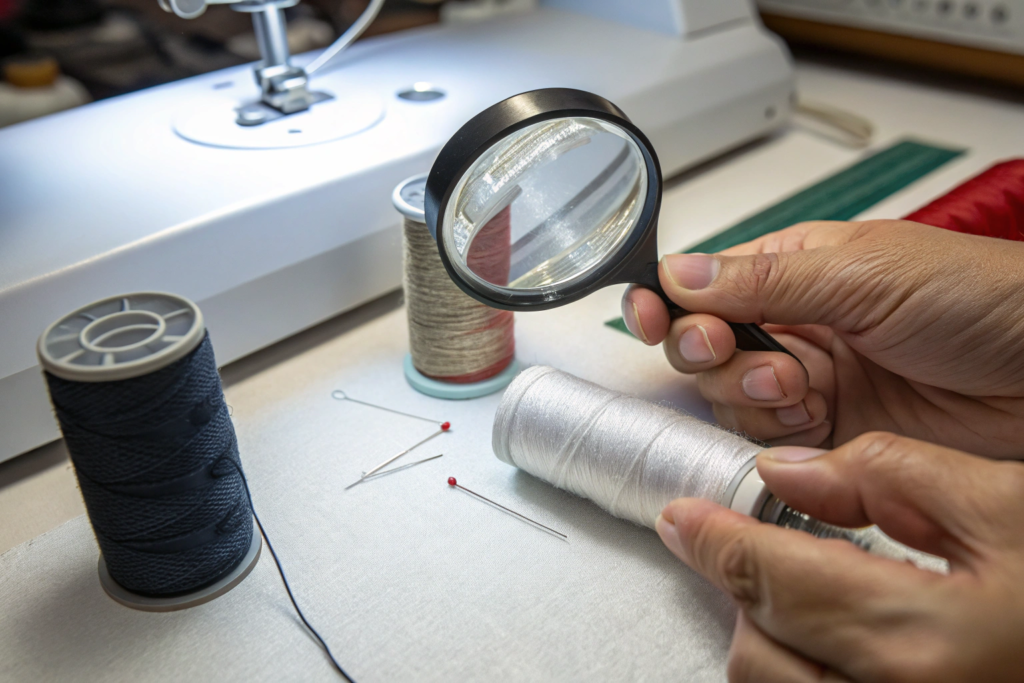
The goal is to maximize thread coverage of the needle hole. A fine, high-tenacity continuous filament polyester thread fills a small hole more completely than a coarse, fuzzy spun polyester thread in a large hole. The thread should be smooth, with minimal hairiness, to avoid wicking oils or moisture and to present a clean, gap-free surface to the down clusters attempting to squeeze past. I specify only high-tenacity microfilament polyester threads for down-proof construction. Cotton thread and spun poly are simply too fuzzy and too weak.
Why Is a Ball-Point Needle a Disaster for a Calendared Down-Proof Shell?
Needle point design determines how the needle penetrates the fabric. A ball-point needle (often marked "SES" or "SUK") has a rounded tip designed to push aside the yarns of a knit fabric without cutting them. If you use a ball-point needle on a tightly woven, calendared down-proof nylon, the rounded tip cannot push the densely packed, heat-fused yarns aside. Instead, it punches through by brute force, tearing a ragged, irregular hole with frayed edges.
That ragged hole doesn’t close neatly around the thread. It leaves a distorted, star-shaped gap that down clusters escape through easily. An acute-point needle (marked "R" or "SPI") has a sharp, narrow point that cleanly cuts through the fiber with minimal displacement. This creates the smallest possible hole and the cleanest seal around the thread. For micro-denier down-proof wovens, I mandate acute-point needles in size #65 or #70. No exceptions. You can find a guide on selecting the correct needle point geometry for stitching high-density calendared nylon fabrics. The wrong needle point can undo all the value of a high SPI specification.
What Thread Tension Setting Prevents "Grin-Through" on a Stuffed Baffle?
Grin-through is the ugly phenomenon where you can see the thread on the face of the quilted panel, pulled tight into a dimple. Beyond the aesthetic problem, an over-tensioned top thread pulls the knot up to the surface, creating a funnel-shaped hole through the needle path. This funnel acts like a down-cluster slide, easing the escape path rather than blocking it.
The tension setting must be balanced so the knot sits precisely in the center of the fabric layer, not on the top or bottom surface. The top tension should be just tight enough to form a clean stitch, with the bobbin tension slightly looser. I ask sewing contractors to run a "tension pull test" on a scrap of the actual shell fabric before starting bulk. Adjust the tension until the knot is invisible from both sides when the fabric is gently pulled. You should read about optimal lockstitch thread tension settings to prevent down leakage and seam puckering on lightweight outer shells. A tension that’s even 0.5 grams too high can degrade the hole seal, especially on ultra-light 15-denier shells.
Testing Down-Proof Seams: Beyond the Fabric Mill Certificate
A mill certificate tells you the fabric passed the down-proof test as a flat sheet. It tells you nothing about the seams, which are where the real-world failures occur. You can buy the best calendared 20-denier nylon on the market, and if your garment contractor uses 8 SPI with a ball-point needle, your jacket will leak like a sieve regardless of what the fabric test report says.
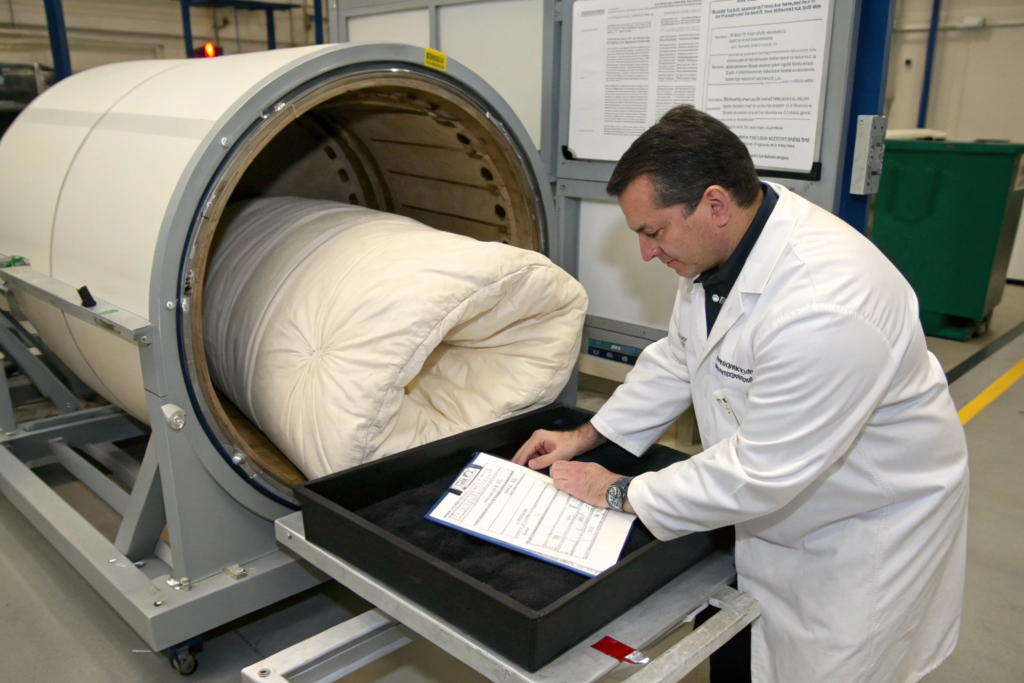
You need a sewn-product-level test. The fabric is only half the system; the sewn seam is the other half. I require my garment manufacturers to run a "filled bag tumble test" on the first production sample, not just a flat fabric swatch. This test involves sewing a pillow of the actual shell fabric using the production seam specifications, filling it with the specified down, and tumbling it in a rotating drum for a set period. The number of escaping fibers is then counted and compared against a standard. This validates the entire system—fabric, thread, needle, SPI, and tension—under dynamic stress.
How Does the IDFL "Tumble Test" for Sealed Seams Differ From a Fabric Mill Test?
IDFL (International Down and Feather Laboratory) is the industry-recognized authority for down and feather testing. Their seam leakage test is the standard most outdoor brands reference. Unlike a mill test that uses a small, un-sewn bag, the IDFL test uses a pillow sewn with the exact shell fabric, seam construction, and stitch density intended for production. The pillow is filled with a specified amount of down and placed in a tumble drum that rotates and agitates the sample.
After tumbling, the escaped down and fibers are collected from the drum and the pillow surface and counted. The result is a "Leakage Rating." A result of less than 10 fibers escaping from a standard pillow is considered excellent. This test places mechanical stress on the seams, flexing the needle holes and working the down clusters against the thread barriers. It is infinitely more predictive of real-world wear than a static fabric test. You need to understand the standard IDFL seam leakage tumble test protocol for down-filled apparel seams. Include this test as a pre-production gate.
Can a "Vacuum Pressure Differential Test" Simulate Body Compression on Seams?
When a wearer sits on a down jacket or leans against a car seat, they compress the baffle, creating internal air pressure that pushes the down clusters forcefully against the seams. A tumble test doesn’t fully replicate this high-pressure pulse. Some advanced testing laboratories now use a vacuum chamber test where a sealed down panel is subjected to pressure differentials, simulating the compression and recovery cycle.
The panel is placed over a vacuum grid, and negative pressure pulls air through the seams. Sensors count the fibers that are pulled through under stress. This test is particularly useful for seat-pad applications or the back panels of jackets that will be constantly compressed. It reveals weak seams that a passive tumble test misses. If you are producing high-wear outerwear like snowmobile jackets, you should investigate the vacuum pressure method for evaluating seam integrity in down-proof fabric construction. This is a premium test, but it catches the failures that only show up after a season of heavy use.
Specifying a Sewing Protocol for Your CMT Contractor
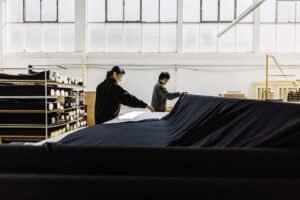
You can spec the perfect fabric and the perfect thread, but if the CMT (Cut, Make, Trim) contractor doesn’t receive a written, enforced sewing protocol, they will use their default settings. Most garment factories default to 8-10 SPI with a #75 ball-point needle and a spun poly thread—a perfectly fine setup for a casual woven shirt, but a disaster for a down-proof shell. The contractor isn’t being malicious; they simply may not understand the engineering requirements of a down-proof seam.
You must issue a mandatory "Down-Proof Sewing Specification Sheet" as an appendix to your purchase order. This sheet overrides the factory’s default machine settings and holds them contractually accountable for seam integrity. Include it in the tech pack, have them sign off on it, and verify compliance during an in-line inspection. At Shanghai Fumao, we help our fabric buyers build this spec sheet to match the specific down-proof article they are purchasing from us.
What Must a "Down-Proof Seam Specification Sheet" Include for a CMT Factory?
A proper spec sheet leaves no room for operator judgment. It’s a step-by-step machine setup guide. Here is the template I provide to brands buying our down-proof shells:
| Specification Element | Required Detail | Verification Method |
|---|---|---|
| Stitch Type | 301 Lockstitch (single needle) | Visual check |
| SPI | 13-14 stitches per inch | Stitch counter gauge on 10 samples per shift |
| Needle | DBx1 #65, Acute Point (R), Titanium-coated | Inspect needle stock; replace every 4 hours |
| Thread (Top) | Polyester continuous filament, Tkt 50 | Check spool label |
| Thread (Bobbin) | Polyester continuous filament, Tkt 50 | Check bobbin stock |
| Top Tension | 90-110 grams force | Tension meter test on seam sample at shift start |
(One more thing I enforce: no lubricating oil on the needle. Some mechanics add oil to reduce friction, but that oil wicks into the fabric and degrades the calendared finish over time. Zero oil on the needle bar.)
This sheet must be translated into the local language of the sewing floor and posted at each quilting machine. You can find a down-loadable down-proof garment sewing protocol template for CMT contractors that includes these details. Sending the fabric without this sheet is like sending a race car without a setup guide for the mechanic.
Why Should a "Needle Change Schedule" Be Part of the Production Line QC?
Sewing machine needles wear out. A sharp acute-point needle is carving through dense, calendared nylon with every stitch. After approximately four to six hours of continuous quilting, the point becomes dull and rounded from friction. A dull needle stops cutting clean holes and starts punching ragged ones. The stitch density remains the same, but the hole quality degrades catastrophically, opening up leakage paths halfway through the shift.
A mandatory needle change schedule eliminates this variable. I require that all needles on down-proof quilting lines be replaced at the lunch break and at the end of the shift. This means each needle runs for a maximum of four hours. The used needles are disposed of, not re-sharpened. The cost? About $0.20 per needle. The benefit? Zero leakage from needle-wear degradation. This simple rule has saved my clients more money in prevented returns than any expensive fabric upgrade. Include the needle change log as a check-off item on the QC’s hourly patrol sheet.
Conclusion
Stitch density is the final, critical link in the down-proof engineering chain that starts with the fabric mill and ends at the consumer’s back. You’ve seen how a single missing stitch per inch creates a highway for 800-fill down clusters to escape through the very seams that should be containing them. We connected the dots between the needle geometry and the thread ticket, revealing that a thick, fuzzy thread in a ball-point hole is a guaranteed failure, while a fine filament thread in a sharp acute-point hole is a reliable barrier. You learned that the fabric mill certificate is not enough—the sewn seam must be tested as a dynamic system under the tumble and compression stresses of real wear. And you now have the framework to issue a binding sewing protocol to your CMT contractor that eliminates operator variability and enforces a needle change discipline.
A down jacket that doesn’t leak is a brand promise kept. It’s the customer who wears your jacket on a freezing chairlift, looks down at their clean black sweater, and trusts you for the next purchase. That trust is built on the geometry of a 13-stitch-per-inch seam, sewn with surgical precision. If you’re ready to pair your next down-filled collection with shell fabrics and sewing specifications that guarantee seam integrity, we are here to provide the technical partnership. Reach out to our Business Director, Elaine, at elaine@fumaoclothing.com. Let’s seal the deal on leakage-free outerwear.