
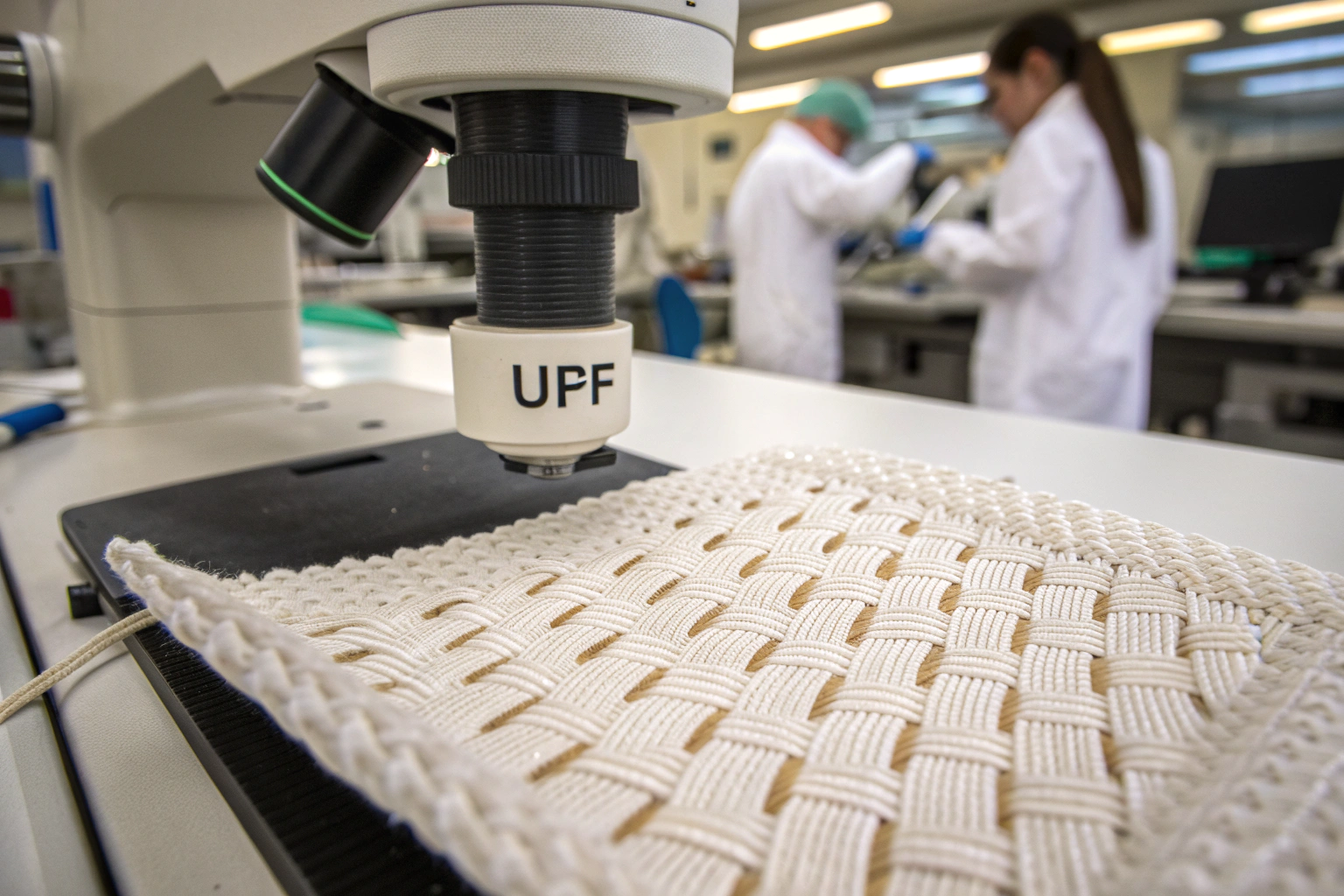
A distributor called me last July in full damage-control mode. He sold 3,000 yards of lightweight nylon to an Australian swimwear brand. The fabric was perfect—vibrant prints, great stretch, fast delivery. Three months later, the brand’s customer posted a photo of a severe sunburn in the exact shape of the bikini on her shoulders. The fabric was supposed to be UPF 50+, but it was barely blocking 20% of UV radiation. The brand got destroyed in online reviews, the distributor had to eat the entire order cost, and the legal threat was real. A simple UV transmission test on the greige fabric would have caught the failure before a single swimsuit was stitched.
UV protection in nylon is not automatic. A tight, thick weave helps, but nylon’s molecular structure is naturally UV-transparent unless you intervene with specific chemical treatments, dense construction, and certified lab testing. You cannot assume a "thick" nylon feels sun-safe. At Shanghai Fumao, we treat UV protection as a measurable, certified performance property—not a marketing guess. Every sun-protective nylon we ship has a test report backing up the UPF number on the hangtag.
I’ve formulated UV-stabilized nylon for sun shelters, swimwear, and athletic outerwear for over two decades. Stick with me, and I’ll walk you through the exact science of why nylon degrades under UV exposure, the difference between a UPF 15 fashion fabric and a UPF 50+ protective textile, and the specific test methods you must demand from your supplier. This is about protecting your customer’s skin and your business from a lawsuit.
Why Nylon’s Molecular Structure Needs Chemical UV Blockers
Nylon 6 and Nylon 6,6 are polyamide fibers. They have excellent tensile strength, abrasion resistance, and elasticity, which is why they dominate the swimwear and activewear markets. But chemically, the amide bonds in the polymer chain are vulnerable to photodegradation. UV radiation—specifically the UVA (315-400nm) and UVB (280-315nm) wavelengths—has enough photon energy to break those chemical bonds. Over time, untreated nylon exposed to sunlight loses strength, yellows, and becomes brittle.
But the more immediate problem for a garment is UV transmission. In a lightweight woven or knitted nylon, the fiber itself is relatively transparent to UV light. The radiation passes right through the individual filaments and through the gaps between yarns. To stop this, you need two things: a UV-absorbing chemical finish that captures the radiation at the fiber surface, and a dense enough construction that minimizes the physical gaps where light can sneak through. Without both, you’re selling sunscreen with an SPF of maybe 2.

What Is the Difference Between a UV Absorber and a UV Stabilizer for Nylon?
These two chemical classes are often confused, but they do fundamentally different jobs. A UV absorber is a sacrificial molecule that captures UV photons before they can damage the polymer chain. Think of it as sunscreen for the fabric. It converts the harmful UV energy into harmless, low-level heat that dissipates. Common UV absorbers for nylon include benzotriazoles and benzophenones. These are applied during dyeing or as a finishing pad application.
A UV stabilizer, specifically a Hindered Amine Light Stabilizer (HALS), does not absorb UV. Instead, it scavenges the free radicals that form when UV radiation does manage to break a polymer bond. It stops the chain reaction of degradation that would otherwise cascade through the fiber. For maximum protection, a high-performance outdoor nylon often contains both: a UV absorber to block the energy at the surface, and a HALS stabilizer to mop up any damage that gets through. You can find a technical comparison of benzotriazole UV absorbers versus hindered amine light stabilizers for polyamide textiles. For a swimwear fabric that faces chlorine, salt, and intense sun, I spec both additives in the dye bath.
Why Does Titanium Dioxide Delustering Also Improve UV Blocking in Nylon Yarn?
This is a happy accident of textile manufacturing. Most nylon fibers contain a small percentage of titanium dioxide (TiO₂), a white pigment added to the polymer melt before spinning. The primary purpose is delustering—breaking up the shiny, synthetic luster of the filament to create a more natural, matte cotton-like appearance. Full-dull nylon contains about 1.5% to 2% TiO₂; semi-dull contains about 0.3% to 0.5%; bright nylon contains zero.
TiO₂ happens to be an excellent inorganic UV blocker. The pigment particles scatter and reflect UV radiation, preventing it from penetrating the fiber. A full-dull nylon yarn will have significantly higher inherent UV protection than a bright nylon yarn of the same denier and weave construction. I always specify full-dull nylon for any sun-protective application, even if the brand wants a slightly brighter color. The matte base is functionally superior for UV blocking. You can read about how TiO₂ delustering pigment in nylon yarn contributes to inherent UV protection. It’s not a replacement for a chemical UV absorber, but it’s an excellent baseline that makes the absorber’s job easier.
Testing UPF: Why a Lab Report Matters More Than a Hangtag
A hangtag that says "UPF 50+" is a marketing claim. A test report from an accredited lab is evidence. I’ve seen too many brands buy generic "sun protection" hangtags from a printing company and sew them onto untested fabric. That’s not just dishonest—it’s legally reckless. In the US, the FTC regulates UV protection claims under the same truth-in-advertising laws that govern SPF sunscreen labels. In Australia and New Zealand, the standard AS/NZS 4399 is mandatory for any garment labeled as sun protective. If your fabric fails a random test, your brand faces fines, forced recalls, and class-action lawsuits.
You must demand a test report that references a specific standard. The global gold standard for fabric UV testing is UPF—Ultraviolet Protection Factor—measured according to AS/NZS 4399, AATCC 183, or EN 13758-2. UPF 50+ means the fabric blocks at least 98% of UV radiation. Anything below UPF 15 is not considered protective and should never be marketed as such. At Shanghai Fumao, we send every new UV-protective nylon article to an external ISO 17025 accredited lab for initial certification, then run internal quality control checks on every bulk lot.

How Is UPF Calculated Differently From SPF That Consumers Know From Sunscreen?
Consumers know SPF from sunscreen bottles. SPF 50 means you can theoretically stay in the sun 50 times longer without burning. But SPF measures only UVB protection, and it’s an in-vivo test (on human skin). UPF measures both UVB and UVA protection, and it’s an in-vitro test (in a laboratory spectrophotometer). UPF is actually a more comprehensive measurement for a physical barrier like fabric.
The calculation is an integrated weighted average of UV transmission across the entire UV spectrum. The formula weights UVB wavelengths more heavily (because they cause more biological damage) but includes UVA in the calculation. A fabric that blocks 98% of UVB but lets 50% of UVA through will have a UPF rating much lower than 50. This is why a thin, white nylon shirt might feel shady but still deliver a significant UVA dose to the skin. You should consult the official AATCC 183 standard method for measuring the ultraviolet radiation transmittance of apparel textiles. This document details the exact wavelength range, the weighting function, and the sampling requirements.
What Are the Minimum Sample Requirements for an EN 13758-2 Certified Test?
EN 13758-2 is the European standard for UV protective clothing. It requires a UPF of at least 40, with average UVA transmission below 5%. The standard also specifies strict sampling rules. You cannot test one relaxed, un-stretched sample and call it a day. The standard mandates testing the fabric in a stretched condition to simulate the tension of wearing a snug swimsuit or compression top.
Specifically, the test samples must be stretched biaxially by 10% in both warp and weft directions. This stretching opens up the pores and represents the worst-case wearing scenario. A fabric that measures UPF 60 in a relaxed state might drop to UPF 15 when stretched across a shoulder. A responsible test report will include both relaxed and stretched UPF values. I’ve seen cheap nylon swimwear linings that test beautifully in the lab but fail catastrophically when the garment is on a moving body. Insist on the stretched test condition.
Chemical Finishing: The Bath Recipe That Delivers UPF 50+
Applying a UV absorber is not like adding salt to soup. It’s a precise chemical engineering process that must be integrated into the dyeing or finishing cycle. The UV absorber molecule needs to diffuse into the nylon fiber, not just sit on the surface, because a surface coating would wash off in the first pool swim or laundry cycle. The application requires the correct temperature, pH, and dwell time to achieve proper exhaustion onto the fiber.
The chemistry must also be compatible with the other ingredients in the bath. If you’re dyeing the nylon a dark navy, the dyes, leveling agents, and UV absorber all have to coexist without interfering with each other’s uptake. A poorly formulated bath produces uneven dyeing, reduced fastness, or a UV absorber that’s only 60% exhausted and washes down the drain. At Shanghai Fumao, we treat the UV absorber addition as a programmed step in our automated dyeing controllers, with the same precision as the dye addition itself.

How Does Exhaustion Rate Affect the Durability of UV Protection in Swimwear?
Exhaustion is the percentage of the chemical that leaves the water and permanently attaches to the fiber. A good UV absorber applied at the correct temperature (usually 130°C for nylon under pressure) achieves 90% to 95% exhaustion. The remaining 5% to 10% is rinsed away. But if the bath temperature is too low, or the pH is off, the exhaustion might only be 60%.
That 40% of the UV absorber that stayed in the water is gone, but the 60% that attached to the fiber is often weakly bonded to the surface, not diffused into the polymer matrix. This surface-bound chemical will leach out rapidly in chlorinated pool water or salt water. The garment might pass a UPF test when new, but after ten pool sessions, the protection has literally washed away. You must request the wash durability test data from your supplier. A proper application guarantees UPF retention after the equivalent of 40 home launderings, tested according to AATCC 135. Look up the standard procedure for evaluating washfastness of UV protective finishes on nylon swimwear. A 40-wash durability standard is what separates a premium protective textile from a temporary coating.
Can You Achieve UPF 50+ With a Clear Finish, or Must the Fabric Be Dark Colored?
Color matters enormously for UV protection. Dark colors absorb UV radiation naturally because the dye molecules themselves are UV-absorbing chromophores. A black or navy nylon tight can achieve UPF 30 to 50 just from color alone, depending on weight and stretch. This is why dark rash guards are inherently more protective than white ones.
But what about a pastel pink or white swimsuit? White pigments reflect visible light but often scatter and transmit UV radiation. A thin white nylon tricot is notoriously transparent to UV. To achieve UPF 50+ on a pastel or white nylon, you need a heavy dose of an organic UV absorber that works in the clear, non-discoloring part of the spectrum, plus the TiO₂ from a full-dull yarn, plus a dense construction. It’s a triple challenge. I always warn brands: if your swimwear collection is pastel-heavy and you want a legitimate UPF 50+ claim, be prepared for a higher finishing cost and insist on testing every color separately. A test report on a black sample does not validate the white colorway. Each color recipe is a different UV transmission profile.
Specifying the Right Weave and Denier to Reduce UV Transmission
Chemistry is half the battle. Physics is the other half. UV light travels in straight lines, and it will go through any gap it can find. A chemical absorber only works on the UV that actually hits the fiber surface. If the weave is open—think a mesh or a loosely knitted jersey—a significant percentage of UV photons will pass straight through the gaps between yarns without ever touching a UV-absorbing molecule. The chemical can’t block what it never encounters.
Construction density is the physical gate. A high-thread-count plain weave with minimal porosity is the ideal UV barrier. The pores are small, the path length for light is tortuous, and most photons are forced to interact with the fiber. Knits are inherently more porous than wovens and need extra design attention, either through a double-knit construction or a heavier yarn. When a buyer asks me for a UPF 50+ nylon, my first calculation is not about chemicals—it’s about cover factor.

What Is the Minimum Cover Factor for a Woven Nylon to Achieve UPF 30 Without Chemicals?
Cover factor is a mathematical description of how much of the fabric area is actually fiber versus empty space. A cover factor of 1.0 means theoretically no gaps (tightly packed yarns); a cover factor of 0.5 means half the area is holes. For a woven nylon to hit UPF 30 without chemical absorbers, just through construction, you generally need a cover factor above 0.85 in both warp and weft directions.
Achieving that with fine denier nylon means you need a very high thread count. A 40-denier nylon in a tight taffeta weave with 120 ends per inch and 100 picks per inch might reach a cover factor of 0.88 and deliver UPF 30+ in a dark color. The same 40-denier yarn in a looser plain weave with 80 EPI drops to a cover factor of 0.6 and provides almost no protection. You can explore how to calculate the fabric cover factor for UV protective woven nylon textiles. The formula is straightforward: Cover Factor = (threads per inch × √denier) / constant. I run this calculation on every new sun-protective article before we even sample it. If the math says the cover factor is below 0.8, I know we’ll need maximum chemical assist to hit UPF 50.
Why Do Circular Knits Pose a Special Challenge for UV Blocking Consistency?
Knitting creates loops, and loops stretch. A circular-knit nylon jersey might have adequate cover factor on a relaxed roll, but when you stretch it across a torso, the loops elongate, the pores open, and the UV transmission skyrockets. This is the stretch variability problem that EN 13758-2 specifically addresses with its stretched test condition.
To overcome this in a knit, you need structural tricks. A double-knit or interlock construction layers two interconnected knit surfaces, which greatly increases the tortuosity of the light path. Even if pores open on the face, the back layer catches the light. Another trick is to use a textured, false-twist nylon yarn that has higher bulk and fills the interstitial spaces more completely than a flat filament. I always warn new buyers: a single jersey in nylon will never achieve UPF 50+ reliably, even with chemicals. The construction is simply too elastic and porous. Choose a double knit or a woven for the highest claims.
Conclusion
Ensuring your nylon fabric genuinely meets UV protection standards is a holistic engineering challenge, not a single checkbox on a spec sheet. We’ve peeled back the layers from the molecular photodegradation of polyamide chains to the practical art of dye bath exhaustion and the geometric reality of cover factor. You now understand that UPF is a rigorously calculated ratio, not a marketing opinion, and that the Australian and European standards demand testing in the worst-case stretched condition—not the relaxed, flattering state. You’ve learned to ask your supplier about the specific chemical absorber, the TiO₂ delustering level, and the wash durability beyond 40 cycles, not just the initial lab submission.
A genuine UPF 50+ nylon protects your customer from more than sunburn. It protects them from long-term skin damage, and it protects your brand from the devastating legal and reputational consequences of a protective claim that fails in the field. That’s value worth verifying. If you’re developing sun-protective swimwear, rash guards, or outdoor gear and need certified, tested, wash-durable nylon fabrics, we are ready to provide the technical data and the production quality to back up your claims. Reach out to our Business Director, Elaine, at elaine@fumaoclothing.com. Let’s put a certified number behind your sun protection promise.








