I remember a distributor calling me in full panic mode. He sold 5,000 yards of beautiful cotton twill to a workwear brand. Six weeks later, the pants started splitting at the knee—not from the seams, but right through the body of the fabric. The end customer threatened a lawsuit, the brand demanded a full refund, and my distributor was left holding a $120,000 bill. The root cause? Nobody, not the brand, not the distributor, not even the original mill, had ever tested or specified the tear strength. The fabric had great tensile strength, sure, but a low tear resistance means once a small hole starts, it zips open like a zipper.
Tear strength isn’t just a lab number for engineers to geek out over. It is the single most practical durability metric for any fabric that faces dynamic stress—kneeling, snagging on a door handle, or a kid yanking on a sleeve. Unlike tensile strength, which measures how hard it is to pull a flawless fabric apart, tear strength measures how easily a small rip propagates. As a distributor, you are the quality gatekeeper between the mill and the brand. If you don’t know this number, you’re selling a ticking time bomb. At Shanghai Fumao, we include a tear strength report on every spec sheet for bottom-weight fabrics because it’s the difference between a loyal repeat buyer and a legal dispute.
I’ve been in this textile game for two decades, and I’ve seen the "silent rip" destroy more brands than fading color ever has. Stay with me, and I’ll walk you through why this metric matters more than you think. I’ll explain why a 400-Newton tensile strength fabric can fail at a tear force of just 15 Newtons, why the ASTM D1424 Elmdorf test is your best friend, and how knowing your fabric’s "tongue tear" value can actually become a sales advantage. You might be leaving money on the table by ignoring this spec.
Why Tensile Strength Alone Doesn’t Guarantee Durability
Let’s clear up the biggest misconception in fabric sourcing right now. Tensile strength is a team effort; tear strength is a solo sprint. When you pull a woven fabric apart in a tensile test, you’re asking every yarn in that cross-section to resist at the same time. But a tear only stresses one or two yarns at a time. This is why a tightly packed, dense Oxford weave might record a fantastic 700 Newtons of tensile force but rip like paper if you snag it on a nail.
Imagine a tightly bound bundle of dry spaghetti. If you pull the whole bundle from both ends, it’s incredibly strong. But if you take a single strand and pull it sideways until it snaps? It breaks instantly. That lateral, single-strand stress is exactly what a tear test measures. A fabric can have a massive "spaghetti bundle" strength but weak individual yarns. The distributor who confuses these two metrics will inevitably face a catastrophic field failure.

Why Does a High Thread Count Sometimes Lead to Lower Tear Resistance?
This one surprises a lot of my clients. You’d think more yarns packed tightly together would make a fabric stronger against everything. But it creates a problem we call "lack of mobility." For a fabric to resist tearing, the individual yarns need to slide and bunch up against each other, forming a little rope of reinforcement in front of the tear. If the weave is too dense, the yarns are locked in place by friction. They can’t move, so the tear just pops them one by one, like snapping toothpicks in a row.
It’s a classic trade-off. Look at a high-density poplin for a dress shirt. Beautifully smooth, great tensile strength, but notoriously fragile if a cuff catches on a sharp edge. Now look at a looser basket weave or a ripstop fabric. Ripstop is a genius design. We weave thicker "reinforcement" yarns into a grid pattern. If a tear hits one of those thick yarns, it stops dead in its tracks. If it hits the lighter area, the loose weave lets the yarns slide together to resist. To master this balance, you really need to study how to optimize weave density and yarn mobility for maximum tear performance in cotton shirting. It’s about finding the sweet spot where the cover factor is high enough to block wind but low enough to let the yarns dance.
How Does the ASTM D1424 Elmendorf Test Actually Simulate Real-World Snags?
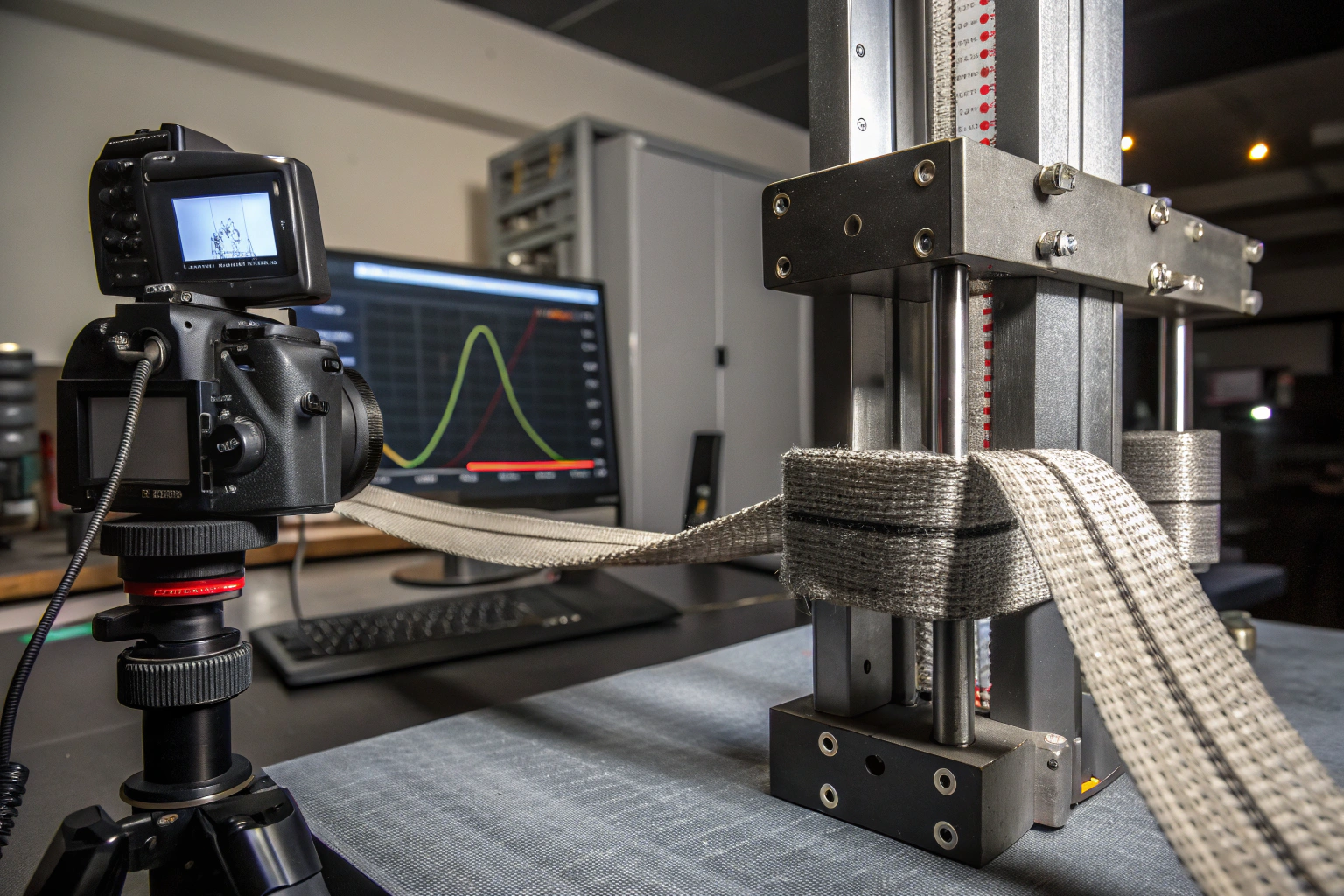
This is the machine I trust to tell me the truth about a fabric’s toughness. The Elmendorf tear tester doesn’t pull slowly. It uses a pendulum that swings down and rips through a pre-cut slit in the fabric. The energy lost in the swing is directly measured as the force required to propagate that tear. It mimics the sudden, violent snag of catching your pants on a sharp corner of a shipping pallet.
The beauty of this test is that it measures the energy propagation, not just the peak force. A fabric that can absorb a lot of energy before the yarns fully snap will record a high Elmendorf value. We express this in Newtons or grams-force. As a distributor, you should memorize the benchmark numbers for common bottom-weight categories. A standard 8oz denim might hit 30-40 Newtons in the warp direction. A lightweight khaki might only manage 12-15. I recently consulted a safety-equipment distributor who was baffled by his high-vis vest fabric failing despite great tensile data. We brought him onto our factory floor and showed him the Elmdorf in action. Watching the pendulum swing and seeing the low number pop up made the problem instantly clear—the weave was too dense and brittle. He updated his spec sheet immediately.
How to Use Tear Strength Data as a Distributor’s Sales Tool
Most distributors sell the sizzle: the hand feel, the color, the drape. But the smart ones sell the story of security and liability protection. When you walk into a meeting with a brand manager for children’s wear or performance outdoor gear, tear strength data isn’t just a dry number; it’s your competitive moat. The buyer has a deep, unspoken fear: "Will this product make me look stupid or cost me my job?" A high tear strength score answers that fear directly.
You stop being a commodity broker and become a solutions provider. You can frame the conversation around risk mitigation. Instead of saying, "This is a nice nylon," you say, "This ballistic nylon has a warp tear strength of 80 Newtons, which is 40% higher than the industry standard for a toddler’s snowsuit. Your liability insurance team will love it." Suddenly, you’re not negotiating on pennies. You’re selling peace of mind. At Shanghai Fumao, we help our distribution partners build "Technical Comparison Decks" that highlight exactly these points.

What Are the Minimum Tear Resistance Benchmarks for Government Uniform Tenders?
If you want to tap into the lucrative but strict government and institutional market, you can’t bluff on specs. These tenders don’t ask for "strong fabric." They ask for a specific ASTM or ISO number. If your fabric falls 1 Newton short, you’re disqualified. That’s a brutal reality, but it’s also an opportunity because it weeds out the low-quality competition instantly.
Here’s a quick reference guide for North American tactical and uniform benchmarks I keep handy:
| End Use (U.S. Market) | Typical Spec Reference | Minimum Warp Tear Strength (Elmendorf) |
|---|---|---|
| BDU/Military Combat Pants | MIL-DTL-44436 / GL-PD-07-12 | 25-30 Newtons (min) |
| Wildland Firefighting Pants | NFPA 1977 | 40+ Newtons |
| Law Enforcement Polo Shirts | Often ASTM D1424 | 15-20 Newtons |
| Heavy Duty Canvas Tents | CPAI-84 | 50+ Newtons (depending on weight) |
(I must note here—never trust a mill’s verbal guarantee on this. Always demand a certified test report from an accredited lab, and check that the fabric was washed once before testing.)
Knowing these numbers lets you approach military surplus contracts or police uniform bids with absolute confidence. You can look up the standard guide for sourcing tear-resistant ripstop nylon fabrics for law enforcement tactical gear and match your product perfectly. This turns a generic piece of nylon into a specialized, high-margin product.
How Can Guaranteeing Tear Resistance Reduce Your Customer Return Rate?
Customer returns kill a distributor’s bottom line. And not just the refund cost—the shipping, the admin, the wasted inventory, the damaged reputation. A large chunk of apparel returns labeled as "poor quality" are actually fabric failures due to tearing at stress points. The crotch seam blows out not because the stitching broke, but because the fabric right next to the stitch gave way.
By proactively guaranteeing a tear strength threshold, you dramatically cut these failure modes. You need to educate your brand buyers about how understanding tear and burst strength specifications reduces apparel liability for USA importers. If they sign off on a 20-Newton spec and you deliver 22, you’re covered. If they ignore the spec and only care about price, you have the documented proof that they accepted the risk.
I recall a specific case from 2023 with a distributor in Texas who supplies scrub uniforms for hospitals. He was plagued with returns because pockets were ripping off when nurses caught them on bed rails. The fabric tensile was fine, but the tear strength was a pitiful 8 Newtons. We switched him to a polyester-cotton blend with a special ripstop construction that boosted the tear strength to 25 Newtons. His return rate for "fabric failure" dropped by 70% the very next season. He took that data back to the hospital group, justified a slight price increase, and locked in a three-year contract. That’s the power of a single data point.
The Differences Between Warp, Weft, and Tongue Tear in Wovens
When you read a tear strength report, you’ll notice it’s never just one number. You get warp, you get weft, and sometimes you get "tongue tear." Confusing these is a rookie error. The direction a fabric tears matters just as much as the material itself. The warp yarns run the length of the roll, and the weft yarns run across the width. They are fundamentally different systems—warp yarns are usually stronger and have higher twist because they take a beating on the loom.
You must look at both numbers. A woven twill might tear effortlessly in the weft direction because the single filling yarn snaps easily, but resist fiercely in the warp where you need to break multiple dense ends. If you’re making a garment where stress is diagonal to the grain—like the pocket of a jacket—you need the weaker number to be strong enough. Don’t average the two; design for the lowest one. That’s your safety floor.

What Is a "Tongue Tear" Test and Why Is It Better for Coated Fabrics?
The Elmendorf test is the quick, violent "snag" simulation. The tongue tear test is a slow, cruel pull that measures the ongoing force to keep a tear moving. We cut a long, thin strip of fabric (looking like a two-pronged tongue) and pull the legs apart in a tensile machine. This generates a series of peaks and valleys on the graph—each peak represents a yarn or a group of yarns being ripped out of the weave.
This method is far superior for coated or heavily finished fabrics. Why? A PU-coated synthetic leather, for example, has a sticky matrix. The Elmendorf pendulum swing often happens too fast for the coating to stretch and absorb energy. The tongue tear moves slowly, giving the plastic coating time to deform and elongate before it breaks. The data tells you how well the lamination bonds to the base fabric. If you’re sourcing for outdoor gear, you need to research how to specify a tongue tear test protocol for durable waterproof tarpaulin laminates. This will tell you if your tent fabric can handle a steady wind load pulling on a small cut, rather than just a flying stick hitting it.
Why Is Warp-Way Tear Usually Higher Than Weft-Way in Plain Weaves?
It comes down to loom tension and yarn preparation. The warp yarns are individually drawn through the loom and held under constant, high tension. They’re the "skeleton" of the fabric. To survive this brutal process without snapping every few seconds, we size them—coating them with a protective starch or PVA layer—and use yarn with a high twist factor. The weft yarn is just whisked across by air or a rapier; it doesn’t need the same tensile strength or stiffness.
Consequently, in a standard plain weave, the warp yarns are tougher and packed tighter than the weft yarns. When you tear across the weft (which means you’re breaking the warp yarns), you’re fighting that dense, strong skeleton. When you tear across the warp (breaking the weft yarns), you’re breaking a looser, softer filling. This is also why fabric typically breathes and stretches more in the width. I once had a distributor argue that a lab report was wrong because the weft tear was "too low." We had to physically show him on the loom how the filling insertion was a gentler process, resulting in a lower-tension, less twist-intensive yarn. Once he saw the loose filling yarn in the microscope, he got it. You can’t change physics.
Why Tear Strength Is Non-Negotiable for Children’s Apparel
Kids are stress-testing machines. They don’t just wear clothes; they attack them. They bite sleeves, snag pants on playground equipment, and drag across carpets. The Consumer Product Safety Commission (CPSC) in the US has strict regulations for children’s sleepwear and apparel, but even beyond the fire-retardant laws, there’s an increasing liability pressure around mechanical safety. A small tear quickly becomes a large hole, which can become a choking or entanglement hazard.
If you distribute children’s wear, tear strength is your legal shield. Imagine a jacket hood getting caught on a sliding board. A weak fabric tears instantly and the child falls. A strong, tear-resistant fabric holds long enough for an adult to intervene, but then releases as a safety feature—it’s a delicate balance. You have a moral and legal duty to ensure the fabric doesn’t fail catastrophically under a child’s unpredictable use. I don’t let any nursery fabric leave our mill without a rigorous tear test.

How Do US Flammability Standards Indirectly Relate to Fabric Tear Mechanics?
This is a connection many miss. Certain chemical flame retardant finishes required to pass 16 CFR Part 1610 or 1615 (children’s sleepwear) can degrade the cellulose in cotton fibers. The acid-based treatments that stop the flame can also weaken the molecular chain of the cotton, drastically reducing its tear resistance. You might start with a sturdy 200gsm cotton terry, apply the FR finish, and end up with a fabric that tears like wet newspaper.
This is the hidden trap. A fabric can pass the "char length" requirement for flammability but fail the mechanical safety requirements for normal wear and tear because of chemical degradation. To understand this destructive synergy, you need to read up on how FR chemical treatments degrade the mechanical tear properties of cotton terry cloth. The better route is to source inherently FR fibers like modacrylic blends, or double-check your tear numbers after the finishing application, not before. Never rely on the greige data.
What Is the CPSC Mechanical Hazard Guide for Fabric Integrity in Toddler Clothing?
The CPSC isn’t just about chemicals and buttons; they care about fabric integrity. The "Small Parts" regulations focus on items that can be bitten off, but a garment that shreds easily creates its own small parts (loose fibers and tufts). These can become inhalation or choking hazards for young children. Furthermore, a garment that rips easily exposes internal components—snaps, zippers, drawstrings—that a child can then access and potentially swallow.
The ASTM International has specific guidelines under ASTM F963 (Toy Safety) that can bleed into apparel, especially for dress-up costumes and toddler apparel with attached plush elements. You must check the guidelines for seam slippage and fabric tear resistance under CPSC enforcement for infant apparel. A strong seam doesn’t matter if the fabric right next to it dissolves under a baby’s chewing pressure (which is a lot of Newtons, trust me!). In 2022, a large US children’s brand was forced to recall a line of organic cotton rompers because the fabric around the snap tape tore too easily, releasing the metal snaps. A simple tear strength test would have caught it. We now laminate a lightweight interfacing behind the snap area on all our toddler fabric specifically to prevent this failure mode, pushing the local tear resistance up by 15 Newtons.
Conclusion
We’ve ripped, pulled, and dissected this topic from every angle, haven’t we? You now understand that tear strength isn’t just a minor footnote on a mill’s spec sheet; it’s the master key to understanding how a garment will actually survive in the wild. We separated the myth of tensile strength from the reality of tear propagation, highlighting the danger of dense weaves that trap yarns and shatter under pressure. You saw how the Elmendorf pendulum mimics that sudden, sharp snag that destroys a uniform on the job. And you learned how to turn this data into a sales advantage for government tenders and into a protective barrier against liability claims for children’s wear.
The thread that ties all this together is predictability. Your brand clients don’t just buy fabric; they buy a promise. They promise their own customers a garment that won’t fall apart on the second wear. Knowing your tear strength—down to the directional warp and weft values, and the specific tongue tear for your coated goods—gives you the power to actually keep that promise. It transforms you from a passive middleman into an active quality assurance partner.
Ready to make durability your brand’s signature? Stop taking risks with unverified bulk stock. We can provide you with a detailed, predictive analysis of your fabric’s mechanical properties before you cut a single meter. We love working with distributors who speak the language of quality. Please reach out to our Business Director, Elaine, directly at elaine@fumaoclothing.com. Let’s make sure your next shipment is built to last, not built to fail.