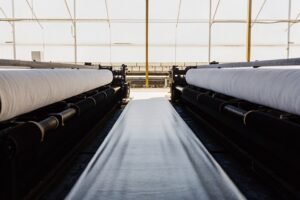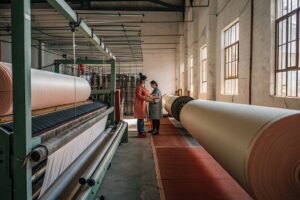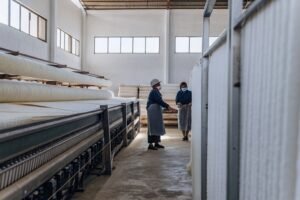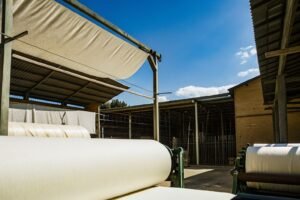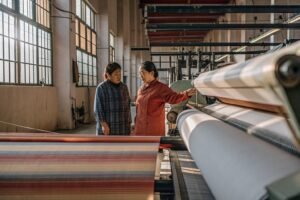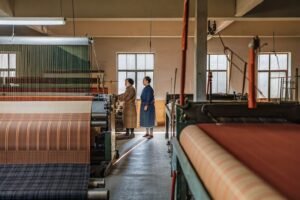
A buyer once showed me two white cotton jersey T-shirts from the same knitting batch. One felt like a luxury department-store staple—smooth, clean, with sharp print clarity. The other felt like a cheap promotional giveaway—fuzzy, dull, and already looking worn out. The construction, the yarn, the GSM were identical. The only difference? The premium shirt went through a 40-minute bio-polishing bath. The cheap one skipped it to save $0.08 per garment. That eight-cent decision cost the brand a $15 retail price premium and a spot on a prime shelf.
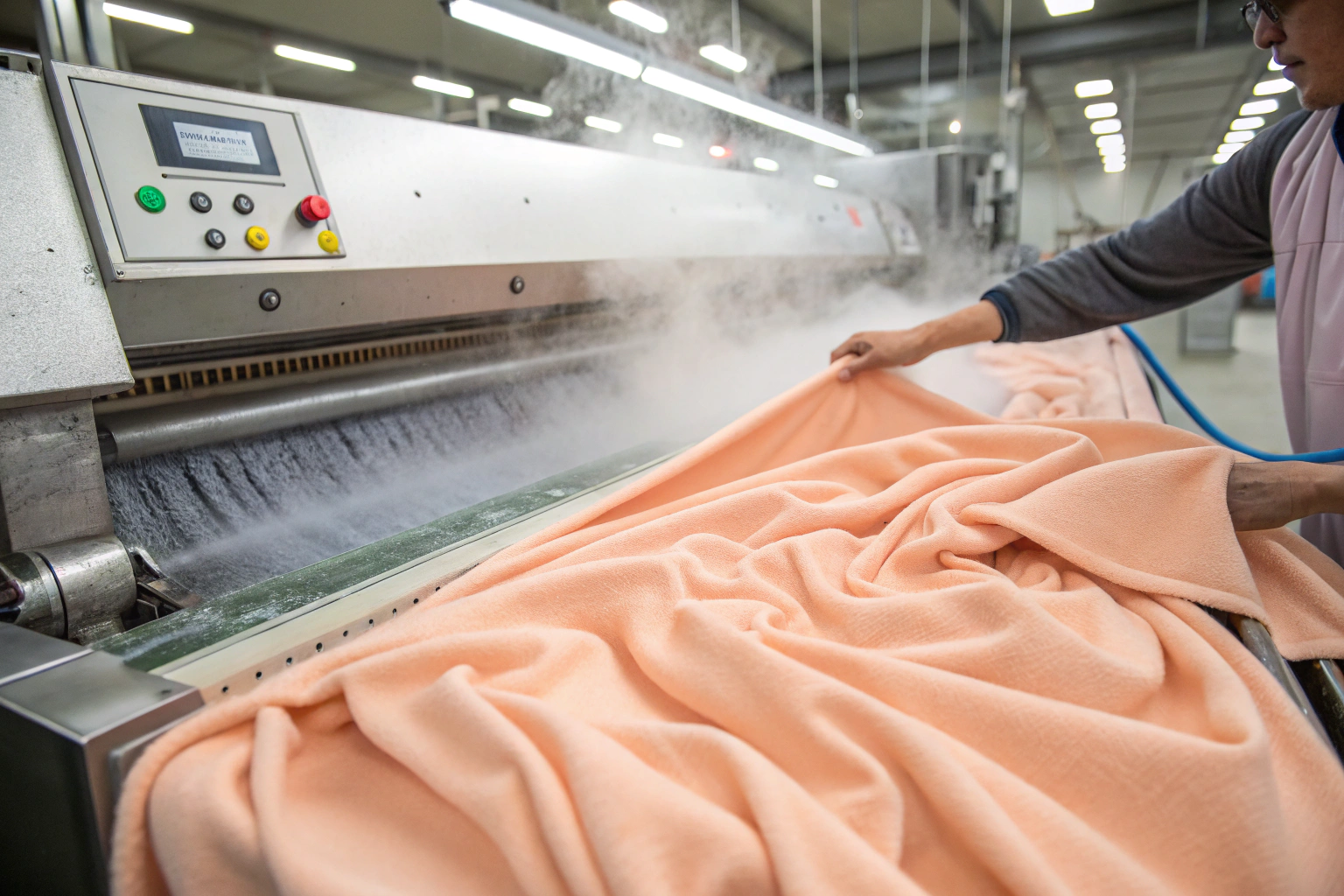
Bio-polishing is not a marketing gimmick or a chemical coating that washes off. It is a permanent enzymatic resurfacing of the cotton fiber that strips away the micro-fuzz pills before they ever form. The process uses cellulase enzymes—biological catalysts that selectively digest the loose, immature, protruding fiber ends on the yarn surface without attacking the strong, crystalline core of the fiber. The result is a knit that starts smooth and stays smooth wash after wash after wash. At Shanghai Fumao, we run bio-polishing as a standard step on every cotton and viscose knit that leaves our dyeing house, not as an optional add-on.
I’ve been specifying enzyme finishes since the early 2000s, and I’ve watched this single process transform cheap ring-spun cotton into a silk-like hand. Stick with me, and I’ll break down the science without the jargon. I’ll explain exactly what temperature kills the enzyme, how to write "bio-polish" into your purchase order so you actually get it, and why this process pays for itself by reducing returns from pilling complaints by up to 70%. This is one of those rare textile processes where the sustainability benefit and the quality benefit are perfectly aligned.
How Cellulase Enzymes Actually "Shave" the Cotton Fiber Surface
Let’s talk about the actual biology, but keep it simple. Cotton is a plant cell. It has a tough, crystalline cellulose core that gives it strength, and a softer, amorphous outer layer of loose fibrils that sticks out like split ends on damaged hair. Those split ends are the source of fuzz, pilling, and dull color reflection. A chemical flame from a singeing machine can burn them off a flat woven surface, but you can’t singe a knitted fabric without destroying the loop structure and the stretch.
This is where the enzymes earn their keep. Cellulase enzymes are like Pac-Man on a microscopic scale. They are proteins engineered to recognize and hydrolyze (break down with water) only the disordered, weak cellulose chains on the fiber surface. They dock onto those fuzzy split ends, clip the chemical bonds, and release them into the wash water. They cannot penetrate the dense, crystalline core of the fiber, so the structural integrity of the yarn remains intact. The enzyme only eats the fuzz, not the fabric. It’s the most selective surface refinishing tool we have in the textile industry.

What Is the Difference Between Acid Cellulase and Neutral Cellulase Polishing?
Not all cellulases are the same beast. The original bio-polishing enzymes from the 1990s were acid cellulases—they worked best at a pH of 4.5 to 5.5. They were effective, but aggressive. If you left the fabric in the bath ten minutes too long, the enzyme kept eating, and you’d lose 3% to 5% of the fabric weight. That’s a lot of lost money on a 10-ton order.
Neutral cellulases, developed later, operate at a pH of 6.0 to 7.0. They are gentler, more forgiving on cycle time, and produce a more uniform surface finish. Here is how I choose between them for our knits:
| Enzyme Type | Optimal pH | Temperature | Best Use Case |
|---|---|---|---|
| Acid Cellulase | 4.5 – 5.5 | 50°C – 55°C | Heavy slub yarns, denim, tough surface fuzz removal. |
| Neutral Cellulase | 6.0 – 7.0 | 50°C – 60°C | Fine-gauge cotton jersey, modal, viscose blends. Lower weight loss risk. |
(Here is a hard lesson from my floor: never run bio-polishing on a Monday morning with cold water. The enzyme activity is highly temperature-dependent. If you’re 5 degrees below the optimal range, the reaction slows to a crawl, and you get a patchy, inconsistent surface. We pre-heat the bath water for exactly 20 minutes before adding the enzyme.)
You should look at how to select the correct cellulase enzyme type based on fabric fiber composition and desired finish. For a 100% organic cotton baby rib knit, I always specify neutral cellulase. The gentler action preserves the fabric’s tensile strength while delivering a clean, pill-free surface that passes the strictest children’s wear safety standards.
Why Does the Enzyme Stop Working Without Damaging the Fabric’s Strength?
This is the elegant part of the biology. Enzymes are proteins with a specific three-dimensional shape. That shape is the key that fits into the lock of the loose cellulose chain. When you raise the temperature above 70°C, or when you raise the pH above 9.0 at the end of the cycle, the protein denatures—it unfolds, loses its shape, and permanently stops working. It becomes just another harmless bit of protein in the water.
So the process has a built-in kill switch. Once the bio-polishing cycle has run for the specified time (usually 30 to 60 minutes), we raise the bath temperature to 80°C or add an alkaline agent to spike the pH. The enzyme deactivates instantly. The weight loss stops. The fabric strength is preserved. This is not a chemical reaction that can run away if you forget about it, provided you follow the termination protocol. I train every new dye house operator that the "kill step" is just as critical as the polishing step. An unterminated enzyme bath continues eating the fabric all the way through the rinse cycle.
Bio-Polishing vs. Traditional Singeing: Why Knits Need a Different Approach
Woven fabrics are flat, stable, and can withstand a direct flame. Knitted fabrics are loops, and loops are stretchy, dimensional, and delicate. If you try to run a cotton jersey through a standard singeing machine, three bad things happen. One, the flame catches the tiny fiber loops and singes them unevenly, creating a blotchy surface. Two, the heat can set wrinkles and creases permanently into the relaxed knit structure. Three, you lose the soft, springy hand feel that makes a knit a knit.
Bio-polishing is the knit-friendly alternative. It processes the fabric in rope form, fully submerged in water, with zero mechanical tension. The enzyme reaches every surface of every loop, inside the curl and out. There are no flame marks, no scorching, no flattened areas. The fabric retains its full dimensional stretch and recovery. For a distributor or brand, this means you get the clean surface of a singed woven, but with the soft, bouncy handle that consumers expect from a premium T-shirt or baby onesie.

Can Bio-Polishing Replace Silicone Softeners in the Long Run?
Silicone softeners are a quick fix. You dip the fabric, the silicone macromolecules coat the fiber, and the hand feel becomes instantly slippery and soft. It’s a nice effect, but it’s temporary. Three to five home washes later, the silicone washes off, and the true, rough fiber surface reveals itself. The consumer feels betrayed. The garment they loved now feels cheap.
Bio-polishing is a structural fix, not a coating. By removing the rough fibrils at the fiber level, the smoothness is permanent and intrinsic. You don’t need to mask a rough fiber with a chemical coating; you simply remove the roughness. Many of our best circular knit programs now use bio-polishing as the primary softness mechanism, then add a tiny amount of a hydrophilic (water-loving) softener just for cutting sewability, not for hand feel. This combination produces a fabric that actually gets softer with repeated washing, rather than degrading. You should read about how bio-polishing enhances the long-term wash durability of knit fabrics compared to topical softener treatments. The data consistently shows that an enzyme-treated knit retains its softness rating after 20 washes, while a silicone-treated knit drops off sharply after 5 washes.
Why Is "Weight Loss" a Controlled KPI, Not a Defect, During Bio-Polishing?
Some buyers panic when I tell them we target a 3% to 5% weight loss during bio-polishing. They think we’re selling them less fabric. That’s the wrong framing. The 3% to 5% weight we are removing is the fuzzy, weak, loose fiber mass that would have formed ugly pills in the first consumer wash anyway. We’re simply removing it in our controlled factory bath, where it can be filtered and properly disposed of, rather than in your customer’s washing machine where it ruins the garment appearance.
Think of it like trimming the fat off a steak before cooking it. You’re not losing edible meat; you’re removing the part that would have degraded the eating experience. We measure the weight loss precisely using a formula: Weight Loss % = (Weight Before – Weight After) / Weight Before × 100. We log this for every single batch. If the weight loss exceeds 5%, we know the enzyme activity was too high or the time too long, and we flag the batch for tensile strength testing before it ships. A controlled weight loss KPI is the sign of a sophisticated finishing operation. It proves we hit the target.
How to Specify Bio-Polishing in a Knit Purchase Order
Saying "I want bio-polished fabric" to a supplier is as vague as saying "I want a fast car." It means nothing without a measurable standard. A shady mill will take your verbal request, run a 5-minute cold-water rinse with a splash of cheap expired enzyme, and charge you a $0.15 upcharge for a process that did absolutely nothing. You won’t know until the returns start flooding in three months later.
You must lock the specification down in writing. A proper bio-polishing specification on a purchase order includes the enzyme type, the target weight loss percentage, the required pilling resistance test grade, and a statement that silicone softeners are not to be used as a substitute for the mechanical finish. This transforms a subjective hand-feel request into an objective, testable, and legally enforceable requirement. At Shanghai Fumao, we actually prefer buyers who write detailed finishing specs because it proves they know what they’re buying and reduces disputes over softness later.

What Is the Exact Test Standard for Verifying "Pilling Resistance Grade 4"?
Your PO must reference a specific lab test and a passing grade. The global gold standard for pilling resistance is the Martindale method, defined in ISO 12945-2 or ASTM D4970. The fabric sample is rubbed against a standard abradant fabric for a specified number of cycles (usually 2,000 cycles for knits), then visually compared against a set of reference photographs on a 1-to-5 scale.
Grade 5 means "no pilling." Grade 4 means "slight surface fuzzing, no pills." Grade 3 means "moderate pilling, visible pills." For any bio-polished knit, I insist on a minimum of Grade 4 after 2,000 cycles. If the supplier can’t provide a recent lab report from an accredited lab (like SGS or Intertek) showing Grade 4, the bio-polish was either inadequate or never done. You must search for the standard ISO 12945-2 pilling test protocol for verifying the effectiveness of a bio-polishing finish on cotton knits. I include this exact test standard in my purchase agreements, with a clause that failing a random third-party re-test triggers a 10% price penalty.
How Do You Write a "No-Silicone" Clause to Protect the Bio-Polish Integrity?
This is the follow-up trap. The mill does a beautiful bio-polish, removes the fuzz, and creates a clean, slightly crisp fabric surface. Then their finishing department panics that the fabric doesn’t feel "slippery enough" and throws a heavy pad-batch silicone softener on top. The silicone coats the clean fibers, and the beautiful bio-polish effect is buried under a temporary, greasy-feeling layer that washes off in three cycles.
Your purchase order needs a clear clause: "Bio-polishing must be the primary surface finish. Application of any amino-functional silicone macro-emulsion softener exceeding 1% on weight of fabric is prohibited without prior written buyer approval. A hydrophilic (non-silicone) softener for sewability may be applied up to 0.5% OWF." This language forces the mill to stand behind the structural smoothness they created, rather than masking a rough surface with a wash-away chemical. I’ve had European buyers who test every shipment with a simple drop of water on the fabric surface. If the water beads up and rolls off, they know a silicone coating is present. If the water absorbs instantly, the surface is clean, bio-polished cotton. That’s a thirty-second quality check.
The Sustainability Angle: Bio-Polishing as an Eco-Friendly Finish
Your brand’s ESG team will love this process as much as your quality manager. Bio-polishing ticks three major sustainability boxes simultaneously. First, it eliminates the need for heavy, persistent silicone softeners that are often petroleum-derived and non-biodegradable. Second, modern cellulase enzymes are produced through fermentation by non-pathogenic microorganisms, and after the "kill step," they denature into harmless amino acids that can be discharged in wastewater safely. Third, the process reduces pilling returns—which means fewer discarded garments, less return shipping carbon, and less textile waste in landfills.
This is a rare win-win-win. A single enzyme bath replaces multiple softening chemical applications, cuts water consumption by eliminating the need for repeated post-softener rinses, and delivers a higher-performing, longer-lasting garment. When I sit down with sustainability directors, the bio-polishing story is one of the easiest to explain. The chemistry is clean, the outcome is measurable, and the consumer benefits directly.

How Does Enzyme Finishing Reduce Total Chemical Load in Wastewater Discharge?
Traditional knit finishing uses a cocktail: softening agents, anti-wrinkle resins, anti-pilling acrylic coatings, and sometimes even a light resin to glue down fuzz. Each of these has a Chemical Oxygen Demand (COD) load that your wastewater treatment plant has to handle. Many of these chemicals are also poorly biodegradable, meaning they persist in the water system.
Cellulase enzymes dramatically simplify the recipe. You replace three or four auxiliary chemicals with one biological catalyst that self-destructs after its job is done. Our internal wastewater monitoring at Shanghai Fumao shows that switching a jersey line from a conventional silicone plus anti-pill resin finish to a bio-polish plus light hydrophilic finish reduced the COD load in the discharge water by approximately 35%. That’s a hard number you can report in your supply chain sustainability disclosures. You should investigate the data on the reduction of chemical oxygen demand in textile effluent by replacing softening chemicals with cellulase enzymes. This data supports a cleaner manufacturing story.
Does Bio-Polishing Contribute to a Closed-Loop or Circular Textile Model?
Circularity in textiles means the garment can be recycled back into new fibers at the end of its life. A fabric coated in persistent silicone cross-polymers is a contaminant in the recycling stream; the silicone gums up the mechanical recycling machinery and degrades the quality of the recovered fiber. A bio-polished, silicone-free knit is chemically "cleaner" at end-of-life. The fiber surface is pure cellulose, ready to be shredded and re-spun into a new yarn.
This positions bio-polished knits as a preferred input for fiber-to-fiber recycling programs that are rapidly being developed by the major brands. By specifying this finish, you’re future-proofing your garment against upcoming Extended Producer Responsibility (EPR) regulations that will penalize brands for putting non-recyclable materials on the market. The connection between enzyme finishing and recyclability is still under-communicated in the industry. Your brand can get ahead of this curve by documenting the clean chemistry of your finishing process.
Conclusion
Bio-polishing is one of those rare industrial processes that delivers absolutely everything a brand could want: better quality, longer durability, a cleaner environmental profile, and a demonstrable return on investment through reduced returns. We traced the biological mechanism—the Pac-Man enzymes selectively eating the fuzzy split ends while leaving the strong fiber core intact. We understood why knits can’t be singed like wovens, and why a submerged, tensionless enzyme bath is the only way to clean the surface of a delicate loop structure without damaging it. We put the legal armor around the process, learning how to write a specification that demands Grade 4 pilling resistance and bans the silicone mask. And we linked the finish to your sustainability narrative, documenting the reduced chemical load and the improved end-of-life recyclability.
The eight cents per garment that bio-polishing costs is not a cost; it’s an investment in a brand that survives the laundry basket. It’s the structural smoothness that tells your customer, "This brand cares about how the garment wears, not just how it sells." That’s a message worth delivering. If you’re ready to upgrade your knit programs from a fuzzy gamble to a certified, wash-durable standard, let’s have a conversation about your specific fabric requirements. I invite you to connect with our Business Director, Elaine, at elaine@fumaoclothing.com. Let’s build a finish that lasts.