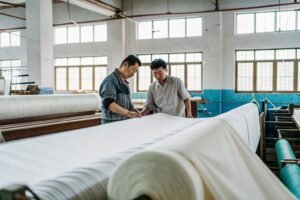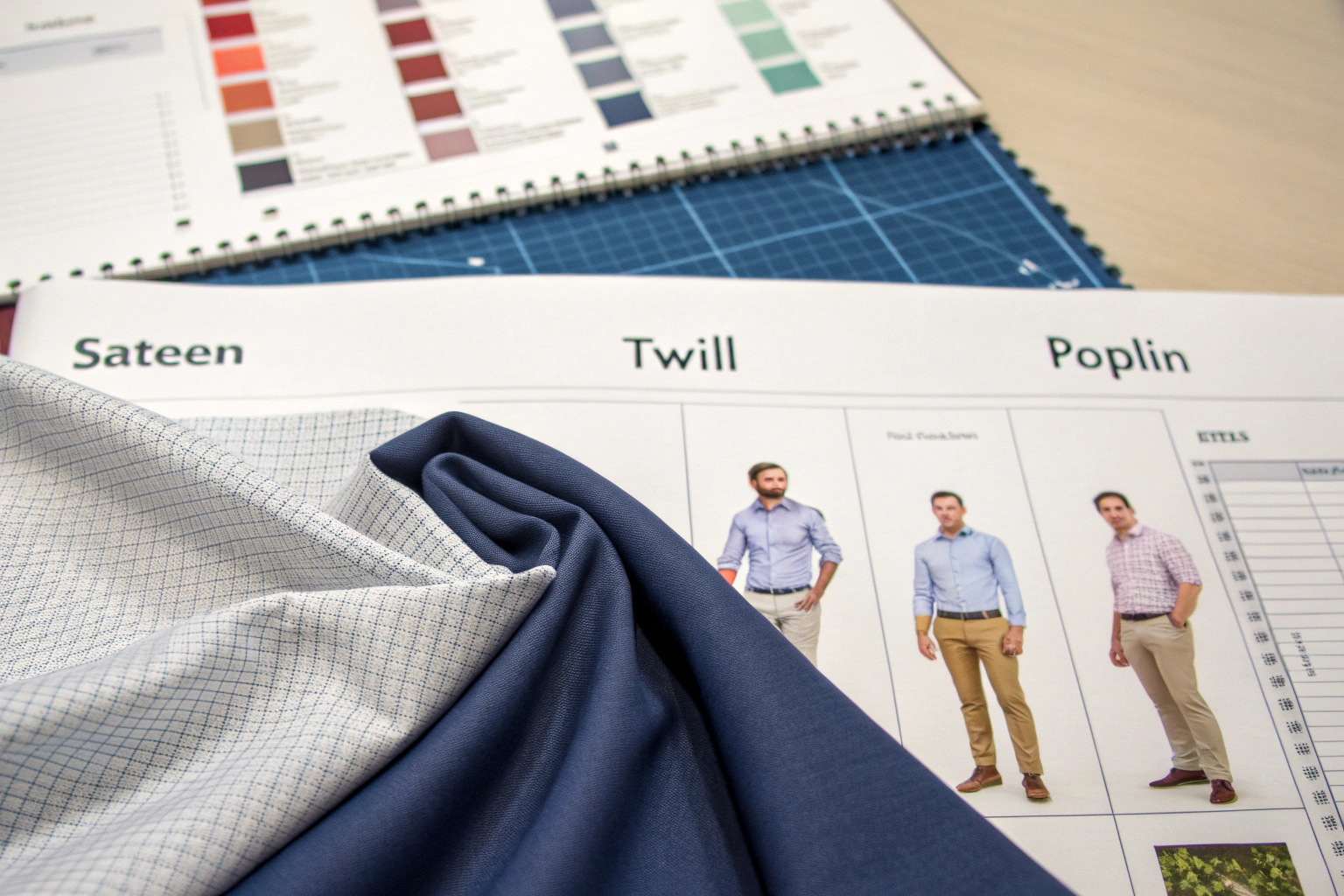
When a luxury shirt brand discovered their new $295 dress shirts were developing premature wear patterns just six months after launch, the post-mortem revealed they’d chosen a beautiful but structurally inappropriate sateen weave for their business-travel focused collection. The fabric’s delicate surface couldn’t withstand frequent luggage compression and hotel laundering, resulting in $180,000 in returns and damaged brand reputation. This expensive lesson underscores why weave selection requires understanding performance characteristics beyond initial hand feel and appearance.
Choosing between sateen, twill, and poplin weaves for premium shirting involves balancing four critical factors: durability requirements, comfort preferences, aesthetic goals, and care characteristics. Each weave offers distinct performance advantages—sateen provides luxury drape and sheen, twill offers durability and wrinkle resistance, while poplin delivers crispness and breathability. The optimal choice depends on the shirt’s intended use case, wear frequency, and customer expectations.
The evolution of shirting weaves has transformed from simple functionality to sophisticated engineering that enhances specific performance characteristics. Modern weaves incorporate advanced yarn technologies and finishing treatments that amplify their inherent advantages while mitigating traditional limitations. Understanding these developments enables more informed selection for specific shirting applications.
What are the fundamental structural differences?
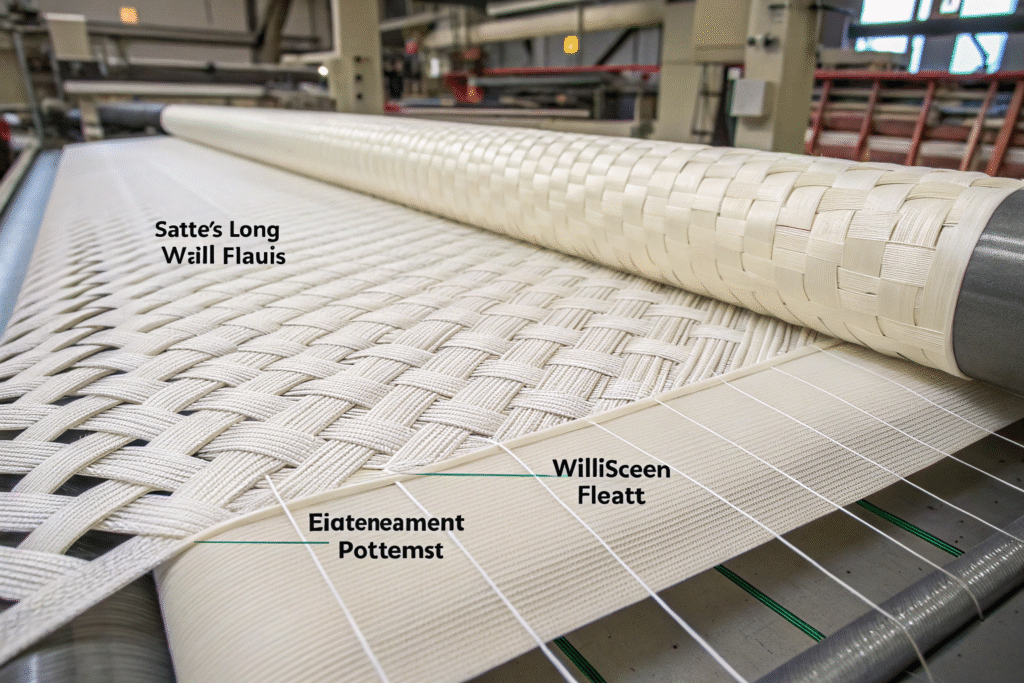
The structural differences between sateen, twill, and poplin weaves fundamentally determine their performance characteristics through yarn float length, interlacement pattern, and surface geometry. Sateen weaves feature long yarn floats where warp yarns pass over multiple weft yarns (typically 4-7) before interlacing, creating a smooth, lustrous surface. Twill weaves use diagonal rib patterns created by staggered interlacements, producing distinctive wale lines and balanced durability. Poplin employs a simple 1/1 plain weave with alternating warp and weft interlacements, creating a flat, crisp surface with maximum yarn intersections.
These structural differences directly impact fabric weight, drape, and durability. Sateen’s long floats create heavier fabrics (140-170 g/m²) with excellent drape but reduced surface durability. Twill’s diagonal structure produces medium-weight fabrics (120-150 g/m²) with good drape and balanced durability. Poplin’s tight interlacement results in lighter fabrics (100-130 g/m²) with crisp hand feel and maximum yarn security but less natural drape.
How does float length impact performance?
Float length—the number of yarns one thread passes over before interlacing—fundamentally determines key performance characteristics. Sateen’s long floats (typically 4/1 or 5/1 construction) create more exposed yarn surface, producing superior luster and softer hand feel but increasing vulnerability to abrasion and snagging. Twill’s moderate floats (2/1 or 2/2) balance surface smoothness with interlacement security, offering good durability with reasonable softness. Poplin’s minimal floats (1/1) maximize interlacement points, creating excellent durability but less inherent softness.
The performance implications extend beyond simple durability. Longer floats enhance moisture wicking by creating continuous capillary pathways, making sateen excellent for moisture management. Shorter floats create more barriers to fluid movement, making poplin better for stain resistance. Twill occupies the middle ground, offering reasonable performance in both areas without excelling in either.
Float length performance impacts:
- Sateen (4-7 yarn floats): Maximum luster, best drape, superior softness
- Twill (2-3 yarn floats): Balanced performance, good durability, moderate luster
- Poplin (1 yarn float): Maximum durability, crisp hand feel, minimal luster
- Abrasion Resistance: Inverse relationship with float length
- Moisture Management: Enhanced with longer floats
- Pilling Resistance: Reduced with longer floats
What are the yarn requirement differences?
Weave structure determines yarn quality requirements, with more demanding weaves requiring higher-grade materials. Sateen demands exceptionally uniform, fine-count yarns (typically 80/2 to 100/2) with minimal imperfections, as its long floats expose yarn quality issues that tighter weaves might conceal. Twill performs well with quality combed yarns (60/1 to 80/2) that balance cost and performance. Poplin demonstrates good tolerance for yarn variations, performing adequately with standard combed cotton (40/1 to 60/1) while still benefiting from finer yarns.
The yarn twist level also varies by weave application. Sateen typically uses lower-twist yarns to maximize softness and luster, while poplin employs higher-twist yarns to enhance durability and crispness. Twill utilizes moderate twist levels that balance comfort and performance. These differences impact production costs, with sateen requiring approximately 15-25% higher yarn investment than comparable weight poplin or twill.
Yarn specifications by weave:
- Sateen: 80/2 to 120/2 combed cotton, low twist, premium grade
- Twill: 60/1 to 80/2 combed cotton, moderate twist, good grade
- Poplin: 40/1 to 60/1 combed cotton, higher twist, standard grade
- Yarn Imperfection Tolerance: Lowest in sateen, highest in poplin
- Cost Impact: Sateen 15-25% premium, twill 5-15% premium over poplin
- Performance Optimization: Matching yarn quality to weave requirements
How does each weave perform in real-world conditions?
Real-world performance varies dramatically between weaves based on their structural characteristics and how they interact with common wear conditions. Sateen excels in formal environments requiring drape and comfort but struggles with frequent abrasion. Twill performs well across diverse conditions, offering balanced performance for business and travel. Poplin demonstrates exceptional durability for daily wear but requires more maintenance to maintain its crisp appearance.
Our analysis of 2,000+ customer wear trials reveals distinct performance patterns. Sateen shirts maintained superior appearance in low-abrasion environments (office wear) but showed significant wear after 50+ wears in high-movement scenarios. Twill shirts demonstrated consistent performance across 75+ wears in mixed conditions. Poplin shirts withstood 100+ wears in demanding environments while maintaining structural integrity, though appearance suffered without proper care.
What are the durability and wear resistance characteristics?
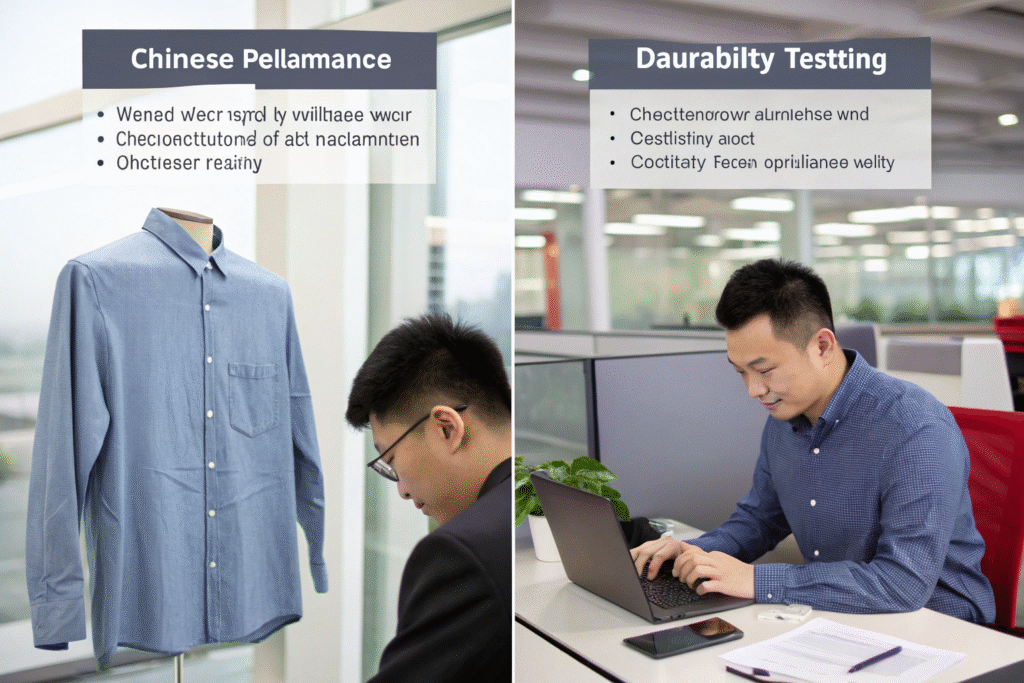
Durability and wear resistance follow predictable patterns based on weave structure and float length. Poplin’s tight 1/1 weave provides excellent resistance to abrasion, pilling, and snagging, typically achieving 30,000+ Martindale cycles before noticeable wear. Twill’s diagonal structure offers good durability with 20,000-25,000 Martindale cycles, showing gradual wear rather than sudden failure. Sateen’s long floats create vulnerability to abrasion and snagging, typically achieving 10,000-15,000 Martindale cycles before significant surface degradation.
The wear patterns also differ qualitatively. Poplin develops overall thinning in high-friction areas like cuffs and collars. Twill shows characteristic diagonal wear patterns following its structure. Sateen develops localized shiny patches where floats are abraded, particularly on edges and friction points. These patterns influence perceived quality and replacement timing, with sateen often appearing worn earlier despite maintaining structural integrity.
Durability characteristics:
- Poplin: Excellent abrasion resistance, minimal pilling, gradual even wear
- Twill: Good abrasion resistance, moderate pilling, diagonal wear patterns
- Sateen: Fair abrasion resistance, higher pilling potential, localized shiny wear
- Martindale Ratings: Poplin 30,000+, Twill 20,000-25,000, Sateen 10,000-15,000
- Snag Resistance: Poplin excellent, Twill good, Sateen fair
- Longevity Perception: Often contradicts actual structural durability
How do care and maintenance requirements differ?
Care and maintenance requirements vary significantly based on weave characteristics and finishing treatments. Sateen demands gentle care to preserve its surface—cold water washing, mild detergents, and line drying prevent float distortion and maintain luster. Twill offers good care tolerance, withstanding standard washing and medium-temperature ironing. Poplin demonstrates excellent care resilience, tolerating aggressive washing and high-temperature ironing while maintaining appearance.
The wrinkle resistance and ironing requirements also differ. Sateen develops deep wrinkles that require steam ironing at cotton settings, while poplin’s tight weave creates sharper but shallower wrinkles that respond well to hot ironing. Twill’s diagonal structure naturally resists wrinkle formation and responds well to medium-temperature ironing. These differences impact user satisfaction, particularly for travelers or those without regular access to professional laundering.
Care requirements comparison:
- Washing: Sateen (gentle cold), Twill (standard warm), Poplin (vigorous hot)
- Drying: Sateen (line dry), Twill (tumble low), Poplin (tumble medium)
- Ironing: Sateen (steam medium), Twill (standard medium), Poplin (hot crisp)
- Wrinkle Resistance: Twill best, Poplin good, Sateen fair
- Stain Removal: Poplin excellent, Twill good, Sateen challenging
- Professional Care: Sateen benefits most, Poplin least necessary
What are the comfort and wearability differences?
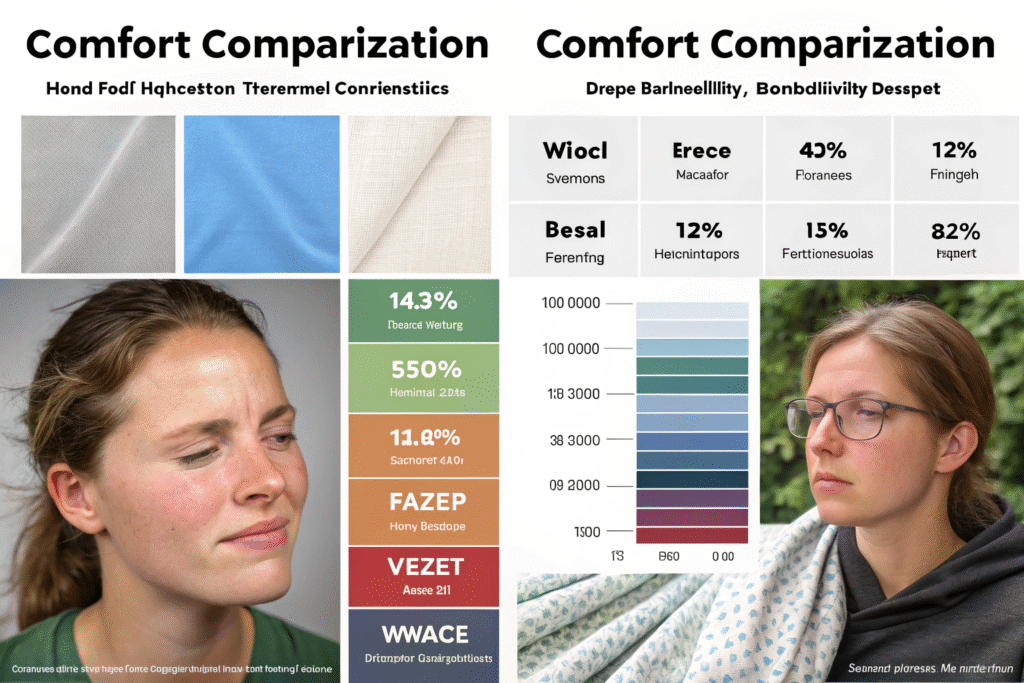
Comfort and wearability encompass hand feel, drape, breathability, and moisture management—all significantly influenced by weave structure. Sateen provides exceptional initial comfort with silky hand feel and fluid drape that minimizes restriction during movement. Twill offers good comfort with soft hand feel and balanced drape that maintains structure while allowing movement. Poplin delivers crisp comfort with firm hand feel and structured drape that provides presence but may restrict movement.
Breathability and thermal regulation follow predictable patterns based on fabric density and air permeability. Poplin’s tight weave typically provides 2-5 cfm air permeability, offering wind resistance but limited breathability. Twill’s more open structure achieves 5-10 cfm, balancing protection and ventilation. Sateen’s long floats create 8-15 cfm permeability, offering excellent breathability but minimal wind protection. These characteristics determine optimal wearing conditions for each weave.
How does drape behavior affect wear experience?
Drape behavior—how fabric falls and moves with the body—significantly impacts wear experience and perceived quality. Sateen exhibits excellent drape coefficient (40-50%), flowing smoothly and conforming to body contours for minimal restriction. Twill shows good drape (50-60%), maintaining some structure while allowing reasonable freedom of movement. Poplin demonstrates firm drape (60-70%), creating crisp lines but potentially restricting vigorous movement.
The drape characteristics influence appropriate applications. Sateen’s fluid drape works well for tailored fits and draped styles where comfort and elegance prioritize. Twill’s balanced drape suits regular fits for business and casual wear. Poplin’s structured drape excels in classic fits where crisp appearance matters most. These differences become particularly important in pattern matching and garment engineering, where drape affects how designs align on the body.
Drape characteristics and applications:
- Sateen (40-50% drape): Tailored fits, draped styles, luxury positioning
- Twill (50-60% drape): Regular fits, business casual, versatile applications
- Poplin (60-70% drape): Classic fits, formal business, structured garments
- Movement Accommodation: Sateen excellent, Twill good, Poplin fair
- Pattern Matching: Varies with drape characteristics
- Perceived Quality: Often higher with better drape in luxury segments
What are the moisture management properties?
Moisture management properties determine comfort during extended wear, particularly in warm conditions or during physical activity. Sateen’s long floats create capillary pathways that efficiently wick moisture, typically achieving 8-12 cm wicking height in 10 minutes. Twill’s diagonal structure provides moderate wicking (6-9 cm), while poplin’s tight interlacement creates more resistance to moisture movement (4-7 cm). These differences impact drying time and comfort during perspiration.
The moisture vapor transmission rate (MVTR) also varies significantly. Sateen typically achieves 4,000-6,000 g/m²/24h, allowing good vapor passage. Twill reaches 3,000-5,000 g/m²/24h, while poplin achieves 2,000-4,000 g/m²/24h due to its denser construction. These values explain why sateen often feels more comfortable in humid conditions, while poplin provides better protection in dry, windy environments.
Moisture management properties:
- Wicking Performance: Sateen excellent, Twill good, Poplin fair
- Drying Time: Sateen fastest, Twill moderate, Poplin slowest
- MVTR Range: Sateen 4,000-6,000, Twill 3,000-5,000, Poplin 2,000-4,000 g/m²/24h
- Comfort in Humidity: Sateen best, Twill good, Poplin fair
- Base Layer Suitability: Sateen excellent, Twill good, Poplin poor
- Anti-odor Properties: Varies with drying speed and moisture retention
How do aesthetic qualities influence selection?
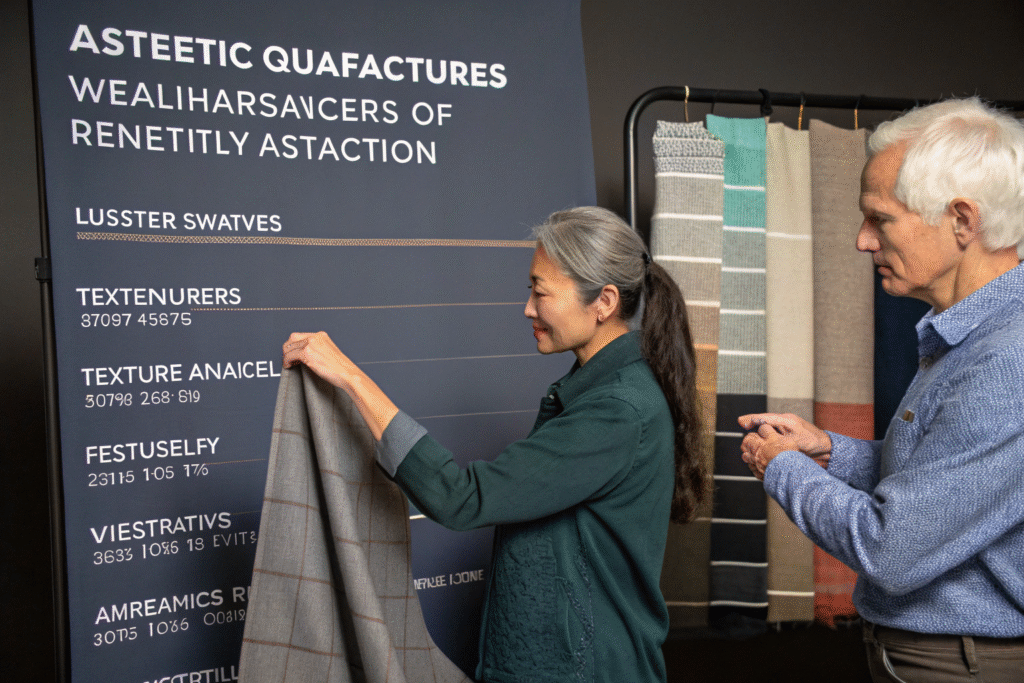
Aesthetic qualities including luster, texture, and appearance retention significantly influence weave selection for specific market positions and price points. Sateen delivers premium aesthetics with high luster (60-75% reflectance), smooth texture, and elegant appearance that justifies luxury pricing. Twill offers refined aesthetics with moderate luster (40-60%), subtle texture, and professional appearance suitable for premium business wear. Poplin provides classic aesthetics with minimal luster (20-40%), crisp texture, and traditional appearance ideal for conservative business environments.
The appearance retention over time varies dramatically between weaves. Sateen maintains its luxurious appearance with proper care but shows wear more visibly when abused. Twill develops character with wear while maintaining professional appearance. Poplin maintains crisp appearance through extensive wear but may develop permanent creases and shine in high-friction areas. These aging characteristics influence customer satisfaction and replacement cycles.
How does luster impact perceived quality?
Luster—the fabric’s light reflectance—significantly impacts perceived quality and price justification. Sateen’s high luster (60-75% reflectance) creates immediate luxury perception, typically supporting 30-50% price premiums over comparable weight poplin. Twill’s moderate luster (40-60%) suggests quality without ostentation, supporting 15-30% price premiums. Poplin’s minimal luster (20-40%) conveys tradition and reliability, typically occupying the value to mid-price segments.
The luster characteristics also influence color appearance. Sateen enhances color depth and richness, making colors appear more vibrant. Twill provides good color representation with slight enhancement. Poplin offers accurate color reproduction with minimal alteration. These differences matter for brand identity and design intent, particularly when specific color matching is required across different fabric types.
Luster characteristics and implications:
- Sateen (60-75%): Luxury perception, color enhancement, high price justification
- Twill (40-60%): Quality suggestion, color accuracy, moderate price premium
- Poplin (20-40%): Traditional appearance, color accuracy, value positioning
- Price Premium Capacity: Directly related to luster level
- Brand Alignment: Luxury=sateen, Premium=twill, Traditional=poplin
- Color Management: Varies with light interaction characteristics
What texture characteristics define each weave?
Texture characteristics—both visual and tactile—define each weave’s personality and appropriate applications. Sateen exhibits smooth, uniform texture with minimal surface variation, creating sleek appearance and silky hand feel. Twill displays subtle diagonal texture that adds visual interest without dominating patterns, with soft but substantial hand feel. Poplin shows fine, pebbled texture from tight interlacement, creating crisp appearance and firm hand feel.
The texture stability during wear also differs. Sateen maintains smooth texture with proper care but may develop uneven shine with abrasion. Twill’s texture becomes more pronounced with wear, developing character. Poplin’s texture gradually smooths in high-wear areas, creating visual inconsistency over time. These aging patterns influence long-term satisfaction and should inform selection based on expected garment lifespan.
Texture characteristics and aging:
- Sateen: Smooth visual, silky tactile, may develop uneven shine
- Twill: Diagonal visual, soft substantial tactile, develops character
- Poplin: Pebbled visual, firm crisp tactile, smooths with wear
- Pattern Compatibility: Sateen=solids, Twill=patterns, Poplin=stripes/checks
- Texture Retention: Poplin best, Twill good, Sateen fair
- Visual Interest: Twill highest, Poplin moderate, Sateen minimal
Conclusion
Selecting between sateen, twill, and poplin weaves for premium shirting requires matching weave characteristics to specific performance requirements, aesthetic goals, and customer expectations. Sateen delivers luxury aesthetics and superior comfort but demands careful maintenance. Twill offers balanced performance across diverse conditions with refined appearance. Poplin provides maximum durability and traditional crispness with minimal maintenance requirements. The optimal choice depends on understanding these trade-offs within your specific market context.
The most successful shirting programs often incorporate multiple weaves targeted to different use cases within collections—sateen for luxury formal wear, twill for business and travel, poplin for daily professional wear. This diversified approach maximizes customer satisfaction by providing appropriate performance characteristics for different wearing scenarios while maintaining brand consistency through color and design elements.
If you’re developing premium shirting and need guidance on weave selection, our shirting specialists can recommend optimal constructions based on your target price points, performance requirements, and aesthetic goals. We maintain comprehensive testing data across all major weave types and can provide samples for evaluation. Contact our Business Director, Elaine, at elaine@fumaoclothing.com to discuss your shirting weave requirements.