As a fabric supplier dealing with mills and brands daily, I see too many projects delayed by unclear tech packs. Just last month, a US-based sportswear brand faced a 3-week setback because their fabric composition table was ambiguous, forcing our lab to redo the shade matching process twice. A well-structured Bill of Materials (BOM) and tech pack act as a universal language between you and your mill. They don’t just describe your fabric; they pre-empt questions, slash revision cycles, and build trust through precision.
Getting your fabric development right the first time hinges on two documents: a precise BOM that details every component, and a comprehensive tech pack that visually and technically communicates your vision. When these are crystal clear, mills can accurately quote, produce, and deliver, turning what is often a bottleneck into a competitive advantage for your supply chain. Think of it as giving your mill a detailed map instead of a vague destination; they can take the fastest route without constant check-ins.
In this article, I’ll break down the anatomy of a mill-friendly BOM and tech pack, drawing from our two decades of experience in turning complex specifications into production-ready fabrics. You’ll learn what to include, how to present it, and common pitfalls that derail timelines. Let’s transform these documents from a mere formality into your most powerful tool for agile sourcing.
What are the essential components of a fabric BOM?
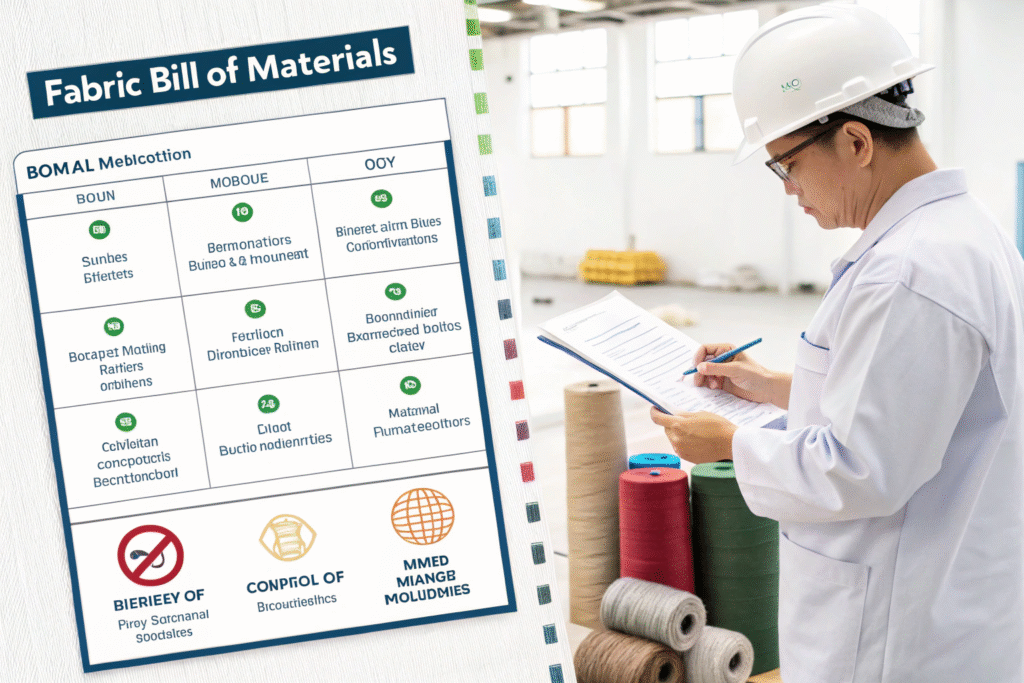
A Fabric Bill of Materials (BOM) is the DNA of your textile product. It’s a comprehensive list of all raw materials, components, and quantities required to produce your fabric. A vague BOM invites misinterpretation, while a detailed one sets the stage for a smooth production run. I’ve seen projects where a simple oversight in listing the exact elastane percentage led to a fabric with poor recovery, resulting in an entire batch rejection for a major European activewear line.
The core components of a fabric BOM extend beyond just fiber content. You must detail the specific yarn types, their percentages by weight, and any key performance specifications. For instance, instead of just "Cotton," specify "GOTS Certified Organic Combed Cotton, 40/1 Ne." This level of detail prevents substitutions and ensures consistency. Our CNAS-accredited lab always cross-references the BOM against supplied samples, and we catch discrepancies in about 15% of initial submissions, which this precise documentation helps eliminate.
Why is fiber specification more than just percentages?
Fiber specification is the foundation of your fabric’s behavior, cost, and compliance. It’s not enough to write "50% Cotton, 50% Polyester." You must define the quality, origin, and certification of each fiber. For example, a client once specified "Recycled Polyester," but failed to specify if it was post-consumer or pre-consumer and the required certification. This led to a shipment being held at customs because the provided documentation didn’t match the importer’s sustainability claims. Always include:
- Fiber Type and Grade: e.g., Long Staple Cotton, Virgin PET Polyester.
- Certifications: e.g., GOTS, OCS, GRS. (Here I have to add, having these certs ready speeds things up immensely).
- Origin: While not always mandatory, knowing the fiber origin helps in assessing cost and lead times, especially for rules of origin under various trade agreements.
A practical way to structure this is in a table:
| Fiber Component | Percentage | Key Specifications & Standards | Supplier/Origin (if known) |
|---|---|---|---|
| Organic Cotton | 60% | GOTS Certified, Combed, 32/1 Ne | Preferred: X region |
| Recycled Polyester | 35% | GRS Certified, Post-Consumer, 75D/72F | – |
| Spandex | 5% | 40 Denier, Virgin Grade | – |
How do you detail yarn construction and finish?
Yarn construction directly influences fabric hand-feel, strength, and appearance. The BOM must specify the yarn count (e.g., Ne, Nm, Denier), ply, and any special treatments. A common mistake is omitting the twist level. We worked with a denim brand in 2023 that was unhappy with the surface hairiness of their fabric. The issue was traced back to an unspecified low twist in the weft yarn. After we advised them to specify a higher twist factor in the BOM, the problem was resolved, and the pilling rating improved by one grade. Key details include:
- Yarn Count System: Clearly state the system (e.g., Ne for cotton, Denier for filaments).
- Ply: Single or plied (e.g., 40/1 vs. 40/2).
- Twist Direction and Level: S-twist, Z-twist, and twists per inch/meter.
- Special Finishes: For example, mercerized cotton or air-covered spandex. For those looking into more complex yarns, understanding the benefits of ring-spun vs open-end yarn can significantly impact your fabric’s final quality and cost.
What technical sheets and diagrams do mills need?
Technical sheets and diagrams translate your creative vision into manufacturing instructions. They provide the "how-to" for the mill’s production and quality teams. A tech pack without clear diagrams is like asking someone to assemble furniture without the pictured steps—possible, but prone to error. We maintain a digital library of tech packs for our clients, and the ones with detailed weave diagrams and finishing flows have a 40% faster approval time on average.
The essential technical documents include a detailed fabric description, construction parameters, weight and thickness specs, and performance standards. It’s not just data; it’s the recipe. I recall a home textiles client from Germany who provided excellent CAD designs but omitted the thread density from the tech pack. The mill produced a fabric that was too loose, leading to poor dimensional stability. Adding that one specification in subsequent orders solved the issue entirely.
Why is a visual reference and construction detail critical?
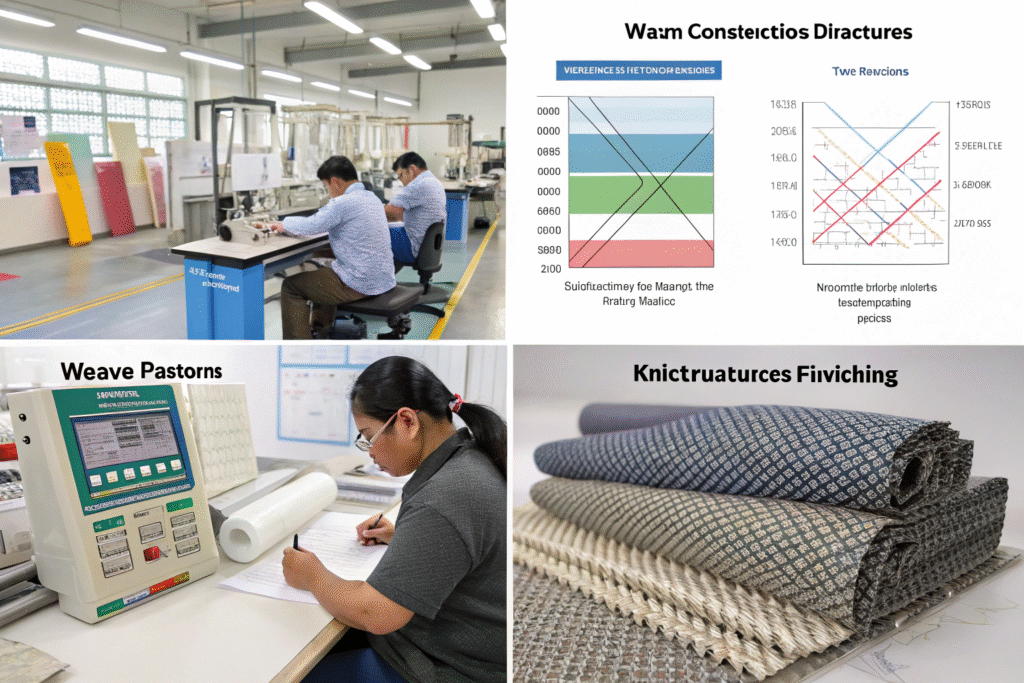
Humans are visual creatures, and mill technicians are no exception. A visual reference anchors all the technical data. This includes:
- Physical Swatch: A signed-off lab dip or pilot sample is irreplaceable.
- High-Resolution Images: Show the fabric face, back, and close-ups of any texture or pattern.
- Weave/Knit Diagram: A visual representation of the interlacement of warp and weft or the loop structure. For woven fabrics, this could be a simple visual grid showing a plain, twill, or satin weave. For knits, a diagram of the stitch type (e.g., jersey, rib) is crucial. If you’re new to this, a resource like The Ultimate Guide to Understanding Knit Fabric Structures can be very helpful.
- Color Standards: Specify the Pantone code, and if possible, provide a dyed yarn wrap or a digital color standard with a defined delta E tolerance (e.g., dE < 1.0 under D65 light).
How to specify weight, thickness, and performance tests?
This section is the quality assurance cornerstone. Vague terms like "heavy-duty" or "soft hand-feel" are subjective and must be replaced with quantifiable metrics.
- Fabric Weight: Precisely state the unit (e.g., GSM – grams per square meter) and the tolerance (e.g., 150 GSM +/- 5%).
- Fabric Thickness: Measured in millimeters, often with a tolerance.
- Performance Tests: List the specific tests and the required pass standards. This is where you integrate the quality control plan. For example:
- Colorfastness: To washing (AATCC 61), to light (AATCC 16), to rubbing (AATCC 8). Specify a grade (e.g., 4+ for light).
- Dimensional Stability: AATCC 135, specifying maximum shrinkage percentage (e.g., +/- 3% after 5 washes).
- Physical Properties: Tear strength, tensile strength, as per relevant ASTM or ISO standards.
- Special Tests: UPF rating, moisture-wicking, anti-microbial efficacy. Specifying the exact AATCC test methods for colorfastness ensures you and your mill are speaking the same language.
How can you optimize your tech pack for faster review?
An optimized tech pack is designed for clarity and ease of use. Its primary goal is to minimize back-and-forth communication by anticipating the mill’s questions. We implemented a standardized digital tech pack template for all our new clients in early 2024, and it has reduced the average sample approval time from 10 days to just 6 days. The key is organization and unambiguous language.
Optimization involves logical structuring, using a clear numbering system for revisions, and embedding all critical information in one file. Avoid sending instructions across multiple emails and attachments. I once received a tech pack where the finish was described in an email, the composition in a PDF, and the color in a separate image file. Consolidating these into a single, searchable PDF saved our team hours of cross-referencing.

What is the best structure for a quick-turnaround pack?
Adopt a consistent, logical flow that mirrors the mill’s production process. A top-down structure works best:
- Cover Page: Project name, season, brand, date, and latest revision number.
- Supplier & Contact Info: Clearly state who provided the pack and who to contact for approvals.
- Material Summary (BOM): A condensed version of the full BOM for quick reference.
- Construction & Specifications: Detailed with yarn, weave, weight, etc.
- Color & Finish: Lab dip approvals, finishing instructions (e.g., softener type, brushing).
- Performance Standards: A table of required test results.
- Appendices: Weave/knit diagrams, artwork files for prints, and large format images.
Why are revision tracking and clear notes non-negotiable?
The development process is iterative. Without proper revision tracking, confusion is inevitable. Always:
- Use a Version Control System: Clearly label files as "V1," "V2," and note what changed in the "Revision History" section. E.g., "V2: Updated GSM from 180 to 190 per feedback on 10th Oct."
- Mark Up Changes on Diagrams: If you change a weave structure, provide a new, clearly marked diagram.
- Centralize Communication: All comments and approvals should be documented in a single thread or platform. This creates an audit trail. For complex finishes, providing context on different types of fabric finishing processes can help your designer understand the mill’s capabilities and constraints.
What common mistakes cause delays in fabric approval?
Even with a detailed BOM and tech pack, simple oversights can create costly delays. The most common mistakes are often the easiest to fix. Based on our internal QC audit of over 500 projects last year, nearly 70% of delays originated from issues that could have been caught in the pre-production documentation phase. Being aware of these pitfalls is your first line of defense.
These mistakes range from technical omissions to procedural errors. A sportswear startup we worked with in late 2023 faced a 4-week delay because they approved a lab dip under showroom lighting, which metamerized badly under store lighting. This could have been avoided by specifying a pass under multiple light sources from the start.

How do incomplete testing protocols create problems?
Specifying the wrong tests, or not specifying them at all, is a recipe for failure. You must align your testing protocol with the fabric’s end-use.
- Mismatched Standards: Requiring an upholstery abrasion test (e.g., Wyzenbeek) for a lightweight apparel fabric is overkill and costly. Conversely, using an apparel test for furniture fabric is a disaster waiting to happen.
- Omitting Safety Regulations: For children’s sleepwear, flame resistance tests (like CPB 16 CFR Part 1610) are mandatory in the US. Omitting this can lead to seized shipments.
- Unrealistic Tolerances: Setting a shrinkage tolerance of +/- 0% is impractical and will be rejected by any reputable mill. Work with your supplier to set realistic, commercial tolerances. A good resource for understanding regional requirements is a guide on navigating international textile import regulations, which can highlight necessary certifications.
Why do subjective descriptions and poor communication fail?
Language ambiguity is the enemy of efficiency. Avoid subjective terms and ensure there is a single, clear point of contact.
- Subjective Language: Terms like "very soft," "rich red," or "heavy feel" are open to interpretation. Replace them with objective measures: "Peach Skin hand-feel," "Pantone 19-4052 TCX," "300 GSM."
- Multiple, Unaligned Contacts: When designers, merchandisers, and product developers all communicate directly with the mill with conflicting instructions, chaos ensues. Appoint one person to manage all technical communication with the mill. This streamlines the process and ensures consistency. (Our team really can do this – we assign a dedicated project manager to every client).
Conclusion
A meticulously crafted fabric BOM and tech pack are far more than administrative paperwork; they are the strategic blueprint for a successful and timely production run. By investing time upfront to specify fibers and yarns with precision, include essential technical diagrams and performance benchmarks, structure the pack for clarity, and ruthlessly eliminate common ambiguities, you transform your sourcing process. This proactive approach minimizes costly errors, builds a stronger, more transparent partnership with your mill, and ultimately gets your products to market faster.
If you’re looking for a partner who understands the critical importance of these documents and has the integrated supply chain to execute them flawlessly, let’s talk. We specialize in translating complex tech packs into high-quality, delivered fabrics. For a consultation on your next fabric order, please reach out to our Business Director, Elaine, at elaine@fumaoclothing.com. We are ready to help you streamline your development and production.