
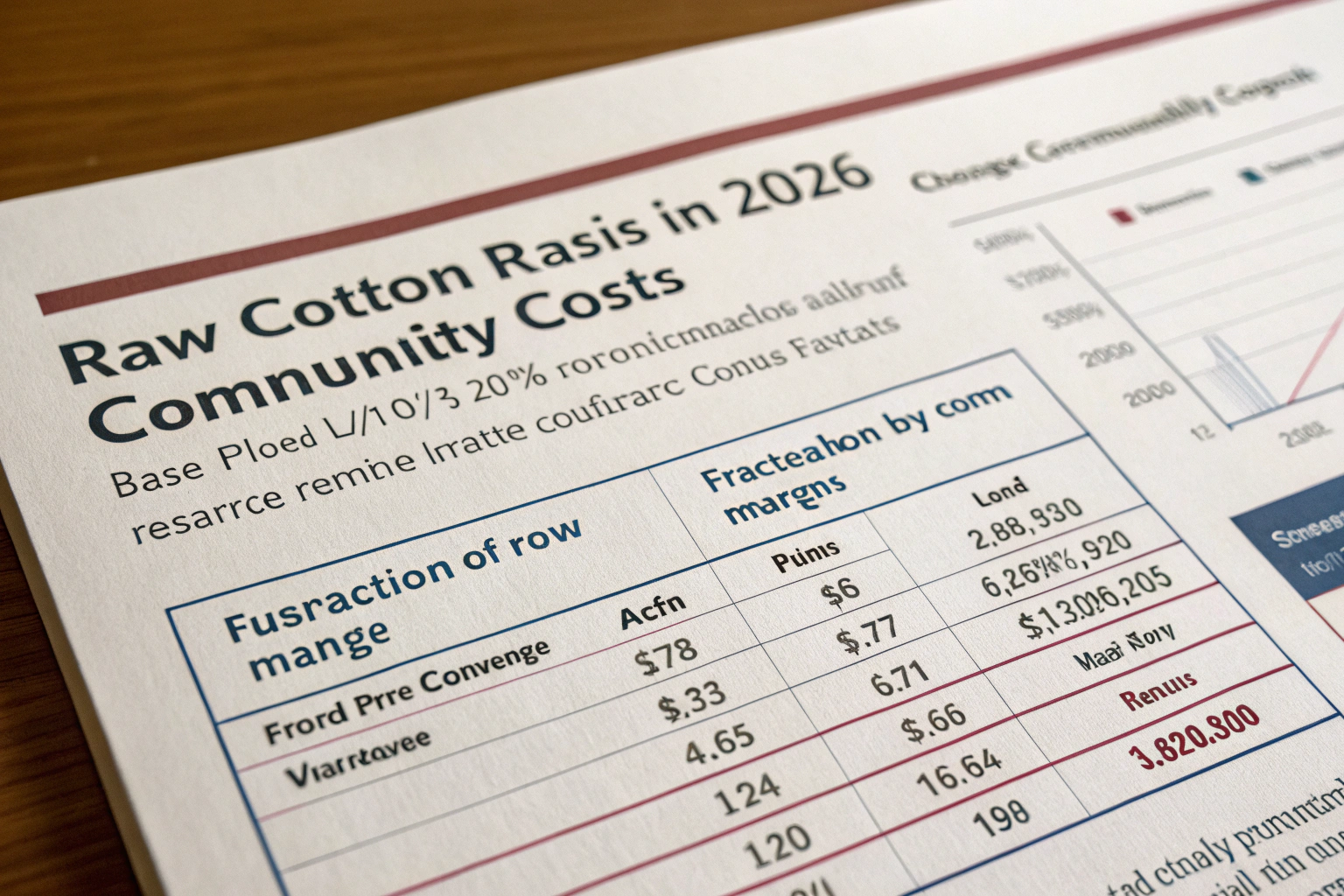
You open the latest fabric quote and feel a knot in your stomach. The price of your best-selling cotton poplin has jumped 15% since last season. Your margins are evaporating. You read the news about global cotton shortages—droughts in Texas, export restrictions in India, speculators driving up ICE futures—and you start to wonder if your Chinese supplier is using the headlines as an excuse to pad their own profits. Is the "raw material crisis" just a convenient story to squeeze a few extra cents out of you? That doubt, that lingering suspicion that you’re not getting the straight truth, erodes the trust that a sourcing partnership needs to survive.
The straight truth is this: No, we did not raise our base manufacturing and service margins in 2026. What changed is the raw cotton commodity cost—a publicly verifiable number—and we pass that fluctuation through with absolute transparency. At Shanghai Fumao, we operate on a "Cost-Plus" model for our long-term partners. When the price of Xinjiang or Australian cotton jumps by 12%, your final fabric price reflects exactly that 12% shift in the yarn cost, plus a locked-in conversion fee for weaving and dyeing that we haven’t changed in 18 months. I don’t gamble with my customers’ trust by hiding a margin hike inside a commodity panic. I’d rather show you the yarn invoice.
Now, I want to take you deeper than a simple "yes or no" answer. Because if I just stop here, you still don’t have the full toolset to negotiate with any supplier in this volatile market. Stick with me, and I’ll pull back the curtain on exactly how we structure our transparent pricing model, what alternatives exist that completely bypass the cotton volatility trap, and how we’re working with mills to stabilize costs even when the futures market is a rollercoaster. This isn’t about defending a price hike; it’s about showing you the blueprint so you can make informed decisions for your brand.
How Does Fumao’s Transparent Cost-Plus Pricing Model Work?
In an industry where backroom deals and "market price" quotes are the norm, we chose a different path. The opaque pricing model is broken. A trading company might quote you $3.50 a meter today and $4.10 tomorrow, blaming the market without showing any proof. That infuriates me, and I know it infuriates you. You aren’t buying a mystery box; you’re building a budget, forecasting your COGS, and presenting numbers to your own investors or retail buyers. An unexplainable price swing makes you look incompetent, not us.
We fix this with a simple equation. Your final price equals the raw material cost (the yarn) plus the processing cost (weaving, dyeing, finishing) plus our agreed management fee. When cotton spikes, only the first variable moves. You see the exact yarn price we paid on the mill invoice. No "blended" rate, no black box. This forces us to be more efficient on the factory floor, because we can’t just inflate the processing charge to cover our mistakes. Let’s break down how we deconstruct a fabric quote and how we guard against currency volatility.

What exactly goes into a fabric price quotation, and how can you verify each line item?
Most buyers only see two things: a fabric swatch and a total price. That’s a recipe for overpaying. A true quote has a skeleton, and if a supplier won’t show you the bones, they are likely hiding meat. For a standard cotton twill, the skeleton looks like this: the yarn cost (which is the current cotton spot price plus the spinning fee), the weaving cost (calculated per shuttle pick), the dyeing cost (driven by the color depth and the dye stuff type), and the finishing cost (any softeners, sanforizing, or coatings). On top of that, there is a logistics loading and a small profit percentage.
Let me give you a concrete example. In April 2026, a mid-size workwear brand from Germany asked us for 20,000 meters of a 100% Cotton Ripstop with a peach-skin finish. Instead of just emailing a final number, I sent them a breakdown. The 20/2 carded cotton yarn was quoted at 28,500 RMB per ton based on the China Cotton Index spot rate. Weaving that dense ripstop construction took longer, so the cost was 2.8 RMB per meter. The reactive dyeing, since it was a dark navy with high colorfastness requirements, came to 3.5 RMB per meter. The peach-skin enzyme wash was 1.2 RMB. We laid all this out. The client saw that our management fee was fixed at 5%, regardless of the cotton price. This transparency built such trust that they actually agreed to a quarterly pricing review rather than haggling on every order. They saw we weren’t the enemy; the weather in Texas was.
But you need to protect yourself against the other hidden killer: currency. We quote in RMB with our domestic mills, but we invoice international clients in USD. If the Yuan strengthens by 4% against the Dollar between contract signing and delivery, we could lose our shirt—or you could get an unexpected surcharge. We solve this with forward contracts. We peg the exchange rate on the day you sign the purchase order. We learned this lesson in 2022 when the dollar spiked; we locked in rates for our clients and actually passed the savings back to them on final billing. That bought us a lifetime of loyalty. You should definitely explore how to negotiate a transparent cost-plus contract with a Chinese textile supplier, because if you don’t have line-item visibility, you’re just donating margin to middlemen. Also, understanding the difference between cotton yarn spot pricing versus futures in fabric contracts can save you 8-10% if you time your booking right. Most mills price yarn at the current monthly settlement rate, not the daily spike. We show you the settlement sheet.
How does Fumao lock in raw material costs to protect buyers from price spikes?
You don’t want to watch the ICE cotton futures every morning. That’s my job. The futures market is a casino, but hedging is an insurance policy. When you place a 6-month forward order with us, we don’t wait until the month of delivery to buy the yarn. We go to the cotton yarn mill immediately and lock in a forward price for the physical yarn. We essentially pre-pay the yarn cost (or secure it via a bank guarantee) so that the volatile commodity fluctuation stops at the contract date. This is called "price-fixing the greige."
Here’s the practical impact. In December 2025, a UK fashion house confirmed their Autumn/Winter 2026 collection, which included 50,000 meters of a heavy cotton flannel. The market was jittery, with rumors of Indian export bans. We sat down with our spinning mill partners in Zhejiang and negotiated a fixed yarn price for delivery in July 2026. The mill was happy because they had a guaranteed order; we were happy because we removed risk; the client was thrilled because their price was cemented. Fast forward to March 2026—spot cotton had jumped 10% due to a speculative run. The buyer’s competitors, sourcing on a "market price at time of shipment" basis, got hit with that 10% surcharge. Our client? Their price didn’t move a single cent. They won the retail shelf space because their landed cost was predictable.
(This is where I have to add—we don’t always get it right on the direction. If prices drop, the locked price looks expensive. But as a brand, you buy consistency, not a lottery ticket.)
We also play the "substitution chess game" to avoid the spike entirely. If the price of 40s combed cotton goes through the roof, we proactively bring you a swatch of a 70/30 Cotton/Tencel™ blend that drapes beautifully, costs 5% less, and is completely immune to the pure cotton shortage. We did this for a French loungewear brand in early 2026. They wanted 100% cotton slub jersey. Cotton slub yarn had a 20% premium attached to it due to low supply. I sent them a micro-modal slub jersey sample. It felt ten times softer, took the dye better, and cost 10% less than the inflated cotton slub price. They switched, and their sell-through increased because the hand-feel was superior. If you are worried about this, read up on how to use futures contracts to hedge raw cotton costs when sourcing fabric and ask your suppliers about their mill partnerships. I also recommend buyers check out how to validate a textile supplier’s yarn inventory strategy before a contract, because if a factory just buys yarn on the spot market, you are sailing directly into the storm with no life jacket.
Can Alternative Fibers Solve the 2026 Cotton Price Volatility Trap?
I’ve been in this business long enough to know that when raw cotton becomes a headache, the cure isn’t always in finding cheaper cotton. It’s in finding a fiber that doesn’t play by cotton’s rules. We are seeing a massive shift in 2026. The "Big Staple" crisis—driven by weather and geopolitics—is pushing smart brands to look at man-made cellulosic fibers (MMCFs) like Lyocell, Modal, and Cupro, not as "cheap alternatives," but as premium upgrades that happen to have a more stable pricing base. These fibers come from wood pulp, not a field in Texas. The supply chain is fundamentally different.
The trap is thinking you have to sacrifice the "natural" story to escape the price risk. You don’t. A modern Tencel™ twill can wick moisture better than cotton and biodegrade in the ocean. It doesn’t need pesticides. It doesn’t rely on monsoon seasons. The price of dissolving wood pulp hasn’t swung wildly like cotton because it isn’t subject to the same speculative futures trading frenzy. I tell my clients: "Control the input, control the cost." Let’s look at why bamboo and hemp are winning bids right now.

Why are brands switching to Tencel and Modal blends during the cotton crisis?
The switch isn’t just about saving money; it’s about getting a better fabric for the same or lower price, with total price predictability. Cotton in 2026 is a stress test. Lyocell is a steady heartbeat. We have a proprietary blend we call "BAMSILK"—a 60% Bamboo Lyocell / 40% Organic Cotton mix. The bamboo provides a silky, cool-to-the-touch handle and moisture-wicking properties, while the cotton gives it that familiar, stable body. In a bulk market comparison this April, our standard 100% organic cotton jersey was under severe cost pressure. The BAMSILK blend came in at exactly the same price as the pre-crisis cotton price, with a superior drape and a natural sheen that doesn’t wash out.
We saw a huge conversion in March 2026 with a US-based direct-to-consumer bedding brand. They built their entire identity on "crisp percale cotton." When the cotton crisis hit, they faced either a 20% retail price increase or a total margin wipeout. I sent them a set of sheets made from our 100% Lyocell micro-fiber weave with a peach-skin finish. We did a blind feel-test in their office. 80% of their staff picked the Lyocell as "premium cotton." We used a specific mechanical fibrillation process—where the fibers split into tiny fibrils—to create that fuzzy, dry hand that mimics Egyptian cotton. The result? They launched a "new generation sustainable soft cotton" line. The cost was 12% lower than the crisis-impacted cotton, and their return rate dropped by 4% because the sheets didn’t pill like their old cotton. They never looked back.
If you’re nervous about moving away from the word "cotton" on your label, look for how to market Tencel and modal fabrics as premium alternatives to cotton for fashion brands. You need to use the right language—"botanic origin," "closed-loop production," "cooling touch." We can provide you with the Lanzing certification swing tags if you meet the fiber percentage threshold. Also, check out how bamboo lyocell supply chains remain price-stable compared to raw cotton futures. The key is the "NMMO solvent recovery rate." In our partner mills, 99.7% of the spinning solvent is recycled. That high efficiency keeps the cost of the fiber largely independent of oil or agricultural commodity spikes. It’s an industrial process, not a farming one. I can predict the cost of a cellulose pulp bale from Austria six months out much better than I can predict a cotton harvest in Xinjiang.
How does Fumao ensure quality consistency when substituting fibers for clients?
Here’s the hard part nobody talks about. Changing a fiber is easy. Keeping the exact same garment specs is incredibly hard. If you substitute 100% cotton single jersey with a Modal blend, the width will shrink differently in the dye bath. The shrinkage rate jumps from maybe 3% to 5%. The needle in the sewing factory might skip stitches because the fiber is smoother and weaker when wet. If I send you a new blend without adjusting these variables, you’ll cut 5,000 shirts, wash them, and they’ll all fit a size too small. That’s the nightmare I prevent.
We treat fiber substitution as a complete product re-engineering exercise. We don’t just send a swatch; we send a full technical packet update. In May 2025, I convinced a UK motorcycle jeans brand to switch from 100% Cotton Denim to an 88% Cotton / 10% Recycled Poly / 2% Elastane to get around the cotton price spike, but more importantly, to add stretch. The problem was the width stability. Cotton shrinks predictably; elastane snaps back unpredictably when heated. We ran three trial batches through our Monforts stenter frame to dial in the overfeed. The first batch came out too stretchy—the waistband would have bagged out after an hour of wear. The second batch was too stiff. By adjusting the temperature curve and the dwell time in the heat-setting zone to exactly 180 seconds, we nailed the perfect 1% residual shrinkage. We then updated the fabric’s cuttable width from 175cm to 168cm and issued a revised spec sheet. The client cut the sample, washed it, and it fit the mannequin perfectly. Zero pattern adjustments needed at their end.
(This is where the decades of hands-on experience in Keqiao kick in. You can’t learn this from a PDF; you learn it by ruining a few hundred meters of denim at 2 AM in the dye house.)
If you’re considering a switch, you must understand the technical substitution guides for replacing cotton with cellulosic fibers in woven fabrics. Key test standards matter. For a standard 40s cotton poplin vs. an EcoVero viscose poplin, you must test the seam slippage according to ASTM D434. Viscose fibers are rounder and often slip under the sewing needle more easily than flat cotton ribbons. We often add a textile anti-slip agent to the finishing bath to solve this. I also advise diving into the research on pilling resistance of viscose and modal blends compared to 100% cotton textiles. A Martindale test of 2,000 rubs will tell you everything. A cheap viscose pilles up like a sheep; a high-quality cross-linked Lyocell stays smooth. We run this test on every new blend before shipping a single meter.
Is Small-Batch Production the Answer to 2026 Commodity Inflation?
When every yard of fabric costs more, the worst business decision is to buy a mountain of stock you haven’t sold. The era of the "massive open-buy" is dying, and honestly, good riddance. The 2026 commodity crisis is accelerating the shift to small-batch, agile manufacturing. In a high-cost environment, inventory is a liability, not an asset. If you park $50,000 in greige cotton inventory and the market drops 10%, you’ve just destroyed $5,000 of value sitting on a pallet. Plus, in fashion, the trend could change in a month.
We designed our entire service model around "micro-lots." While most big factories in China have a minimum order quantity (MOQ) of 3,000 meters per color, we built a dedicated flexible line that handles runs as small as 300 meters. This allows you to test the market, run a pre-order campaign on your website, and buy only what you’ve already sold. It shifts the risk from the brand to the supply chain—and we handle that risk through advanced scheduling. Let’s dig into how we bypass the MOQ wall and why placing bets on proven sellers is safer than speculating on cotton.

How does Fumao bypass high minimum order quantities for startups and niche brands?
The standard industry logic is brutal: "Small orders waste dye, waste loom time, go away." That logic is from factories that only know how to make one thing. I built Fumao to be different. We use a "Mother Roll" concept. Instead of loading a 1,000kg dye vat for one client, we aggregate compatible small orders. If we have four brands all ordering different reactive-dyed cotton interlock in medium weights, we run their greige together in a single bleaching bath, and then split it for the individual dye colors. This shares the fixed heat-up cost of the machine.
We also have a network of "sample loom" specialists in Keqiao. These aren’t the massive, high-speed water jet looms that need 10,000 meters just to be profitable. These are small rapier looms that we can set up in 2 hours with your specific warp. I remember a startup from Brooklyn in late 2025. They had a concept for custom-designed jacquard pillowcases—a very intricate, geometric pattern inspired by Art Deco. A big mill quoted them 6,000 meters minimum and a $2,000 loom setup fee. They came to us, devastated. We used our in-house electronic Jacquard loom, which allows for rapid warp changes. We configured the digital file in 4 hours, ran a 50-meter sample, got their approval via video call, and ran a 500-meter bulk order. We charged a slightly higher per-meter price to cover the setup, but the total cash outlay was one-tenth of the big mill’s demand. They sold out on Etsy in three weeks and came back for 1,000 meters. By then, they had the cash flow to afford the bulk, and we even lowered the price on the reorder because the loom file was already saved.
For the new designers reading this, check out strategies for navigating high MOQ restrictions with Chinese textile mills. Look for "stock-supported service." We keep a library of 50+ greige fabrics (standard cottons, poly blends, rayons) ready to dye. This means you don’t pay the weaving MOQ; you only pay the dyeing MOQ. Also, learn how small batch digital printing is changing the landscape for startup clothing brands. Digital textile printing is the ultimate MOQ-killer. There is no screen engraving. You upload the file, we print 10 meters or 1,000 meters—the cost per meter is linear after the first meter. This is how small brands go to market without a warehouse full of dead stock.
How to use product diversification to offset raw material price speculation?
Don’t put all your eggs in the cotton basket. Seriously. I see too many brands that are 100% dependent on one fiber. When cotton spikes, they are dead in the water. A smarter strategy is to build a "fiber hedge" within your own collection. If you run a t-shirt brand, you typically have a core cotton jersey and maybe a fleece. What if you added a linen slub tee to the line? Linen is a bast fiber with a completely different agricultural cycle. It doesn’t correlate perfectly with cotton. In fact, in 2026, European flax prices have been relatively stable while cotton exploded. By having a diversified fabric portfolio, you can weight your marketing spend toward the product with the best margin at any given time.
I coached a Canadian casual wear label on this in February 2026. Their Spring drop was heavy on cotton canvas chore jackets. Cotton was sky-high. We looked at their line and suggested a switch for one style to a hemp/Tencel canvas blend. Hemp is a hardy weed that grows fast and requires little water. The price hadn’t moved much. The fabric had a beautiful natural slub texture, more "story" than plain cotton. The brand positioned it as a "planet-friendly premium edition" and priced it higher than the cotton jacket. The production cost was 8% lower. That specific SKU became their top seller, not because it was cheaper to make, but because the value proposition and the texture were unique.
You need a sourcing plan that isn’t just "find the cheapest cotton." Read up on how to build a supply chain strategy to mitigate fiber price volatility in clothing. It’s about cross-category sourcing. We often recommend clients keep an "open line" with us for reactive purchases. If we see a batch of high-end Supima cotton at a good price, we email them: "Can you use 1,000 meters of a specific white pique?" Because they have an open relationship with us, they say yes, and they save 15% over the spot market. Furthermore, check how blending natural and synthetic fibers can stabilize fabric costs for brands. A 70/30 Cotton/Polyester fleece will always be more price-stable than 100% cotton. The polyester acts as a price shock absorber. I’m not saying sell out—I’m saying understand the math so you can make a conscious choice about your brand’s purity versus its profitability. This is what we map out in our quarterly review meetings with clients.
Conclusion
So, did the 2026 raw cotton shortage force us to raise our prices? We’ve walked through the evidence. We held our manufacturing margin flat. The increase you see is the transparent pass-through of a global commodity spike—a spike we verify with open invoices, not hidden smoke and mirrors. But more importantly, we’ve explored the escape routes that a lazy supplier wouldn’t bother showing you. Whether it’s locking the yarn price six months early to freeze your budget, pivoting to a sumptuous Lyocell that outclasses cotton on every metric, or shifting to a small-batch model that lets you buy exactly what you need rather than speculating on a warehouse full of greige goods, the tools are all on the table. The crisis isn’t an excuse for a factory to get rich; it’s a test of whether your supplier is a true partner or just a transactional vendor. At Shanghai Fumao, we’ve spent 20 years building a buffer against this kind of chaos, not profiting from it.
Now, I want you to look at the fabric hanging on your sample rack. If you’re staring at a cost sheet that doesn’t add up, or if you’re paralyzed by a cotton budget that seems to change every Monday morning, let’s rewrite that plan. You don’t need to be a commodities trader to build a clothing brand; you just need a mill that understands that your success is our succession plan. If you want to dig into the true cost of your next run of shirting, knitwear, or bed linen, reach out to our Business Director, Elaine. She has the latest yarn indexes, the alternative fiber swatch kits, and the ability to reserve loom space without a deposit that breaks your bank. Email her at elaine@fumaoclothing.com. Tell her your pain point, and she’ll send you back a solution that doesn’t rely on wishful thinking about the cotton harvest.








