Two years ago, I watched a buyer from a major European fast-fashion brand spend forty-five minutes digging through our physical swatch library. She pulled out rayon challis samples, held them up to the window light, stacked three or four together, and asked my team to find "something similar but with a slightly drier hand feel." My staff ran back and forth to the warehouse three times, each trip taking ten minutes, each stack of fabric barely closer to what she wanted. She found what she needed eventually—a viscose-linen blend we’d developed two seasons earlier—but the process ate nearly an hour of her two-day visit. When she left, I turned to our R&D director and said what we were both thinking: there has to be a faster way to connect a buyer’s mental image of the perfect fabric with the physical inventory sitting on our shelves. That frustration, repeated across hundreds of buyer visits, is what convinced us to go all-in on digital fabric libraries.
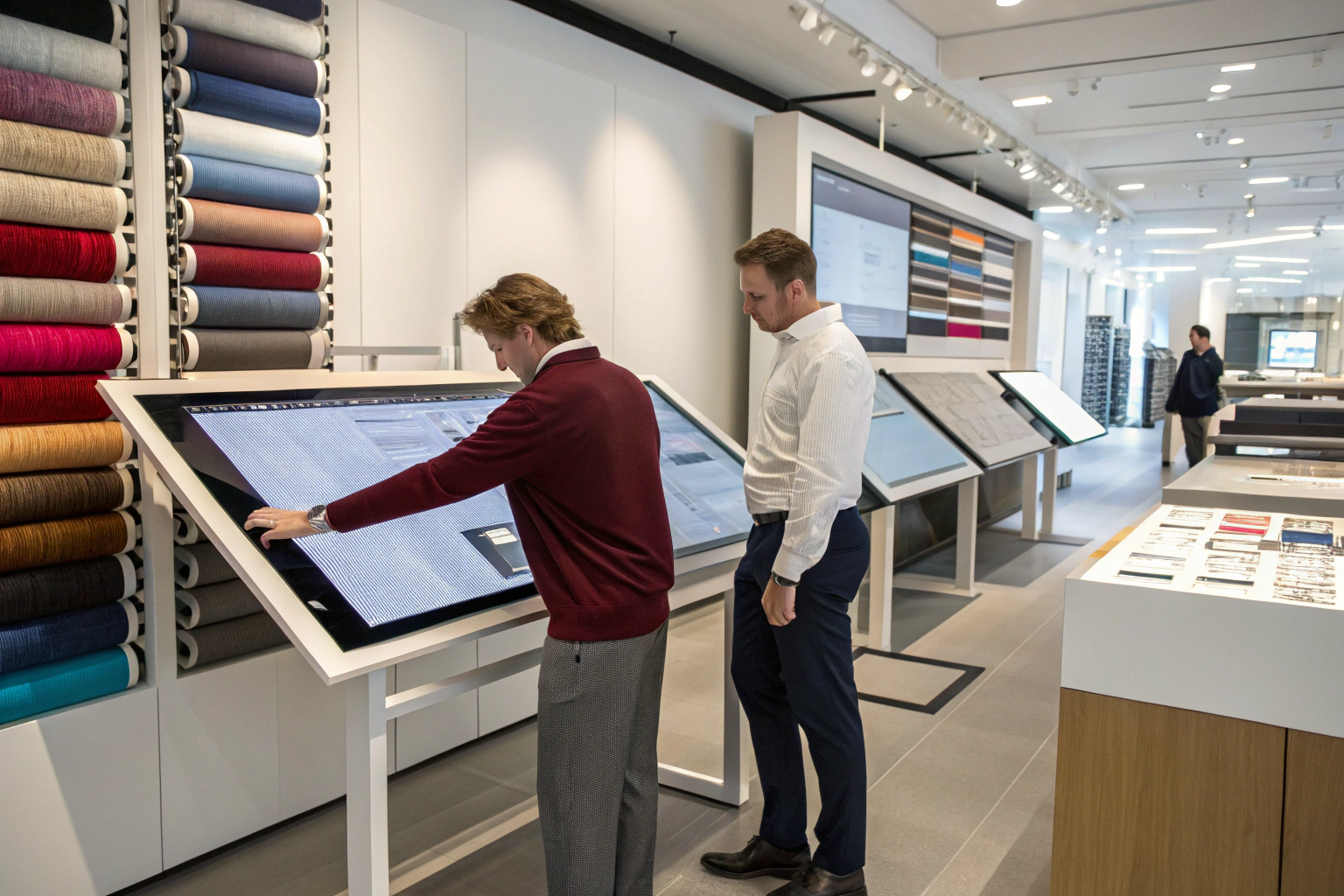
Shanghai Fumao’s 2026 investment in digital fabric libraries represents a fundamental shift in how we connect buyers to our 30,000-plus active fabric designs. We’re building a searchable, filterable, high-resolution digital catalog that captures not just how fabrics look, but how they behave—drape characteristics, stretch recovery, surface texture mapped at thread-level detail, and spectral color data accurate enough for digital proofing. The platform integrates with our live inventory system so buyers see real-time stock availability, and it connects directly to our CNAS lab database so every digital swatch carries complete technical specifications. This isn’t a website photo gallery with pretty fabric pictures. It’s a professional sourcing tool designed to compress the weeks-long sampling process into hours, while preserving the tactile confidence that fabric buyers need before committing to bulk orders.
The textile industry has been talking about digitization for a decade, but most "digital fabric libraries" are just online catalogs with slightly better photography than what you’d find on Alibaba. That’s not what we’re building. Our investment—$2.8 million in scanning hardware, software development, and integration with our existing ERP and quality systems—reflects a conviction that digital fabric representation has finally reached a fidelity level where professional buyers can make real decisions from screen-based evaluation. The technology hasn’t replaced physical sampling, and it won’t for the foreseeable future. But it has compressed the sampling funnel so dramatically that buyers who use our digital library effectively can shortlist 12 fabrics from 30,000 options in an afternoon, request physical hangers for only their top three choices, and cut their development cycle by 40-60%.
How Are Digital Fabric Libraries Replacing Physical Swatch Sourcing in 2026?
The physical swatch process has barely changed in fifty years. Buyer describes what they want. Supplier pulls samples from inventory. Samples ship via courier. Buyer receives package a week later, reviews options, narrows to a few choices, requests more samples or lab dips. Each iteration adds 7-14 days. For a seasonal collection requiring 15-20 fabric selections, the sampling phase alone can consume 8-12 weeks. The cost isn’t just the courier fees and sample yardage; it’s the design calendar compression that forces rushed decisions, the creative compromises when the right fabric arrives too late, and the air freight premiums when delayed fabric approvals push production against delivery deadlines.
Our digital library attacks this timeline at every point. A buyer logs into our platform, specifies their requirements through structured filters—fiber composition, weight range, stretch percentage, certifications, price band—and immediately sees every matching fabric in our active inventory. Each listing includes a spectral color measurement that their calibrated monitor can display with Delta E accuracy below 1.5, which is close enough for initial color evaluation. Video clips show drape behavior on a standardized form. Zoom functionality reveals weave structure at thread level. Technical data from our CNAS lab—shrinkage, colorfastness, tensile strength, pilling resistance—attaches to every listing. The buyer shortlists in hours, not weeks. Physical samples ship only for final confirmation, not initial exploration. A process that consumed 8-12 weeks compresses to 2-3 weeks, with the physical samples arriving as validation rather than discovery.

Can High-Resolution Fabric Scanning Truly Capture Drape and Texture Accurately?
The honest answer is that scanning technology captures about 85% of what a buyer evaluates when handling physical fabric. That’s not perfect, but it’s dramatically better than the 40-50% information fidelity of traditional product photography. Our scanning system uses a combination of technologies: spectrophotometers capture color data across the visible spectrum at 10-nanometer resolution, structured light scanners map surface topology at 0.1mm precision, and standardized video rigs record drape behavior under controlled conditions. The combined data creates what we call a "digital twin" of each fabric—a representation accurate enough for elimination decisions but not yet perfect enough for final approval.
The 15% gap between digital and physical matters most for specific fabric characteristics. Hand feel—what we call "handle" in the industry—doesn’t digitize because it’s a tactile perception combining surface friction, compression resistance, thermal conductivity, and weight distribution. A brushed cotton flannel and a sanded polyester fleece can look nearly identical on screen but feel completely different to touch. Drape over complex three-dimensional forms—how a fabric folds around a curved seam or gathers at a waistband—doesn’t fully capture in standardized video tests because real garment drape depends on pattern piece geometry, seam construction, and lining interactions. Our digital library is honest about these limitations. Every fabric listing includes a "digital confidence score" indicating how reliably the digital representation predicts physical performance, and fabrics with low scores automatically trigger a recommendation to request physical samples before ordering. Understanding the technical limitations and accuracy rates of high-resolution textile scanning for professional fabric sourcing helps buyers set realistic expectations about when digital evaluation suffices and when physical sampling remains essential.
What Time and Cost Savings Do Digital Libraries Deliver Versus Traditional Swatch Requests?
Let me give you real numbers from our pilot program with twelve distributor partners who tested the digital library system from November 2025 through April 2026. We tracked their sourcing behavior before and after digital library access, measuring time from initial inquiry to confirmed order, number of physical sample requests, courier costs, and order accuracy rates. The results confirmed what we hoped but exceeded what we expected.
| Sourcing Metric | Traditional Process (Pre-Pilot) | Digital Library Process (Pilot) | Improvement |
|---|---|---|---|
| Inquiry to Shortlist | 8-14 days | 4-8 hours | 95%+ reduction |
| Physical Samples Requested per Order | 18-25 swatches | 3-5 swatches | 78% reduction |
| Courier Costs per Sourcing Cycle | $180-320 | $45-80 | 75% reduction |
| Total Inquiry to Order Confirmation | 7-10 weeks | 3-4 weeks | 55% reduction |
| Order Accuracy (First Shipment Pass Rate) | 91% | 94% | 3 percentage points |
| Samples That Never Convert to Orders | 40-45% | 15-20% | 55% reduction |
The cost savings extend beyond courier fees. When a buyer shortlists efficiently, our sampling department spends less time cutting, packaging, and shipping samples that never convert to orders. When the right fabric gets identified faster, production slots get reserved earlier, reducing the rush charges that eat margin. When technical specifications accompany digital samples from the start, the back-and-forth clarification emails that consume sales team hours nearly disappear. One of our LA-based distributor partners calculated that the digital library saved her roughly 15 hours per collection cycle just in communication time with her buying team. She now manages three additional brand accounts with the same staffing because the sourcing process no longer consumes her schedule.
What Technology Powers Fumao’s Searchable Fabric Database?
The technology stack behind our digital library isn’t magic—it’s methodical engineering applied to a specific industry problem. The core challenge isn’t storing fabric data; it’s making that data searchable in ways that match how buyers actually think about fabrics. A buyer doesn’t search for "HTS 5208.32.3040"—they search for "lightweight cotton poplin with a crisp finish, similar to what I used for last spring’s shirting program but with better wrinkle recovery." Translating that natural language query into structured database queries requires layers of technology working together.
The system we built uses four integrated technology layers. The capture layer handles physical-to-digital conversion: spectrophotometers, structured light scanners, and standardized video capture rigs that create the digital twin data. The cataloging layer applies metadata—fiber composition, construction, weight, certifications, technical specifications, and a standardized taxonomy of hand feel descriptors developed with textile academics from Donghua University. The search layer uses natural language processing trained on thousands of buyer queries to translate descriptive language into structured filters. The presentation layer renders the digital twin data on the buyer’s screen with calibration tools that ensure color accuracy across different display hardware. Each layer required custom development because off-the-shelf solutions designed for general e-commerce couldn’t handle fabric-specific requirements.

How Does AI-Powered Fabric Search Match Buyer Descriptions to Inventory?
The AI component of our search system addresses a problem familiar to anyone who’s sourced fabric: the vocabulary gap between what buyers say and how suppliers catalog. A buyer describes wanting fabric with "a fluid drape but enough body to hold a pleat." Our catalog uses terms like "drape coefficient of 0.42" and "bending stiffness of 2.8 mN·m." The AI bridges that gap by learning associations between descriptive language and measured properties across thousands of fabrics. When the system processes "fluid drape but holds a pleat," it searches for fabrics with drape coefficients between 0.35-0.50 and bending stiffness between 2.0-3.5 mN·m—translating subjective description into objective parameters.
The training data came from three sources: five years of our internal buyer communication records (anonymized and permission-cleared), structured evaluations where we asked twenty professional buyers to describe 200 fabrics using their own language while we recorded the corresponding technical measurements, and academic textile description corpora from our Donghua University partnership. The system improves with use—every search query and subsequent sample request provides feedback about whether the AI’s interpretation matched the buyer’s intent. After eighteen months of training and refinement, the system achieves about 87% relevance on first-pass search results, meaning the fabric the buyer ultimately selects appears in the top twenty results 87% of the time. That’s not perfect search, but it’s dramatically better than the 40-50% relevance of keyword-based catalog searches and the 20-30% hit rate of having a junior sales associate pull samples based on a verbal description. The development of AI-powered natural language fabric search engines trained on textile industry description patterns represents a genuine advance over traditional parametric filtering.
What Metadata Standards Ensure Digital Fabric Consistency Across the Supply Chain?
Standardization has been the hardest problem to solve, and I’ll be honest about why. The textile industry has never agreed on a universal language for describing fabrics. One mill’s "medium weight" is another mill’s "lightweight." Hand feel descriptors—crisp, soft, dry, slick, buttery, papery—mean different things to buyers from different fashion segments. A "silk-like" polyester means something specific to a bridal wear designer and something entirely different to an activewear developer. Without shared definitions, a digital library becomes a Tower of Babel where search results frustrate rather than help.
Our metadata standards address this through three mechanisms. First, every fabric in the library carries objective measurements alongside subjective descriptors. "Lightweight" gets paired with grams per square meter. "Soft" gets paired with Kawabata surface friction measurements. The subjective descriptor helps buyers find fabrics; the objective measurement lets them verify whether our definition of "lightweight" matches theirs. Second, we developed a controlled vocabulary of 140 fabric descriptors with explicit definitions and reference standards—physical fabric swatches that exemplify each term. Every new fabric gets classified against these references by trained evaluators, not by individual buyer interpretation. Third, we publish our taxonomy openly and have begun discussions with other mills and industry organizations about adoption as a shared standard. The digital supply chain only delivers its full value when buyers can search across multiple suppliers using consistent language, and we’d rather lead that standardization effort than wait for someone else to solve it. Understanding the emerging metadata standards for consistent digital fabric description across the textile supply chain matters for any buyer planning to integrate digital sourcing into their development process.
Why Are North American Distributors Adopting Fumao’s Digital Showroom?
The distributor adoption story isn’t about technology enthusiasm—it’s about competitive pressure. Distributors who rely on traditional sampling methods are losing deals to competitors who can present options faster. A buyer choosing between two distributors for their seasonal fabric program doesn’t care about the back-end complexity; they care about who can show them viable options within their development timeline. The distributor who responds to an inquiry with "I’ll pull some samples and courier them to you—should arrive by Tuesday" is operating on last decade’s clock speed. The distributor who responds with "I’m sharing a link to a curated digital collection matching your requirements—review the top picks now and I’ll ship physical hangers for your final three choices this afternoon" wins the business.
Our distributor partners who adopted the digital showroom in early 2026 report that their average response time to new inquiries dropped from 2-3 days to under 4 hours. Their sample-to-order conversion rate improved because the samples they do send are pre-qualified through digital review, meaning the buyer is further along the decision process when physical fabric arrives. More importantly, their relationships with buyers deepened because the digital platform frees up time for consultative conversations about design direction, price engineering, and production planning—the high-value interactions that build loyalty—instead of consuming meeting time with "let me go check if we have something like that in the warehouse."

How Does the Digital Platform Create New Revenue Opportunities for Distributors?
The revenue impact operates on three levels. First, existing customers buy more because the friction of exploring new fabrics drops to near zero. A brand that previously limited their fabric selection to whatever the distributor could physically present during a quarterly meeting now browses the digital library between meetings, discovers fabrics they wouldn’t have asked about, and incorporates them into surprise capsule collections or test programs. One distributor in Vancouver reported that his average SKUs per customer increased from 4.2 to 7.8 after digital library adoption—nearly doubling the fabric diversity his clients purchase.
Second, the digital platform enables distributors to serve customers outside their local geography without travel costs. A distributor based in Dallas previously limited his active client base to a drivable radius because in-person sample presentations were his primary sales method. With the digital showroom, he now serves brands in Oklahoma, Arkansas, and Louisiana—territories within his contractual rights but previously unreachable without prohibitive travel investment. His 2026 revenue from these "digital-only" clients already exceeds $180,000, representing pure growth with minimal incremental cost.
Third, the digital library creates a new service tier that justifies premium positioning. Distributors who offer digital library access, AI-assisted search, and rapid digital-to-physical sampling command higher margins than those competing on price alone for commodity fabrics. The platform isn’t just a tool—it’s a differentiator that shifts the competitive conversation from "who has the lowest price per meter" to "who can help me develop my collection fastest." Understanding how digital fabric showrooms are enabling North American textile distributors to expand their service offerings and revenue streams explains why adoption is accelerating despite the initial technology investment required.
What Training and Support Does Fumao Provide for Distributor Digital Onboarding?
I learned from watching other digital transformation projects fail that the technology is never the hard part—the human transition is. A distributor who has built a twenty-year career on physical sample books, face-to-face meetings, and the tactile ritual of spreading fabric across a showroom table doesn’t abandon those methods overnight just because we built a platform. They need to see the platform working in their specific business context, with their specific customers, solving their specific pain points.
Our onboarding program runs six weeks and combines technical training with business integration support. Week one is platform orientation: navigating the interface, building searches, creating curated collections, sharing links with customers. Weeks two and three focus on customer introduction: our team joins the distributor on customer calls to demonstrate the platform, explain the digital-to-physical sampling workflow, and address buyer skepticism about screen-based fabric evaluation. Weeks four through six are optimization: analyzing the distributor’s search patterns to refine their saved filters, building custom collections for their top customer segments, and integrating the platform into their quoting and ordering workflow. After the formal onboarding, each distributor has a dedicated digital support contact—a real person who answers calls within four hours during business hours—for ongoing questions and feature requests.
The onboarding investment is significant. We dedicate roughly 40 hours of staff time per distributor during the six-week program. But the alternative—launching the platform and hoping distributors figure it out themselves—produces the 20% adoption rates typical of supplier portals that become digital ghost towns. Our approach yields over 90% active usage among onboarded distributors, measured by monthly logins and sample requests generated through the platform. We’d rather have fifty distributors using the system deeply than two hundred who logged in once and forgot their password.
Will Digital Libraries Eventually Replace Physical Fabric Trade Shows?
The trade show question comes up in every conversation about our digital investment, and I understand why. If buyers can browse 30,000 fabrics from their office, request targeted physical samples, and access complete technical data without leaving their desk—what’s left for a trade show booth to accomplish? The question assumes trade shows are primarily about fabric discovery, and discovery is exactly what digital libraries do better. But trade shows serve functions that screens cannot replicate, and understanding those functions explains why we’re not canceling our exhibition calendar.
Trade shows are relationship verification events disguised as product showcases. A buyer walking through our booth isn’t just looking at new fabrics; they’re assessing whether we’re the kind of supplier they want to trust with their seasonal production. They watch how our team interacts with each other. They observe how we handle the booth visitors who clearly aren’t going to place orders. They ask unexpected questions and evaluate whether our answers feel rehearsed or genuine. These trust-building signals don’t transmit through a digital platform, no matter how sophisticated the fabric visualization becomes. Trade shows also serve serendipitous discovery—the fabric you weren’t looking for but that solves a design problem you couldn’t articulate before seeing it. Digital search excels at finding what you’re looking for; physical browsing excels at finding what you didn’t know you needed.

How Are Trade Shows Evolving From Discovery Events to Relationship-Building Venues?
Our trade show strategy has shifted significantly to reflect the new division of labor between digital and physical channels. Pre-2024, our booth was essentially a miniature version of our physical swatch library—racks of fabric hangers organized by category, with buyers spending most of their visit flipping through samples. In 2026, our booth looks different. The fabric displays are smaller and more curated—highlighting new developments, innovative finishes, and category leaders rather than attempting to represent the entire catalog. The physical space is designed for conversation, with seating areas, refreshments, and large screens displaying the digital library for buyers who want to dive deeper into a specific category.
The booth staff role has evolved correspondingly. Instead of acting as sample retrievers, our team now functions as consultative partners—discussing the buyer’s upcoming collection challenges, demonstrating how our digital platform can accelerate their development cycle, and scheduling follow-up virtual sessions where they can explore the full catalog with a dedicated technical specialist. The trade show becomes the beginning of a digital relationship rather than a standalone transaction. One buyer told us after our last Première Vision appearance that she spent twenty minutes in our booth discussing her sustainable activewear line strategy, then two hours the following week on a video call with our R&D team reviewing digital fabric matches—a much more productive use of her time than the old model of spending two hours at the booth flipping through hangers and then waiting weeks for follow-up samples. The evolution of international textile trade shows from product discovery venues to relationship and strategy events reflects the broader digitization of fabric sourcing.
Can Virtual Fabric Showrooms Attract the Same Quality of Buyer Leads as Physical Events?
The lead quality comparison data surprised even us. We assumed physical trade shows would continue generating higher-quality leads because the commitment of attending—travel, time, expense—screens for serious buyers. The data tells a different story. Our 2025 virtual showroom events generated leads that converted to orders at a 12% rate, compared to 14% for physical trade show leads. The virtual events reached 3.5 times as many buyers, meaning the absolute number of converted orders from virtual events exceeded physical events by a factor of nearly three. The buyers attending virtual events were different—more first-time sourcing managers, more indie designers, more brands from geographies we’d never see at a Paris or New York show—but they placed real orders with real budgets.
The key insight is that virtual showrooms expand the top of the funnel dramatically without proportionally diluting quality. The additional buyers who attend virtually include many who are serious about sourcing but couldn’t justify the trade show travel budget, couldn’t get away from their businesses for three days, or simply prefer evaluating suppliers digitally before committing to an in-person visit. These aren’t lower-quality buyers; they’re buyers who were previously invisible to us because the physical trade show model filtered them out for logistical rather than commercial reasons. Our hybrid approach—maintaining a physical trade show presence for relationship deepening while running virtual showroom events for broad discovery—captures both populations effectively.
Conclusion
The digital fabric library investment reflects a conviction that has been building at Shanghai Fumao for years: the textile industry’s resistance to digitization wasn’t about inherent incompatibility, but about the quality of the tools available. When digital representations of fabric were low-resolution photos on an Alibaba listing page, physical sampling was genuinely superior. When spectral color measurement, structured light scanning, and standardized drape video became available, the calculation shifted. Digital became good enough for the 80% of sourcing decisions that involve elimination and shortlisting, while physical sampling remains essential for the 20% that require tactile confirmation.
The numbers from our pilot program tell a clear story: 55% reduction in sourcing cycle time, 78% fewer physical samples requested, 75% lower courier costs, and higher order accuracy rates. Distributors using the platform are expanding their geographic reach, increasing their SKU count per customer, and building deeper consultative relationships with the time the digital library frees up. Trade shows are evolving into relationship events rather than discovery events, and our booth strategy has adapted accordingly. The technology investment is significant, but the competitive advantage it creates for our distributor partners is more significant still.
If you’re sourcing fabric for an upcoming collection and want to experience what modern fabric discovery looks like, I invite you to see our digital library in action. Whether you work with one of our distributor partners or directly with our team, the platform changes how quickly you can move from concept to confirmed fabric. Reach out to our Business Director Elaine at elaine@fumaoclothing.com to schedule a demo and see your specific fabric requirements matched against our 30,000-plus active designs. The days of waiting a week for swatches that miss the mark are ending. Let’s show you what replaces them.